Timelines
Trace change across the book. Dates stay on the left, facts and source context stay in the center, and interpretations stay in the margin.
Browse all 38 timelines
People & communities
Systems & struggle
Close studies
Three key ideas
Book chapters
- Introduction · My Story, Our Story
- Chapter 1 · Why a Different Mirror?
- Chapter 2 · Removing the “Savages”
- Chapter 3 · The Hidden Origins of Slavery
- Chapter 4 · The Road to the Reservation
- Chapter 5 · Life in Slavery
- Chapter 6 · The Flight from Ireland
- Chapter 7 · The War Against Mexico
- Chapter 8 · From China to Gold Mountain
- Chapter 9 · Dealing with the Indians
- Chapter 10 · The Japanese and “Money Trees”
- Chapter 11 · Jews Are Pushed from Russia
- Chapter 12 · Up from Mexico
- Chapter 13 · Blacks Arrive in Northern Cities
- Chapter 14 · World War II and America’s Ethnic Problem
- Chapter 15 · Calls for Change
- Chapter 16 · New Waves of Newcomers
- Chapter 17 · “We Will All Be Minorities”
Black history
Selected turning points in Black history in the United States. The story does not begin or end with this selection.
Think as you readHow do Black struggles for freedom expose the relationship between labor, citizenship, and power?
Keep in mind. 1619 marks an arrival in English Virginia, not the first African presence or the beginning of slavery in the Americas.
- 1619
Captive Africans arrive in VirginiaAn English privateer brings captive Africans to Point Comfort.
A closer lookThey were forcibly taken from Angola. African presence and enslavement in the Americas predate 1619.
- 1662
Virginia makes slavery hereditaryVirginia makes a child’s free or enslaved status follow the mother.
A closer lookLawmakers protect enslavers’ claims to children born to enslaved women.
- 1863
The Emancipation ProclamationLincoln declares enslaved people in designated rebelling areas free.
A closer lookIt does not abolish slavery nationwide; its reach depends on Union victory and enforcement.
- 1865
The 13th AmendmentThe Constitution abolishes slavery and involuntary servitude, with a criminal-punishment exception.
A closer lookA constitutional change is broader and more permanent than the wartime proclamation.
- 1868
The 14th AmendmentThe amendment establishes birthright citizenship and equal protection.
A closer lookIts citizenship clause covers people born in the United States and subject to its jurisdiction.
- 1896
Plessy upholds segregationThe Supreme Court upholds Louisiana’s segregated railway-car law.
A closer lookThe ruling gives constitutional support to the “separate but equal” doctrine.
- 1910–1970
The Great MigrationMillions of Black southerners move to northern, midwestern, and western communities.
A closer lookThey seek jobs, education, and escape from racial terror; new destinations also contain discrimination.
- 1954
Brown challenges school segregationThe Supreme Court rules racial segregation in public schools unconstitutional.
A closer lookThe decision does not produce immediate integration; enforcement faces organized resistance.
- 1964
The Civil Rights ActFederal law prohibits discrimination in public accommodations and employment.
A closer lookMovement pressure helps secure legislation, but passing a law is not the same as ending discrimination.
- 1965
The Voting Rights ActCongress targets racial discrimination in voting with federal protections.
A closer lookActivism, including the Selma campaign, helps force action against exclusion at the polls.
Sources & reading notes · 10 references
Event summaries are paraphrases. Use the linked records and histories to check details or explore further. A key-idea connection is an interpretation to test against evidence; one event can support more than one key idea.
- Jamestown Rediscovery · The first Africans ↗
- Virginia Humanities · Virginia’s 1662 hereditary-slavery law ↗
- National Archives · Emancipation Proclamation ↗
- National Archives · 13th Amendment ↗
- National Archives · 14th Amendment ↗
- National Archives · Plessy v. Ferguson ↗
- National Archives · The Great Migration, 1910–1970 ↗
- National Archives · Brown v. Board of Education ↗
- National Archives · Civil Rights Act ↗
- National Archives · Voting Rights Act ↗
Mexican American history
Selected Mexican and Mexican American history, with emphasis on conquest, land, borders, and labor.
Think as you readWhat changes when people migrate across a border—or the border moves across them?
Keep in mind. This is a course-focused selection, not a complete history of Mexico. Indigenous histories long predate the Spanish conquest.
- 1521
Tenochtitlan fallsSpanish forces and Indigenous allies defeat the Mexica capital.
A closer lookSpanish colonial rule grows, but Indigenous peoples, communities, and resistance continue.
- 1810
Mexico’s independence struggle beginsMiguel Hidalgo’s uprising helps launch the war against Spanish rule.
A closer lookThe struggle involves competing visions of authority and social change.
- 1821
Mexico becomes independentMexico gains independence from Spain after years of war.
A closer lookIts territory includes lands that later become part of the southwestern United States.
- 1836
Texas breaks from MexicoTexan rebels establish a republic after fighting Mexico.
A closer lookSlavery, settler power, and the central Mexican government’s authority are among the conflicts.
- 1846
The U.S.–Mexico War beginsThe United States and Mexico go to war after annexation and a border dispute.
A closer lookU.S. expansionists seek western territory, including California and Pacific ports.
- 1848
The Treaty of Guadalupe HidalgoMexico cedes a vast northern territory to the United States after the war.
A closer lookMexican residents face a new border and legal order; treaty promises do not prevent later dispossession.
- 1910
The Mexican Revolution beginsAn uprising against Porfirio Díaz develops into a prolonged revolutionary struggle.
A closer lookDemands for land and political change accompany violence that also propels migration north.
- 1930s
Mexican repatriation campaignsDeportation and pressure to leave force people of Mexican ancestry out of U.S. communities.
A closer lookU.S. citizens are among those affected; not every departure is voluntary.
- 1942–1964
The Bracero ProgramThe United States recruits Mexican workers on temporary labor contracts.
A closer lookThe program offers earnings but also exposes workers to exploitation and limited bargaining power.
- 1965
The Delano grape strike beginsFilipino farmworkers begin the strike; Mexican American organizers and workers join.
A closer lookLarry Itliong, César Chávez, Dolores Huerta, and others build a strike and consumer boycott.
Sources & reading notes · 8 references
Event summaries are paraphrases. Use the linked records and histories to check details or explore further. A key-idea connection is an interpretation to test against evidence; one event can support more than one key idea.
- Library of Congress · The conquest of Tenochtitlan ↗
- Library of Congress · Independence from Spain ↗
- U.S. Department of State · Annexation of Texas and war with Mexico ↗
- National Archives · Treaty of Guadalupe Hidalgo ↗
- Library of Congress · The Mexican Revolution and the United States ↗
- Library of Congress · Depression and the struggle for survival ↗
- Smithsonian · Bittersweet Harvest: The Bracero Program, 1942–1964 ↗
- National Park Service · The Delano grape strike and boycott ↗
Native American history
Distinct Native nations face colonization, defend sovereignty, and continue shaping political life.
Think as you readHow do Native nations defend land and self-government against changing forms of U.S. power?
Keep in mind. “Indian history” here means Native American history. Native nations are distinct political communities, not a single people, and their histories do not start in 1607.
- 1607
Jamestown is establishedEnglish settlers build a colony within the Powhatan peoples’ homeland.
A closer lookThis is an English colonial beginning—not the beginning of the region’s history.
- 1680
The Pueblo RevoltPueblo communities coordinate an uprising against Spanish colonial rule.
A closer lookReligious repression and colonial demands help produce resistance; the Spanish are expelled from New Mexico for years.
- 1830
The Indian Removal ActCongress authorizes removal treaties exchanging Native lands in the East for lands farther west.
A closer lookCoercion and forced removals follow. Removal serves settler demand for Native homelands.
- 1838–1839
The Cherokee Trail of TearsU.S. forces remove Cherokee people from their southeastern homeland.
A closer lookThousands die during removal and its surrounding conditions; other Native nations also endure forced removal.
- 1868
The Fort Laramie TreatyA treaty recognizes a Great Sioux Reservation, including the Black Hills.
A closer lookLater U.S. violations show the gap between formal promises and actual power.
- 1876
The Battle of the Little BighornLakota, Northern Cheyenne, and Arapaho fighters defeat Custer’s forces.
A closer lookThe victory resists a military campaign but does not end U.S. pressure on Native nations.
- 1887
The Dawes ActFederal policy divides many communally held Native lands into individual allotments.
A closer lookLand opened to non-Native ownership produces enormous losses; the policy promotes assimilation.
- 1890
The Wounded Knee massacreU.S. soldiers kill Lakota people, including women and children, at Wounded Knee.
A closer lookThe massacre occurs amid efforts to suppress the Ghost Dance and control reservation communities.
- 1934
The Indian Reorganization ActFederal policy turns away from allotment and encourages tribal self-government.
A closer lookThe law does not restore all lost land or erase earlier coercion.
- 1975
Self-determination gains legal supportFederal law expands tribal authority to administer programs serving their communities.
A closer lookNative organizing helps press the government toward greater tribal control.
Sources & reading notes · 10 references
Event summaries are paraphrases. Use the linked records and histories to check details or explore further. A key-idea connection is an interpretation to test against evidence; one event can support more than one key idea.
- Jamestown Rediscovery · Historical timeline ↗
- National Park Service · Pueblo resistance and the 1680 revolt ↗
- National Archives · Andrew Jackson’s message on Indian removal (1830) ↗
- National Park Service · Trail of Tears history ↗
- National Archives · Fort Laramie Treaty (1868) ↗
- National Park Service · Little Bighorn history ↗
- National Archives · Dawes Act ↗
- National Park Service · Black Elk and the Wounded Knee massacre ↗
- National Archives · Indian Reorganization Act records ↗
- U.S. Congress · Indian Self-Determination and Education Assistance Act ↗
Asian American overview
A selection connecting Chinese, Japanese, South Asian, and Filipino American experiences.
Think as you readHow can people be essential to an economy yet treated as outsiders?
Keep in mind. Asian American is a broad category. This timeline offers examples, not the full history of every Asian American community.
- 1848–1849
California’s gold rush draws migrantsGold discovery draws people from China, Mexico, the United States, and elsewhere.
A closer lookCalifornia comes under U.S. control after war with Mexico; Native communities face dispossession and violence.
- 1867
Chinese railroad workers strikeChinese Central Pacific workers demand higher pay and better working conditions.
A closer lookManagement cuts off supplies, helping defeat the strike; workers nevertheless demonstrate collective organization.
- 1882
The Chinese Exclusion ActFederal law suspends Chinese labor immigration and bars Chinese naturalization.
A closer lookExemptions exist; the act does not prohibit every Chinese person from entering.
- 1898
Wong Kim Ark wins his citizenship caseThe Supreme Court recognizes the U.S. citizenship of American-born Wong Kim Ark.
A closer lookHis case tests the 14th Amendment after officials deny his reentry from China.
- 1913
California restricts immigrant landholdingCalifornia’s alien land law targets people ineligible for citizenship.
A closer lookIts apparently neutral wording particularly restricts Japanese immigrant farmers.
- 1923
The Court denies Thind naturalizationThe Supreme Court rules Bhagat Singh Thind ineligible for citizenship as a white person.
A closer lookThe justices rely on a supposed common understanding of whiteness rather than a consistent scientific category.
- 1942
Japanese American exclusion and incarcerationExecutive Order 9066 enables military exclusion; mass forced removal and incarceration follow.
A closer lookPeople are targeted by ancestry, including U.S. citizens, without individual proof of disloyalty.
- 1965
The Delano grape strike beginsFilipino farmworkers begin the strike; Mexican American organizers and workers join.
A closer lookLarry Itliong, César Chávez, Dolores Huerta, and others build a strike and consumer boycott.
- 1965
National-origins quotas are abolishedA new immigration law prioritizes family ties and employment categories.
A closer lookThe law reshapes migration while retaining numerical limits; it does not create open borders.
- 1988
The Civil Liberties ActThe United States apologizes and authorizes redress for eligible surviving incarceration victims.
A closer lookJapanese American organizing helps win official recognition of the injustice.
Sources & reading notes · 11 references
Event summaries are paraphrases. Use the linked records and histories to check details or explore further. A key-idea connection is an interpretation to test against evidence; one event can support more than one key idea.
- Library of Congress · The gold rush ↗
- National Archives · Treaty of Guadalupe Hidalgo ↗
- Library of Congress · The 1867 Sierra strike ↗
- National Archives · Chinese Exclusion Act ↗
- National Archives · Wong Kim Ark and birthright citizenship ↗
- Densho Encyclopedia · Alien land laws ↗
- U.S. Supreme Court · United States v. Bhagat Singh Thind (1923), via Justia ↗
- National Archives · Executive Order 9066 ↗
- National Park Service · The Delano grape strike and boycott ↗
- U.S. House of Representatives · Immigration and Nationality Act of 1965 ↗
- Densho Encyclopedia · Civil Liberties Act of 1988 ↗
Irish American history
A concise chronology drawn from A Different Mirror for Young People.
Think as you readHow did Irish immigrants move from conquest and famine toward political power and conditional whiteness?
Facts and interpretation. The center column paraphrases the book and links to its pages. The margin offers one possible interpretation to test against the evidence.
-
1100s–1700
England conquers IrelandBeginning in the twelfth century, Irish land was seized and handed to English colonizers; by 1700 the Irish owned fourteen percent of their own island and rented from English landlords.
Context from YPTIrish emigrants later called themselves exiles "pushed out by English oppressors."
-
Late 1500s–1594
"Savages" and "pagans": the English model for conquestElizabeth I's soldiers, including Gilbert and Raleigh, treated Irish Catholics as savages: no property, office, juries, English dress, or intermarriage. In the Nine Years' War villages were burned, families slaughtered, and heads taken as trophies.
-
1700s
Beef for BritainLandlords fenced fields for cattle; ninety percent of laborers lost work; families lived in mud huts on potatoes. Franklin saw it in 1771.
Context from YPTIreland profited from beef while "the common people had been reduced to wretchedness."
-
1815–1845
A million leave; single-son inheritanceLetters told of a country "where no man or woman ever hungered." After 1815 farms passed to one son; non-heirs emigrated, marriage rates fell, cottage weaving collapsed, and women were "shut out of Ireland's economy."
-
1845–1855
The Great FamineA fungus destroyed forty percent of the potato crop the first year and returned until 1854; a million died; landlords evicted tenants and kept shipping food to Britain; a million and a half fled on crowded ships where tens of thousands died.
-
1850s
Listed among the "dangerous classes"Reverend Theodore Parker named "Negroes, Indians, Mexicans, Irish, and the like" as "inferior in nature"; the Irish were called savage, uncivilized, and lacking self-control.
Context from YPTAt North Adams the Chinese were held up as harder working than the Irish.
-
1863
The draft riotsTold that Republicans would sacrifice Irish soldiers to free slaves who would take their jobs, Irish mobs rioted for four days in New York; more than a hundred died before troops arrived.
Context from YPTThe Irish had turned "their rage against others on the lower ranks of society's pecking order."
-
1871–1903
Mother JonesMary Harris of Cork lost her family to disease and her shop to the Chicago Fire, then organized strikes and led the 1903 Children's Crusade to Roosevelt's door: "We Want to Go to School, Not to the Mines!"
-
1890
Irish power in the citiesBecause they were white, the Irish could naturalize and vote; by 1890 they controlled the Democratic organizations of New York, Philadelphia, and Boston and rewarded voters with police, fire, and city jobs and contracts.
-
1900
Into the middle classA third of American seamstresses were Irish immigrants, but only 19 percent of American-born Irish women followed those trades; daughters became teachers, nurses, and secretaries. John Kearney's sons rose from postal clerk to superintendent of streets.
Jewish American history
A concise chronology drawn from A Different Mirror for Young People.
Think as you readHow did migration, labor organizing, education, exclusion, and activism reshape Jewish American life?
Facts and interpretation. The center column paraphrases the book and links to its pages. The margin offers one possible interpretation to test against the evidence.
-
1879
Life in the Pale of SettlementConfined to western Russia and barred from owning land, Jews crowded into shtetls as merchants and craftsmen—forty percent in manufacturing or crafts—with "ten times as many tailors, cobblers, barbers" as the towns could support.
Context from YPTA Gentile who failed could move; a Jew "could make the circle of the Pale" and find the same conditions.
-
1880s
Pogroms and flightState-encouraged massacres—"every year, there was a pogrom before Pesach"—made Jews political refugees. Women sold beds and tables for passage; families crossed on converted cattle boats.
Context from YPTEmma Goldman, seventeen, saw the Statue of Liberty as "the symbol of hope."
-
1900–1910
An army of garment workersStandard sizes from Civil War uniforms plus the sewing machine made New York the garment capital; by 1910 nearly half the city's factories made clothing. Jewish women were a third of the workforce, at eleven to fifteen hours a day in sweatshops.
-
1905
Half a million on the Lower East SideTenements six and seven stories high, families with boarders three to a room, landsmanshafts from the old towns, peddlers and delicatessens, "throngs of children."
-
1909–1910
The Uprising of the Twenty ThousandClara Lemlich, twenty-three, forced the general-strike vote at Cooper Union; twenty thousand mostly Jewish women struck for a fifty-two-hour week and union recognition; three hundred firms settled by February 1910. Fifty thousand cloak makers followed.
Context from YPTMale unionists had said young women could not sustain a strike.
-
1911
The Triangle fire146 workers, mostly young Jewish and Italian women, died jumping from the ninth floor; news reached the shtetls and caused panic.
-
1923
Harvard's "Jewish problem"President Lowell cut Jewish enrollment with "well-rounded" criteria, regional quotas, and required photographs. Mayor Curley of Boston: "If the Jew is barred today, the Italian will be tomorrow."
-
1924
The quota lawTwo percent of each nationality's 1890 population—before mass Jewish immigration—was set as the yearly limit, extending the Chinese Exclusion principle to Europeans.
-
1933–1945
Facing genocide from a safe shoreFour and a half million American Jews watched as 66 percent of Americans opposed admitting even Jewish children, the St. Louis was turned away, and Roosevelt refused refugees until a 1944 board admitted one thousand. Six million died.
-
1963–1964
The black-Jewish allianceRabbi Prinz, a camp survivor, told the March on Washington that the crime was silence; more than half of the movement's white participants were Jewish; Goodman and Schwerner died with James Chaney in Mississippi.
Chinese American history
A concise chronology drawn from A Different Mirror for Young People.
Think as you readWhy did the United States demand Chinese labor while restricting Chinese belonging?
Facts and interpretation. The center column paraphrases the book and links to its pages. The margin offers one possible interpretation to test against the evidence.
-
1848
Palmer's plan for Chinese laborWeeks after the treaty with Mexico, Aaron Palmer told Congress San Francisco would be a hub of commerce and recommended importing Chinese to build the transcontinental railroad and farm California.
-
1849
Gold MountainWar, rebellion, taxes, floods, and famine pushed young men across the Pacific; a railroad wage of thirty dollars a month against three to five at home pulled them. They meant to return rich.
-
1852
The miners' tax and seven women"California for Americans!" produced a three-dollar monthly tax on foreign miners who did not intend to naturalize—which Chinese could not do. Of twelve thousand Chinese in California, seven were women.
-
1854
-
1866–1869
The Central PacificChinese crews drilled and blasted Donner Summit, wintered under snowdrifts, struck for equal pay, and were starved back to work in a week. The road was "a Chinese achievement."
-
1879–1882
Hayes's warning and the Exclusion ActHayes lumped the Chinese with "the weaker races—the Negroes and Indians"; in 1882 Congress barred laborers for ten years and denied citizenship to residents, in a depression, against 0.002 percent of the population. Renewed 1892, permanent 1902.
-
1906
The earthquake and the paper sonsWith San Francisco's records burned, men claimed American birth and citizenship and brought wives and "sons"—real, pretended, or purchased. Jim Quock memorized a 200-page book and was held three weeks at Angel Island; another applicant explained the missing dog: "we ate the dog."
-
1943
Exclusion repealedJapanese radio broadcast America's anti-Chinese laws; Congress repealed exclusion, set a quota of 105 a year, and allowed naturalization.
-
1965–1980
The door reopensWith quotas abolished, the Chinese population grew from 237,000 to 812,200 and became majority foreign-born; students set off chain migrations; new immigrant women returned to garment sweatshops at piece rates.
Context from YPTA former professor scrubbed floors until a federal program retrained her.
-
2010
3.2 millionChinese Americans were the largest Asian American group in the census.
Japanese American history
A concise chronology drawn from A Different Mirror for Young People.
Think as you readHow did Japanese immigrants build power—and how did law and war restrict it?
Facts and interpretation. The center column paraphrases the book and links to its pages. The margin offers one possible interpretation to test against the evidence.
-
1880s
"In America, money grew on trees"Taxes forced farmers to sell their land; a Hawaii plantation paid six times Japan's wages, and three years there could save what took ten at home. Emigration fever followed.
-
1885–1924
Women and picture bridesJapan promoted women's emigration to avoid the Chinese bachelor problems; girls attended school and learned English; the 1907 Gentlemen's Agreement let families join, and sixty thousand women came, many marrying men they knew only from photographs.
Context from YPTBy 1920 women were 46 percent of Japanese in Hawaii, against 5 percent for the Chinese.
-
1900
Hawaii's plantationsHawaii became a US territory; planters ran an ethnically divided workforce, reserved skilled jobs for citizens (whites) in 1904, called workers by brass bango numbers, and drove them with whip-swinging lunas through twelve-foot cane.
-
1900–1920
Transforming CaliforniaIrrigation, railroads, and refrigerated cars created a market for produce; Japanese farms grew from 4,698 acres to nearly half a million, worth $67 million in 1920. George Shima, the Potato King, drained swamps and died worth $15 million—and was still told to leave his Berkeley neighborhood.
Context from YPTJapanese were 2 percent of California and targets of violent white workers.
-
1907–1924
Excluded by law, step by stepThe Gentlemen's Agreement (1907) limited laborers; the Alien Land Law (1913) barred land purchase; the Supreme Court ruled Ozawa "not Caucasian" (1922); the 1924 act barred all ineligible immigrants.
-
1909
The blood-union strikeJapanese workers struck for four months against a lower wage than the Portuguese; leaders were jailed, scabs of four nationalities hired; wages rose and racial pay ended, and planters imported Filipinos.
Context from YPTStrikers declared they wanted to "unite our destiny with that of Hawaii."
-
1920
Japanese and Filipinos strike togetherEight thousand shut Oahu's sugar; planters bribed the Filipino leader, called it a plot to "Japanise Hawaii," and evicted families into a flu epidemic that killed 150. Wages rose fifty percent three months later.
-
1941–1942
InternmentAfter Pearl Harbor, Roosevelt exempted Germans and Italians; General DeWitt ordered 120,000 West Coast Japanese, two-thirds citizens, into desert camps behind barbed wire. In Hawaii General Emmons refused mass camps, interned 1,444, and reported no sabotage.
Context from YPTThe FBI and the attorney general saw no security reason; the Supreme Court accepted "military necessity" without evidence.
-
1942–1945
The 442nd and the translatorsThirty-three thousand Nisei enlisted; the 442nd earned more than 18,000 decorations and 3,600 Purple Hearts in Italy and France; translators crawled close enough to hear Japanese commands and shortened the war by an estimated two years.
-
1970s–1988
Breaking the silence; the apologyThe third generation organized pilgrimages to the camps and demanded hearings; in 1988 Congress apologized and paid $20,000 to each survivor. Reagan called the internment "a sad chapter."
New Waves of Newcomers
A concise chronology drawn from A Different Mirror for Young People.
Think as you readHow did post-1965 newcomers change the nation while confronting older patterns of exclusion?
Facts and interpretation. The center column paraphrases the book and links to its pages. The margin offers one possible interpretation to test against the evidence.
-
1965
The law that changed the newcomersCongress ended national-origin quotas, which for Asia and Africa had meant racial quotas.
-
1975
The first Vietnamese waveAs Saigon fell, 10,000 to 15,000 allied military families were evacuated and 86,000 more fled by helicopter with under ten hours' notice; 130,000 educated, largely English-speaking refugees were dispersed across the country and regrouped in Orange County.
-
1979–1996
Afghan exilesSoviet invasion, US-backed militias, a 1989 withdrawal, civil war, and the 1996 Taliban takeover each sent Afghans to America. Sediqullah Rahi: "Our economy is destroyed, our social life is destroyed."
-
1979–2000
The boat peopleMore than 277,000 fled by 1979 in leaky boats through storms and pirates, many ethnic Chinese; 643,200 Vietnamese lived in America by 1985 and 1.4 million by 2000, forty percent in California. Women became wage earners; daughters resisted arranged marriage; children lost the language.
-
1990s–2010
South AsiansPeople from India, Pakistan, Bangladesh, and Afghanistan became one of the fastest-growing groups; the 2010 census counted 2.6 million Indian Americans.
Context from YPTThe Sikh farmers of 1913 were "not white"; their successors are the second-largest Asian American group.
-
1992
Los Angeles: "a race riot without nationality"After the Rodney King verdict, blacks, Korean store owners, and Hispanic looters were all part of the fires; Richard Rodriguez: "everyone in the city realized—if only in fear—that they were related to one another."
-
1997–2050
"We will all be minorities"Takaki told Clinton that whites would become a minority; Clinton told graduates there would be "no majority race." A third of Americans already trace ancestry outside Europe.
-
2000s
The undocumentedTwelve million undocumented, most Mexican, working and paying taxes; nativists call for fences and troops; Time argued in 2007 that they are "undeportable" and "too enmeshed" in the economy. NAFTA sent 1.5 million ruined farmers north.
-
2001
September 11After the attacks Afghan Americans feared for their safety; some passed as Mexican or Greek; women in hijab were attacked and mosques burned. Fatema Nourzaie called Afghan Americans "an example of successful integration, not assimilation."
-
2011
The DREAMers come outStudents in Charlotte and Georgia announced their undocumented status; Pulitzer winner Jose Antonio Vargas revealed he had been undocumented since twelve. Roy Beck argued legalization "victimizes our own young adults."
Context from YPT"Today is the day that I am coming out of the shadows and saying I exist."
Labor history
From colonial crops to collective bargaining: who works, who profits, and who makes the rules?
Think as you readWhen does labor become a source of power for workers rather than only for employers?
- 1612
Tobacco becomes the cash cropJohn Rolfe develops tobacco that finds a profitable English market.
A closer lookExpanding cultivation increases colonists’ demand for land and a large labor force.
- 1793
The cotton gin accelerates productionEli Whitney develops a machine that separates cotton fibers from seeds.
A closer lookMore profitable cotton production expands demand for enslaved labor rather than making slavery disappear.
- 1867
Chinese railroad workers strikeChinese Central Pacific workers demand higher pay and better working conditions.
A closer lookManagement cuts off supplies, helping defeat the strike; workers nevertheless demonstrate collective organization.
- 1877
The Great Railroad StrikeRailroad wage cuts provoke strikes that spread across the country.
A closer lookMilitias and federal troops help suppress the unrest.
- 1886
The Haymarket affairA Chicago labor rally ends in a bombing and deadly violence.
A closer lookThe aftermath brings a crackdown on radicals during the campaign for an eight-hour workday.
- 1911
The Triangle factory fireA New York garment-factory fire kills 146 workers, many of them immigrant women.
A closer lookThe disaster strengthens demands for workplace safety and government inspection.
- 1935
The National Labor Relations ActFederal law protects organizing and collective bargaining for many private-sector workers.
A closer lookAgricultural and domestic workers are excluded from the act’s original protections.
- 1938
The Fair Labor Standards ActFederal law establishes wage, overtime, and child-labor protections for covered workers.
A closer lookIts initial coverage excludes many workers; national labor protections are not universal.
- 1965
The Delano grape strike beginsFilipino farmworkers begin the strike; Mexican American organizers and workers join.
A closer lookLarry Itliong, César Chávez, Dolores Huerta, and others build a strike and consumer boycott.
- 1968
Memphis sanitation workers strikeBlack sanitation workers demand safer work, better pay, and union recognition.
A closer lookTheir “I AM A MAN” signs connect economic demands to dignity and racial justice.
Sources & reading notes · 11 references
Event summaries are paraphrases. Use the linked records and histories to check details or explore further. A key-idea connection is an interpretation to test against evidence; one event can support more than one key idea.
- National Park Service · Tobacco and the colony ↗
- Jamestown Rediscovery · Historical timeline ↗
- National Archives · Eli Whitney’s cotton gin ↗
- Library of Congress · The 1867 Sierra strike ↗
- Encyclopaedia Britannica · Great Railroad Strike of 1877 ↗
- Library of Congress · Haymarket Square ↗
- Cornell University · Remembering the Triangle Factory Fire ↗
- National Archives · National Labor Relations Act ↗
- U.S. Department of Labor · Fair Labor Standards Act of 1938 ↗
- National Park Service · The Delano grape strike and boycott ↗
- Stanford King Institute · Memphis sanitation workers’ strike ↗
Immigration history
A U.S.-focused selection of migration pressures, recruitment systems, and entry rules.
Think as you readWhy has the United States repeatedly wanted people’s labor while restricting their belonging?
Keep in mind. Immigration, naturalization, forced migration, and internal migration are different processes. The event notes identify the relevant process.
- 1790
Citizenship eligibility is racializedFederal naturalization law limits eligibility to free white persons.
A closer lookNaturalization means becoming a citizen; this is not a general ban on entry.
- 1845–1850s
The Great Famine drives Irish migrationFamine in Ireland, beginning in 1845, helps propel large-scale migration to the United States.
A closer lookMigrants seek survival and work while encountering anti-Irish and anti-Catholic hostility.
- 1848–1849
California’s gold rush draws migrantsGold discovery draws people from China, Mexico, the United States, and elsewhere.
A closer lookCalifornia comes under U.S. control after war with Mexico; Native communities face dispossession and violence.
- 1882
The Chinese Exclusion ActFederal law suspends Chinese labor immigration and bars Chinese naturalization.
A closer lookExemptions exist; the act does not prohibit every Chinese person from entering.
- 1892
Ellis Island opensA federal immigration station begins operating in New York Harbor.
A closer lookIt becomes a major processing center, not the entry point used by every immigrant.
- 1917
A barred zone and literacy testFederal immigration law expands exclusion, including an Asiatic barred zone.
A closer lookNationality and literacy become additional tools for sorting who may enter.
- 1924
National-origins quotas harden exclusionCongress sharply restricts immigration through national-origins quotas.
A closer lookThe law favors northern and western Europe and bars immigrants ineligible for naturalization, including Japanese immigrants.
- 1942–1964
The Bracero ProgramThe United States recruits Mexican workers on temporary labor contracts.
A closer lookThe program offers earnings but also exposes workers to exploitation and limited bargaining power.
- 1965
National-origins quotas are abolishedA new immigration law prioritizes family ties and employment categories.
A closer lookThe law reshapes migration while retaining numerical limits; it does not create open borders.
- 1980
The Refugee ActCongress establishes a more uniform system for refugee admission and assistance.
A closer lookThe law responds to a need for a permanent framework beyond emergency arrangements.
Sources & reading notes · 10 references
Event summaries are paraphrases. Use the linked records and histories to check details or explore further. A key-idea connection is an interpretation to test against evidence; one event can support more than one key idea.
- National Archives / DocsTeach · Naturalization Act of 1790 ↗
- Library of Congress · Irish immigration ↗
- Library of Congress · The gold rush ↗
- National Archives · Treaty of Guadalupe Hidalgo ↗
- National Archives · Chinese Exclusion Act ↗
- National Park Service · Ellis Island history ↗
- U.S. Department of State · Immigration Act of 1924 ↗
- Smithsonian · Bittersweet Harvest: The Bracero Program, 1942–1964 ↗
- U.S. House of Representatives · Immigration and Nationality Act of 1965 ↗
- U.S. Congress · Refugee Act of 1980 ↗
Legal history
Selected U.S. laws and court decisions that make, enforce, or challenge unequal status.
Think as you readHow does law both construct inequality and provide tools to challenge it?
- 1662
Virginia makes slavery hereditaryVirginia makes a child’s free or enslaved status follow the mother.
A closer lookLawmakers protect enslavers’ claims to children born to enslaved women.
- 1790
Citizenship eligibility is racializedFederal naturalization law limits eligibility to free white persons.
A closer lookNaturalization means becoming a citizen; this is not a general ban on entry.
- 1830
The Indian Removal ActCongress authorizes removal treaties exchanging Native lands in the East for lands farther west.
A closer lookCoercion and forced removals follow. Removal serves settler demand for Native homelands.
- 1857
Dred Scott v. SandfordThe Supreme Court rejects Scott’s freedom claim and Black citizenship.
A closer lookThe majority also rules that Congress cannot prohibit slavery in federal territories; the 14th Amendment later overturns its citizenship rule.
- 1865
The 13th AmendmentThe Constitution abolishes slavery and involuntary servitude, with a criminal-punishment exception.
A closer lookA constitutional change is broader and more permanent than the wartime proclamation.
- 1868
The 14th AmendmentThe amendment establishes birthright citizenship and equal protection.
A closer lookIts citizenship clause covers people born in the United States and subject to its jurisdiction.
- 1882
The Chinese Exclusion ActFederal law suspends Chinese labor immigration and bars Chinese naturalization.
A closer lookExemptions exist; the act does not prohibit every Chinese person from entering.
- 1896
Plessy upholds segregationThe Supreme Court upholds Louisiana’s segregated railway-car law.
A closer lookThe ruling gives constitutional support to the “separate but equal” doctrine.
- 1954
Brown challenges school segregationThe Supreme Court rules racial segregation in public schools unconstitutional.
A closer lookThe decision does not produce immediate integration; enforcement faces organized resistance.
- 1964
The Civil Rights ActFederal law prohibits discrimination in public accommodations and employment.
A closer lookMovement pressure helps secure legislation, but passing a law is not the same as ending discrimination.
Sources & reading notes · 10 references
Event summaries are paraphrases. Use the linked records and histories to check details or explore further. A key-idea connection is an interpretation to test against evidence; one event can support more than one key idea.
- Virginia Humanities · Virginia’s 1662 hereditary-slavery law ↗
- National Archives / DocsTeach · Naturalization Act of 1790 ↗
- National Archives · Andrew Jackson’s message on Indian removal (1830) ↗
- National Archives · Dred Scott v. Sandford ↗
- National Archives · 13th Amendment ↗
- National Archives · 14th Amendment ↗
- National Archives · Chinese Exclusion Act ↗
- National Archives · Plessy v. Ferguson ↗
- National Archives · Brown v. Board of Education ↗
- National Archives · Civil Rights Act ↗
Resistance history
Selected examples of revolt, escape, investigation, boycott, labor organizing, and occupation.
Think as you readHow do people excluded from power create leverage to challenge it?
Keep in mind. Resistance is a historical category, not automatic moral approval. Ask who resisted whom, by what means, and with what consequences.
- 1680
The Pueblo RevoltPueblo communities coordinate an uprising against Spanish colonial rule.
A closer lookReligious repression and colonial demands help produce resistance; the Spanish are expelled from New Mexico for years.
- 1739
The Stono RebellionEnslaved people in South Carolina organize an armed uprising.
A closer lookColonial forces suppress the rebellion; enslaved people’s resistance challenges the plantation order.
- 1831
Nat Turner leads a revoltTurner and other enslaved people launch an uprising in Virginia.
A closer lookAuthorities suppress it; retaliation and new restrictions follow.
- 1849
Harriet Tubman escapes slaveryTubman reaches freedom and later returns to help others escape.
A closer lookHer Underground Railroad work depends on courage, planning, and networks of assistance.
- 1867
Chinese railroad workers strikeChinese Central Pacific workers demand higher pay and better working conditions.
A closer lookManagement cuts off supplies, helping defeat the strike; workers nevertheless demonstrate collective organization.
- 1892
Ida B. Wells challenges lynchingWells investigates lynching after a white mob murders three Black businessmen in Memphis.
A closer lookHer journalism exposes the false claims used to justify racial terror.
- 1955–1956
The Montgomery bus boycottBlack residents organize a sustained boycott of segregated buses.
A closer lookRosa Parks’s arrest sparks collective action supported by organizers, churches, and carpool networks.
- 1965
The Delano grape strike beginsFilipino farmworkers begin the strike; Mexican American organizers and workers join.
A closer lookLarry Itliong, César Chávez, Dolores Huerta, and others build a strike and consumer boycott.
- 1969–1971
Native activists occupy AlcatrazIndians of All Tribes occupy the former prison island.
A closer lookThe occupation brings public attention to Native land claims and self-determination.
- 1973
The Wounded Knee occupationOglala Lakota activists and American Indian Movement supporters occupy Wounded Knee.
A closer lookThey protest tribal political conditions and federal failures to honor treaty obligations.
Sources & reading notes · 10 references
Event summaries are paraphrases. Use the linked records and histories to check details or explore further. A key-idea connection is an interpretation to test against evidence; one event can support more than one key idea.
- National Park Service · Pueblo resistance and the 1680 revolt ↗
- Dickinson College · Stono Rebellion, 1739 ↗
- Virginia Humanities · Nat Turner’s revolt ↗
- National Park Service · Harriet Tubman ↗
- Library of Congress · The 1867 Sierra strike ↗
- National Park Service · Ida B. Wells ↗
- Stanford King Institute · Montgomery bus boycott ↗
- National Park Service · The Delano grape strike and boycott ↗
- National Park Service · We Hold the Rock ↗
- National Park Service · From Alcatraz to Wounded Knee ↗
Westward expansion
Beginning with Jamestown, as a long history of settlement, land claims, policy, technology, and dispossession.
Think as you readWhose expansion is this—and whose land and sovereignty make it possible?
Keep in mind. The West was not empty. Beginning this timeline with Jamestown does not make English arrival the beginning of American history.
- 1607
Jamestown is establishedEnglish settlers build a colony within the Powhatan peoples’ homeland.
A closer lookThis is an English colonial beginning—not the beginning of the region’s history.
- 1763
Britain restricts western settlementA royal proclamation seeks to limit colonial settlement beyond the Appalachian boundary.
A closer lookThe policy follows imperial war and Native resistance; settlers and speculators challenge the restriction.
- 1787
The Northwest OrdinanceThe United States creates a process for governing territories and admitting new states.
A closer lookThe ordinance bans slavery in the Northwest Territory but does not end Native claims to the land.
- 1803
The Louisiana PurchaseThe United States buys France’s territorial claim to Louisiana.
A closer lookThe deal does not mean Native nations consent to surrendering their homelands.
- 1830
The Indian Removal ActCongress authorizes removal treaties exchanging Native lands in the East for lands farther west.
A closer lookCoercion and forced removals follow. Removal serves settler demand for Native homelands.
- 1845
Manifest Destiny receives its nameJohn L. O’Sullivan popularizes the phrase “Manifest Destiny.”
A closer lookThe language presents U.S. expansion as a rightful national mission, not merely a contest for power.
- 1848
The Treaty of Guadalupe HidalgoMexico cedes a vast northern territory to the United States after the war.
A closer lookMexican residents face a new border and legal order; treaty promises do not prevent later dispossession.
- 1862
The Homestead ActFederal law offers qualifying settlers a path to land ownership through residence and cultivation.
A closer lookLand presented as available public land often comes from Native dispossession.
- 1869
The transcontinental railroad connectsThe Central Pacific and Union Pacific meet at Promontory Summit, Utah.
A closer lookChinese and other workers build a connection backed by federal land grants and loans.
- 1890
The Wounded Knee massacreU.S. soldiers kill Lakota people, including women and children, at Wounded Knee.
A closer lookThe massacre occurs amid efforts to suppress the Ghost Dance and control reservation communities.
Sources & reading notes · 12 references
Event summaries are paraphrases. Use the linked records and histories to check details or explore further. A key-idea connection is an interpretation to test against evidence; one event can support more than one key idea.
- Jamestown Rediscovery · Historical timeline ↗
- Yale Avalon Project · Royal Proclamation of 1763 ↗
- National Archives · Northwest Ordinance ↗
- National Archives · Louisiana Purchase Treaty ↗
- National Archives · Andrew Jackson’s message on Indian removal (1830) ↗
- Encyclopaedia Britannica · Manifest Destiny ↗
- National Archives · Treaty of Guadalupe Hidalgo ↗
- National Archives · Homestead Act ↗
- National Park Service · Golden Spike history ↗
- National Archives · Pacific Railway Act ↗
- Library of Congress · The 1867 Sierra strike ↗
- National Park Service · Black Elk and the Wounded Knee massacre ↗
Bacon’s Rebellion
The crisis of 1675–1677, with a later legal milestone showing the longer development of racial slavery.
Think as you readHow did land, labor, anti-Native violence, and rival elites shape the rebellion?
Keep in mind. Bacon was a wealthy colonist, not simply a poor farmer. The rebellion attacked Native communities and did not “invent race” or slavery overnight.
- 1675
Frontier violence escalatesDisputes involving settlers and Native communities develop into widening violence.
A closer lookTax burdens, land hunger, and competing trade interests also feed discontent.
- 1676
Berkeley backs a defensive policyVirginia’s assembly approves frontier forts rather than an unrestricted war.
A closer lookBacon and his supporters reject the governor’s approach to Native relations.
- 1676
Bacon attacks the OccaneechiBacon’s forces attack Native people despite Berkeley’s orders.
A closer lookThe Occaneechi are among his targets; hostility reaches communities not responsible for earlier attacks.
- 1676
Armed pressure wins a commissionIn June, Bacon returns to Jamestown with armed supporters.
A closer lookBerkeley yields to his demand for authority to wage war against Native people.
- 1676
Bacon issues his declarationOn July 30, Bacon publicly accuses Berkeley of corruption and favoritism.
A closer lookHis anti-elite claims accompany—not cancel—his campaign against Native communities.
- 1676
The rebels burn JamestownBacon’s forces burn the colonial capital in September.
A closer lookThe conflict now directly threatens the seat of English colonial government.
- 1676
Bacon diesBacon dies of illness on October 26.
A closer lookRebels continue fighting after his death; the revolt does not immediately end.
- 1677
The rebellion is suppressedColonial authorities regain control and execute rebel leaders.
A closer lookThe Crown investigates and Berkeley leaves office; Native communities have also suffered heavily.
- 1705
Virginia consolidates its slave lawsA comprehensive law strengthens distinctions between enslaved people and servants.
A closer lookRacial slavery developed through multiple laws before and after Bacon’s Rebellion—not in one sudden invention.
Sources & reading notes · 3 references
Event summaries are paraphrases. Use the linked records and histories to check details or explore further. A key-idea connection is an interpretation to test against evidence; one event can support more than one key idea.
Early Jamestown
Ten turning points in the early English colony, 1607–1624, within an already inhabited Native world.
Think as you readHow did a precarious trading venture become an expanding colony?
- 1607
Jamestown is establishedEnglish settlers build a colony within the Powhatan peoples’ homeland.
A closer lookThis is an English colonial beginning—not the beginning of the region’s history.
- 1608
John Smith takes chargeSmith becomes president of the colony’s governing council.
A closer lookWork rules and negotiations for food become central to the struggling settlement.
- 1609–1610
The Starving TimeHunger, disease, and war devastate the people inside James Fort.
A closer lookThe colony survives after relief arrives in 1610; survival was not inevitable.
- 1612
Tobacco becomes the cash cropJohn Rolfe develops tobacco that finds a profitable English market.
A closer lookExpanding cultivation increases colonists’ demand for land and a large labor force.
- 1613
Pocahontas is taken captiveSamuel Argall kidnaps Pocahontas and holds her for ransom.
A closer lookEnglish leaders use her captivity to pressure Powhatan; this is not a romance story.
- 1614
A marriage helps establish a trucePocahontas marries John Rolfe after her captivity and baptism.
A closer lookThe marriage helps end the First Anglo-Powhatan War, but peace does not last.
- 1619
The first General Assembly meetsRepresentatives of Virginia’s English settlements gather to make laws.
A closer lookThis limited representative government does not represent everyone living in the colony.
- 1619
Captive Africans arrive in VirginiaAn English privateer brings captive Africans to Point Comfort.
A closer lookThey were forcibly taken from Angola. African presence and enslavement in the Americas predate 1619.
- 1622
Opechancanough organizes an attackPowhatan forces attack English settlements; the English retaliate.
A closer lookContinued colonial expansion intensifies the struggle over land and sovereignty.
- 1624
Virginia becomes a royal colonyThe Crown revokes the Virginia Company’s charter.
A closer lookThe company loses control, but English settlement and tobacco cultivation continue.
Sources & reading notes · 5 references
Event summaries are paraphrases. Use the linked records and histories to check details or explore further. A key-idea connection is an interpretation to test against evidence; one event can support more than one key idea.
Inside American Progress
The historical processes behind John Gast’s 1872 painting: settlement, commerce, technology, and dispossession.
Think as you readHow does Gast make economic expansion look like a moral mission?
Keep in mind. The picture combines different places and historical processes. It is an argument about expansion—not a literal snapshot of the continent in 1872.
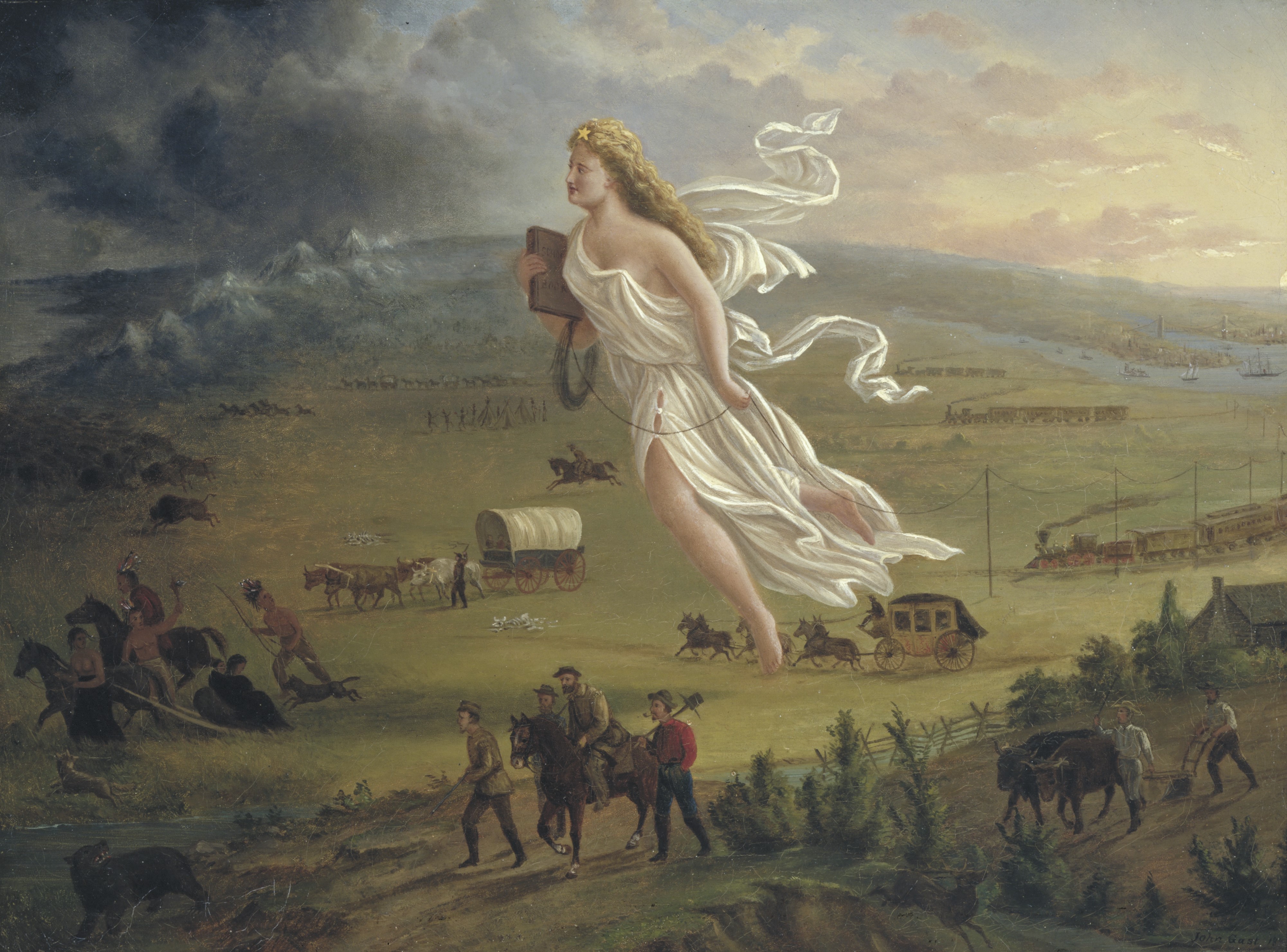
Look first; infer second. These are historical connections, not claims that every figure, place, or event is literally depicted. The Brooklyn Bridge opened after this painting was made. Bison flee in the image; mass killing is part of the history outside its frame.
- 1807
Commercial steam travel expandsRobert Fulton’s steamboat begins successful Hudson River service.
A closer lookSteam transportation helps connect places and markets; Gast’s ships stand for broader networks, not this one voyage.
- 1830
The Indian Removal ActCongress authorizes removal treaties exchanging Native lands in the East for lands farther west.
A closer lookCoercion and forced removals follow. Removal serves settler demand for Native homelands.
- 1845
Manifest Destiny receives its nameJohn L. O’Sullivan popularizes the phrase “Manifest Destiny.”
A closer lookThe language presents U.S. expansion as a rightful national mission, not merely a contest for power.
- 1848–1849
California’s gold rush draws migrantsGold discovery draws people from China, Mexico, the United States, and elsewhere.
A closer lookCalifornia comes under U.S. control after war with Mexico; Native communities face dispossession and violence.
- 1860–1861
From Pony Express to telegraphHorse relays carry mail west; a transcontinental telegraph connection soon overtakes the service.
A closer lookThe Pony Express operates from 1860 to 1861. In October 1861, the telegraph links California to the eastern network; stagecoaches continue carrying people and goods.
- 1862
The Homestead ActFederal law offers qualifying settlers a path to land ownership through residence and cultivation.
A closer lookLand presented as available public land often comes from Native dispossession.
- 1869
The transcontinental railroad connectsThe Central Pacific and Union Pacific meet at Promontory Summit, Utah.
A closer lookChinese and other workers build a connection backed by federal land grants and loans.
- 1869–1883
The Brooklyn Bridge is builtWork begins on a suspension bridge across the East River between New York and Brooklyn.
A closer lookThe bridge opens in 1883—eleven years after Gast’s painting. The pictured bridge is symbolic, not a photograph of a finished 1872 project.
- 1870s–1880s
Mass bison killing devastates the PlainsCommercial hunting drives Plains bison toward extinction.
A closer lookThe destruction undermines Native food systems and independence. Gast shows bison fleeing, not the slaughter itself.
- 1872
Gast paints American ProgressA floating female figure leads settlers, technology, and light toward the West.
A closer lookCommissioned for publisher George Crofutt, the image frames expansion as progress while Native people and animals retreat.
Sources & reading notes · 15 references
Event summaries are paraphrases. Use the linked records and histories to check details or explore further. A key-idea connection is an interpretation to test against evidence; one event can support more than one key idea.
- New York State · First commercially successful passenger steamboat ↗
- National Archives · Andrew Jackson’s message on Indian removal (1830) ↗
- Encyclopaedia Britannica · Manifest Destiny ↗
- Library of Congress · The gold rush ↗
- National Archives · Treaty of Guadalupe Hidalgo ↗
- National Park Service · Pony Express history ↗
- California Trail Interpretive Center · First transcontinental telegraph ↗
- National Archives · Homestead Act ↗
- National Park Service · Golden Spike history ↗
- National Archives · Pacific Railway Act ↗
- Library of Congress · The 1867 Sierra strike ↗
- NYC Department of Transportation · Brooklyn Bridge ↗
- Wikimedia Commons · Public-domain reproduction of American Progress ↗
- National Park Service · Bison, hunting, and near extinction ↗
- Autry Museum · American Progress, 1872 (92.126.1) ↗
Key idea 1 · Economic forces shape history
A combined selection from the course-idea and economic-history materials: follow land, labor, markets, and who gains.A Different Mirror for Young People.
Think as you readHow do economic goals shape choices, policies, and consequences across American history?
Facts and interpretation. The center column paraphrases the book and links to its pages. The margin offers one possible interpretation to test against the evidence.
-
1607–1613
Jamestown discovers tobaccoThe first four barrels of Virginia tobacco reached London in 1613; seven years later the colony shipped sixty thousand barrels. Profit from tobacco is the engine behind everything that follows in Virginia.
-
1676
Bacon's Rebellion and the planters' "crossroads"Five hundred armed men, black and white, burned Jamestown. After it was crushed, the planters chose to replace armed white labor with enslaved Africans who could not legally carry guns.
Context from YPTVirginia's black population went from 5 percent in 1675 to 25 percent by 1715 and over 40 percent by 1750.
-
1830s
Indian removal builds the cotton kingdomJackson uprooted seventy thousand Native Americans and moved them west of the Mississippi. Alabama, Mississippi, and Louisiana were carved out of Indian land.
Context from YPTChoctaw farmers were removed even though they farmed "like whites," and some owned slaves. Farming offered no protection.
-
1845–1855
The Great Famine as a market eventWhile a million Irish died, landlords evicted tenants who could not pay rent and kept shipping beef and grain to Britain. A million and a half fled to the United States.
Context from YPTBetween 1815 and 1845 a million Irish had already emigrated; two million more came between 1855 and 1900.
-
1846–1848
The war with Mexico is really about CaliforniaThe border dispute was the excuse; the goal was California's cattle hides for New England shoe factories and its harbors for Pacific whalers and the China trade.
Context from YPTPolk told Congress the harbors would become centers of "an extensive and profitable commerce with China."
-
1866–1869
The Central Pacific runs on cheap Chinese laborChinese workers blasted tunnels through Donner Summit and lived under sixty-foot snowdrifts for lower wages than whites. When they struck for equal pay, Charles Crocker cut off their food for a week.
Context from YPTWhite workers demanded the Chinese be fired; Crocker answered that he would fire the whites instead.
-
1887–1933
The Dawes Act as a land-transfer machineAllotment broke reservations into 160-acre plots and sold the "surplus" to whites. By 1933 Native Americans had lost about sixty percent of the 138 million acres they held in 1887.
Context from YPTSecretary Schurz predicted in 1880 the land would open to white settlement; Congress handed railroads twenty-nine rights-of-way through Indian country in 1886–1889; a 1902 law forced heirs' land to auction.
-
1929–1933
The Depression sorts people by raceMexican farm wages fell from 35 to 14 cents an hour; four hundred thousand Mexicans were "repatriated"; more than half of blacks in Southern cities were unemployed; college-educated Nisei became "professional carrot washers."
Context from YPTFederal aid paid whites at higher rates than blacks. Black workers were the first fired.
-
1941–1947
War labor shortage forces the door openRoosevelt's 1941 order banned discrimination in defense jobs; a million African Americans, half of them women, worked in war plants. Mexican Americans in Los Angeles shipyards went from zero to 17,000; two hundred thousand braceros were imported by 1947.
-
1960s–1992
Deindustrialization and the underclassPlants moved to suburbs and offshore; auto, rubber, and steel jobs vanished; black America split into a rising middle class and a trapped underclass. Los Angeles exploded in April 1992 with $800 million in losses.
Context from YPTThe civil rights laws of 1964–1965 could end legal discrimination but not poverty: "many did not have the money" to order the hamburger.
Race is socially constructed
Key idea 2 · Track how institutions define, enforce, and challenge racial boundaries.
Think as you readWho draws the boundaries of belonging, and what do those boundaries allow or deny?
Keep in mind. “Socially constructed” does not mean unreal. The categories are human-made; their material effects are real.
- 1662
Virginia makes slavery hereditaryVirginia makes a child’s free or enslaved status follow the mother.
A closer lookLawmakers protect enslavers’ claims to children born to enslaved women.
- 1705
Virginia consolidates its slave lawsA comprehensive law strengthens distinctions between enslaved people and servants.
A closer lookRacial slavery developed through multiple laws before and after Bacon’s Rebellion—not in one sudden invention.
- 1790
Citizenship eligibility is racializedFederal naturalization law limits eligibility to free white persons.
A closer lookNaturalization means becoming a citizen; this is not a general ban on entry.
- 1848
The Treaty of Guadalupe HidalgoMexico cedes a vast northern territory to the United States after the war.
A closer lookMexican residents face a new border and legal order; treaty promises do not prevent later dispossession.
- 1857
Dred Scott v. SandfordThe Supreme Court rejects Scott’s freedom claim and Black citizenship.
A closer lookThe majority also rules that Congress cannot prohibit slavery in federal territories; the 14th Amendment later overturns its citizenship rule.
- 1882
The Chinese Exclusion ActFederal law suspends Chinese labor immigration and bars Chinese naturalization.
A closer lookExemptions exist; the act does not prohibit every Chinese person from entering.
- 1896
Plessy upholds segregationThe Supreme Court upholds Louisiana’s segregated railway-car law.
A closer lookThe ruling gives constitutional support to the “separate but equal” doctrine.
- 1923
The Court denies Thind naturalizationThe Supreme Court rules Bhagat Singh Thind ineligible for citizenship as a white person.
A closer lookThe justices rely on a supposed common understanding of whiteness rather than a consistent scientific category.
- 1942
Japanese American exclusion and incarcerationExecutive Order 9066 enables military exclusion; mass forced removal and incarceration follow.
A closer lookPeople are targeted by ancestry, including U.S. citizens, without individual proof of disloyalty.
- 1954
Brown challenges school segregationThe Supreme Court rules racial segregation in public schools unconstitutional.
A closer lookThe decision does not produce immediate integration; enforcement faces organized resistance.
Sources & reading notes · 10 references
Event summaries are paraphrases. Use the linked records and histories to check details or explore further. A key-idea connection is an interpretation to test against evidence; one event can support more than one key idea.
- Virginia Humanities · Virginia’s 1662 hereditary-slavery law ↗
- Virginia Humanities · An act concerning servants and slaves (1705) ↗
- National Archives / DocsTeach · Naturalization Act of 1790 ↗
- National Archives · Treaty of Guadalupe Hidalgo ↗
- National Archives · Dred Scott v. Sandford ↗
- National Archives · Chinese Exclusion Act ↗
- National Archives · Plessy v. Ferguson ↗
- U.S. Supreme Court · United States v. Bhagat Singh Thind (1923), via Justia ↗
- National Archives · Executive Order 9066 ↗
- National Archives · Brown v. Board of Education ↗
Ideas are weapons
Key idea 3 · See how arguments, images, and shared beliefs justify power—or organize resistance.
Think as you readWhat does an idea help people justify, accept, or challenge?
Keep in mind. Ideas can defend domination or challenge it. Ask what the idea does, for whom, and with what evidence.
- 1606
The Virginia Company receives a charterEngland authorizes a company to colonize part of North America.
A closer lookThe charter joins commercial opportunity to a stated Christianizing mission.
- 1676
Bacon issues his declarationOn July 30, Bacon publicly accuses Berkeley of corruption and favoritism.
A closer lookHis anti-elite claims accompany—not cancel—his campaign against Native communities.
- 1776
The Declaration asserts equalityThe Declaration of Independence announces a break from British rule and a claim of human equality.
A closer lookSlavery and exclusion persist; later movements use that contradiction to demand change.
- 1829
David Walker publishes his AppealWalker urges Black people to oppose slavery and racist oppression.
A closer lookHe challenges a nation that claims liberty while sustaining enslavement.
- 1845
Manifest Destiny receives its nameJohn L. O’Sullivan popularizes the phrase “Manifest Destiny.”
A closer lookThe language presents U.S. expansion as a rightful national mission, not merely a contest for power.
- 1872
Gast paints American ProgressA floating female figure leads settlers, technology, and light toward the West.
A closer lookCommissioned for publisher George Crofutt, the image frames expansion as progress while Native people and animals retreat.
- 1892
Ida B. Wells challenges lynchingWells investigates lynching after a white mob murders three Black businessmen in Memphis.
A closer lookHer journalism exposes the false claims used to justify racial terror.
- 1942
Japanese American exclusion and incarcerationExecutive Order 9066 enables military exclusion; mass forced removal and incarceration follow.
A closer lookPeople are targeted by ancestry, including U.S. citizens, without individual proof of disloyalty.
- 1965
The Delano grape strike beginsFilipino farmworkers begin the strike; Mexican American organizers and workers join.
A closer lookLarry Itliong, César Chávez, Dolores Huerta, and others build a strike and consumer boycott.
- 1968
Memphis sanitation workers strikeBlack sanitation workers demand safer work, better pay, and union recognition.
A closer lookTheir “I AM A MAN” signs connect economic demands to dignity and racial justice.
Sources & reading notes · 10 references
Event summaries are paraphrases. Use the linked records and histories to check details or explore further. A key-idea connection is an interpretation to test against evidence; one event can support more than one key idea.
- Yale Avalon Project · First Virginia Charter (1606) ↗
- National Park Service · Bacon’s Rebellion ↗
- National Archives · Declaration of Independence ↗
- National Park Service · David Walker ↗
- Encyclopaedia Britannica · Manifest Destiny ↗
- Autry Museum · American Progress, 1872 (92.126.1) ↗
- National Park Service · Ida B. Wells ↗
- National Archives · Executive Order 9066 ↗
- National Park Service · The Delano grape strike and boycott ↗
- Stanford King Institute · Memphis sanitation workers’ strike ↗
Introduction · My Story, Our Story
A concise chronology drawn from A Different Mirror for Young People.
Think as you readHow did Takaki’s own experiences shape the different mirror he offers readers?
Facts and interpretation. The center column paraphrases the book and links to its pages. The margin offers one possible interpretation to test against the evidence.
-
1939–1957
A working-class multicultural childhood in HawaiiTakaki grew up the son of a Japanese immigrant father and a plantation-born mother, among Japanese, Chinese, Portuguese, Korean, and Hawaiian playmates; his stepfather was a Chinese cook. He wanted to be a surfer.
-
1957
College in Ohio: "How long have you been in this country?"A teacher who asked "How do you know what you know?" sent him to the College of Wooster, where classmates asked where he learned English and his future father-in-law opposed the marriage because of race—then, years later, said "You can call me Dad."
-
1971
Berkeley and a new field of studyAfter teaching UCLA's first African American history course, Takaki moved to Berkeley to teach comparative ethnic studies; his own family came to include seven heritages.
Chapter 1 · Why a Different Mirror?
A concise chronology drawn from A Different Mirror for Young People.
Think as you readWhat changes in this chapter, and which course idea best explains how that change happened?
Facts and interpretation. The center column paraphrases the book and links to its pages. The margin offers one possible interpretation to test against the evidence.
-
1607–1619
Multicultural from the beginningA taxi driver's "How long have you been in this country?" leads Takaki to Jamestown: land taken from Indians, tobacco profit, and in 1619 a Dutch ship bringing twenty Africans a year before Plymouth Rock.
-
1676
Why African Americans became "the central minority"Planters preferred white workers until an armed uprising in 1676; then they turned to enslaved Africans who could be kept from guns. After emancipation came segregation, lynching, and riots—and King's "our destiny is tied up with America's destiny."
-
1790–1900
The Irish: despised, but whiteFour million Irish fled starvation into a Protestant country that scorned Catholics; because the 1790 Naturalization Act let white immigrants naturalize, they could vote, and by 1900 they were entering the middle class.
-
1848 and 1898–1917
Mexicans and Puerto Ricans: the border movedMexicans became Americans when the war moved the border; most today have immigrant roots and cross for work. Puerto Rico became a colony in 1898 and its people citizens in 1917; 4.7 million now live stateside.
-
1857–1951
Whose stories countAn Irish maid in 1900 asked why anyone would want her story; Harriet Jacobs, a Chinese immigrant, a Jewish immigrant, Silko, and Langston Hughes answer: stories "aren't just entertainment." An incomplete history is a mirror that leaves people invisible.
-
1880s–1940s
Jews: from pogroms to the HolocaustRussian Jews fled massacres to the Lower East Side and rose through education; in the 1930s their demands that America rescue Hitler's victims met indifference and anti-Semitism, producing "a strong wave of Jewish American activism."
-
1882 and 1942
Asian Americans: wanted, never welcomedChinese came as prospectors and railroad builders and were excluded in 1882, the first nationality ban; 120,000 Japanese Americans, two-thirds citizens, were interned in the 1940s. Congressman Matsui: "How could I as a six-month-old child... be declared... an enemy alien?"
Context from YPTVietnamese refugees arrived in 1975; Asian Americans are projected at ten percent by 2050.
-
1951
Handlin's The Uprooted and the Master NarrativeThe prize-winning "epic story" of immigration covered only Europeans. The Master Narrative says Americans are white; demography now says "not all of us came originally from Europe."
Context from YPTMinorities are the majority in California and in Boston, New York, Chicago, Atlanta, Detroit, Houston, San Francisco, and Los Angeles.
-
2001
Afghan Americans after 9/11Refugees from Afghanistan were hardly noticed until the attacks, then lived with fear of anti-Muslim violence and the knowledge they could not go home.
Chapter 2 · Removing the “Savages”
A concise chronology drawn from A Different Mirror for Young People.
Think as you readWhat changes in this chapter, and which course idea best explains how that change happened?
Facts and interpretation. The center column paraphrases the book and links to its pages. The margin offers one possible interpretation to test against the evidence.
-
c. 1000
Vikings and BeothukThorvald Eiriksson's men killed the Beothuk they met; Thorvald died of a Beothuk arrow; the Vikings abandoned Vinland. Ruins were found in Newfoundland in 1960.
Context from YPTColumbus's accident of history, five hundred years later, brought colonists who stayed.
-
1492–1611
Indians as curiosities and "savages"Captives displayed in Europe; Waymouth's 1605 kidnapping; the 1611 "monster" in London; Johnson's "herds of deer" (1609). London planners still planned to "civilize" Indian children, and the 1606 Virginia contract promised Christian teaching.
Context from YPTThe English "were defining the Indians as savages, too" because they resembled "the wild Irish."
-
1594
English over IrishElizabeth I sent Gilbert and Raleigh to colonize Catholic Ireland; the Irish were called savages and pagans, barred from property, office, juries, English dress, and intermarriage; the Nine Years' War brought burned crops, reservations, slaughtered families, and a "lane of heads."
-
1607–1629
Virginia: from starving time to "root out"The Powhatan fed thirty-eight survivors; the English then demanded corn and deerskins, burned villages, and grew from 400 to 4,500 on tobacco. After the 1622 attack killed three hundred, they poisoned two hundred Powhatan at a treaty toast and by 1629 aimed to end the Powhatan as a people.
Context from YPTPercy killed children in the water; Tucker's men brought home parts of heads.
-
1616–1676
New England turns Indians into demonsSmith found a farmed "paradise"; smallpox killed 95 percent of some communities; Pilgrims lived on corn from graves; the English called farmers "foxes and wild beasts"; the Pequot War burned seven hundred; King Philip's War nearly won and then thousands were enslaved; Mather called Indians devil worshippers. Mary Rowlandson's 1682 narrative recorded their kindness anyway.
-
1755–1824
Mary Jemison staysCaptured at fifteen, adopted by Seneca sisters who were "kind good natured women," married among the Indians, and lived with them until nearly ninety; her narrative (1824) shows "right and wrong... on both sides."
-
1776–1824
Jefferson's two facesFriendship to the Kaskaskia and Cherokee; extermination for hostile tribes; trading posts on credit to force land sales; a final letter looking forward to the day "savages" and "wild beasts" were gone.
-
1789
"The times have turned everything upside down"After independence the Mohegan told Connecticut they were starving on fenced lots where once there had been plenty.
Chapter 3 · The Hidden Origins of Slavery
A concise chronology drawn from A Different Mirror for Young People.
Think as you readWhat changes in this chapter, and which course idea best explains how that change happened?
Facts and interpretation. The center column paraphrases the book and links to its pages. The margin offers one possible interpretation to test against the evidence.
-
1613–1620
Tobacco and the demand for laborFour barrels to sixty thousand in seven years; the crop needed hands for clearing, tending, curing, and packing.
-
1619
Slave or servant?The twenty Africans were sold as indentured servants for a term of years, like whites, because Virginia had no slave law.
-
1640–1669
Slavery becomes lawJohn Punch, life servitude (1640); Jowan sold "forever" (1653); lifetime servitude legalized (1661); slave as property (1669). Blacks were forbidden guns and served longer terms first.
-
1650–1675
Why so few Africans?Barbados had a black majority; Virginia had 2 to 5 percent because its family colonists wanted a white society. Three-quarters of arrivals before 1700 were white indentured servants: convicts, the homeless, the kidnapped.
-
1660s–1670
"Poore, Indebted, Discontented and Armed"A land boom, lengthened indentures, servant plots (Friend; nine laborers in 1663), and a 1670 law limiting the vote to landowners while every white man kept a gun. Berkeley counted six of seven as dangerous.
-
1676
Bacon's RebellionBacon's militia killed friendly and hostile Indians; declared a rebel, he marched five hundred men including armed blacks on Jamestown and burned it. Grantham tricked the rebels; eighty blacks and twenty whites held out; several dozen leaders hanged; Bacon died of disease.
Context from YPTThe largest colonial uprising before the Revolution; planters begged the king for troops.
-
1680–1750
The crossroadsPlanters chose African slavery over opportunity for poor whites; blacks rose from 5 to 40-plus percent; laws banned gathering, travel, weapons, and interracial unions and made mixed-race children slaves.
-
1780s
Jefferson and "the ears of the wolf"A slaveholder who called slavery immoral, Jefferson proposed gradual abolition and removal of freed blacks, feared race war, and concluded it was too late: "we have the wolf by the ears."
-
1789
Equiano's Middle PassageThe chained hold, the stench, the fainting, the fear of being eaten, the words "not to be eaten, but to work."
Chapter 4 · The Road to the Reservation
A concise chronology drawn from A Different Mirror for Young People.
Think as you readWhat changes in this chapter, and which course idea best explains how that change happened?
Facts and interpretation. The center column paraphrases the book and links to its pages. The margin offers one possible interpretation to test against the evidence.
-
1787–1814
Jackson, speculator and Indian fighterChickasaw land bought for $100 and sold for $5,312; Horseshoe Bend, eight hundred Creek killed, skin for bridle reins, "fiends" who had "disappeared from the face of the Earth."
-
1803
Jefferson writes to JacksonEncourage Indians to sell forests and farm like whites. Three decades later Jackson removed even the farmers.
-
1828–1832
President Jackson and the broken treatiesJackson backed Georgia and Mississippi in breaking federal treaties, ignored the 1832 Supreme Court ruling, promised land "as long as the grass grows," and uprooted seventy thousand. Cotton states were carved from Indian Territory.
-
1830–1832
The ChoctawMississippi ended Choctaw self-rule; Dancing Rabbit Creek took ten million acres under threat; land grants vanished to loans and squatters; families crossed the frozen Mississippi. Harkins: "wanderers in a strange land."
-
1830–1845
The Pawnee: fur trade and smallpoxThe Pawnee had farmed corn and hunted buffalo in Nebraska and Kansas, killing only what they could eat; the fur trade made hunting commercial, and traders' smallpox cut them from ten thousand to four thousand in fifteen years.
-
1831–1871
Railroads and the Indian Appropriation ActJackson's 1831 message promised rails; 73 miles of track in 1831 became 30,636 in 1860; a 1853 editorial and an 1867 headline asked "What shall we do with the Indians?"; railroads lobbied for the 1871 act ending treaties; buffalo carcasses lined the tracks.
-
1835–1839
The Cherokee and the Trail of TearsRoss resisted; Ridge signed for three million; the militia jailed Ross and silenced the newspaper; Congress called the fraud legal; Scott's seven thousand troops marched the nation west in winter; more than four thousand died.
-
1838–1909
The BushyheadsJesse Bushyhead, a Baptist minister, led a thousand Cherokee west and lost eighty-two, including his daughter; Dennis went to Princeton and the Gold Rush; Carrie taught and became "Aunt Carrie" to generations of students.
-
1873
Massacre Canyon and the Kansas reservationSettlers demanded removal; the Sioux, pushed south by the same settlers, burned Pawnee crops and killed more than a hundred hunters at Massacre Canyon; the Pawnee retreated to a reservation in Kansas. Overtakes the Enemy: "why should we want to be like them, cheaters and greedy?"
Chapter 5 · Life in Slavery
A concise chronology drawn from A Different Mirror for Young People.
Think as you readWhat changes in this chapter, and which course idea best explains how that change happened?
Facts and interpretation. The center column paraphrases the book and links to its pages. The margin offers one possible interpretation to test against the evidence.
-
1785–1829
David Walker's AppealFree-born in North Carolina, self-taught, Walker found Northern "freedom" a pretense and in 1829 argued slavery could only be destroyed by violence. The South banned his book.
-
1818–1895
Frederick DouglassReading lessons banned by Hugh Auld; the fight with slave-breaker Covey; escape in 1838; a lifetime as abolitionist spokesman who believed blacks would be "blended and absorbed" into the American people.
Context from YPTBaltimore's urban slavery was less strict; free blacks planted the idea of escape.
-
1832
Nat TurnerSeventy slaves, two days, almost sixty whites dead, a religious vision, and a leader who had seemed "humble, obedient, and well behaved."
-
1834–1860
Northern freedom?225,000 free blacks faced segregated theaters, inferior schools, slums, and menial jobs (ninety percent in New York); property tests for black voters; Pennsylvania's white-only vote (1838); Philadelphia mobs (1834); interracial marriage bans in Indiana and Illinois.
-
1860
On Southern plantationsFour million slaves, 35 percent of the South, worked dawn to dark; Hammond relied on "the power of fear"; masters held two images—the smiling "Sambo" and the savage who might revolt.
Context from YPTThe Sambo was propaganda for a world that "disapproved of American slavery."
-
1860
Urban slaves and hiring outSeventy thousand slaves in mills, furnaces, and factories; a Savannah man bought his time for $250 a year and hired others; hiring out "weakened the slave system."
-
1860
J. W. Loguen answers his mistressAsked for a thousand dollars for the "property" he stole—himself—Loguen replied: "Did you raise your own children for the market?" He ran an Underground Railroad stop in Syracuse.
-
1861–1865
The Civil War brings freedomA planter class of five percent took the South out; Lincoln enlisted blacks only in 1863's manpower crisis; 186,000 served; the Emancipation Proclamation and Thirteenth Amendment ended slavery; slaves left "without even a good-bye."
Context from YPT"Without the help of African American soldiers... the war would have been lost."
-
1865–1900
The "New South"Freedmen wanted land; Sherman's forty acres were seized back after Johnson's pardons; sharecropping trapped them in debt; blacks became industrial labor (41 percent in Birmingham); Jim Crow laws, disfranchisement, and hundreds of lynchings a year followed.
Context from YPT"Keep the Negroes landless, and as nearly in a condition of slavery as it is possible."
Chapter 6 · The Flight from Ireland
A concise chronology drawn from A Different Mirror for Young People.
Think as you readWhat changes in this chapter, and which course idea best explains how that change happened?
Facts and interpretation. The center column paraphrases the book and links to its pages. The margin offers one possible interpretation to test against the evidence.
-
1100s–1830s
Beef for BritainConquest since the twelfth century left the Irish owning fourteen percent by 1700; cattle ranching threw ninety percent of laborers out of work; Franklin saw mud hovels in 1771; by the 1830s Ireland exported beef while families slept on straw and ate potatoes.
-
1815–1855
The Great FamineA million came before the blight; from 1845 the fungus destroyed the crop yearly; a million died by 1855; landlords evicted and exported; a million and a half fled; two million more followed by 1900.
-
1830s–1860s
An army of workersThe "immortal Irish brigade" built the National Road, the Erie Canal, and the railways in the most dangerous jobs; miners' lungs; "an Irishman is buried under every tie"; a song of no gold on the street corners.
-
1830–1867
A massive migration of womenIrish women replaced black servants (1830 to 1850); single-son inheritance and lost cottage weaving shut women out of Ireland; by 1867 women outnumbered men in New York; maids gained an inside view of the middle class and "awful lonesomeness"; the Lowell mill collapse killed eighty-eight; by 1900 a third of seamstresses were Irish.
-
1837–1903
Mother JonesBorn in Cork, widowed and childless by disease, burned out by the Chicago Fire, she organized strikers' families and in 1903 led child workers from Philadelphia to Oyster Bay: "the white child is sold for $2 a week."
-
1842–1863
Becoming antiblackParker's "dangerous classes"; the 1842 Irish antislavery petition; in America the demand that a "country of the whites" prefer white workers; John E. Bruce's reply; the draft riots of July 1863, four days, more than a hundred dead.
Context from YPT"Identifying African Americans as 'the other' was a way for the Irish to assimilate."
-
1870
The Crispins and North AdamsFifty thousand shoemakers struck; seventy-five Chinese replaced them behind locked gates; nearby strikers took a ten-percent cut; the Chinese were praised as "harder working" than the Irish.
-
1890–1900
Irish powerDaughters entered teaching and nursing (61 percent of immigrant women in needle trades, 19 percent of the American-born); whiteness meant naturalization, college, and the vote; by 1890 the Irish ran Northern Democratic machines and city jobs. Some urged Gaelic; others "left the old world behind."
Chapter 7 · The War Against Mexico
A concise chronology drawn from A Different Mirror for Young People.
Think as you readWhat changes in this chapter, and which course idea best explains how that change happened?
Facts and interpretation. The center column paraphrases the book and links to its pages. The margin offers one possible interpretation to test against the evidence.
-
1769–1846
The taking of CaliforniaSpanish settlement from 1769; Mexican independence in 1821 with three thousand settlers; Anglos as illegal aliens in the 1840s; hides, harbors, and China trade; the Bear Flag at Sonoma; the navy at Monterey.
-
1820s–1835
TejasAmerican slaveholders entered Texas; Adams offered a million dollars (1826); Mexico banned slavery and immigration (1830); illegal aliens kept coming until twenty thousand Americans faced four thousand Mexicans; Austin called for war against the "mongrel" race.
-
1836–1846
War breaks outThe Alamo, Goliad's four hundred executed prisoners, 630 Mexican soldiers killed, the Lone Star Republic; annexation in 1845; the Rio Grande–Nueces dispute; Taylor's blockade; Polk's declaration after a May 1846 skirmish.
-
1846–1848
American conquest and Guadalupe HidalgoGrant and Scott recorded murder, robbery, and rape by volunteers; the treaty took more than half of Mexico for $15 million; Mexicans who stayed were promised citizens' rights; Whitman scorned "miserable, inefficient Mexico"; Pablo de la Guerra: "foreigners in their own land."
-
1846–1850
Mariano VallejoArrested by Los Osos at Sonoma; livestock stolen; land lost to courts and squatters (100,000 acres to 280); elected to the legislature in 1850. "What does that matter to the conqueror?"
-
1848–1891
Anglo over MexicanGold flipped the population (100,000 to 13,000); the foreign miners' tax; mobs in the diggings; Texas primaries and poll taxes; the Court of Private Land Claims (two million confirmed, thirty-three million denied); lawyers' quarter-shares; drought and bank credit.
-
1880s–1910
From landholders to laborersVaqueros vanished with the cattle drives; Mexicans dug irrigation, laid rails, and mined in jobs ranked by race and paid less; Mowry's "natural" peons.
-
1903–1915
Mexican workers get organizedOxnard's JMLA, the AFL's refusal, the Mexican refusal in return; Arizona's 1903 and 1915 strikes; mutualistas; the myth of the "siesta-loving" Mexican blown away.
Context from YPT"Our Japanese brothers here were the first to recognize the importance of cooperating."
Chapter 8 · From China to Gold Mountain
A concise chronology drawn from A Different Mirror for Young People.
Think as you readWhat changes in this chapter, and which course idea best explains how that change happened?
Facts and interpretation. The center column paraphrases the book and links to its pages. The margin offers one possible interpretation to test against the evidence.
-
1848–1849
Pioneers from AsiaPalmer's plan; push from war and famine, pull of Gold Mountain and thirty-dollar wages; sojourning men; 63,000 by 1870, 29 percent of Idaho; 400,000 crossings by 1930 and no path to citizenship under the 1790 Act.
-
1850s–1882
A colony of bachelorsChinatown six blocks long by the 1870s; tongs, fongs, and clans; theaters and holidays; men gambling and reading letters from home.
-
1852–1869
Working in AmericaThe miners' tax; five million dollars by 1870; the Central Pacific's tunnels and snowdrifts; Crocker's food cutoff; San Francisco's Chinese industries after 1869.
-
1852–1875
Chinese women in AmericaSeven women among twelve thousand; tradition, cost, and hostility kept them home; some wives came (Chin Gee Hee's, 1862); most women came alone into prostitution and many bought their way out.
-
1854–1893
Targets of resentmentDepression riots (1893); the retreat into laundries; the debate over a "permanent class of foreign laborers"; People v. Hall (1854); the marriage ban; Hayes's warning (1879); the Exclusion Act (1882), renewed 1892 and made permanent 1902; court victories under the 1870 Civil Rights Act; Kin Huie's fear of being shot in the back.
-
1880
Teaching the state to farmTenant farmers taught employers to grow fruit and built irrigation; two-thirds of farm workers in three counties were Chinese.
-
1900s–1940
Paper sons at Angel IslandCoaching books thrown overboard; Jim Quock's three weeks of questions; the dog "we ate"; those who failed sent back.
-
1900–1940
"Caught in between"Children became common; the American-born rose from 11 to 52 percent; parents worked long hours and demanded study; Victor Wong's "marginal man."
-
1906–1943
An earthquake brings a change in fortuneRecords burned; citizenship claimed; wives and paper sons admitted; Angel Island's barracks; fifty thousand entries by 1943.
Chapter 9 · Dealing with the Indians
A concise chronology drawn from A Different Mirror for Young People.
Think as you readWhat changes in this chapter, and which course idea best explains how that change happened?
Facts and interpretation. The center column paraphrases the book and links to its pages. The margin offers one possible interpretation to test against the evidence.
-
1868–1876
Custer and the frontierWashita: a dawn attack, a hundred dead, scalps paraded, Black Kettle killed; the Little Big Horn: Custer and all his men dead. Custer loved the plains he was closing.
-
1870s
The reservation systemWalker's "Peace Policy": no night attacks, buy the Indians off, confine them to giant reservations, school and train them, and shoot any found outside.
-
1887
The Dawes ActAllotments of 160 acres, surplus sold, citizenship on acceptance; Dawes on "savage habits"; Schurz's 1880 prediction; twenty-nine railroad rights-of-way.
Context from YPT"The Dawes Act gave Indians what they already owned: their land. But it also took land away."
-
1889–1890
Wounded KneeWovoka's Ghost Dance; the panicked agent at Pine Ridge; Sitting Bull killed; Big Foot's surrender; the disarming, the shot, the artillery; Black Elk's account; a mass trench and ghost shirts as souvenirs.
-
1891–1893
The end of the frontierThe Census declared the continent settled; Turner's thesis made the frontier "the meeting point between savagery and civilization" and the maker of American character.
-
1891–1933
Land changes handsOne-seventh sold in 1891; the 1902 auction law; Lone Wolf's defeat at the Supreme Court; sixty percent of 138 million acres gone by 1933.
Context from YPTAn official: without the Court "it might have taken as long as fifty years to get rid of the reservations."
-
1917
Last-Arrow pageantsCompetency commissions, the last arrow shot, the plow, purse, and flag, the English name, and an article that never asked what the Indians thought.
-
1934
A change in directionCollier's Indian Reorganization Act ended allotment, funded land purchase and tribal governments, and let tribes vote: 172 accepted, 73 refused.
Context from YPT"We should be proud and glad to have this different and native culture going on by the side of ours."
Chapter 10 · The Japanese and “Money Trees”
A concise chronology drawn from A Different Mirror for Young People.
Think as you readWhat changes in this chapter, and which course idea best explains how that change happened?
Facts and interpretation. The center column paraphrases the book and links to its pages. The margin offers one possible interpretation to test against the evidence.
-
1853–1885
Push from JapanPerry's ships, the 1868 government, heavy taxes, farmers selling land, wages six times higher in Hawaii, "money grew on trees"; 200,000 to Hawaii and 180,000 to the mainland by 1924.
-
1875–1904
Working in HawaiiCane acreage from 12,000 to 214,000; a deliberately mixed workforce; the 1904 citizens-only rule for skilled jobs; sirens, lunas, bango numbers, whips, twelve-foot cane; women at 55 cents to men's 78.
-
1876–1920
Picture bridesJapan promoted women's emigration; girls were schooled and learned English; the 1907 Gentlemen's Agreement let families join; sixty thousand women came, many as picture brides like Ai Miyasaki and Riyo Orite.
-
1885–1924
Ethnic communities and a new generationTemples, language schools, obon, Pidgin English; 55 percent returned but nearly half stayed; children under twenty were half the population by 1920; the Inouye and Fukuda families chose Hawaii; the second generation chose school over the fields.
Context from YPT"With one woven basket alone I came; now I have children and even grandchildren too."
-
1887–1926
Transforming CaliforniaA barbershop's "yellow race"; Japanese as 2 percent of California; irrigation and refrigerated cars; farms from 4,698 acres to half a million; George Shima's $15 million and his unwelcome Berkeley house.
-
1907–1924
An end to immigrationGentlemen's Agreement (1907), Alien Land Law (1913), Ozawa (1915–1922), the 1924 ban; "now a life of tears."
-
1909–1920
Workers united; divide and controlThe 1909 blood-union strike (four months, wages raised, Filipinos imported); the 1920 joint strike (8,000 workers, Manlapit bribed, "Japanise Hawaii," evictions, 150 flu deaths, a fifty-percent raise three months later).
Context from YPTThe Japanese union proposed one union for "laborers of all nationalities."
-
1920–1940
Nisei: Americans by birthFrom a quarter to two-thirds American-born; two years of college on average; "Japs" and thrown rocks; the Depression's carrot washers; Monica Sone's twoness; a secretarial school's quota of six.
Chapter 11 · Jews Are Pushed from Russia
A concise chronology drawn from A Different Mirror for Young People.
Think as you readWhat changes in this chapter, and which course idea best explains how that change happened?
Facts and interpretation. The center column paraphrases the book and links to its pages. The margin offers one possible interpretation to test against the evidence.
-
1860s–1910
An army of garment workersCivil War standard sizes; the sewing machine; half of New York's factories; sweatshops of fewer than thirty; team piece rates; eleven-to-fifteen-hour days; women a third of the workforce.
-
1879–1914
Persecution in the Old WorldThe Pale, no land, crowded shtetls, ten tailors for every one needed, yearly pogroms; a third of Eastern Europe's Jews gone by 1914; beds sold for passage; cattle boats; Emma Goldman and the Statue of Liberty; literate, skilled, family migrants who returned at three percent.
-
1880s–1908
A shtetl in AmericaEllis Island to the Lower East Side; half a million by 1905; tenements, boarders, landsmanshafts, peddlers; most working in garments.
-
1886–1982
Clara LemlichA secret reader barred from Russian school, an immigrant at seventeen, the voice that called the general strike at twenty-three, blacklisted, then a lifetime for suffrage, tenants, consumers, and against nuclear weapons; she organized her nursing-home orderlies at ninety-six.
-
1900s–1920s
From "greenhorns" to AmericansNew clothes, English over Yiddish, Buckley for Bochlowitz, Christmas presents, the Catskills, wives leaving work.
-
1909–1911
The Great Strike and the Triangle fireCooper Union, fifteen thousand then twenty thousand strikers, three hundred settlements by February 1910, fifty thousand cloak makers; then 146 dead at Triangle, which had settled but not fixed its shop; by 1918 the best-organized workers in America.
-
1910–1923
Ambition, education, and Harvard's "Jewish problem"Daughters' wages funding sons; Hunter, City College, a fifth of Harvard; the 1923 backlash, Lowell's quotas and photographs; Curley's warning.
Context from YPT"More dirty Jews and tactless Jews in college than... Italians, Armenians, or Slovaks."
-
1924
A new nativismThe two-percent-of-1890 quota law; the Chinese Exclusion principle extended to Europeans; restrictive covenants; a hundred thousand Jews leaving the Lower East Side.
Context from YPT"The more the Jews succeeded... the more American nativists disliked them."
Chapter 12 · Up from Mexico
A concise chronology drawn from A Different Mirror for Young People.
Think as you readWhat changes in this chapter, and which course idea best explains how that change happened?
Facts and interpretation. The center column paraphrases the book and links to its pages. The margin offers one possible interpretation to test against the evidence.
-
1895–1914
Crossing the Rio GrandeEntry was easy—Calleros's family simply walked across the river; letters and returning workers advertised El Norte; a 1914 reporter saw the roads full of walkers; the 1910 Revolution and the 1895 Eagle Pass–Durango railroad pushed and carried them.
-
1900–1924
Tortillas and turbansPunjabi Sikhs, 6,400 by 1920, marrying Mexican women and holding land in their names; rotis and tortillas, Spanish-speaking Punjabi fathers, Catholic children.
-
1900–1930
Wanted for low wagesThe Mexican-born population rose from 375,000 to 1,160,000; three-quarters of Texas construction workers, two-thirds of California's 200,000 farmworkers, and 85 percent of Texas farm labor were Mexican.
Context from YPT"His strongest point with his employers is his willingness to work for a low wage."
-
1919–1933
Sprinkling the fields with sweatAnastacio Torres following the crops; canvas camps; "my obligation is ended"; wages cut to 14 cents; the 1933 San Joaquin strike, "we herd them like pigs," women pickets, a raise; Juan Berzunzolo's "sweat of my brow."
-
1920s
On the other side of the tracksSaturday-only shopping, counter-only cafés, barrios across the tracks, segregated schools meant to produce obedient workers, teachers who said "dig ditches," Galarza's proud principal; nativists' "half-breeds" and the AFL's complaints.
-
1920s–1930s
The barrio and Spanish HarlemThe barrio was an ethnic island: job networks, mutual aid, asistencia for those in need; in New York, Puerto Ricans built Spanish Harlem and the second generation became Nuyoricans.
-
1929–1935
RepatriationFour hundred thousand Mexicans and Mexican Americans were removed by threats, boxcars, and raids; sixty percent of the children were citizens.
-
1931–1947
Ignacio PiñaSix years old in Montana, seized at gunpoint without his birth certificate, ten days in jail, a train to Mexico, typhoid, his father's death, sixteen years before he could prove he was born in Utah.
Chapter 13 · Blacks Arrive in Northern Cities
A concise chronology drawn from A Different Mirror for Young People.
Think as you readWhat changes in this chapter, and which course idea best explains how that change happened?
Facts and interpretation. The center column paraphrases the book and links to its pages. The margin offers one possible interpretation to test against the evidence.
-
1790–1920s
Black pride in HarlemBlack Harlem under the Dutch; white by 1890; the collapsed housing boom; black agents; 118,000 whites out and 87,000 blacks in; rats, rents, and menial jobs; Hughes, Toomer, Lawrence, Calloway, and the New Negro Renaissance.
-
1865–1914
Pushed and pulledSharecropping as debt slavery; World War I's labor shortage; recruiters and free train fare; $1.50 in Georgia versus $2.75 in Newark; a young man's hundred dollars and bank deposit.
-
1900s–1930
The new generationThose born after the Civil War refused their "place"; the Chicago Defender asked why stay where mothers are "burned at the stake"; two million went north by 1930.
-
1900–1919
African American ChicagoThe Illinois Central; 30,000 to 109,000; "the districts which are now white must remain white"; ten thousand arrivals a month in 1917; factory jobs for most black men by 1920; Richard Parker's paid black union; bombings; the beach drowning and the riot (23 blacks, 15 whites dead); black banks and stores.
-
1910–1920
"The wind said North"Detroit's black population from 5,700 to 40,800; Cleveland 8,400 to 34,400; Chicago 44,000 to 109,400; New York 91,700 to 152,400.
-
1914–1927
Marcus GarveyJamaica; the friend's parents; Black Nationalism; the UNIA (1914) in Harlem (1916); parades and the Black Star Line; the weak fraud case (1922), two years in prison, deportation; "thousands who merely dreamed dreams, now see visions."
-
1929–1930s
The Great DepressionHarlem's squalor revealed; more than half of Southern urban blacks jobless by 1932; unequal federal aid; Du Bois's voluntary segregation versus the NAACP's united labor; the UMW, CIO, and UAW; the shift to the Democrats.
Chapter 14 · World War II and America’s Ethnic Problem
A concise chronology drawn from A Different Mirror for Young People.
Think as you readWhat changes in this chapter, and which course idea best explains how that change happened?
Facts and interpretation. The center column paraphrases the book and links to its pages. The margin offers one possible interpretation to test against the evidence.
-
1933–1948
Jewish Americans: facing genocide4.5 million American Jews; 66 percent of Americans against admitting children; the St. Louis; 1942 news of the camps; the 1944 board's one thousand; six million dead; Zionism's growth; Israel recognized in 1948.
-
1939–1941
War and the "master race"Pearl Harbor, December 7, 1941; Allies and Axis; Nazi fascism and its "us and them"; Americans forced to ask how they could fight racism abroad with racism at home.
-
1941–1943
African Americans: a Jim Crow army900,000 in segregated units; Tuskegee, the 761st, black WACs; Roosevelt's refusal to integrate; the 1941 defense-jobs order; a million war workers; the 1943 Detroit riot; the eight-ethnicity soldiers' letter.
-
1941–1943
Chinese Americans: an explosion of patriotismChinatown cheered draftees; 13,499 served; defense jobs; the China Victory; Alice Yick; exclusion repealed with a quota of 105 and the right to naturalize.
-
1941–1945
Japanese Americans: a hole in the ConstitutionFewer than 2,100 initial arrests; Germans and Italians cleared; Emmons's "American Way" in Hawaii (1,444 interned); DeWitt's order for 120,000; property sold at bargain prices; barbed wire; "military necessity" without evidence; 33,000 enlistees; translators; the 442nd's 18,000 decorations; "No Japs allowed" on return.
-
1941–1946
Native Americans: the white man's war?Navajo enlistment; income of $128; code talkers at Iwo Jima; four killed; "Without the Navajos, the marines would never have taken Iwo Jima"; return to under $100 a year; Teddy Draper on the language boarding schools tried to kill.
-
1941–1947
Mexican Americans: up from the barrioAlex Romandia and his Jewish friends enlisting "to show that we were more American than the Anglos"; 500,000 in service; Guy Gabaldon's eight hundred prisoners; braceros; 17,000 in Los Angeles shipyards; riveters; Antonia Molina's lunch table.
-
1942
The Double VJames G. Thompson, twenty-six, a cafeteria worker in a Kansas aircraft plant, asked in the Pittsburgh Courier, "Should I sacrifice my life to live half American?" and proposed victory over "enemies within."
-
1945
A holocaust called HiroshimaTruman's "savages" diary; unconditional surrender; two bombs; Japan's one condition; Du Bois: democracy "for yellow, brown, and black."
Chapter 15 · Calls for Change
A concise chronology drawn from A Different Mirror for Young People.
Think as you readWhat changes in this chapter, and which course idea best explains how that change happened?
Facts and interpretation. The center column paraphrases the book and links to its pages. The margin offers one possible interpretation to test against the evidence.
-
1946–1948
Protest in the barriosJuana Caudillo's "totally unfair"; the GI Forum; Cesar Chavez; women refusing to "turn the clock back"; Mendez v. Westminster and the Fourteenth Amendment; California's repeal of Asian school segregation.
-
1948
Randolph and Truman desegregate the military"Negroes are in no mood to shoulder guns for democracy abroad"; facing a march, Truman ordered equal treatment.
-
1948–1988
Japanese Americans raise their voicesThe Oyamas beat the Alien Land Law at the Supreme Court; the law fell in 1952 along with the whiteness clause; 46,000 took the oath by 1965; pilgrimages; the 1988 apology and $20,000.
-
1954–1956
The civil rights movement beginsBrown v. Board; Marshall's faith in wartime service; integration "on paper"; Rosa Parks; the boycott; King's leadership.
-
1955–1960s
Gladis Williams and the MIAAfter-school organizing in mixed groups, "girl/boy," next-of-kin lists, sit-ins at "Whites Only" counters, arrests as "a badge of honor." "We just had our minds set on freedom."
-
1960–1963
"I have a dream"Greensboro and SNCC's sit-ins; CORE's freedom rides; Medgar Evers murdered; 200,000 at the March; King's speech; Rabbi Prinz on silence; the black-Jewish alliance; Chaney, Goodman, and Schwerner.
-
1964–1965
The laws, and the alliance breaksPublic accommodations, equal employment, literacy tests removed, federal contractors required to hire minorities; Black Power's rejection of white allies; Jewish store ownership in ghettos.
-
1965–1992
Economic inequalityWatts; Malcolm X's "American nightmare" and assassination; JFK, King, and RFK killed; riots in Detroit, Chicago, and Newark; SDS bombings; two black classes; factories to suburbs and offshore; Los Angeles 1992; Rodriguez's "riot without nationality."
-
2008
Barack ObamaThe first nonwhite president, elected in an economic downturn.
Chapter 16 · New Waves of Newcomers
A concise chronology drawn from A Different Mirror for Young People.
Think as you readWhat changes in this chapter, and which course idea best explains how that change happened?
Facts and interpretation. The center column paraphrases the book and links to its pages. The margin offers one possible interpretation to test against the evidence.
-
1965–1980
The door opens to the ChineseQuotas that meant race abolished; 237,000 to 812,200; students and chain migration; new sweatshops; a professor turned librarian.
Context from YPT"Just as we sought to end discrimination... through the Civil Rights Act."
-
1975
The fall of Saigon and the first waveTen to fifteen thousand were evacuated in the last days; 86,000 more left by helicopter with less than ten hours' notice; 130,000 arrived in 1975, two-thirds speaking English, many settling in Orange County.
-
1977–2007
Twelve million undocumentedNativists demanded removal; Time argued for amnesty; Reagan warned in 1977 that apples would rot without pickers; by 2006 seventy percent of Mexicans in California were citizens; Roselia Aguilar took the oath with 450 people from 57 nations.
Context from YPT"Beneath this nativist speech is a fear of the 'browning' of America."
-
1978–2000
The boat people and a Vietnamese AmericaA second wave of 277,000 by 1979, many ethnic Chinese; 643,200 by 1985; gender roles and generations shifted; 1.4 million by 2000, forty percent in California.
-
1979–2007
Terrorism and Afghan refugeesThe Soviet war, the Taliban, 9/11, the 2002 invasion; fear, passing as Mexican, flags on houses; Nourzaie's "integration, not assimilation"; South Asians' growth; 2.6 million Indian Americans.
-
1994–2011
NAFTA, recession, and the state lawsNAFTA's cheap corn bankrupted 1.5 million Mexican farmers and sent six million north; the 2008 recession brought Arizona's and Utah's laws and Alabama's, the strictest, requiring schools to check status.
-
2011
The DREAMersCharlotte and Georgia rallies; Alicia Torres and Dulce Guerrera; Jose Antonio Vargas's confession; Roy Beck's objection.
Chapter 17 · “We Will All Be Minorities”
A concise chronology drawn from A Different Mirror for Young People.
Think as you readWhat changes in this chapter, and which course idea best explains how that change happened?
Facts and interpretation. The center column paraphrases the book and links to its pages. The margin offers one possible interpretation to test against the evidence.
-
1997
At the White HouseTakaki told Clinton "we will all be minorities"; Clinton told San Diego graduates of a Declaration of equality and a Constitution that enshrined slavery, of Indians pushed off land, of the 442nd and the Tuskegee Airmen, and asked whether America would become "the world's first truly multi-racial democracy."
-
The present
Diversity as destinyBacon's Rebellion, the Civil War, and World War II as crossroads; Ellis Island, Angel Island, Chinatown, Harlem, "White Christmas"; the victories won—abolition, integrated schools and armed forces, citizenship regardless of race, interracial marriage legal, the internment apology.