From the 1860s to the 1930s, how did the United States use ideology and policy to dispossess Native Americans of their land while claiming to “civilize” them?
Select a highlight to read its note.
No yellow annotations for this aim yet. Blue highlights connect to the key ideas.
Listen to chapter 9
21:09Chapter 9
Dealing with the Indians
ONE OF THE MOST SIGNIFICANT events of the 1890s in the United States was the end of the frontier. In 1891 the US Census Bureau announced that Americans had settled the entire continent, and that the frontier had come to an end. Two years later a historian named Frederick Jackson Turner published a thesis that would make him famous.
Turner’s thesis was titled “The Significance of the Frontier in American History.” It said that America and its people had been shaped by the great historic movement of advancing the frontier, which Turner called “the meeting point between savagery and civilization.” Conquering the frontier had made Americans strong and self-reliant, producing a new civilization that was different from any other.
These ideas supported the popular but inac-
curate story that says that the United States was settled by Europeans, and that Americans are white. With this view of history, it was inevitable that the Native Americans would be overcome and replaced by white Americans. The conquest of those first inhabitants was a necessary part of the taming and civilizing of the land.
The official closing of the frontier in 1891, many people thought at the time, marked the triumph of civilization. An event the year before, however, had showed the tragic cost of that triumph.
The Massacre at Wounded Knee
In 1889 an Indian prophet emerged from the shores of Pyramid Lake in Nevada. He was Wovoka of the Paiute tribe, and he called on Native Americans everywhere to perform a ceremony he called the Ghost Dance, wearing “ghost shirts” decorated with sacred symbols of blue and yellow lines. Wovoka claimed that the Ghost Dance would bring about the return of Indian ways, the restoration of the buffalo, and Indian control of their former lands.
“All Indians must dance, everywhere, keep on dancing. ... The game [will] be thick everywhere.
All dead Indians [will] come back and live again,” Wovoka said. His vision of a world without whites spread like a prairie fire through Indian country. Ghost dancing seized hold of the Sioux reservations. In the winter of 1890 a government agent at Pine Ridge Reservation in South Dakota told his superiors in Washington, “Indians are dancing in the snow and are wild and crazy. We need protection and we need it now.”
The Indian Bureau in Washington ordered the army to arrest several Sioux leaders, including Chiefs Sitting Bull and Big Foot. When Indian policemen arrested Sitting Bull, a scuffle broke out with his followers, and the police shot and killed the chief. Alarmed by this news, Big Foot tried to escape with his people. When the cavalry caught them, the Indians surrendered. The soldiers took them to a camp near a frozen creek called Wounded Knee.
The following morning the Indians were ordered to turn over their weapons. Then soldiers began searching the tepees, and the situation grew tense. When a medicine man began dancing the Ghost Dance, a shot rang out, and suddenly the soldiers were firing on the unarmed Indians. “There were only about a hundred warriors and there were
nearly five hundred soldiers,” a survivor named Black Elk recalled. “The warriors rushed to where they had piled their guns and knives.”
Artillery guns fired from a ridge overlooking the camp took a terrible toll on the Indians. Those who fled from the camp were chased down by soldiers. “Dead and wounded women and children and little babies were scattered all along there where they had been trying to run away,” Black Elk reported. “The soldiers had followed them along the gulch, as they ran, and murdered them in there.”
When the guns stopped spewing their deadly fire, a terrible silence descended on the bloody scene. Hundreds of Indians lay dead or wounded on the icy ground, along with many soldiers, most of whom had been shot in the chaos by weapons fired by their own side. Heavy snow began to fall. After the storm passed, the soldiers threw the Indian bodies into a long trench for mass burial, stripping the ghost shirts from the dancers’ bodies as souvenirs.
Custer and the Frontier Before Wounded Knee there was the massacre at the Washita River in Oklahoma, in the winter
of 1868. Lieutenant Colonel George Armstrong Custer and eight hundred soldiers had been tracking a band of Cheyenne Indians when they came upon an Indian camp in the darkness. Custer ordered his men to surround it. At dawn they attacked, destroying the lodges, killing more than a hundred men, and capturing more than fifty women and children. Custer and his men marched triumphantly back to their own camp waving the scalps of the Cheyenne men and their leader, Chief Black Kettle.
Eight years later, Custer—who had been promoted to general—met his own violent death at the Battle of the Little Big Horn River in the Montana Territory. Surrounded by the Lakota and Cheyenne warriors of Chief Crazy Horse, Custer refused to surrender. He and all his men were killed.
Custer was famous as an Indian fighter, yet he identified with the Indians in many ways. He loved the freedom of the frontier and the beauty of the Western wilderness, and he wrote that if he were an Indian, he would choose the “free open plains” rather than the “confined limits of a reservation.”
The Reservation System
Unlike Custer, Francis A. Walker tried to avoid using armed force against the Indians. Walker was the federal government’s Commissioner of Indian Affairs in the 1870s. He recommended that soldiers should not surprise Indian camps at night and should not shoot down men, women, and children. Instead, he wanted the government to pursue peace by buying off the Indians to avoid violent conflict.
Walker had little experience with Indians, but he had confidence in the civilizing forces of technology and commerce. He saw that progress was bringing an end to the frontier, as railways crossed the continent and Americans migrated in ever-larger numbers into the Great Plains. Indians faced a grim future in this rapidly changing world. Walker felt that his mission was to save the Indians, making sure that they survived until they were ready to enter civilization. He believed in social engineering—in other words, he thought that the government should scientifically manage the welfare of Indians, for their own good.
Industrial progress had cut off the Indians from their traditional ways of making a livelihood. So, Walker argued, the government should support
them temporarily until they mastered new ways. His plan for this transition was to move the Indians of the West into one or two large reservations, leaving the land outside these reservations open for white settlement. Indians outside the reservation boundaries would be fair game to be attacked by the military at any time.
The long-term goal, Walker explained, was to help the Native American people assimilate. He pictured the giant reservation as a place where Indians would have to work, learn industrial skills, attend school, and generally do as they were told. A program of education and work would turn the former wanderers into settled laborers. Trained and reformed on the reservation, the Indians would be prepared to enter civilized society.
The Dawes Act
Other white reformers had a different solution to the question of what to do with the Indians. In their view, reservations only kept Native Americans apart from the rest of society and delayed their assimilation. This view became official policy in 1887, when Congress passed the Dawes Act.
The Dawes Act reversed Walker’s Peace Policy.
It was designed to break up the reservations that already existed and to turn Indians into individual property owners and US citizens. Reservation lands belonged to tribes, not to individuals, but the Dawes Act gave the president the power, without tribal consent, to give land to individual families in plots of up to 160 acres. These parcels were called allotments. Any “surplus” reservation land that was left after individuals had received their allotments could be sold by the government to white settlers. Profits from these sales would go toward educating the Indians, who would become US citizens when they accepted their allotments.
Senator Henry Dawes, the author of the act, believed that for the Indians to be civilized the tribal system must be destroyed. Owning communal land led to savage habits and laziness. By creating private property holders, the allotment system would make Indians independent and self-reliant. Selling the “surplus” reservation land to whites would help the Indians, too. Native American farmers would learn good work habits from the white farmers who would be their neighbors.
The Dawes Act gave Indians what they already owned: their land. But it also took land away from them. White farmers and business interests were
well aware of the economic advantages they stood to gain from the allotment program. In 1880, Secretary of the Interior Carl Schurz predicted that the allotments would “eventually open to settlement by white men the large tracts of land now belonging to the reservations, but not used by the Indians.”
Railroad companies also benefited from the policy of breaking up reservations. In 1886-1887, Congress made six land grants to railroad interests, giving them the right to build railways through Indian land and to claim property along the railway lines. During the next two sessions of Congress, the nation’s lawmakers granted another twenty-three railroad rights-of-way through Indian territories.
Land Changes Hands
Four years after the Dawes Act became law, Indian Commissioner Thomas Morgan calculated that in the year 1891 alone, one-seventh of all Indian lands were sold to non-Indians. While Morgan admitted that this might look like a rapid loss of land, he explained that the Indians had hardly used it and did not need it.
In 1902 Congress passed a new law that sped up the transfer of land from Indians to whites. The law said that when the Indian owner of a land allotment died, the property could not be left to the owner’s heirs but had to be sold at open auction. Unless the heirs were able to buy their own family land, they would lose it. A government official assured President Theodore Roosevelt that under this system “it will be but a few years at most before all the Indians’ land will have passed into the possession of the settlers.”
Native Americans resisted these efforts to take their lands away. Chief Lone Wolf of the Kiowa, for example, insisted in court that an 1868 treaty required that all deals involving tribal land must be approved by the whole tribe. The US Supreme Court ruled against him, saying that the federal government had the power to change or cancel the provisions of an Indian treaty. This decision allowed the government to dispose of Indians’ land without their permission. One Indian Affairs official greeted the decision with relief, saying that without the Supreme Court it might have taken as long as fifty years to get rid of the reservations and free up the land for white farmers.
By 1933 the Native American peoples of the
United States had lost about Go percent of the 138 million acres they had owned at the time of the Dawes Act. The policy of allotment had been turning the Indians into a landless people.
A Change in Direction
The allotment program was halted suddenly in 1934. by a new law called the Indian Reorganization Act. This Act was the creation of John Collier, who had been named Commissioner of Indian Affairs by President Franklin D. Roosevelt.
Collier admired the sense of community he found among the Native American peoples of New Mexico. He declared that only the Indians still knew the secret of building character through communal life. Collier wanted to let Indians remain Indians and allow them to enter modern life without giving up their heritage and culture. “If the Indian life is a good life,” he wrote, “then we should be proud and glad to have this different and native culture going on by the side of ours.”
In Collier’s view, allotment was destroying the Indian communal way of life. His Indian Reorganization Act represented a complete change in direction from the Dawes Act. It not only ended
the allotment program but also authorized the use of federal funds for tribes to buy land and establish their own local self-governments. This reorganization, though, would apply only to tribes in which a majority of members voted to accept it. No tribe would be forced to reorganize. Collier felt that letting the tribes choose whether or not to change from one system to the other was a way of giving Indians some say in their destiny.
A year after the new law went into effect, 172 tribes with a total of 132,426 members voted to accept reorganization. Another 73 tribes with a total of 63,467 voted not to be included in the reorganization.
The Navajos’ Long Walk
The Navajo of the Southwest were one of the tribes that turned down the offer of reorganization. To them, Collier represented a long tradition of white people telling Indians what was in their best interest.
The Navajo remembered decisions that whites had made for them in the 1860s. For several centuries, ever since they acquired sheep from the Spanish, the Navajo had been herders. After the United States won the Southwest in the war
against Mexico, whites began intruding on Navajo lands. Conflict followed.
In 1863 the Navajo surrendered to an army scout named Christopher “Kit” Carson after his troops destroyed their orchards and sheep herds. The Indians were rounded up and marched to a reservation called Bosque Redondo. They called this event the Long Walk. Five years later, the government moved the Navajo again—to a reservation in their original homeland. The Indians also received sheep to replace the livestock Carson’s forces had destroyed.
Now, in the 1930s, the Navajo were getting instructions not from a soldier like Carson but from a government administrator. Although Collier wanted to give the Indians self-rule, he was also trying to socially engineer their world—he even called it an ethnic laboratory. The Navajos rejected his reorganization plan because they did not want an outside “guardian” telling them what was best for them.
The reorganization vote was only one of Collier’s interactions with the Navajo. In 1933 he decided that the Navajo owned half a million more livestock than their reservation could support. Overgrazing by their sheep and goats, he claimed, was causing severe soil erosion. Unless
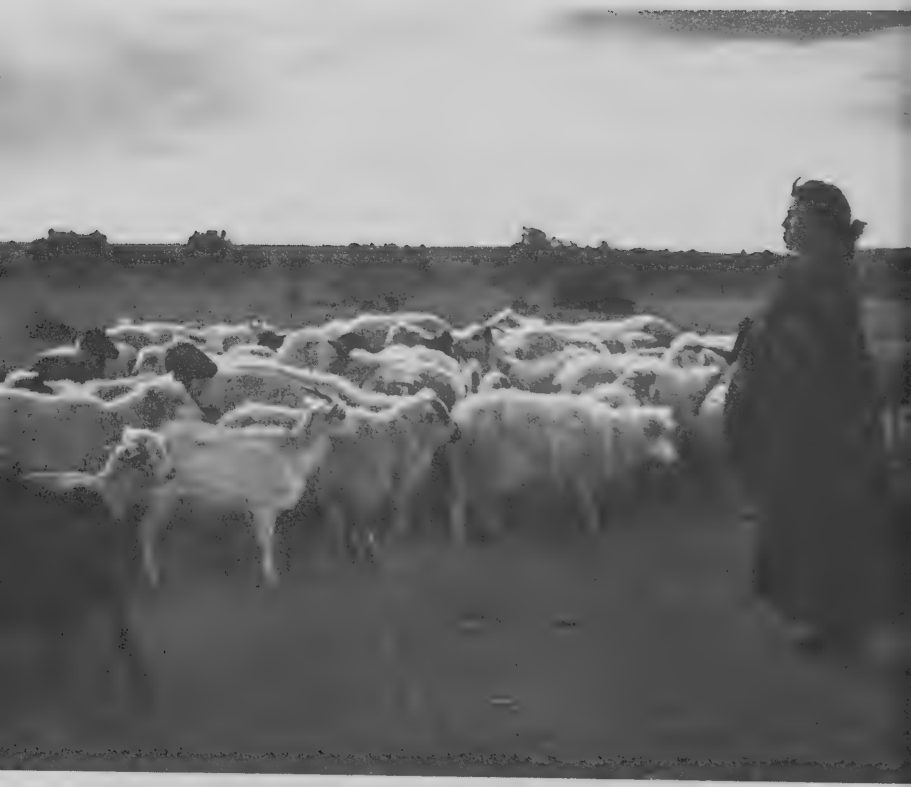
The federal government and the Navajo clashed over the issue of sheep, which had long been central to Navajo life.
the problem of erosion was solved, and soon, the sheep-raising Navajo would experience great hardship and suffering.
Collier was worried about Navajo survival, but he was also worried about white interests. He had received reports that silt from erosion on Navajo land was filling the Colorado River and threatening to clog Boulder Dam (now called Hoover Dam), a huge hydroelectric project that was being built to supply water to California’s agricultural heartland and to provide electricity for Los Angeles. The United States Geological Survey identified the Navajo reservation as the chief cause of the Colorado silt problem.
The solution, Collier decided, was to reduce Navajo livestock by 400,000 animals. Over a fiveyear period he flew to the reservation seventeen times to explain and promote the stock reduction program, but the Navajo did not accept it. “In my long life of social effort and struggle,” Collier later wrote, “I have not experienced among any other Indian group, or any group whatsoever, an anxietyridden and anguished hostility even approaching that which the Navajo were undergoing.”
Erosion For the Navajo, sheep and survival were the same. Raising sheep was their way of life. Boys grew up caring for the flocks, and herding represented the closeness of the family and the passing of values from one generation to the next. Reducing their herds went against everything they believed, everything they had learned from years of living on their land.
But Collier carried out his program to remove livestock in order to stop erosion. Agents removed sheep and goats while the Navajo wondered how they would live without their stock. After his sheep had been taken away, one herder cursed the officials: “You people are indeed heartless. You have now killed me. You have cut off my arms. You have cut off my legs. You have taken my head off. There is nothing left for me. This is the end of the trail.”
Meanwhile, the Navajo found themselves increasingly living on wages, mostly from temporary government employment. The stock reduction program had reduced many Navajo to dependency on the federal government. To the Indians, Collier’s project was the most devastating experience in their tribal history since the Long Walk.
Tragically, the stock reduction program was not even necessary to control erosion. After more research on soil erosion, scientists would discover that overgrazing was not the source of the problem. The Navajo had known that all along, and had tried in vain to tell the government. They knew that erosion had occurred many times in the past. It was part of a years-long cycle of dry weather, erosion, rainfall, and recovery. The problems of erosion and silt had more to do with drought than with the number of Navajo livestock.
The 1930s had brought years of little rain. The Indians predicted that the dry rangelands would be covered with fresh new grass when the drought ended. But by that time, sadly, their herds and their way of life would be eroded along with the soil.
“LAST-ARROW PAGEANTS” WERE EVENTS THAT the federal government organized to symbolize the Native Americans’ shift from their old way of life to a new life as landowners and farmers. An article from the Gettysburg Times of January 5, 1917, describes how the Department of the Interior held these ceremonies “to modernize the race” of Indians:
The Indians who are to be honored with the confidence of the government are selected by a “competency commission” of three men... who go through a reservation from house to house, reporting on the progress of each family—the condition of the house and farm, the way the children are cared for and their general economic status. . . . [T]he Indians selected are invited to a public meeting. .. .
There a representative of the department of the interior tells them very solemnly that the president has heard that they are ready to leave the control of the Indian bureau and become free American citizens. ... He then calls the English name of the first man on his
list—James Robinson, it may be, whose Indian name, perhaps, was Rain-in-the-Face. . . .
[T]he official hands him a bow and arrow, telling him to shoot the arrow. The Indian complies.
As the arrow strikes the ground the representative of the government says: “Rainin-the-Face, you have shot your last arrow. That means that you are no longer to live the life of an Indian. You are from this day forward to live the life of a white man. But you may keep that arrow. It will be to you a symbol of your noble race and of the pride you feel that you come from the first of all Americans.
“James Robinson, take in your hand this plow.”
The government official then told the Indian that the plow represented work. Another gift, a purse, represented savings, and the official urged the Indian to work hard and use his earnings wisely. The third gift, a flag, represented American citizenship.
“The general effect of the ceremonial has proved most happy,” says the final sentence of the article, “and the honor of participating in it has served as
a stimulus to many of the Indians to work harder for the privileges of citizenship.” Nowhere does the article say what the Indians themselves thought about this ceremony, or of the way it required them to give up the names and customs of their people.