TEN YEARS BEFORE the U.S. war against Spain, from the shores of Pyramid Lake in Nevada there came an Indian prophet. Claiming he was the messiah, Wovoka of the Paiutes called for Indians everywhere to dance the Ghost Dance, for Christ had returned to earth as an Indian. As they danced, Wovoka's followers wore muslin "ghost shirts," decorated with sacred symbols of blue and yellow lines. They believed that the garments would protect them against bullets. Wovoka's message promised the restoration of Indian ways as well as their land and the buffalo:
All Indians must dance, everywhere, keep on dancing. Pretty soon in next spring Big Man [Great Spirit] come. He bring back all game of every kind. The game be thick everywhere. All dead Indians come back and live again. When Old Man [God] comes this way, then all the Indians go to mountains, high up away from whites. Whites can't hurt Indians then. Then while Indians way up high, big flood comes like water and all white people die, get drowned. After that water go away and then nobody but Indians everywhere and game all kinds thick.1
Wovoka's vision of a world without whites spread like prairie fire through Indian country. On Sioux reservations, Ghost Dancing
became the rage, seizing Indian imaginations and mobilizing their frustrations. In the winter of 1890, an agent at Pine Ridge Reservation in South Dakota sent a warning to Washington: "Indians are dancing in the snow and are wild and crazy. We need protection and we need it now. The leaders should be arrested and confined at some military post until the matter is quieted, and this should be done at once."2 The Indian Bureau in Washington quickly identified the Ghost Dance "fomenters of disturbances" and ordered the army to arrest them, including Chiefs Sitting Bull and Big Foot. Indian policemen were sent to Sitting Bull's cabin; after arresting him, they were confronted by angry and armed Sioux. During an exchange of gunfire, the police shot and killed the chief. The news of Sitting Bull's murder alarmed Big Foot, chief of another group of Sioux. While trying to escape, Big Foot and his people, mostly women and children, were intercepted by the cavalry. They surrendered and were escorted to a camp near a frozen creek called Wounded Knee. 3 As the Indians set up their tepees for the night, they saw two manned Hotchkiss guns on the ridge above them. "That evening I noticed that they were erecting cannons up [there]," Wasu Maza recalled, "also hauling up quite a lot of ammunition." The guns were trained on the Indian camps, and the scene became terribly ominous. In the morning, under a clear blue sky, the Indians heard a bugle call. Surrounded by mounted soldiers, the men were instructed to assemble at the center of camp. Suffering from pneumonia, Big Foot was carried to the meeting. 4 The captives were ordered to turn over their weapons. "They called for guns and arms," White Lance recounted, "so all of us gave the guns and they were stacked up in the center." Thinking there were more arms hidden in the tepees, the soldiers began a search. The situation became tense and volatile. Medicine man Yellow Bird began dancing the Ghost Dance to reassure the worried Indians. He urged them to wear their sacred shirts: "The bullets will not hurt you." Suddenly, a shot rang out. Instantly, the troops began shooting indiscriminately at the Indians. "There were only about a hundred warriors and there were nearly five hundred soldiers," Black Elk reported. "The warriors rushed to where they had piled their guns and knives."5 The Indians tried to defend themselves, but then they heard an "awful roar," the death sounds of the Hotchkiss guns. Shells hailed down upon them, at the rate of fifty per minute, each
missile carrying a two-pound charge that exploded into thousands of shrapnel. The smoke was so dense it was like fog, blinding the Indians. "My father ran and fell down and the blood came out of his mouth [he was shot through the head]," recalled Yellow Bird's son, who was four years old at the time. Blue Whirlwind received fourteen wounds, while her two children running at her sides were also shot. "We tried to run, but they shot us like we were buffalo," said Louise Weasel Bear. "I know there are some good white people, but the soldiers must be mean to shoot children and women."6 Fleeing the camp, the Indians were pursued by the soldiers. "I saw some of the other Indians running up the coulee so I ran with them, but the soldiers kept shooting at us and the bullets flew all around us," reported Mrs. Rough Feathers. "My father, my grandmother, my older brother and my younger brother were all killed. My son who was two years old was shot in the mouth that later caused his death." Trails marked by blood and bodies radiated outward from the camp. "Dead and wounded women and children and little babies were scattered all along there where they had been trying to run away," Black Elk reported. "The soldiers had followed them along the gulch as they ran, and murdered them in there."7
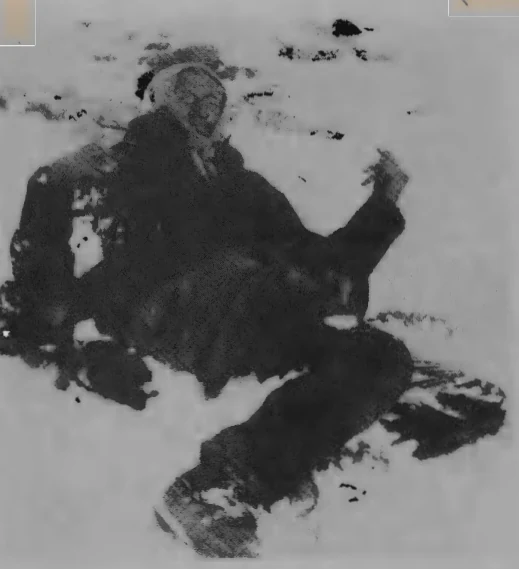
When the Hotchkiss guns stopped spewing their deadly charges, a terrible silence descended on the bloody scene. Hundreds of Indians lay dead or wounded on the icy ground, along with scores of soldiers, most of them hit by their own fire. Shortly afterward, clouds rolled across the sky and "a heavy snow began to fall," covering the corpses like a white blanket as if Nature were trying to shroud or cleanse the gore and blood. After the storm passed, the soldiers threw the dead Indians into a long trench, their frozen bodies "piled one upon another like so much cordwood, until the pit was full." Many of the corpses were naked: the "ghost shirts" had been stripped from the dead as souvenirs. A photograph of Big Foot lying in the snow showed the contorted body of the chief, his hands still trying to shield himself and his pained face fixed in a grotesque grimace by the massacre he had witnessed at Wounded Knee.8
Where the Buffalo No Longer Roam
Like the heroic frontiersman celebrated by Frederick Jackson Turner in his 1893 paper on the significance of the frontier in American history, General George Armstrong Custer personified the advance of "civilization" against "savagery."
In the winter of 1868, Custer had tracked Black Kettle's band of Cheyennes to the Washita River; as he quietly surveyed the Indian encampment in the darkness and heard the cry of a~ infant, he knew he had his enemy trapped. Custer divided his eight hundred soldiers into four groups and ordered them to surround the sleeping Indians. Then, at dawn, with his band playing "Gary Owen," Custer and his troops mounted a four-pronged attack, destroying the lodges, killing 103 Cheyenne men, and capturing 53 women and children. Marching triumphantly into Camp Supply, Custer's soldiers waved the scalps of Black Kettle and the slain men. Eight years later, Custer met his own violent death at the Battle of the Little Big Horn in Montana territory. News of Custer's death provoked shrill cries for revenge. Buffalo Bill Cody was so angry he closed his Wild West Show and pledged to go west and take the "first scalp for Custer." Demanding that the federal government avenge Custer's defeat, the editor of the Bismarck Weekly Tribune called for the establishment of reservations for all Indians. In their loud clamor for retaliation, both Buffalo Bill and the editor failed to discern the special irony that Custer's death contained, for they did not know that the general in many ways had identified with the Indians. 9 In his prolific writings on the West and the Indian character, Custer revealed his complicated and often contradictory feelings. He portrayed the land's original people as "infesting" the plains, their "cruel and ferocious nature" far exceeding that of any "wild beast." At the same time, Custer felt a certain empathy for them. When the Europeans arrived in America, he wrote, they found the natives in their homes of"peace and plenty," the "favored sons of nature." Indians stood in their "native strength and beauty, stamped with the proud majesty of free born men." But what were they now, these "monarchs of the west"? Their homes and their forests had been swept away by the ax of the woodsman; they had been driven to the "verge of extinction," resolved to die amid the "horrors of slaughter." Interacting with Indians in the West, he found much to be admired-their "remarkable taciturnity," "perseverance" for revenge and conquest, "stoical courage," and the "wonderful power and subtlety" of their senses.10 What would happen to Indians in an advancing technological society? Custer believed that their options were limited and degrading. To locate them on reservations would make them "grovel in beggary" and deny them the qualities derived from the
wilderness. To civilize Indians would be to require them to abandon their way of life as warriors, and to sacrifice their manhood by working for a living.11 Custer thought that "if" he were an Indian, he would choose the "free open plains" rather than submit to the "confined limits of a reservation." Death would be preferable to life in a cage.12
Deep within Custer was a rage against the very modern society he was helping to extend into the West. The eastern settlement was to Custer what the reservation was to the Indian. He wanted to be free from the restraints of white society, its commercialism, "luxuries," and "easy comforts." Beyond civilization in the West, Custer could still "indulge in the wild Western life with all its pleasures and excitements" and recover the "virtues of real manhood." There, like the Indian, he could roam the plains and experience the thrill of a buffalo chase.13 In the wilderness, Custer was able to enter a "new world, a Wonderland." The beauty of the Wichita Mountains mesmerized him: "The air is pure and fragrant, and as exhilarating as the purest of wine; the climate entrancingly mild; the sky clear, and blue as the most beautiful sapphire, with here and there clouds of rarest loveliness, presenting to the eye the richest commingling of bright and varied colors; delightful odors are constantly being wafted by." And everywhere were sounds-the singing of the mockingbird, the colibri, hummingbird, and thrush. Swept away by the magnificence of nature, he felt an intoxication. Riding across the plains, with its horizon after horizon of grass, Custer was hypnotized, drawn irresistibly into its awesome vastness. Its undulations reminded him of the ocean: they were like "gigantic waves," "standing silent and immovable." Here was the ultimate expanse of"vacant lands." The West offered Custer what his wife, Libby, described as an "escape" a world still beyond the noises of the machine and the constraints of modern society. 14 At the Little Big Horn on that fateful day in 1876, General Custer knew his troops were outnumbered and surrounded by Crazy Horse and his Lakota and Cheyenne warriors. Yet he refused to surrender. Instead the general ordered his soldiers to take a last stand on that grassy hillside, and all of them were killed. In that final clash, perhaps Custer understood only too clearly and too profoundly how much he and the Indian shared a common fate in a world where the buffalo no longer roamed. As Commissioner of Indian Affairs during the 1870s, Francis Amasa Walker had tried to avoid the use of armed force against
Indians. American soldiers, he recommended, should not surprise Indian "camps on winter nights" and shoot down "men, women, and children together in the snow." Instead, Walker believed the government should pursue a "Peace Policy" - buy off and feed the Indians in order to avoid violent conflict.15 Unlike Custer, Walker had very limited personal contact with Indians. He made only one visit of inquiry and inspection to the agencies of the Sioux in the Wyoming and Nebraska territories. But Walker believed that he knew what was best for the Indians. What gave Commissioner Walker such confidence was his belief in technology and the market as civilizing forces. He observed:
The labor that is made free by discoveries and inventions is applied to overcome the difficulties which withstand the gratification of newly-felt desires. The hut is pulled down to make room for the cottage; the cottage gives way to the mansion, the mansion to the palace. The rude covering of skins is replaced by the comely garment of woven stuffs; and these, in the progress of luxury, by the most splendid fabrics of human skill. In a thousand forms wealth is created by the whole energy of the community, quickened by a zeal greater than that which animated the exertions of their rude forefathers to obtain a scanty and squalid subsistence.16
Progress was bringing an end to the frontier and the Indian way of life. The railroad-"the great plough of industrial civilization" - had drawn its "deep furrow" across the continent, Walker explained, and Americans were now migrating to the Great Plains, "creeping along the course of every stream, seeking out every habitable valley, following up every indication of gold among the ravines and mountains ... and even making lodgement at a hundred points on lands secured by treaty to the Indians." Indians were facing a grim future in this rapidly changing world. Thus the "friends of humanity should exert themselves in this juncture, and lose not time" in order to save the Indians. For Walker, the "Indian Question" had become urgent: what should be done to ensure the survival of the Plains Indians?17 Walker believed in social engineering: government should scientifically manage the welfare of Indians. Since industrial "progress" had cut them ·off from their traditional means of livelihood, Indians should be given temporary support to help them make the necessary adjustments for entering civilization. To accomplish this transition, Walker conceived a plan: Indian tribes would be
consolidated into one or two "grand reservations" with railroads cutting through them here and there, leaving the rest of the territory open for white settlement, free from Indian "obstruction or molestation." Warlike tribes would be corraled onto reservations, and all Indian bands outside their boundaries would be "liable to be struck by the military at any time, without warning." Such areas would, in effect, be free fire zones.18 The ultimate goal, Walker explained, was the eventual assimilation of Indians. On the reservations, the government would subject them to "a rigid reformatory discipline." Not allowed to "escape work," they would be "required" to learn industrial skills until at least one generation had been placed on a course of "selfimprovement." "Unused to manual labor" and accustomed to "the habits of the chase," Indians lacked "forethought" and selfdiscipline. Unless the government planned their education, Walker predicted, the "now roving Indians" would become "vagabonds" and "festering sores" within civilization. Trained and reformed on the reservations, Indians would be prepared to enter civilized society.19 What he hoped his reservation system would do, Walker insisted, was to help the Indians over the rough places on "the white man's road." He believed he knew, from his own experience, what was required. He once told a friend that Indians were like "children" who disliked school and preferred to "play truant at pleasure." Then he added: "I used to have to be whipped myself to get me to school and keep me there, yet I always liked to study when once within the school-room walls." Grateful for the "whipping" he had received as a child and the self-discipline he had developed, Walker was certain "wild Indians" would become "industrious" and "frugal" through "a severe course of industrial instruction and exercise under restraint." Indians should not be left alone, "letting such as will, go to the dogs, letting such as can, find a place for themselves in the social and industrial order." In Walker's view, Indians should not be allowed to remain Indians. There was no longer a West, no longer the "vacant lands" of the continent. Indians everywhere would eventually have to settle down to farming and urban labor. 20
Allotment and Assimilation
Other white reformers had a different solution to the "Indian Question," however. Regarding themselves as "friends" of the
Indians, they believed that the reservations only served to segregate native peoples from white society and postpone their assimilation. Their viewpoint became policy in 1887, when Congress passed the Dawes Act. Hailed by the reformers as the "Indian Emancipation Act," the law reversed Walker's strategy, seeking instead to break up the reservations and accelerate the transformation of Indians into property owners and U.S. citizens. Under the Dawes Act, the president was granted the power, at his discretion and without the Indians' consent, to allot reservation lands to individual heads of families in the amount of 160 acres. These lands would be ineligible for sale, or "inalienable," for twenty-five years. This would protect the Indians from landgrabbers and also give them time to become farmers. The federal government was authorized to sell "surplus" reservation land-land that remained after allotment-to white settlers in 160-acre tracts. The money derived from the sales would be held in trust for the Indians to be used for their "education and civilization." In the allotment program, Indians would be granted U.S. citizenship.21 During the debate over the bill, a senator from Texas declared his opposition to Indian citizenship: "Look at your Chinamen, are they not specifically excepted from the naturalization laws?" But Indians, unlike the Chinese, were generally seen as capable of assimilation. "The new law," observed historian Frederick Hoxie, "was made possible by the belief that Indians did not have the 'deficiencies' of other groups: they were fewer in number, the beneficiaries of a public sympathy and pity, and capable of advancement. "22
To advance and civilize the Indians, Senator Henry Dawes contended, the tribal system had to be destroyed, for it was perpetuating "habits of nomadic barbarism" and "savagery." As members of tribes, Indians would continue to live in idleness, frivolity, and debauchery. As owners of lands in common, they would lack "selfishness," which was "at the bottom of civilization." The key to civilizing Indians would be to convert them into individual landowners. Repeatedly, the "friends" of the Indians declared that allotment was designed to make them independent and self-reliant. With the breakup of the reservations and the sale of "surplus" lands to whites, they would learn the "habits of thrift and industry'" from their white neighbors. "The aggressive and enterprising Anglo-Saxons" would set up their farms "side by side" with Indian farms, and "in a little while contact alone" would lead Indians to emulate the work ethic of their white neighbors.
"With white settlers on every alternative section of Indian lands," allotment supporters predicted, "there will be a school-house built, with Indian children and white children together; there will be churches at which there will be an attendance of Indian and white people alike. They will readily learn the tongue of the white race. They will for a while speak their own language, but they will readily learn the ways of civilization."23 This conversion of Indians into individual landowners was ceremonialized at "last-arrow" pageants. On these occasions, the Indians were ordered by the government to attend a large assembly on the reservation. Dressed in traditional costume and carrying a bow and arrow, Indians were individually summoned from a tepee and told to shoot an arrow. Each one then retreated to the tepee and reemerged wearing "civilized" clothing, symbolizing a crossing from the primitive to the modern world. Made to stand before a plow, the Indian was told: "Take the handle of this plow, this act means that you have chosen to live the life of the white man-and the white man lives by work." At the close of the ceremony, each Indian was given an American flag and a purse with the instruction: "This purse will always say to you that the money you gain from your labor must be wisely kept."24 While giving Indians what they already owned, their land, the Dawes Act also took lands away from them. White farmers and business interests were well aware of the economic advantages that the allotment program offered. In 1880, Secretary of the Interior Carl Schurz predicted that allotment would "eventually open to settlement by white men the large tracts of land now belonging to the reservations, but not used by the Indians." Shortly after Congress passed his bill, Senator Henry Dawes recounted an experience he had while traveling by train on a recently completed railroad track across five hundred miles of Indian territory. The potential of the terrain impressed Dawes. "The land I passed through was as fine a wheat-growing country as it could be. The railroad has gone through there, and it was black with emigrants ready to take advantage of it." In his recommendation for allotment on the White Earth Reservation in Minnesota, a government official pointed out that the present Chippewa lands were "valuable for the pine timber growing thereon, for which, if the Indian title should be extinguished, a ready sale could be found." 25
Legislation that granted railroad corporations right-of-way through Indian lands coincided with the enactment of the Dawes
law: in 1886-87, Congress made six land grants to railroad interests. "The past year," the Indian affairs commissioner observed that September, "has been one of unusual activity in the projection and building of numerous additional railroads through Indian lands." During the next two sessions, Congress enacted twenty-three laws granting railroad right-of-ways through Indian territories. 26 Four years after the passage of the Dawes Act, Indian commissioner Thomas Morgan calculated that Indian land reductions for the year 1891 alone totaled 17,400,000 acres, or one-seventh of all Indian lands. "This might seem like a somewhat rapid reduction of the land estate of the Indians," he noted. But the Indians were not "using" most of the relinquished land "for any purpose whatever" and had "scarcely any of it ... in cultivation," and therefore they "did not need it." Moreover, they had been "reasonably well paid" for the land. "The sooner the tribal relations are broken up and the reservation system done away with," Morgan added, "the better it will be for all concerned. If there were no other reason for this change, the fact that individual ownership of property is the universal custom among civilized people of this country would be a sufficient reason for urging the handful of Indians to adopt it."27 In 1902, Congress accelerated the transfer of lands from Indians to whites: a new law required that all allotted lands, upon the death of the owners, be sold at public auctions by the heirs. Unless they were able to purchase their own family lands, Indians would lose what had been their property. "Under the present system," a government official informed President Theodore Roosevelt, "every Indian's land comes into the market at his death, so that it will be but a few years at most before all the Indians' land will have passed into the possession of the settlers." Four years later, Congress passed the Burke Act, which nullified the twenty-five-year trust provision in the Dawes Act and granted the secretary of the interior the power to issue fee-simple title to any allottee "competent and capable of managing his or her affairs." Thus, Indian allotments were no longer protected from white land purchasers. 28
Native Americans resisted these efforts to usurp their lands. Chief Lone Wolf of the Kiowas, for example, insisted in court that the 1868 Treaty of Medicine Lodge Creek had provided for tribal approval of all land cessions. But in 1903, the Supreme Court decided that the federal government had the power to abrogate the provisions of an Indian treaty. An official of the Indian affairs welcomed the Lone Wolf decision, for it allowed the government
to dispose of Indian land without their consent. If their consent were required, he asserted, it would take fifty years to eliminate the reservations. Now the government had the power to allot reservation lands and sell "the balance" of reservation lands in order to make "homes for white farmers."29 What would be the future for the Indians if they no longer had any land? "When the last acre and last dollar are gone," Indian Affairs Commissioner Francis Leupp answered, "the Indians will be where the Negro freedmen started thirty-five years ago." Therefore, it was the government's duty to transform Indians into wage earners. In order to train Indians to become agricultural workers, Leupp arranged for the leasing of tribal lands to sugarbeet companies willing to employ Indians. As a field laborer, the commissioner explained, the Indian would acquire valuable work habits. "In this process the sensible course is to tempt him to the pursuit of a gainful occupation by choosing for him at the outset the sort of work which he finds the pleasantest; and the Indian takes to beet farming as naturally as the Italian takes to art or the German to science .... Even the little papoose can be taught to weed the rows just as the pickaninny in the South can be used as a cotton picker."30 But allotment led neither to self-sufficient Indian farmers nor to wage earners. Most reservations were located in the plains region where land could be effectively used only for ranching or large-scale farming. Plots of 160 acres were hardly realistic. What happened to the Cheyennes and Arapahoes illustrated a general pattern of dispossession and pauperization. The reservation lands of both tribes had been allotted in 1891, and the "surplus" lands sold to whites. Sixteen years later, the combined income of the Cheyennes and Arapahoes totaled $217,312. About two-thirds of this revenue came from the sale of inherited lands and the remainder from leasing allotments; only $5,312 came from farming. Per capita tribal income for that year was just $ 78. 31 Forty years after the Dawes Act, the Brookings Institution reported that 55 percent of all Indians had a per capita annual income of less than two hundred dollars, and that only 2 percent had incomes of more than five hundred dollars per year. In 1933, the federal government found that almost half of the Indians living on reservations that had been subject to allotment were landless. By then, the Indians had lost about 60 percent of the 138 millionacre land base they had owned at the time of the Dawes Act. Allotment had been transforming Indians into a landless people. 32
The Indian "New Deal": What Kind of a "Deal" Was It?
The allotment program was suddenly halted in 1934 by the Indian Reorganization Act, a policy devised by John Collier. As the Indian affairs commissioner appointed by President Franklin D. Roosevelt, he offered Indians a "New Deal." A critic of individualism, Collier admired the sense of community he found among the Indians of New Mexico. "Only the Indians," he observed," ... were still the possessors and users of the fundamental secret of human life-the secret of building great personality through the instrumentality of social institutions." This valuable knowledge should be preserved. Defining "the individual and his society as wholly reciprocal," the Indian way of life had much to teach whites and should be appreciated "as a gift for us all." Allow Indians to remain Indians, Collier insisted. ''Assimilation, not into our culture but into modern life, and preservation and intensification of heritage are not hostile choices, excluding one another, but are interdependent through and through." Collier's philosophy called for cultural pluralism: "Modernity and white Americanism are not identical. If the Indian life is a good life, then we should be proud and glad to have this different and native culture going on by the side of ours .... America is coming to understand this, and to know that in helping the Indian to save himself, we are helping to save something that is precious to us as well as to him."33 In Collier's view, allotment was destroying the Indian communal way of life. By breaking the tribal domain into individual holdings, allotment had been "much more than just a huge white land grab; it was a blow, meant to be fatal, at Indian tribal existence." The goal of government policy, Collier contended, should not be the absorption of Indians into the white population, but the maintenance of Indian cultures on their communally owned lands. Thus, as the architect of the Indian reorganization bill, Collier proposed the abolition of allotment and the establishment of Indian self-government as well as the preservation of "Indian civilization," including their arts, crafts, and traditions. 34 After reading a draft of the bill, President Roosevelt noted on the margin: "Great stuff." On June 18, 1934, he signed the Indian Reorganization Act.. While the final version of the law did not include a provision for the preservation of Indian culture, it abolished the allotment program and authorized federal funding for tribes to purchase lands, reversing policy dating back not only to 1887 but to 1607. Indians on reservations would be allowed to
establish local self-governments. Reorganization, however, would apply only to those tribes in which a majority of members had voted to accept it. "This was ... a further means of throwing back upon the tribes the control over their own destinies-of placing Indian salvation firmly in Indian hands," Collier explained. "The role of government was to help, but not coerce, the tribal efforts." The following year, 172 tribes representing 132,426 people voted in favor of the law, while 73 tribes with a combined population of 63,467 chose to be excluded.35 One of the tribes that turned down the Indian Reorganization Act was the Navajo. The Navajos' negative vote reflected their opposition to Collier and the Indian New Deal. To them, Collier belonged to a tradition reaching back to Jefferson and Walker: though he was articulating a philosophy oflndian autonomy, Collier was telling them what was in their interest and making decisions for them. 36 Navajos remembered decisions that whites had made for them in the 1860s. Since the seventeenth century, when they acquired sheep from the Spanish, Navajos had been herders. After the war against Mexico and the American annexation of the Southwest, they began to encounter white intruders. In 1863, they surrendered to Kit Carson after his troops destroyed their orchards and sheep herds. According to a Navajo account, "those who escaped were driven to the Grand Canyon and the Painted Desert, where they hid in the rocks like wild animals, but all except a few were rounded up and caught and taken away to Hwalte [Bosque Redondo]." Navajos have remembered this march as the "Long Walk."37
"A majority of the Navajos," according to a member of the tribe, "didn't know the reason why they were being rounded up and different stories went around among the people." Many feared that they "would be put to death eventually." When they arrived at Bosque Redondo, they were told by the government to irrigate the land and become farmers. The general in charge of removal explained that the Navajos had to be taken away from "the haunts and hills and hiding places of their country" in order to teach them "the art of peace" and "the truths of Christianity." On their new lands, they would acquire "new habits, new ideas, new modes of life" as they ceased to be "nomads" and became "an agricultural people." But the Navajos refused to switch from herding to farming. Five years later, the government resettled the Navajos on a reservation in their original homeland
and issued sheep to replace the stock Kit Carson's forces had destroyed. 38
Now in the 1930s, their instructions were coming, not from a soldier like Kit Carson, but from a liberal government administrator. Although Collier was proposing to give Indians self-rule, he was also trying to socially engineer the Indian world-what he called an "ethnic laboratory." Collier's policy reflected the broad philosophy of the New Deal with its faith in government planning. "To this extent," observed historian Graham D. Taylor, "it resembled earlier Indian policies in that it proposed to manipulate Indian behavior in ways which their white 'guardians' thought best for them."39 In 1933, Collier decided that it was best for the Navajos to reduce their stock. Government studies had determined that the Navajo reservation had half a million more livestock than their range could support, and that this excess had produced overgrazing and severe soil erosion. Unless the problem of erosion was controlled soon, Collier feared, the sheep-raising Navajos would experience great hardship and suffering. The government had to intervene for the sake of the tribe's survival. "The future of the Navajo is in our hands," stated an official. "His very economy is dependent upon our solution of his land problems." Using a revealing metaphor to describe the relationship between the government and the Navajos, he explained: "When formerly the parents placated the children with a stick of candy when it cried, now the parents are attempting to find the cause of the tears and to take such corrective measures as are necessary .... The youngster will not always understand a dose of castor oil may sometimes be more efficacious than a stick of candy."40 While Collier was concerned about Navajo survival, he was also worried about white interests. He had received reports that silt from erosion on Navajo land was filling the Colorado River and threatening to clog Boulder Dam. Under construction during the early 1930s, the dam was designed to supply water to California's Imperial Valley and electricity to Los Angeles. The United States Geological Survey had studied the silt problem and located its origin on the Navajo reservation: "Briefly in the main Colorado system, the Little C_olorado and the San Juan are major silt problems, while within each of these basins the Navajo Reservation's tributaries are the major silt problem. The fact is the ... Navajo Reservation is practically 'Public Enemy No. 1' in causing the
Colorado Silt problem." Unless Navajo sheep overgrazing and hence erosion were controlled, the silt would block economic development in the Southwest. Collier told the Navajo council that soil erosion must be stopped, or else Boulder Dam would be damaged and not able to supply water and electric power to Southern California. 41 Thus Collier initiated a stock reduction program on the Navajo reservation. The federal government would purchase four hundred thousand sheep and goats, and would compensate for any loss of income resulting from this stock reduction by employing Navajos on federal work projects. Collier flew to the Navajo reservation seventeen times over the next five years to explain and promote the program. But the Navajos were not receptive. "The Council members, and hundreds, even thousands, of Navajos listened and answered back," Collier recalled. "In my long life of social effort and struggle, I have not experienced among any other Indian group, or any group whatsoever, an anxiety-ridden and anguished hostility even approaching that which the Navajos were undergoing."42 Determined to have his way, Collier brought in a federal government expert to explain to the Navajos how herd reduction would actually mean increased livelihood. Using a chart to present his ideas, A. C. Cooley showed a blue line for the number of stock, a yellow line for wages from federal projects, and a red line for income derived from stock. He then argued that as the blue and yellow lines fell over the next few years, the red line would rise with improved grazing conditions, livestock breeding, and management. The Navajos were not impressed. One of them asked Cooley why all three lines could not rise together. 43 Collier kept pushing his agenda for stock reduction and finally managed to secure the support of the Navajo tribal council. But the Navajos themselves, Collier found, "resisted with a bitterness sometimes sad, sometimes wild, but always angry." Indeed, many Navajos felt Collier had manipulated the council.44 What worried the Navajos was the fact that they depended on sheep for their livelihood. For them, sheep and survival were the same. "Remember what I've told you," a Navajo father instructed his son, "you must not lose, kill or give away young ewes, young mares and cows, because ... there's a million in one of those." He warned: "So with anyone who comes to you and tells you to let the herd go. You mustn't let the herd go, because as soon as you do
there'll be nothing left of them .... The herd is money. It gives you clothing and different kinds of food. . . . Everything comes from the sheep. "45
Raising sheep was a way of life for the Navajos. The animals were a part of their world. "When the sheep are grazing," said Haske Chamiso, "I always walked right in the middle of the sheep. I didn't turn the sheep back. I just go along with the sheep. When I get tired, I just lay down in the middle of the sheep and go to sleep and finally my sister would find me." Navajo boys grew up caring for the flocks. Herding represented the closeness of the family and the teaching of values. "All I was doing was herding sheep all the time," explained Ted Chamiso. "I was raised right there at my home, with my mother and father all the time. Then my father used to teach me once in a while. Told me never to steal anything. So I never steal horses, sheep, or goats that don't belong to me. So I never steal all my life since I know myself. I never do any of those bad things my father told me not to do. Not to laugh or make fun of people."46 Now the government was ordering the Navajos to reduce their stock. In a letter to a Navajo minister, a group of Navajos denounced the Indian affairs commissioner: "John Collier promised to help us more than any other white man, but before he made these promises he forced us to agree to some hard things that we didn't like. We Indians don't think it is right for Collier to tell us we should govern ourselves, and then tell us how to do it. Why does he want to fool us that way and make us believe we are running our country, when he makes us do what he wants."47 Collier proceeded to carry out his stock reduction program. "No Washington people came here to reduce the goats," a Navajo reported. "But policemen told us those were orders from Washington and we had to be rid of the goats. The poorest people were scared and they just reduced the goats and sheep." As they watched the agents take their animals, the Navajos anxiously wondered how they would live without their stock. They issued a chorus of complaints: "The poorest people owned goats-the easiest people to take away from. The pressure was so great the little fellow sold, everyone sold. A goat sold for one dollar. The money doesn't mean half so much to the family as having the goat to kill and eat for several days." "I sure don't understand why he wants us to be poor. They reduce all sheep. They say they only goin' to let Indians have five sheep, three goats, one cattle, and one horse." "A
great number of the people's livestock was taken away. Although we were told that it was to restore the land, the fact remains that hunger and poverty stood with their mouths wide open to devour us." After his sheep had been taken away from him, a herder cursed the officials: "You people are indeed heartless. You have now killed me. You have cut off my arms. You have cut off my legs. You have taken my head off. There is nothing left for me. This is the end of the trail."48 By 1935, the stock had been reduced by 400,000 sheep and goats; still Collier was not satisfied. Noting that 1,269,910 animals were still grazing on land capable of supporting only 560,000, he impatiently stated: "This means that a further reduction of 56 percent would be necessary in order to reduce the stock to the carrying capacity of the range." A Navajo complained: "The sheep business gives us the only decent living. When we have no more sheep then Mr. Collier will dance the jig and be happy."49 Meanwhile, Navajos found themselves becoming increasingly dependent on wage income: nearly 40 percent of their annual per capita income of $128 came from wage earnings, mostly from temporary government employment. The stock reduction program had reduced many Navajos to dependency on the federal government as employees in New Deal work programs. They denounced Collier's project as "the most devastating experience in Navaho history" since their imprisonment at Bosque Redondo in the 1860s. 50
Tragically, the stock reduction program was unnecessary as an erosion control program. Scientists would do further research on silt settlement and determine that overgrazing was not the source of the problem. "By the 1950s, although 5 percent of the Lake Mead reservoir had already silted up," according to historian Richard White, "scientists were far more hesitant in attributing blame for the situation than their colleagues in the 1930s." But the Navajos had been telling this to the government all along. They argued that erosion had been reported as early as the 1890s and was related more to drought than to overgrazing. Trying to explain this cycle of dry weather and subsequent erosion to the government experts, Navajos had pointed out that the 1930s were also years with little rain and predicted that the range would recover when the drought ended. They reminded the government bureaucrats: "We know something about that by nature because we were born here and raised here and we knew about the pro-
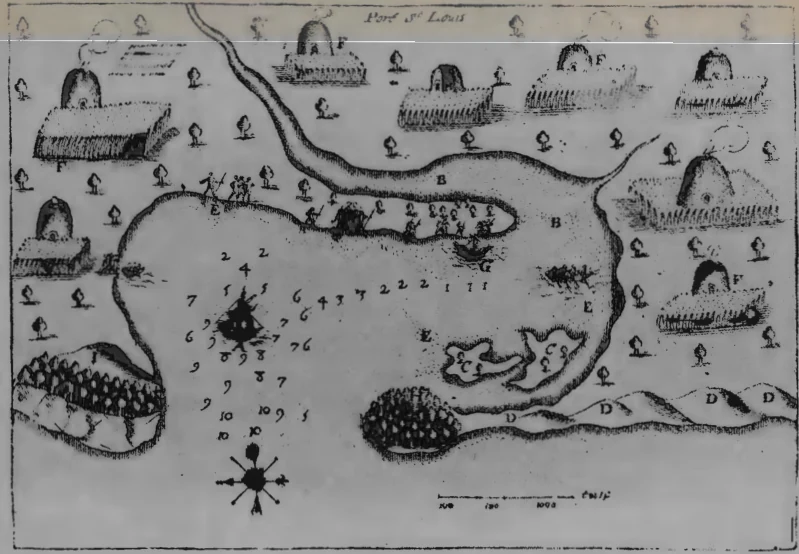
A map of Wampanoag villages and cornfields on Cape Cod drawn by Samuel de Champlain. (Des Sauvages: ou Voyage de Samuel de Champlain de Brouage faict en la France Nouvelle [Paris, 1604])
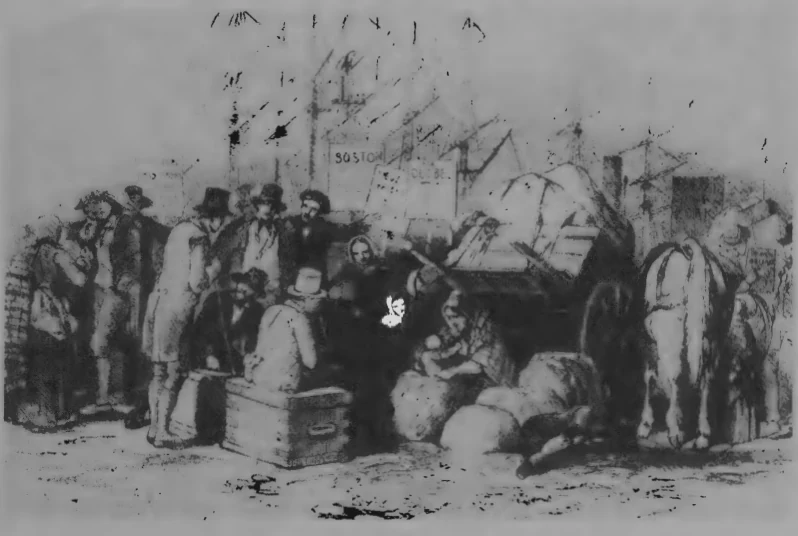
Irish immigrants boarding ships at Queenstown, Cork, 1851. (Illustrated London News, May 10, 1851)
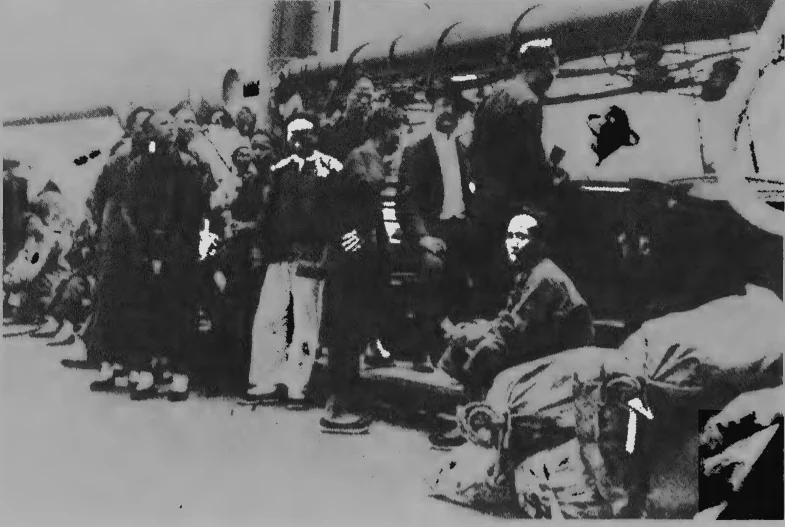
Learning about "Gold Mountain," many of the younger, more impatient, and more daring Chinese left their villages for America. (Asian American Studies Library, University of California, Berkeley)
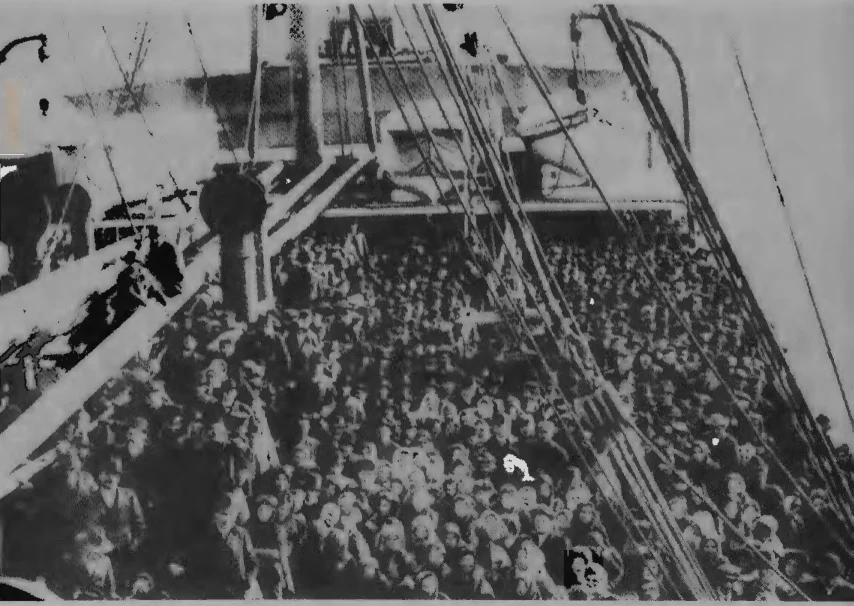
European immigrants packed on a ship bound for America. (Library of Congress)
Facing page, above: Chinese railroad workers building the transcontinental railroad, circa 1866. (Asian American Studies Library, University of California, Berkeley)
Facing page, below: Irish railroad workers building the transcontinental railroad, circa 1866. (Union Pacific Railroad Museum Collection, Omaha, Nebraska)
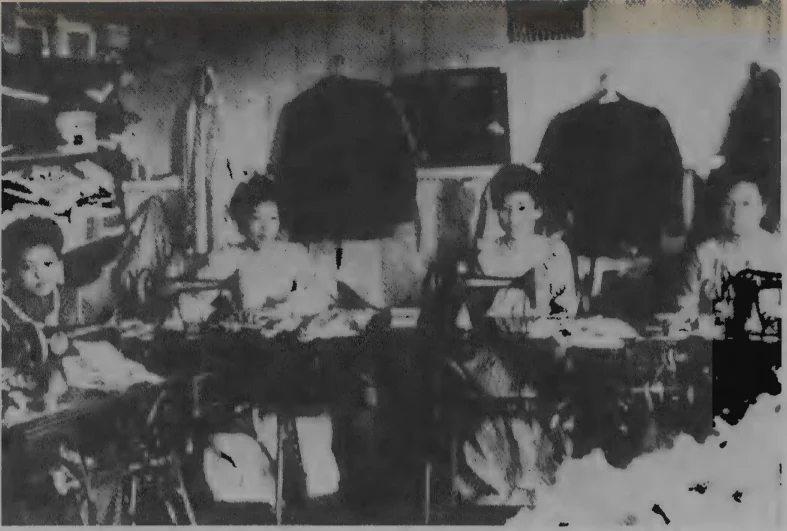
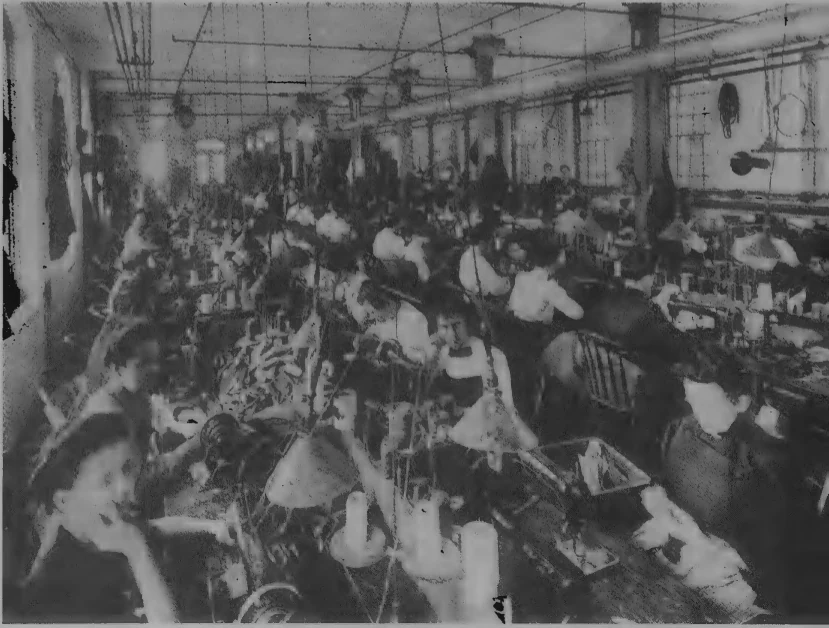
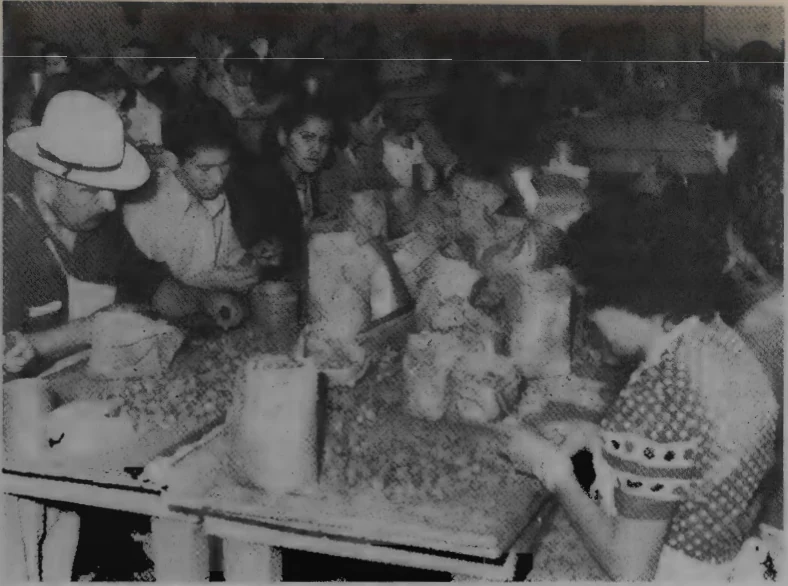
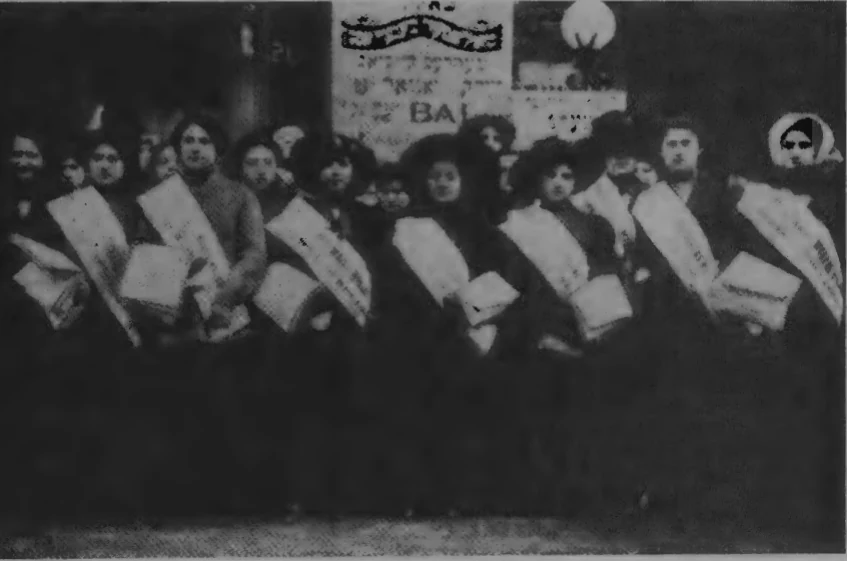
Japanese immigrant women sewing clothing for laborers in a garment shop on a plantation in Hawaii. (Hawaii State Archives) Below: Jewish immigrant women working in a garment factory. "The machines were all in a row. And it was so hot, not even a decent fan. And you worked, and you sweated." (Brown Brothers)
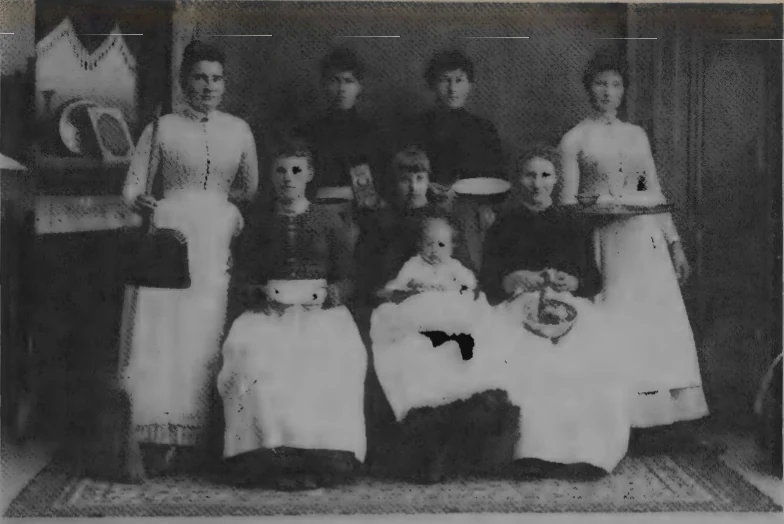
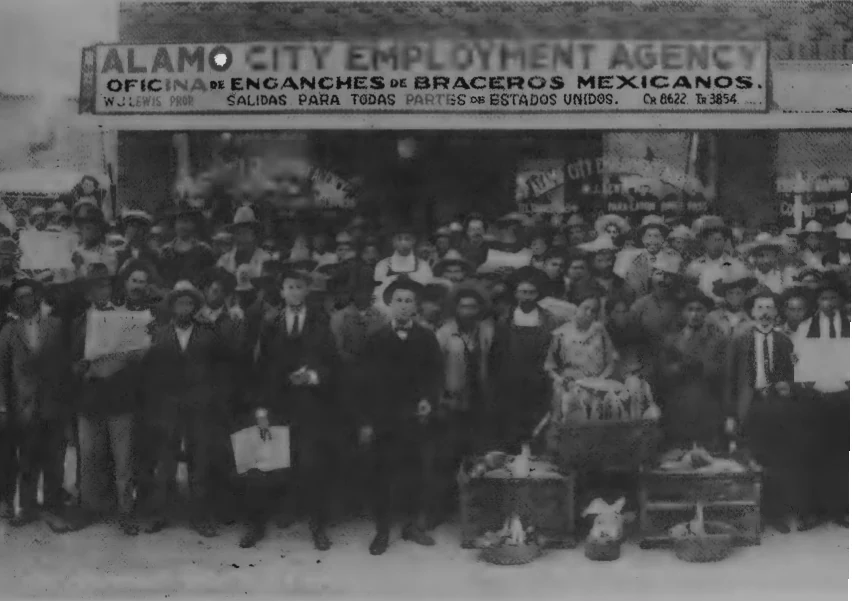
Irish immigrant maids. As they cooked, laundered, and took care of the children, servants were required to wear aprons. (State Historical Society of Wisconsin) Below: Mexican workers in San Antonio, Texas, 1924. (Goldbeck Collection, Humanities Research Center, University of Texas, Austin)
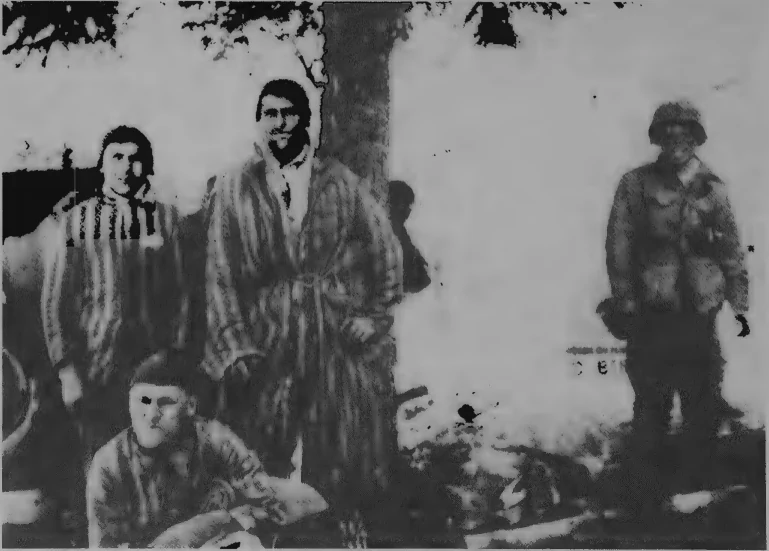
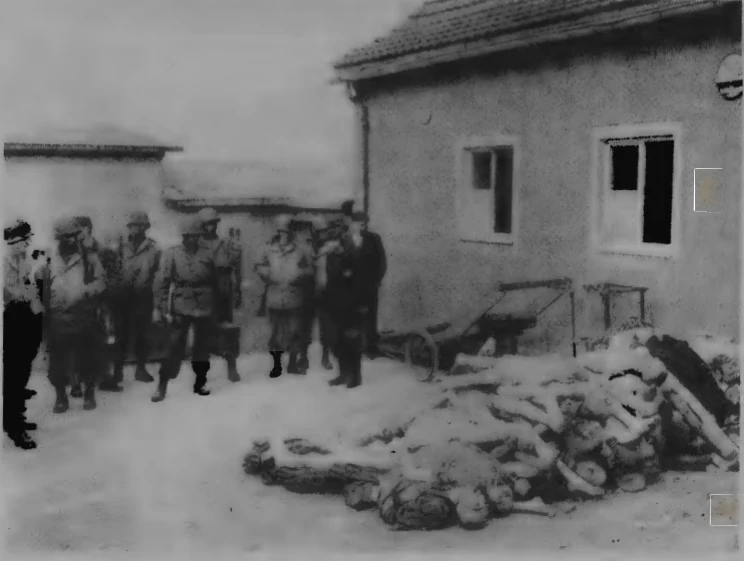
At Dachau, Jewish prisoners were liberated by U.S. troops, including Japanese- American soldiers. (Photograph by Sus Ito. Courtesy of the Japanese American Resource Center and Rudy Tokiwa)
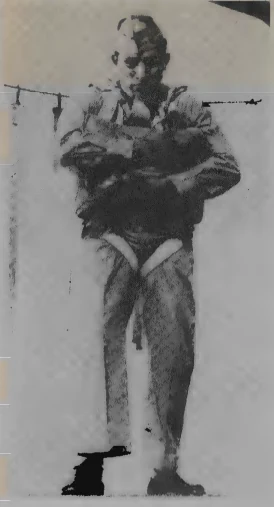
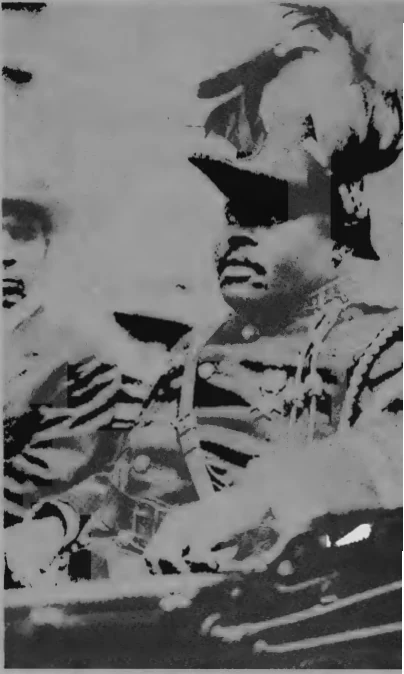
One of "MacArthur's boys," Marine Ira Hayes of the Pima tribe participated in the landing at Iwo Jima in 1945. (U.S. Department of the Army)
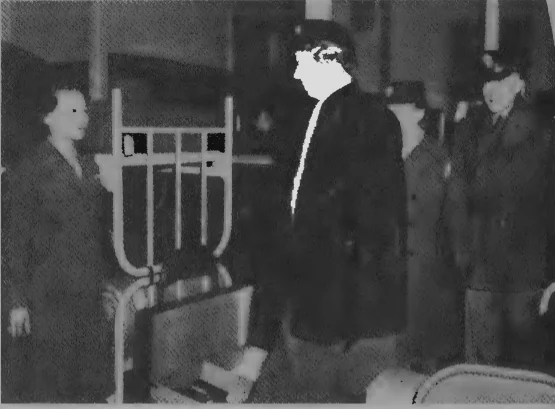
Mrs. Emily Lee Shek became the first Chinese woman to join the WAACS. She is pictured here with Eleanor Roosevelt. (U.S. Department of the Army)
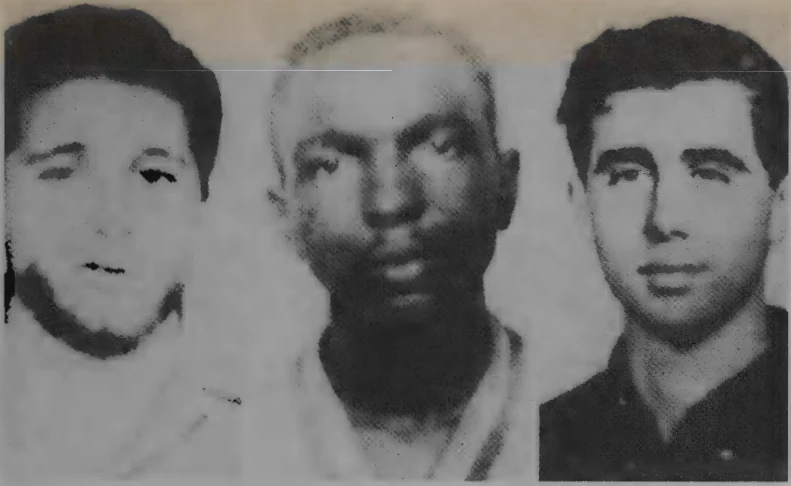
The three civil rights workers murdered in Mississippi - Michael Schwerner, James Chaney, and Andrew Goodman. (AP/Wide World)
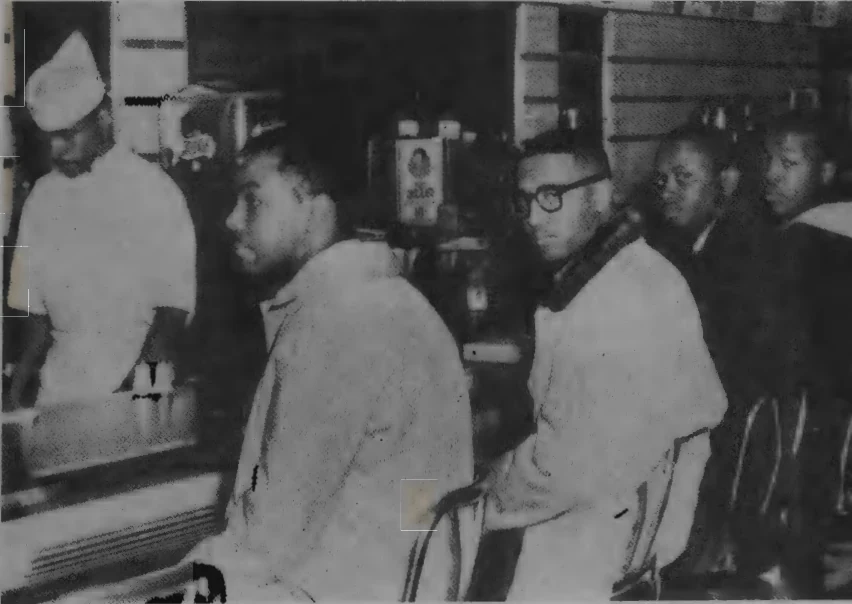
Sit-in at the Greensboro Woolworth's lunch counter, February 2, 1960 - Joseph McNeil, Franklin McCain, Billy Smith, and Clarence Henderson. (Greensboro News & Record Library)
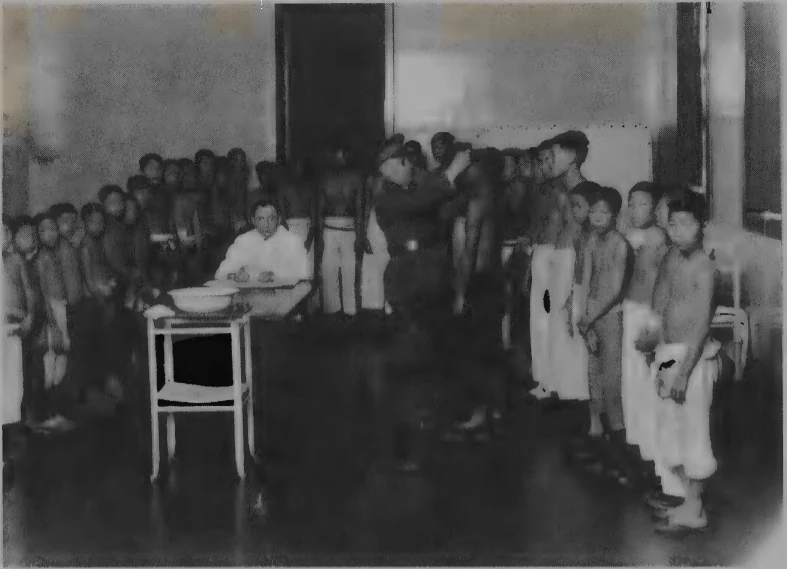
Angel Island Immigration Station (Courtesy of the National Archives)
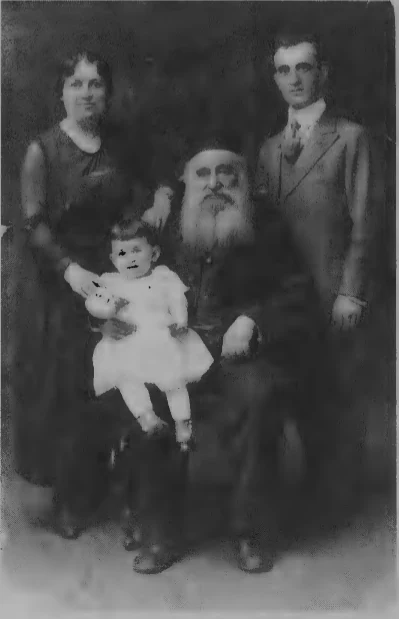
Minnie Miller (nee Glauberman); her husband, Abraham; her father, Lazar; and her daughter, Sarah-Jewish immigrants from Poland, 1920s (Courtesy of Rick Balkin)
Fatema Nourzaie, the American-born daughter of Afghan refugees who fled from their war-torn homeland (Photograph by the author)
Alexis Lopez and his mother at his graduation, University of California, Berkley, 2007. The grandson of a Mexican immigrant who worked in the fields of California, Alexis is planning to pursue his dream of becoming a doctor. (Courtesy of Alexis Lopez)
cesses of nature on our range." One of their ancient songs told them about their land's dependency on rain:
House made of dawn, House made of the dark cloud, The zigzag lightning stands high upon it, Happily, with abundant showers, may I walk.
Problems of erosion had always gone away when the grass returned along with the rain, Navajos knew, as they searched the skies for dark clouds in the dawn and evening, hopeful that showers would bless the land and their people. 51