How did England's conquest of Ireland become a political, economic, and racial blueprint for colonizing North America?
Select a highlight to read its note.
No yellow annotations for this aim yet. Blue highlights connect to the key ideas.
Listen to chapter 2
22:40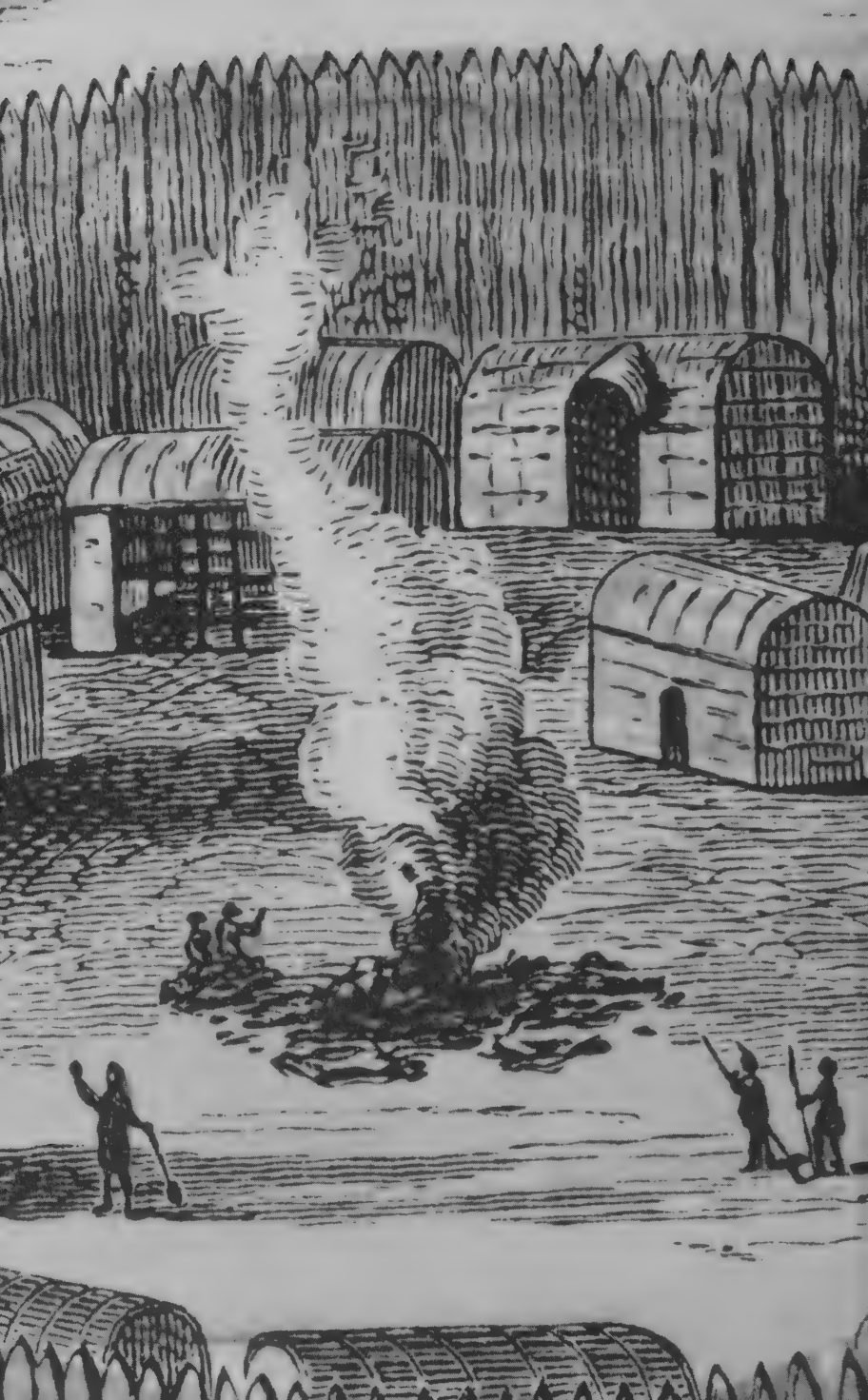
Detail: Woodcut showing Indian walled town, like those of the Powhatans near Jamestown.
Chapter 2
Removing the “Savages”
MORE THAN A THOUSAND years ago, a meeting took place on the edge of North America. On the shore stood Beothuk, Native Americans who lived along what is now the eastern coast of Canada. From the sea came longships filled with tall strangers who had pale skin, yellow hair, and blue eyes. The meeting ended in bloodshed. The strangers killed the Indians—all but one, who escaped in his small skin-covered boat.
The strangers were Norsemen, Vikings from Greenland who had originally come from Norway. Their leader was Thorvald Eiriksson, the brother of Leif Eiriksson. On a voyage from Iceland around the year 1000, Leif had become the first European to reach North America. Thorvald and his men had followed Leif’s directions to the new land, where they had fought with the first people they met.
After Thorvald and the others made camp, they were attacked in their sleep by a band of Beothuk. Thorvald died of his wounds, but that did not stop another group of Vikings from trying to settle in the place they called Vinland. Before long, though, the Vikings abandoned Vinland and returned to Greenland. They realized that “although this was a good country, there would always be terror and trouble from the people who lived there.” The Viking settlement in North America remained little more than a legend until 1960, when the remains of thousand-year-old Viking buildings were found on the Canadian island of Newfoundland.
Almost five hundred years later, another group of Europeans landed in North America. A Spanish expedition commanded by Christopher Columbus reached the islands of the Caribbean Sea. Columbus had planned to sail to Asia. He believed he had succeeded, but in reality he had bumped into lands unknown to Europeans. This accident of history opened the way for Spain, Portugal, France, Holland, and England to send explorers, soldiers, and colonists to the continents that would be named the Americas.
Unlike the Vikings, these new strangers stayed.
English Over Irish
English colonists settled in Virginia in 1607 and Massachusetts in 1620. Just as had happened to the Vikings, the English found Native American peoples living in the “new land” they wanted to make home. In deciding how to deal with the Indians, the English used a method they had already practiced on another frontier.
England’s other frontier was Ireland. In both Ireland and America, the English were interacting with people they saw as “Other,” different from themselves. And in both places, the English drew a line between “civilization” and “savagery”—a line that defined the English as civilized and the Others as savage.
In the late sixteenth century, shortly before the beginning of the English migrations to North America, England’s Queen Elizabeth I encouraged some of her subjects to colonize Ireland, an island just west of England. The queen’s advisers warned her that Ireland posed a threat. It was a Catholic nation, and more powerful Catholic countries such as Spain or France might use it as a base from which to attack England.
Elizabeth’s chosen soldiers included Sir Humphrey Gilbert and Sir Walter Raleigh. Like many
English people, these two were Protestants who believed that the Irish Catholics were not just savages but also pagans, or people who were not even Christians. To the English, the Irish were also completely lacking in “good manners,” good work habits, and a proper sense of private property.
The English colonizers in Ireland set up a two-level social structure. Irish people were forbidden to wear English-style clothes or carry English weapons, on pain of death. No Irish could own property, hold public office, or serve on a jury. To reinforce this social separation, the English outlawed marriage between the Irish and their colonizers. The new world order was to be one of English over Irish.
The Irish also became targets of English violence, especially during the Nine Years’ War, which began in 1594. “Nothing but fear and force can teach duty and obedience to such rebellious people,” the invaders insisted. The English burned Irish villages and crops, moving the people onto reservations. Whole families were slaughtered, but the English justified their actions by saying that the families provided support for the rebels.
The invaders took the heads of their slain enemies as trophies. Sir Humphrey Gilbert
ordered that the path to his tent on the battlefield should be lined with these trophies, so that anyone who came to see him must “pass through a lane of heads.”
The high death toll of the Irish soon left the land almost empty, which to the English meant that it was vacant and ready for them to settle it. And the same awful acts that had been committed against the Irish would soon be committed against the Native Americans, often by English veterans of the war in Ireland.
English over Indians
Even before the English began colonizing America, they viewed the Native American people as savage, even, sometimes, as less than human. They had heard about the Indians, and some had seen them. Ever since Columbus gave six captive Indians to the Spanish king and queen after his voyage, along with some gold nuggets and parrots, sea captains who sailed to the Americas had been kidnapping Indians and carrying them across the ocean to be displayed as curiosities.
In 1605 Captain George Waymouth sailed along the coast of New England. He lured Abenaki
Indians onto his ship and kidnapped three of them. Another account boasted of having shipped back to England “five savages, two canoes, with all their bows and arrows.” And in 1611 an Indian was brought to England and, because he was tall, “was showed up and down London for money as a monster.”
Those who displayed these Native Americans presented them as “cruel, barbarous, and most treacherous.” A writer named Richard Johnson described them in 1609 as “wild and savage people” who lived “like herds of deer in the forest.”
When the first English colonizers arrived in the Americas, they found that the houses, clothes, and customs of the Native American people reminded them of “the wild Irish.” From the start, the English viewed the Americas in terms of their experiences in the Old World. Because they saw the Irish as “savages,” when they compared the Indians to the Irish, they were defining the Indians as Savages, too.
Company that founded Jamestown, King James I supported a plan to teach Christianity to the Indians. Publicity for the colony said that the savage Indians could and should be educated, which would civilize them.
What would happen to these ideas about American “savages,” and to the plans for “civilizing” them, when Indians and English colonizers faced each other?
Virginia Aims to “Root Out” Native People
At the Jamestown colony in Virginia, the English found themselves living in the ancestral homeland of about fourteen thousand Powhatan Indians. The Powhatan were farmers who cultivated corn and lived in walled towns, where the buildings were covered with tree bark and mats made of reeds. They cooked in ceramic pottery and wove baskets so fine that some of them could hold water.
The first encounters between the English and the Powhatan opened possibilities for friendship and cooperation. The original 120 colonizers were poorly prepared for survival in the American wilderness. They found conditions so harsh that one
of them, John Smith, called their first year “the starving time.” At the end of it only thirty-eight remained, hanging onto the edge of survival, and “expecting every hour the fury of the savages,” as Smith wrote. The Indians did come, but instead of fury they brought food and rescued the starving strangers.
Several hundred more settlers arrived from England. Again, they soon ran out of provisions. They had to eat “dogs, cats, rats, and mice,” and some turned to cannibalism. The English tried to force the Powhatans to give them food by attacking them and burning their villages.
Relations between the two peoples got worse after a new governor arrived with orders that the Indians must make yearly payments of corn and deerskins to the colonists and also work for them. These orders were brutally carried out. The English burned Indian villages and fields. One commander, George Percy, described killing Indian children by “throwing them overboard and shooting out their brains in the water.” The Indians came to doubt that the two peoples could live together in peace. They felt the newcomers were determined to take their land.
Within a few years the Jamestown colonists
discovered a profitable new business—growing tobacco for export. To expand their tobacco farms they wanted more land, especially land that the Powhatan had already cleared for their own farms. Tobacco farming, in turn, drew more immigrants to the colony. In just five years, from 1618 to 1623, the population of Jamestown grew from 400 to 4,500.
The Indians tried to drive out the intruders, killing some three hundred colonists in an attack that Smith called a “massacre” by “cruel beasts.” These deaths made the English feel that they had a right to the land—that it had been bought with English blood. They decided to “destroy them who sought to destroy us” and take over the Indians’ towns and farms.
The war against the Indians was vicious and treacherous. The English rode down the Powhatan on horseback and chased them with dogs. They starved them by burning their food. A captain named William Tucker went to a Powhatan village to make a peace treaty. After they signed the treaty, he persuaded the Indians to drink a toast—then served them poisoned wine, killing an estimated two hundred. Tucker’s soldiers “brought home parts of their heads” as trophies.
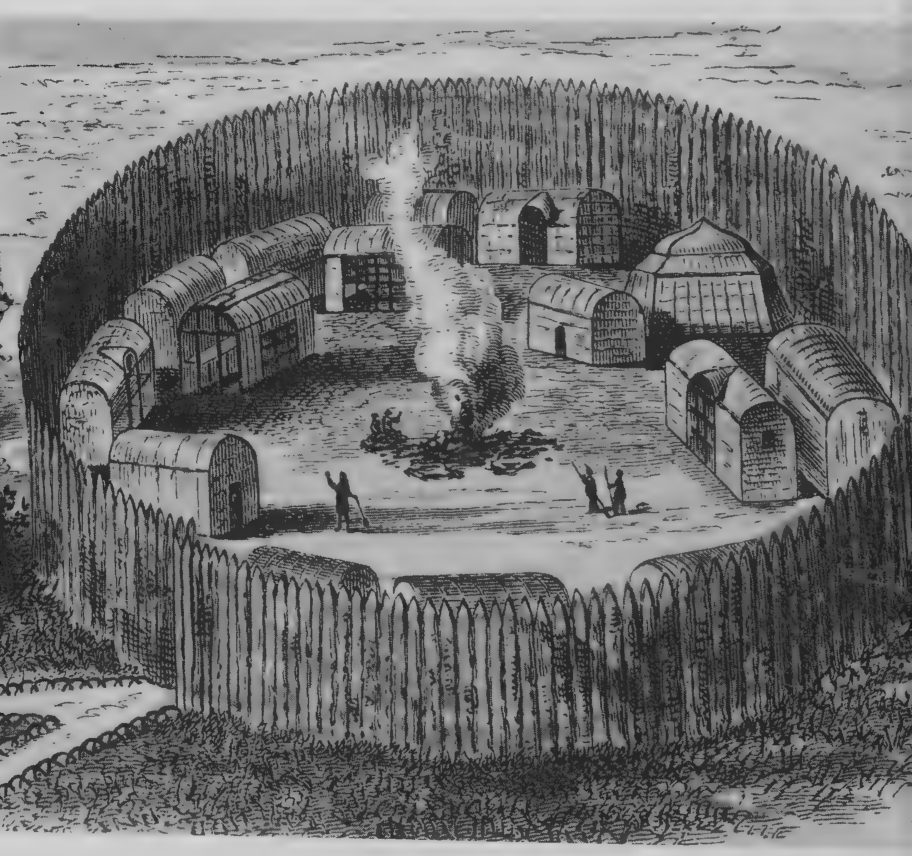
Woodcut showing Indian walled town, like those of the Powhatans near Jamestown.
New England Turns Indians into Demons
John Smith had sailed north from Virginia in 1616 to explore the New England coast. The “paradise” of Massachusetts, he reported, was “all planted with corn, groves, mulberries, savage gardens.” Indeed, the Native Americans of the New England coast—the Wampanoag, Pequot, Narragansett, and others—were farmers. They grew corn, beans, and pumpkins, and they planted groves of chestnut and hickory trees to supply their communities with nuts. This way of life brought them into competition with the English Pilgrims who founded a colony at Plymouth Rock in 1620, and then with the Puritans who soon settled on Massachusetts Bay.
New England is hilly and rocky. Less than 20 percent of the area in the English colonies was good for farming—and the Indians already occupied the best areas. At first the English managed to take over those lands without fighting because Indians had died in massive numbers from European diseases such as smallpox. William Bradford, who led the Pilgrims to Plymouth Rock, wrote in his diary, “For it pleased God to visit these Indians with a great sickness and such a mortality that of a thousand, above nine and a half hundred of them died, and many of them did rot above ground for want of burial.”
The colonizers saw the Indian deaths as a sign that God had given the land to them—God was “making room” for the settlers. Indian death did mean life for the Pilgrims, who owed their survival to a store of corn they had found among Indian graves on Cape Cod. Later, many New England towns were founded on the very places where Indians had lived before the epidemics of disease wiped them out.
As the English population grew, the settlers needed even more land. To justify taking it from the Native Americans who had survived, the English argued that the Indians did not deserve the land because they were lazy and did not work as hard as the English did. Ignoring the evidence that Indians had been farmers in New England, the English compared the Indians to “foxes and wild beasts” who did nothing “but run over the grass.”
Over the years, the growth of the English settlements led to wars. During the Pequot War of 1637, the English and their Indian allies killed some seven hundred Pequot, burning many of them—including women and children—in their forts. Nearly forty years later the Indians struck back at the colonists in King Philip’s War, which nearly succeeded in driving the English out of New England. Reinforced by
troops from England, however, the settlers overcame the Indians, killing and enslaving thousands.
Religious leaders led the way in justifying violence against the Native Americans. Ministers talked of the war against the Indians as a battle between God and the Devil. Cotton Mather called the Indians “miserable savages” who worshipped the Devil. The Puritan colonists in Massachusetts were strict Protestants who believed in witchcraft. They claimed that some of the colonists whom they accused of witchcraft had been encouraged by demons in the form of Indians.
Not everyone in the English settlements saw the Native Americans as completely demons or animals. Mary Rowlandson had been captured by the Narragansett during King Philip’s War. She lived with them for eleven weeks. In 1682, after she had returned to white society, she published a book about her experiences with the Indians.
Rowlandson’s story echoed many English stereotypes of the Indians as “barbarous creatures,” “merciless and cruel,” and “hellhounds.” At the same time, some parts of her story challenged these negative images. Indians had treated her and her six-year-old daughter with kindness and generosity, she reported. They were also generous with each
other. She wrote, “I did not see (all the time I was among them) one man, woman, or child, dy[die] with hunger.”
By recognizing the humanity of the Indians, Rowlandson’s story offered a chance for the English to understand, or even share the feelings of, the people whose land they were taking. But the English did not pursue this chance. Instead, they continued their relentless conquest of the North American continent.
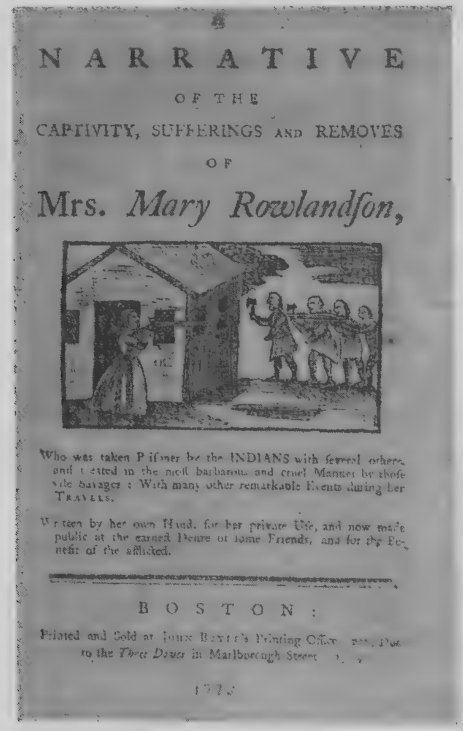
Title page of the 1773 edition of Mary Rowlandson’s book about her time as an Indian captive.
Stolen Lands and a World Turned “Upside Down”
During the eighteenth century, the English colonies in North America grew larger in population and developed thriving economies. Eventually they fought for independence, and after they had won it, they joined to form the United States of America. Cities and towns expanded, settlers moved westward, and the new nation seemed set on a path of prosperity and progress.
Progress for white Americans, however, led to poverty for Native Americans. In 1789 the Mohegan tribe sent a message to the government of Connecticut, lamenting their hardships. “[T]he Times have turn’d everything Upside down,” said the message.
Once, the Mohegan had had plenty of game, fish, and crops, and no need to fight over land. “But alas, it is not so now.” The Indians had begun to live like white people, with horses and cattle and fenced lots, but there was no longer enough for all, “and poor Widows and Orphans Must be pushed one side and there they Must Set a Crying, Starving and die.”
Ever since the arrival of the English, the Indians’ story had been one of stolen lands, sickness, starvation, suffering, and sadness. After the War of
Independence and the founding of the new nation of the United States, the Native Americans wondered what the future would hold for them.
Another person who asked this question was one of the Founding Fathers—a lawyer, Virginia planter, and author of the Declaration of Independence. In 1781, as governor of Virginia, Thomas Jefferson had told the Kaskaskia tribe that whites and Indians were “both Americans, born in the same land,” and that he hoped the two peoples would “long continue to smoke in friendship together.” Other statements, however, revealed that Jefferson held a very different view.
In 1776, when the colonists began their War of Independence, Jefferson had supported removing, even destroying, hostile Indians. “Nothing will reduce those wretches so soon as pushing the war into the heart of their country,” he wrote to a friend. “But I would not stop there. ... We would never cease pursuing them with war while one remained on the face of the earth.” In Jefferson’s view, Indians had to be either civilized (in other words, made to act like white people) or exterminated.
Later, as president, Jefferson told the Cherokee people, “I shall rejoice to see the day when the red man, our neighbors, become truly one people with
us, enjoying all the rights and privileges we do, and living in peace and plenty as we do.” But in order to do that, Jefferson insisted, Native Americans must give up their customs, beliefs, and traditional ways of life. They must build fences, learn arithmetic, and live like whites.
Jefferson also promised the Indians that they could keep their own lands. “Your lands are your own; your right to them shall never be violated by us; they are yours to keep or sell as you please.” Yet Jefferson worked to make it harder for Indians to refuse to sell land to whites. One way was to discourage Indians from hunting and make them take up farming. If they did not need the forests for hunting, Jefferson claimed, they would be more willing to sell them to whites. Another plan was to build more trading posts to sell white-manufactured goods to the Indians on credit. This would destroy the Indians financially. When the Indians found themselves in debt, they would have no choice but to hand over their land.
For Jefferson, the Indians could not be allowed to remain within society as Indians. In the seventeenth century, New Englanders had celebrated the disappearance of wolves and bears from their settlements. In 1824, the year he died, Jefferson
wrote a letter that revealed his vision of America’s future. He looked forward to the day when “wild beasts” and the “savages” who lived like them would be gone from the land, and “the advance of civilization” would be complete.
SOME OF AMERICA’S FIRST ADVENTURE TALES were Captivity narratives like Mary Rowlandson’s. These were the stories of white colonists who had been captured by Native Americans. Captives who escaped or were released would return to white society and write or talk about their experiences.
Not all captives chose to return, however. Mary Jemison is one of those who remained with the Native Americans.
Mary was fifteen years old when, sometime between 1755 and 1758, her family was captured by a band of Shawnee Indians and French soldiers. At the time, frontier wars in the American colonies pitted the English against the French and their Indian allies. The Jemison family had settled on Indian land in central Pennsylvania. Like other settlers there, they were taken by the enemy. The Shawnees killed Mary’s parents and siblings but gave Mary to members of the Seneca tribe, who adopted her as a replacement for a young man who had been killed in the fighting.
“During my adoption,” Mary recalled years later,
“I sat motionless, nearly terrified to death at the appearance and actions of the company, expecting every moment to feel their vengeance, and suffer death on the spot. I was, however, happily disappointed, when at the close of the ceremony the company retired, and my [Indian] sisters went about employing every means for my consolation and comfort.” She added, “I was very fortunate in falling into their hands; for they were kind good natured women; peaceable and mild in their dispositions; temperate and decent in their habits, and very tender and gentle toward me.”
Mary married a Delaware Indian. They had a son, but Mary's husband died while the family was moving to a new home in New York State. Later Mary married a Seneca man, and they had six children together. They survived the American Revolution—although they sided with the British in that conflict—and Mary lived with the Seneca until her death at nearly ninety.
Mary’s story is known to us because, when she was an old woman, she told it to a minister, James E. Seaver, who published it in 1824. Historians think A Narrative of the Life of Mrs. Mary Jemison is fairly accurate. Like the story of Mary Rowlandson more than a century earlier, Mary Jemison’s story
shows that in the clash between whites and Native Americans, there was right and wrong, and also gentleness and violence, on both sides.