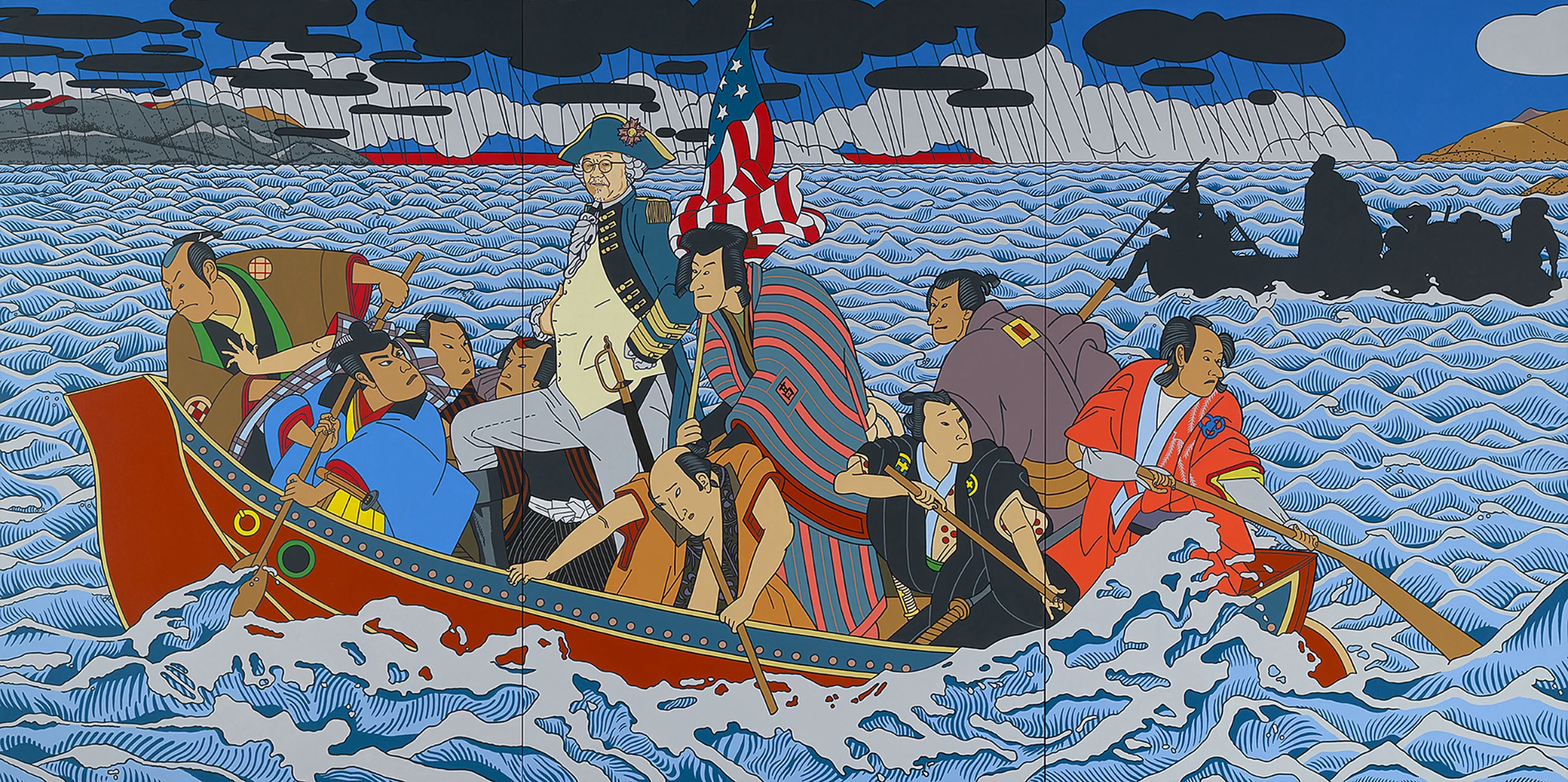
THE WHOLE EARTH is the Lord's garden," John Winthrop declared to his fellow English colonizers as they prepared to embark for America in 1629, "and he hath given it to the sons of men [to] increase and multiply and replentish the earth and subdue it. Why then should we stand starving here for the places of habitation ... and in the meantime suffer a whole Continent as fruitful and convenient for the use of man to lie waste without any improvement." The Puritan "errand into the wilderness" was to create "a city upon a hill," with "the eyes of the world upon" their religious utopia. Beneath the English migrations was an economic reality-the increase in the population of their homeland from three to four million, the problems of famine, and the rise of the wool industry with its accompanying evictions of farmers. On this side of the Atlantic was a continent bursting with resources-timber, furs, fish, and especially land. The English settlement was given a religious meaning: "starving" in England, they would migrate to America where they would cultivate the "Lord's garden." The colonizers would not "suffer" the land to "lie waste without any improvement" by its original inhabitants.1
In their first encounters with Europeans, the Indians tried to comprehend who the invaders were. Traditional Penobscot accounts had described the earth as flat and surrounded by ocean, the "great salt water," ktci-sobe-k. Beyond this body of water, there were other islands and countries inhabited by "tribes of strangers." The Indians of Massachusetts Bay, according to early reports by the English, "took the first ship they saw for a walking island, the mast to be a tree, the sail white clouds, and the discharging of ordnance for lightning and thunder." They were seized by curiosity. By word of mouth, the fantastic news spread, and the "shores for many miles were filled with this naked Nation, gazing at this wonder." Armed with bows and arrows, some of them approached the ship in their canoes, and "let fly their long shafts at her ... some stuck fast, and others dropped into the water." They ~ wondered why "it did not cry."2 Indian dreams had anticipated the coming of the strangers. In an old Wampanoag story, a wise chief foretold the arrival of Europeans: "On his death-bed he said that a strange white people would come to crowd out the red men, and that for a sign, after his death a great white whale would rise out of the witch pond below. That night he died ... and the great white whale rose from the witch pond." Another version of this story added a warning from the chief: "That's a sign that another new people the color of the whale [would arrive], but don't let them have all the land because if you do the Indians will disappear." In Virginia, a Powhatan shaman predicted that "bearded men should come & take away their Country & that there should be none of the original Indians be left, within an hundred & fifty years." Similarly, an Ojibwa prophet had a dream many years before actual contact between the two peoples: "Men of strange appearance have come across the great water. Their skins are white like snow, and on their faces long hair grows. [They come here] in wonderfully large canoes which have great white wings like those of a giant bird. The men have long and sharp knives, and they have long black tubes which they pqint at birds and animals. The tubes make a smoke that rises into the air just like the smoke from our pipes. From them come fire and such terrific noise that I was frightened, even in my dream."3 Across the Atlantic, William Shakespeare also had a dream
about the arrival of the English in America. The Tempest was first performed in London in 1611, a time when the English were encountering what they viewed as strange inhabitants in new lands. A perspicacious few in the audience could have seen that this play was more than a mere story about how Prospero was sent into exile with his daughter, took possession of an island inhabited by Caliban, and plotted to redeem himself. 4 Indeed, The Tempest can be approached as a fascinating tale that served as a masquerade for the creation of a new society in America. Seen in this light, the play invites us to view English expansion not only as imperialism, but also as a defining moment in the making of an English-American identity based on race. For the first time in the English theater, an Indian character was being presented. What did Shakespeare and his audience know about the native peoples of America, and what choices were they making in the ways they characterized Caliban? Although they saw him as a "savage," did they racialize savagery? Was the play a prologue for America?5 The Tempest, studied in relationship to its context, can help us answer these questions. The timing of the play was crucial: it was first performed after the English invasion of Ireland but before the colonization of New England, after John Smith's arrival in Virginia but before the beginning of the tobacco economy, and after the first contacts with Indians but before full-scale warfare against them. This was an era when the English were interacting with peoples that they would define as the "Other" in order to enable them to delineate the boundary between "civilization" and "savagery." The social constructions of both these terms were dynamically developing on two frontiers- Ireland and America.
English Over Irish
Attending the first performance of The Tempest, London theatergoers were familiar with the "wild Irish" on stage, for such images had been presented in plays like Sir John Oldcastle (1599) and Honest Whore (1605). To many in the audience, Caliban might have resembled the Irish. In the late sixteenth century, shortly before the beginning of the English migrations to America, Queen Elizabeth I encouraged some of her subjects to take up private colonization projects in Ireland. This island to the west posed a military threat, her advisers warned, because either Spain or France might use Catholic Ireland as a base from which
to attack England. Among Elizabeth's chosen soldiers were Sir Humphrey Gilbert and his half-brother Sir Walter Raleigh. Both were ardent Protestants who believed the Irish Catholics to be pagan savages-a view shared by many of their countrymen.6 Like Caliban, the Irish were viewed as a people living outside of "civilization." They had tribal organizations, and their practice of herding seemed nomadic. Even their Christianity was said to be merely the exterior of strongly rooted paganism. "They are all Papists by their profession," claimed Edmund Spenser in 1596, "but in the same so blindly and brutishly informed for the most part as that you would rather think them atheists or infidels." To the English colonizers, the Irish lacked "knowledge of God or good manners." They had no sense of private property and did not "plant any Gardens or Orchards, Inclose or improve their· lands, live together in setled Villages or Townes." The Irish were described as lazy, "naturally" given to "idleness," and unwilling to work for "their own bread." Dominated by "innate sloth," "loose, barbarous and most wicked," and living "like beasts," they were also thought to be criminals inclined to steal from the English. The colonizers complained that the Irish were not satisfied with the "fruit of the natural unlaboured earth" and therefore continually "invaded the fertile possessions" of the "English Pale."7 The English colonizers established a two-tiered social structure: "Every Irishman shall be forbidden to wear English apparel or weapon upon pain of death. That no Irishman, born of Irish race and brought up Irish, shall purchase land, bear office, be chosen of any jury or admitted witness in any real or personal action." To reinforce this social separation, British laws prohibited marriages between the Irish and the colonizers. The new world order was to be one of English over Irish. 8
The Irish also became targets of English violence. "Nothing but fear and force can teach duty and obedience" to this "rebellious people," the invaders insisted. While the English were generally brutal in their warfare practices at that time, they seemed to have been particularly cruel toward the Irish. The colonizers burned the villages and crops of the inhabitants and relocated them on reservatioz:is. They slaughtered families, "man, woman and child," justifying their atrocities by arguing that families provided support for the rebels. 9 The invaders took the heads of the slain Irish as trophies. Sir Humphrey Gilbert pursued a campaign of terror: he ordered that "the heads of all those ... killed in the day, should be cut off from
their bodies and brought to the place where he encamped at night, and should there be laid on the ground by each side of the way leading into his own tent so that none could come into his tent for any cause but commonly he must pass through a lane of heads .... [It brought] great terror to the people when they saw the heads of their dead fathers, brothers, children, kinsfolk, and friends." After seeing the head of his lord impaled on the walls of Dublin, Irish poet Angus O'Daly cried out:
0 body which I see without a head, It is the sight of thee which has withered up my strength. Divided and impaled in Ath-cliath, The learned of Banba will feel its loss. Who will relieve the wants of the poor? Who will bestow cattle on the learned? 0 body, since thou art without a head, It is not life which we care to choose after thee. 10
After four years of bloody warfare in Munster, according to Edmund Spenser, the Irish had been reduced to wretchedness. "Out of every corner of the woods and glens they came creeping forth upon their hands, for their legs would not bear them. They looked anatomies of death; they spake like ghosts crying out of their graves." The death toll was so high that "in short space there were none almost left and a most populous and plentiful country suddenly left void of man and beast." The "void" meant vacant lands for English settlement.11 The atrocities that had been committed against the Irish would in fact be committed again against the Indians by English veterans of the wars in Ireland.
English Over Indian
Sir Humphrey Gilbert, Lord De La Warr, Sir Francis Drake, and Sir Walter Raleigh participated in both the invasion of Ireland and the colonization of the New World. The conquest of Ireland and the settlement of Virginia were bound so closely together that one correspondence, dated March 8, 1610, stated: "It is hoped the plantation of Ireland may shortly be settled. The Lord Delaware [Lord De La Warr] is preparing to depart for the plantation of
Virginia." Commander John Mason conducted military campaigns against the Irish before he sailed to New England, where he led troops against the Pequots of Connecticut. Samuel Gorton wrote a letter to John Winthrop, Jr., connecting the two frontiers: "I remember the time of the wars in Ireland (when I was young, in Queen Elizabeth's days of famous memory) where much English blood was spilt by a people much like unto these [Indians] .... And after these Irish were subdued by force, what treacherous and bloody massacres have they attempted is well known."12 The first English colonizers in the New World found that the Indians reminded them of the Irish. In Virginia, Captain John Smith observed that the deerskin robes worn by the Indians did not differ much "in fashion from the Irish mantels." Thomas Morton noticed that the "Natives of New England [were] accustomed to build themselves houses much like the wild Irish." Roger Williams reported that the thick woods and swamps of New England gave refuge to the Indians engaged in warfare, "like the bogs to the wild Irish." Thus, in their early encounters, the English projected the familiar onto the strange, their images of the Irish onto the native people of America. Initially, "savagery" was defined in relationship to the Irish, and the Indians were incorporated into this definition.13 The Tempest, the London audience knew, was not about Ireland but about the New World, for the reference to the "Bermoothes" [Bermuda] revealed the location of the island where Prospero landed. What was happening on stage was a metaphor for English expansion into America. The play's title was inspired by a recent incident: caught in a violent storm in 1609, the Sea Adventure had been separated from a fleet of ships bound for Virginia and had run aground in the Bermudas. Shakespeare knew many of the colonizers of Virginia, including Sir Humphrey Gilbert and Lord De La Warr. One of his personal friends was geographer Richard Hakluyt, author of widely read books about the New World. England's future was in America, proclaimed Hakluyt as he urged the English to "conquer a country" and "to man it, to plant it, and to keep it, and to continue the making of Wines and Oils able to serve England."14 In the play, the images of Caliban's island evoked descriptions of Virginia. "The air breathes upon us here most sweetly," the theatergoers were told. "Here is everything advantageous to life." "How lush and lusty the grass looks! how green!" Gonzalo praised the Edenic island as a retreat where everything was as
yet unformed and unbounded, where letters, laws, metals, and occupations were yet unknown. In both imagery and language, it was almost as if Shakespeare had lifted his materials from contemporary documents about the New World. Tracts on Virginia had described the air as "most sweet" and as "virgin and temperate," and its soil "lusty" with meadows "full of green grass." In A True Reportory of the Wracke, published in 1609, William Strachey depicted Virginia's abundance: "no Country yieldeth goodlier Corn, nor more manifold increase .... We have thousands of goodly Vines. "15 Moreover, the play offered a clue that the story was indeed about America: Caliban, one of the principal characters, was a New World inhabitant. "Carib," the name of an Indian tribe, came to mean a savage of America, and the term cannibal was a derivative. Shakespeare sometimes rearranged letters in words ("Amleth," the name of a prince in a Viking-era tale, for example, became "Hamlet"), and here he had created the word "Caliban."16 The English had heard or read reports about Indians who had been captured and brought to London. Indians had been displayed in Europe by Christopher Columbus. During his first voyage, he wrote: "Yesterday came [to] the ship a dugout with six young men, and five came on board; these I ordered to be detained and I am bringing them." When Columbus was received by the Spanish court after his triumphal return, he presented a collection of things he had brought back, including some gold nuggets, parrots in cages, and six Indians. During his second voyage, in 1493, Columbus again sent his men to kidnap Indians and returned to Spain with 550 Indian captives. "When we reached the waters around Spain," Michele de Cuneo reported, "about 200 of those Indians died, I believe because of the unaccustomed air, colder than theirs. We cast them into the sea."17 Similarly, English explorers engaged in this practice of kidnapping Indians. When Captain George Waymouth visited New England in 1605, he lured some Abenakis to his ship; taking three of them hostage, he sailed back to England to display them. An early-seventeenth-century pamphlet stated that a voyage to Virginia was expected to bring back its quota of captured Indians: "Thus we shipped five savages, two canoes, with all their bows and arrows." In 1611, according to a biographer of William Shakespeare, "a native of New England called Epenew was brought to England ... and 'being a man of so great a stature' was showed up and down London for money as a monster." In the play, Stephano
considered capturing Caliban: "If I can recover him, and keep him tame, and get to Naples with him, he's a present for any emperor." Such exhibitions of Indians were "profitable investments," literary scholar Frank Kermode noted, a11-d were "a regular feature of colonial policy under James I. The exhibits rarely survived the experience."18
To the spectators of these "exhibits," Indians personified "savagery." They were depicted as "cruel, barbarous and most treacherous." They were thought to be cannibals, "being most furious in their rage and merciless ... not being content only to kill and take away life, but delight to torment men in the most bloody manner ... flaying some alive with the shells of fishes, cutting off the members and joints of others by piecemeal and broiling on the coals, eating the collops of their flesh in their sight whilst they live." According to Sir Walter Raleigh, Indians had "their eyes in their shoulders, and their mouths in the middle of their breasts." In Nova Brittania, published in 1609, Richard Johnson described the Indians in Virginia as "wild and savage people," living "like herds of deer in a forest." One of their striking physical characteristics was their skin color. John Brereton described the New England Indians as "of tall stature, broad and grim visage, of a blacke swart complexion."19 Like Caliban, Indians seemed to lack everything the English identified as civilized-Christianity, cities, letters, and clothing. Unlike the English, Indians were allegedly driven by their passions, especially their sexuality. Amerigo Vespucci was struck by how the natives embraced and enjoyed the pleasures of their bodies: "They ... are libidinous beyond measure, and the women far more than the men .... When they had the opportunity of copulating with Christians, urged by excessive lust, they defiled and prostituted themselves."20 Could Caliban ever become civilized? The native seemed educable, for Prospero had taught him a European language: "I took pains to make thee speak, taught thee each hour one thing or other. When thou didst not, savage, know thine own meaning, but wouldst gabble like a thing most brutish." Defiantly, the slave retorted: "You taught me language, and my profit on't is, I know how to curse. The red plague rid you for learning me your language." A Virginia tract stated that the colonizers should take Indian children and "train them up with gentleness, teach them our English tongue." In the contract establishing the Virginia Company in 1606, the king endorsed a plan to propagate the
"Christian Religion to such people" who as yet lived in "darkness and miserable ignorance of the true knowledge and worship of God." Three years later, the Virginia Company in London instructed the colony's governor to encourage missionaries to convert Indian children. They should be taken from their parents if necessary, since they were "so wrapped up in the fog and misery of their iniquity." A Virginia promotional tract stated that it was "not the nature of men, but the education of men" that made them "barbarous and uncivil." Savage Indians could and should be educated. 21 All of these cultural constructs of Indians at this point in time were either the fantasy of Shakespeare or the impressions of policymakers and tract writers in London. What would happen to these images on the stage called history?
Virginia: To "Root Out" Indians as a People
The first English settlement in the New World was in Virginia, the ancestral homeland of some fourteen thousand Powhatans. An agricultural people, they cultivated corn - the mainstay of their subsistence. Their cleared fields were as large as one hundred acres, and they lived in palisaded towns, with forts, storehouses, temples, and framed houses covered with bark and reed mats. They cooked their food in ceramic pots and used woven baskets for storing corn; some of their baskets were constructed so skillfully they could carry water in them. The Powhatans had a sophisticated numbering system for evaluating their harvests. According to John Smith, they had numbers from one to ten, after which counting was done by tens to one hundred. There was also a word for "one thousand." The Powhatan calendar had five seasons: "Their winter some call Popanow, the spring Cattaapeuk, the sommer Cohattayough, the earing of their Corne Nepinough, the harvest and fall of the leafe Taquitock. From September until the midst of November are the chief Feasts and sacrifice."22 In Virginia, the initial encounters between the English and the Indians opened possibilities for friendship and interdependency. After arriving in 1607, the first one hundred twenty colonizers set up camp. Then, John Smith reported, came "the starving time." A year later, only thirty-eight of them were still alive, hanging precariously on the very edge of survival. The reality of America did not match the imagery of the New World as a garden; the descriptions of its natural abundance turned out to be exaggerated. Many
of the English were not prepared for survival in the wilderness. "Now was all our provision spent ... all help abandoned, each hour expecting the fury of the savages," Smith wrote. Fortunately, in that moment of "desperate extremity," the Powhatans brought food and rescued the starving strangers. 23 A year later, several hundred more settlers arrived, and again they quickly ran out of provisions. They were forced to eat "dogs, cats, rats, and mice," even "corpses" dug from graves. "Some have licked up the blood which hath fallen from their weak fellows," a survivor reported. "One [member] of our colony murdered his wife, ripped the child out of her womb and threw it into the river, and after chopped the mother in pieces and salted her for his food, the same not being discovered before he had eaten part thereof." "So great was our famine," John Smith stated, "that a savage we slew and buried, the poorer sort took him up again and ate him; and so did diverse one another boiled and stewed with roots and herbs."24
Hostilities soon broke out, however, as the English tried to extort food supplies by attacking the Indians and destroying their villages. In 1608, an Indian declared: "We hear you are come from under the World to take our World from us." A year later, Governor Thomas Gates arrived in Virginia with instructions that the Indians be forced to labor for the colonizers and also make annual payments of corn and skins. The orders were brutally carried out. During one of the raids, the English soldiers attacked an Indian town, killing fifteen people and forcing many others to flee. Then they burned the houses and destroyed the cornfields. According to a report by commander George Percy, they marched the captured queen and her children to the river where they "put the Children to death ... by throwing them overboard and shooting out their brains in the water."25 Indians were beginning to doubt that the two peoples could live together in peace. One young Indian told Captain John Smith: "[We] are here to intreat and desire your friendship and to enjoy our houses and plant our fields, of whose fruits you shall participate." But he did not trust the strangers: "We perceive and well know you intend to 9-estroy us." Chief Powhatan had come to the same conclusion, and he told Smith that the English were not in Virginia to trade but to "invade" and "possess" Indian lands. 26
Indeed, Smith and his fellow colonizers were encouraged by their culture of expansionism to claim entitlement to the land. In the play, the theatergoers were told: "I think he will carry this
island home in his pocket and give it his son for an apple." Prospero declared that he had been thrust forth from Milan and "most strangely" landed on this shore "to be the lord on't." Projecting his personal plans and dreams onto the wilderness, he colonized the island and dispossessed Caliban. Feeling robbed, Caliban protested: "As I told thee before, I am subject to a tyrant, a sorcerer, that by his cunning hath cheated me of the island." But the English in Virginia did not see their taking of land as robbery. In 1609, Robert Gray declared that "the greater part" of the earth was "possessed and wrongfully usurped by wild beasts ... or by brutish savages." A Virginia pamphlet argued that it was "not unlawful" for the English to possess "part" of the Indians' land. 27 The English colonizers soon wanted more than just a "part" of Indian territory. Their need for land was suddenly intensified by a new development after 1613-the cultivation of tobacco as an export crop. The settlers increasingly coveted Indian lands, especially the already cleared fields. Tobacco agriculture stimulated not only territorial expansion but also immigration. During the "Great Migration" of 1618-23, the colony grew from 400 to 4,500 people. In 1622, the natives tried to drive out the intruders, killing some three hundred colonizers. John Smith denounced the "massacre" and described the "savages" as "cruel beasts," who possessed "a more unnatural brutishness" than wild animals. The English deaths, Samuel Purchas argued, established the colonizers' right to the land: "Their carcasses, the dispersed bones of their countrymen ... speak, proclaim and cry, This our earth is truly English, and therefore this Land is justly yours O English." English blood had watered the soil, entitling them to the land. In retaliation, the English waged total war. "Now by right of war," the colonizers declared, they would "invade the Country, and destroy them who sought to destroy us." They felt they could sweep away their enemies and take even their developed lands. "We shall enjoy their cultivated places .... Now their cleared grounds in all their villages (which are situated in the fruitfulest places of the land) shall be inhabited by us." Their tactics of warfare were vicious and treacherous, even sadistic. "Victory may be gained in many ways," a colonizer declared: "by force, by surprise, by famine in burning their Corn, by destroying and burning their Boats, Canoes, and Houses ... by pursuing and chasing them with our horses, and bloodhounds to draw after them, and mastives to tear them." In 1623, Captain William Tucker led his soldiers to a
Powhatan village, presumably to negotiate a peace treaty. After concluding the treaty, he persuaded the Indians to drink a toast, but he served them poisoned wine. An estimated two hundred Indians died instantly, and Tucker's soldiers then killed another fifty and "brought home parts of their heads." In 1629, a colonizer reported, the English forced a hostile Indian leader to seek peace by "continual incursions" and by "yearly cutting down, and spoiling their corn." The goal of the war was to "root out [the Indians] from being any longer a people."28
New England: The "Utter Extirpation" of Indians
What occurred in New England was a different story, however; here again, the play was preview. The theatergoers were told that Caliban was "a devil, a born devil" and that he belonged to a "vile race." On the stage, they saw Caliban, with long, shaggy hair and with distinct racial markers-"freckled" and dark in complexion. His distinctive physical characteristics signified intellectual incapacity. Caliban was "a thing of darkness" whose "nature nurture [could] never stick." In other words, he had natural qualities that precluded the possibility of becoming civilized through "nurture," or education. The racial distance between Caliban and Prospero was inscribed geographically. The native was forced to live on a reservation located in a barren region. "Here you sty [to lodge, to place in a pigpen or sty] me in this hard rock," he complained, "whiles you do keep from me the rest o' the island." Prospero justified this segregation, charging that the "savage" possessed distasteful qualities "which good natures could not abide to be with. Therefore wast thou deservedly confined into this rock, who hadst deserved more than a prison." The theatergoers saw Caliban's "sty" located emblematically at the back of the stage, behind Prospero's "study," signifying a hierarchy of white over dark and cerebral over carnal. 29 Prospero believed he could dispossess Caliban of his island because the "savage" was simply living there. The English colonizers in New England, however, found the Indians already farming the land. In 1616, Captain John Smith sailed north from Virginia to explore the 'New England coast, where he found not wild men but farmers. The "paradise" of Massachusetts, he reported, was "all planted with corn, groves, mulberries, savage gardens." "The sea Coast as you pass shews you all along large Corne fields." Indeed, the tribes in New England were horticultural. For
example, the Wampanoags, whom the Pilgrims encountered in 1620, were a farming people, with a representative political system as well as a division of labor, with workers specializing in arrow making, woodwork, and leathercrafts. 30
The Wampanoags as well as the Pequots, Massachusetts, Nausets, Nipmucks, and Narragansetts cultivated corn. As the main source of life for these tribes, corn was the focus of many legends. A Narragansett legend told how a crow had brought this grain to New England: "These Birds, although they do the corn also some hurt, yet scarce one Native amongst a hundred will kill them, because they have a tradition, that the Crow brought them at first an Indian Grain of Corn in one Ear, and an Indian or French bean in another, from the Great God Kautantouwits field in the Southwest from whence ... came all their Corn and Beans." A Penobscot account celebrated the gift of Corn Mother: during a time of famine, an Indian woman fell in love with a snake in the forest. Her secret was discovered one day by her husband, and she told him that she had been chosen to save the tribe. She instructed him to kill her with a stone ax and then drag her body through a clearing. "After seven days he went to the clearing and found the corn plant rising above the ground .... When the corn had born fruit and the silk of the corn ear had turned yellow he recognized in it the resemblance of his dead wife. Thus originated the cultivation of corn."31 These Indians had a highly developed agricultural system. Samuel de Champlain found that "all along the shore" there was "a great deal of land cleared up and planted with Indian corn." Describing their agricultural practices, he wrote: "They put in each hill three or four Brazilian beans [kidney beans] .... When they grow up, they interlace with the corn ... and they keep the ground very free from weeds. We saw there many squashes, and pumkins, and tobacco, which they likewise cultivate." According to Thomas Morton, Indians "dung[ed] their ground" with fish to fertilize the soil and increase the harvest. After visiting the Narragansetts in Rhode Island, John Winthrop, Jr., noted that although the soil in that region was "sandy & rocky," the people were able to raise "good corn without fish" by rotating their crops. "They have every one 2 fields," he observed, "which after the first 2 years they let one field rest each year, & that keeps their ground continually [productive]." According to Roger Williams, when the Indians were ready to harvest the corn, "all the neighbours men and women, forty, fifty, a hundred," joined in the work and
came "to help freely." During their green corn festival, the Narragansetts erected a long house, "sometimes a hundred, sometimes two hundred feet long upon a plain near the Court ... where many thousands, men and women," gathered. Inside, dancers gave money, coats, and knives to the poor. After the harvest, the Indians stored their corn for the winter. "In the sand on the slope of hills," according to Champlain, "they dig holes, some five or six feet, more or less, and place their corn and other grains in large grass sacks, which they throw into the said holes, and cover them with sand to a depth of three or four feet above the surface of the ground. They take away their grain according to their need, and it is preserved as well as it be in our granaries." Contrary to the stereotype of Indians as hunters and therefore savages, these Indians were farmers. 32 This reality led to antagonistic competition over resources between the original inhabitants and the English strangers. Within ten years after the arrival of Winthrop's group, twenty thousand more settlers came to New England. This growing English population had to be squeezed into a limited area of arable land. Less than 20 percent of the region was useful for agriculture, and the Indians had already established themselves on the prime lands. 33
What opened the way for the English appropriation of Indian lands was the massive deaths of the indigenous people due to unseen pathogens. When the colonizers began arriving in New England, they found that the Indian population was already being reduced by European diseases. By 1616, epidemics had been ravaging Indian villages. Victims of "virgin soil epidemics," the Indians lacked immunological defenses against the diseases that had been introduced by European explorers. After he arrived at Plymouth Rock in 1620, William Bradford reported that the Indians living near the trading house "fell sick of the smallpox, and died most miserably." The condition of those still alive was "lamentable." Their bodies were covered with "the pox breaking and mattering and running one into another, their skin cleaving" to the mats beneath them. When they turned their bodies, they found "whole sides" of their skin flaying off. In this terrible way, they died "like· rotten sheep." After one epidemic, William Bradford recorded in his diary: "For it pleased God to visit these Indians with a great sickness and such a mortality that of a thousand, above nine and a half hundred of them died, and many of them did rot above ground for want of burial."34
The colonizers interpreted these Indian deaths as divinely sanctioned opportunities to take the land. John Winthrop declared that the decimation of Indians by smallpox manifested a Puritan destiny: God was "making room" for the settlers and "hath hereby cleared our title to this place." After an epidemic had swept through Indian villages, John Cotton claimed that the destruction was a sign from God: when the Lord decided to transplant his people, he made the country vacant for them to settle. Edward Johnson pointed out that epidemics had desolated "those places, where the English afterward planted."35 Indeed, many New England towns were founded on the very lands the Indians had been living on before the epidemics. The Plymouth colony itself was located on the site of the Wampanoag village of Pawtuxet. The Pilgrims had noticed the village was empty and the cornfields overgrown with weeds. "There is a great deal of Land cleared," one of them reported, "and hath beene planted with Corne three or foure yeares agoe." "Thousands of men have lived there, which died in a great plague not long since," another Pilgrim wrote; "and pity it was and is to see so many goodly fields, and so well seated, without men to dress and manure the same." During their first spring, the Pilgrims went out into those fields to weed and manure them. Fortunately, they had some corn seed to plant. Earlier, when they landed on Cape Cod, they had come across some Indian graves and found caches of corn. They considered this find, wrote Bradford, as "a special providence of God, and a great mercy to this poor people, that here they got seed to plant them corn the next year, or else they might have starved." The survival of these pallid strangers was so precarious that they probably would have perished had it not been for the seeds they found stored in the Indian burial grounds. Ironically, Indian death came to mean life for the Pilgrims. 36
As the English population increased and as their settlements expanded, the settlers needed even more land. To justify the taking of territory, the colonizers argued that the original inhabitants were not entitled to the land, for they lacked a work ethic. Native men were pursuing "no kind of labour but hunting, fishing and fowling." Ownership of the land required its utilization. "The Indians are not able to make use of the one fourth part of the Land," argued Reverend Francis Higginson in 1630, "neither have they any settled places, as Towns to dwell in, nor any ground as they challenge for their owne possession, but change their habitation from place to place." "Fettered in the chains of
idleness," William Wood of Boston complained in 1634, Indians would rather starve than work. Indians were sinfully squandering America's resources. Under their irresponsible guardianship, the land had become "all spoils, rots," and was "marred for want of manuring, gathering, ordering, etc." Like the "foxes and wild beasts," Indians did nothing "but run over the grass." Ignoring the presence of Indian farms in New England and claiming the Indians were lazy and unproductive, the English colonizers were determined to transform Indian lands into Puritan farms. 37 Over the years, the expansion of English settlements led to wars. During the Pequot War of 1637, some seven hundred Pequots were killed by the English and their Indian allies. Describing the massacre at Fort Mystic, an English officer wrote: "Many were burnt in the fort, both men, women, and children .... There were about four hundred souls in this fort, and not above five of them escaped out of our hands. Great and doleful was the bloody sight." Commander John Mason explained that God had pushed the Pequots into a "fiery oven," "filling the place with dead bodies." During King Philip's War of 1675-76, the Wampanoag leader Metacom, also known as King Philip, united several tribes in a widespread attack on the English settlements. "By August 1676," wrote historian Jill Lepore, "when Philip was shot to death near his home in Mount Hope, twenty-five English towns, more than half of all the colonists' settlements in New England, had been ruined and the line of English habitation had been pushed back almost to the coast. The struggling colonists had nearly been forced to abandon New England entirely, and their losses left them desperately dependent on England for support." With support from their home country, however, the colonizers fought back and defeated King Philip's forces. In the end, some six thousand Indians died from combat and disease, and thousands more were shipped out of New England as slaves. Victorious, the English soldiers decapitated King Philip and staked his head for public viewing in Plymouth. 38 Ministers led the way in justifying the English violence and atrocities aimed at the original inhabitants. Warfare against the Indians, Reverend Cotton Mather explained, was a conflict between the Devil ~nd God: "The Devil decoyed those miserable savages [to New England] in hopes that the Gospel of the Lord Jesus Christ would never come here to destroy or disturb His absolute empire over them." Indian deaths were viewed as the destruction of devil worshippers. The Indians, Reverend Increase
Mather observed, were "so Devil-driven as to begin an unjust and bloody war upon the English, which issued in their speedy and utter extirpation from the face of God's earth." What was forged in the violent dispossession of the original inhabitants was an ideology that demonized the "savages."39 This demonization of Indians served complicated ends. The enemy was not only external but also internal. To the Puritans, the Indians were like Caliban, a "born devil": they had failed to control their appetites, to create boundaries separating mind from body. They represented what English men and women in America thought they were not, and, more important-what they must not become. As exiles living in the wilderness far from "civilization," the Puritans used their negative images of Indians to delineate the moral requirements they had set up for themselves. As sociologist Kai Erikson explained, "Deviant forms of behavior, by marking the outer edges of group life, give the inner structure its special character and thus supply the framework within which the people of the group develop an orderly sense of their own cultural identity .... One of the surest ways to confirm an identity, for communities as well as for individuals, is to find some way of measuring what one is not." By depicting Indians as demonic and savage, the Puritans, like Prospero, were able to define more precisely what they perceived as the danger of becoming Calibanized.40 The Indians represented a threat to the Puritan errand in America. "The wilderness through which we are passing to the Promised Land is all over fill'd with fiery flying serpents. Our Indian wars are not over yet," warned Reverend Cotton Mather. "We have too far degenerated into Indian vices. The vices of the Indians are these: They are very lying wretches, and they are very lazy wretches; and they are out of measure indulgent unto their children; there is no family government among them. We have [become] shamefully Indianized in all those abominable things." The wars were now within the Puritan self and society; the dangers were internal. Vigilance against sin was required, or else the English would become like the Indians.41 To be "Indianized" meant to serve the Devil. Cotton Mather thought this was what had happened to Mercy Short, a young girl who had been a captive of the Indians and who was suffering from tormenting fits. According to Mather, Short had seen the Devil. "Hee was not of a Negro, but of a Tawney, or an Indian colour," she said; "he wore an high-crowned Hat, with straight Hair; and had one Cloven-foot." During a witchcraft trial, Mather reported,
George Burroughs had lifted an extremely heavy object with the help of the Devil, who resembled an Indian. Puritan authorities hanged an English woman for worshipping Indian "gods" and for taking the Indian devil-god Hobbamock for a husband. 42 For the Puritans, to become Indian was the ultimate horror, for they believed Indians were "in very great subjection" of the Devil who "kept them in a continual slavish fear of him." Governor Bradford harshly condemned Thomas Morton and his fellow prodigals of the Merrymount settlement for their promiscuous partying with Indians: "They also set up a maypole, drinking and dancing about it many days together, inviting the Indian women for their consorts, dancing and frisking together like so many fairies." Interracial cavorting threatened to fracture a cultural and moral border-the frontier of Puritan identity. Congress of bodies, white and "tawney," signified defilement, a frightful boundlessness. If the Puritans were to become wayward like the Indians, it would mean that they had succumbed to savagery and failed to shrivel the sensuous parts of the self. To be "Indianized" meant to be decivilized, to be "Devil-driven."43 Indians came to personify the Devil and everything the Puritans feared- the body, sexuality, laziness, sin, and the loss of self-control. They had no place in a "new England." This was the Puritan triumph trumpeted by Edward Johnson in his Wonder- Working Providence. Where there had originally been "hideous Thickets" for wolves and bears, he proudly exclaimed in 1654, there were now streets "full of Girls and Boys sporting up and down, with a continued concourse of people." Initially, the colonizers themselves had lived in "wigwams" like Indians, but now they had "orderly, fair, and well-built houses ... together with Orchards filled with goodly fruit trees, and gardens with variety of flowers." The settlers had also expanded the market, making New England a center of production and trade. The settlers had turned "this Wilderness" into "a mart." Merchants from Holland, France, Spain, and Portugal were coming here. "Thus," proclaimed Johnson, "hath the Lord been pleased to turn one of the most hideous, boundless, and unknown Wildernesses in the world in an instant ... to a well-ordered Commonwealth."44 Within the English settlements, however, some misgivings about the violent English advance of "civilization" against "savagery" surfaced in a widely read book, A True History of the Captivity and Restoration of Mrs. Mary Rowlandson, published in 1682. Retaliating for English attacks on their villages during King Philip's War
in 1676, a band of Narragansetts raided a small town, capturing several settlers, including Rowlandson. In her captivity story, she described living with_ the Indians for eleven weeks. Although her account reflected and reinforced English stereotypes of Indians as "barbarous creatures," "merciless and cruel heathens," and "hellhounds," it also contained stories that challenged these negative images. Rowlandson related, for example, how some of the Indians had noticed that she lacked the strength to carry her wounded six-year-old daughter, so they put her on a horse with the child on her lap. One cold day, an Indian woman welcomed Rowlandson into her wigwam to give her warmth and some ground nuts. Afterward, she told the English woman to come back again sometime. Commenting on this hospitality, Rowlandson wrote: "Yet these were strangers to me that I never saw before." On another occasion, the Indian leader, King Philip, asked her to knit a shirt for his son and paid her a shilling for it. She also knitted a cap for the boy, and King Philip invited her to eat dinner with his family. Rowlandson contrasted the Indians in retreat with the English in pursuit. In the dead of winter, the Indians were able to survive by eating nuts, roots, and weeds as well as wild animals; whereas the English soldiers ran out of provisions and were forced to return to the settlements. Indian resourcefulness impressed Rowlandson: "I did not see (all the time I was among them) one man, woman, or child, dy with hunger."45 Rowlandson's observations, acknowledging the humanity of the Indians, offered possibilities for the English to understand, even empathize with, the people they were dispossessing. But the Prosperos in power would not allow such possibilities to be pursued. Instead, like Frederick Jackon Turner's frontiersman, they would continue their relentless conquest of the continent.
Stolen Lands: A World Turned "Upside Down"
Progress for white Americans was leading to poverty for indigenous Americans. In a 1789 petition to the Assembly of Connecticut, the Mohegans lamented that "the times" had been "Exceedingly alter'd":
Yea the Times have turn'd everything Upside down, or rather we have Chang'd the good Times, Chiefly by the help of the White People. For in Times past our Fore-Fathers lived in Peace, Love and great harmony, and had everything in Great plenty. When they
Wanted meat they would just run into the Bush a little ways with their Weapons and would Soon bring home good venison, Racoon, Bear and Fowl. If they Choose to have Fish, they Wo'd only go to the River or along the Sea Shore and they wou'd presently fill their Cannous With Veriety of Fish, both Scaled and shell Fish, and they had abundance of Nuts, Wild Fruit, Ground Nuts and Ground Beans, and they planted but little Corn and Beans and they kept no Cattle or Horses for they needed none. And they had no Contention about their Lands, it lay in Common to them all, and they had but one large Dish and they Cou'd all eat together in Peace and Love. But alas, it is not so now, all our Fishing, Hunting and Fowling is entirely gone. And we have now begun to Work on our Land, keep Cattle, Horses and Hogs And We Build Houses and fence in Lots, And now we plainly See that one Dish and one Fire will not do any longer for us. Some few there are Stronger than others and they will keep off the poor, weak, the halt and the Blind, And Will take the Dish to themselves. Yea, they will rather Call White People and Molattoes to eat With them out of our Dish, and poor Widows and Orphans Must be pushed one side and there they Must Set a Crying, Starving and die.46
Ever since the arrival of the English strangers in Jamestown in 1607 and at Plymouth Rock in 1620, the Indians' story had been one of stolen lands, sickness, suffering, starvation, and sadness. After the War of Independence in 1776 and the founding of a new nation, the original people of the land ominously asked: What would the future hold for them, with the advance of "civilization" against "savagery" westward across America to the Pacific? This was the question addressed by one of the Founding Fathers-a young lawyer, Virginia planter, and author of the Declaration of Independence. In 1781, as governor of Virginia, Thomas Jefferson declared to the Kaskaskias that whites and Indians were both "Americans, born in the same land," and that he hoped the two peoples would "long continue to smoke in friendship together." At the same time, Jefferson advocated the removal and even the destruction of hostile Indians. "Nothing will reduce those wretches so soon as pushing the war into the heart of their country," he wrote to a colleague in 1776. "But I would not stop there. I would never cease pursuing them while one of them remained on this side [of1 the Mississippi. We would never cease pursuing them with war while one remained on the face of the earth." In his view, Indians had to be civilized or exterminated.47
To become civilized, Jefferson believed, Indians had to give up their hunting way of life and transform themselves into farmers. As president, he explained to the Shawnees why they had no choice but to accept civilization: "When the white people first came to this land, they were few, and you were many; now we are many, and you few; and why? because, by cultivating the earth, we produce plenty to raise our children, while yours ... suffer for want of food ... are exposed to weather in your hunting camps, get diseases and die. Hence it is that your numbers lessen." They were, in other words, victims of their own culture, not of the introduction of unfamiliar diseases, the appropriation of their lands, and the brutal warfare waged against them.48 In blaming the Indians for their own decline, Jefferson was defensive, insisting that the transfer of Indian lands to whites had been done fairly and legally. "That the lands of this country were taken from them by conquest," he argued in Notes on the State of Virginia, "is not so general a truth as is supposed. I find in our historians and records, repeated proofs of purchase." If Jefferson's denial of guilt contained a quality of shrillness, there was a reason for it. In the original manuscript, he had written and then crossed out: "It is true that these purchases were sometimes made with the price in one hand and the sword in the other."49 In order to survive, Jefferson declared, Indians must adopt the culture of the white man. They must no longer live so boundlessly; instead, they must enclose farms as private property and learn arithmetic so they could keep accounts of their production. "My children," President Jefferson told the Cherokees, "I shall rejoice to see the day when the red man, our neighbors, become truly one people with us, enjoying all the rights and privileges we do, and living in peace and plenty as we do .... But are you prepared for this? Have you the resolution to leave off hunting for your living, to lay off a farm for each family to itself, to live by industry, the men working that farm with their hands ... ? " "Indians must learn how," Jefferson explained, "a little land, well cultivated, was superior in value to a great deal, unimproved." Jefferson assured the Indians that whites would respect their territorial possessions. "We take from no nation what belongs to it," he told them. "Our growing numbers make us always willing to buy lands from our red brethren, when they are willing to sell." He elaborated: "Your lands are your own; your right to them shall never be violated by
us; they are yours to keep or to sell as you please .... When a want of land in a particular place induces us to ask you to sell, still you are always free to say 'No."'50 While he offered these assurances, however, Jefferson worked to create conditions that would make Indians "willing to sell." In an 1803 "Confidential Message" to Congress, he explained how this could be done. First, encourage them to abandon hunting and turn to agriculture. "The extensive forests necessary in the hunting life will then become useless." Second, sell more manufactured goods to Indians by multiplying the trading houses and bring them into the market. This policy, Jefferson predicted, would lead the Indians to transfer their lands to whites. On February 27, 1803, in an "unofficial and private" letter to Indiana governor William Henry Harrison, Jefferson recommended: "To promote this disposition to exchange lands, which they have to spare and we want, we shall push our trading houses, and be glad to see the good and influential individuals among them run in debt, because we observe that when these debts get beyond what the individuals can pay, they become willing to lop them off by a cession oflands." To destroy Indians financially, Jefferson favored federal over private trading houses. While private business had to make profits, government enterprise could sell goods to Indians at prices "so low as merely to repay us cost and charges." By this process, he continued, white settlements would gradually "circumscribe" the Indians, and in time they would either "incorporate" with whites as "citizens" or retreat westward beyond civilization. In a letter to John Adams, Jefferson pointed out that Indians who rejected assimilation would face a dismal future. "These will relapse into barbarism and misery, lose numbers by war and want, and we shall be obliged to drive them, with the beasts of the forests into the Stony mountains."51 Ultimately, for Jefferson, Indians as Indians would not be allowed to remain within the borders of civilized society. In the seventeenth century, Edward Johnson had celebrated the disappearance of wolves and bears in "new" England; now Jefferson and men like him were clearing more wilderness for a new nation. The very transform,ation of the land emblematized progress, the distance whites in America had come from the time when barbarism had been dominant. In a letter to a friend written in the last year of his life, in 1824, Jefferson offered his vision of an American empire:
Let a philosophic observer commence a journey from the savages of the Rocky Mountains, eastwardly towards our sea-coast. There he would observe in the earliest stage of association living under no law but that of nature, subsisting and covering themselves with flesh and skins of wild beasts. He would next find those on our frontiers in the pastoral state, raising domestic animals to supply the defects of hunting. Then succeed our own semi-barbarous citizens, the pioneers of the advance of civilization, and so in progress he would meet the gradual shades of improving man until he would reach his, as yet, most improved state in our seaport towns. This, in fact, is equivalent to a survey, in time, of the progress of man from infancy to the present day. 52
Here was a Jeffersonian version of John Winthrop's "city upon a hill." The land was not to be allowed to "lie waste without any improvement," the early forefathers had commanded, and now the republican "errand into the wilderness" was requiring the citizens of the new nation to subdue the land and advance their frontier westward. Such a view carried dire consequences for the Calibans of America called Indians. Like Prospero before him, Jefferson saw the westward advance of the frontier as the movement from "savagery" to "civilization."