How did Japanese Americans use collective organizing to build power, and how did their strategies mirror those of Mexican Americans?
Select a highlight to read its note.
No yellow annotations for this aim yet. Blue highlights connect to the key ideas.
Listen to chapter 10
32:04Chapter 10
The Japanese and “Money Trees”
WHILE THE FRONTIER WAS BEING declared closed in 1890, America was receiving a new group of immigrants: the Japanese. Like the Irish and the Chinese, the Japanese were pushed toward the United States by forces that made life difficult in their homeland.
In the middle of the nineteenth century, America’s influence reached across the Pacific. US naval ships had entered Tokyo Bay in 1853 and forcefully opened Japan’s doors to the rest of the world. Meanwhile, Western powers were busy colonizing China. To prevent the same thing from happening in their country, Japan’s leaders established a strong central government in 1868. The Japanese government launched programs to develop the country’s industrial and military might. Heavy taxes on the people paid for these programs.
Bearing the burden of taxation, Japanese farm-
ers suffered severe economic hardship during the 1880s. Thousands of farmers were forced to sell their land to pay their taxes and debts. Hunger stalked many parts of the country. Searching for a way out of their plight, impoverished farmers were seized with emigration fever.
Fabulous stories of high wages abroad stirred their imaginations. A plantation laborer in Hawaii could earn six times more than in Japan. In three years, a worker in Hawaii might manage to save as much as he could earn in ten years in Japan. Stories about wages in the mainland United States seemed even more fantastic. No wonder young men begged their parents to let them go to America. They exclaimed, “In America, money grew on trees.”
Between 1885 and 1924, hundreds of thousands of Japanese left their homeland. About 200,000 Japanese went to Hawaii, and another 180,000 went to the US mainland. One migrant captured their excitement in the traditional Japanese form of poetry called haiku:
Huge dreams of fortune
Go with me to foreign lands,
Across the ocean.
Picture Brides Like the Chinese, the Japanese crossed the Pacific driven by dreams of making money. But there was a significant difference between the two migrations. Most of the Chinese immigrants were men, but the Japanese flow to America included an abundance of women.
By 1920, women made up 46 percent of the Japanese in Hawaii and 35 percent in California, compared with only 5 percent for the Chinese. Why the difference?
Unlike China, Japan was ruled by a strong central government that could regulate emigration. Hearing that the mostly male Chinese community in America had problems with prostitution, gambling, and drunkenness, the Japanese government hoped to prevent the same problems among its own emigrants by promoting the emigration of women. Men with wives and families, government leaders reasoned, would be more likely to lead settled, productive lives and not give the Japanese people a bad name. The Hawaiian government shared these views and encouraged married couples and women to immigrate.
In addition, Japanese women were less bound by tradition than Chinese women. Japan’s move
toward an industrial economy had brought women into the workforce as construction workers, coal miners, and laborers in textile factories. By 1900, three-fifths of Japan’s industrial laborers were women. And because Japan’s new government required girls as well as boys to attend school, Japanese women were more likely than Chinese women to be educated and to know how to read and write. Starting in 1876, many learned English in school. These factors may have paved the way for women to consider working in America.
A loophole in American immigration policy also favored Japanese women. Under a 1907 arrangement called the Gentlemen’s Agreement, the United States allowed Japanese immigrants to bring their family members to join them. Some sixty thousand women came to America this way. Many of them were “picture brides,” women who had been joined through arranged marriages to men they had never met.
Arranged marriages were an established custom in Japan. Marriage was considered not an individual choice but a family concern, and parents consulted go-betweens to help them select partners for their sons and daughters. After the invention of photography, the exchange of pictures
became part of this practice. When a potential bride and groom did not live near each other, they would exchange photographs before they met.
This custom was well suited to the needs of Japanese migrants. Men who had gone to America could exchange pictures through the mail with women in Japan. Their families would arrange long-distance marriages, after which the new brides would be able to enter the United States to join their husbands.
As they prepared to leave for Hawaii or the US mainland, many women felt anxious about separating from their homes in Japan. One woman remembered that when her husband’s brother said farewell, he added, “Don’t stay in the States too long. Come back in five years and farm with dis
“Are you kidding?” her father quickly said. “They can’t learn anything in five years. They’ll even have a baby over there. . . . Be patient for twenty years.” Her father’s words shocked her. Suddenly she realized how long the separation could be.
Working in Hawaii
Hawaii was a kingdom until 1900, when it became a territory of the United States. Even before 1900, American planters had developed a successful sugarcane industry in the Hawaiian Islands, producing sugar for export. Between 1875 and 1910, land under cultivation in the islands increased from 12,000 to 214,000 acres. To work this land, the planters needed laborers. Their chief source was Japan, but it was not their only source.
The planters paid attention to the nationalities of their workers. They systemically developed a labor force that was ethnically diverse, so that they could create divisions among the workers. This kept the workers from uniting and made it easier for management to control them. A plantation manager told how to avoid workers’ strikes: “Keep a variety of laborers, that is different nationalities, and thus prevent any concerted action in case of strikes, for there are few, if any, cases of Japs, Chinese, and Portuguese entering into a strike as a unit.” Planters also imported laborers from Korea and the Philippines in order to pit them against the Japanese, hoping that this would keep Japanese workers from making demands.
To strengthen their authority over this ethnically
diverse workforce, planters created a status system of tasks based on race. Whites occupied the supervisory and skilled positions. Asians did unskilled fieldwork. In 1904, the Hawaiian Sugar Planters’ Association passed a resolution saying that only US citizens, or people eligible to become citizens, could hold skilled positions. This ruled out Asians, because only white people were allowed to become naturalized US citizens at that time.
“I haven’t got a chance,” one Japanese worker told an interviewer, explaining his frustration with racial discrimination. “You can’t go very high up and get big money unless your skin is white. You can work here all your life and yet a haole [white person] who doesn’t know a thing about the work can be ahead of you in no time.”
Tears in the Cane Fields On the plantations, Japanese workers found themselves in a regimented world, not an organized world. Early in the morning they were jarred out of sleep by the loud scream of the plantation siren. Foremen strode through the camps, knocking on doors and shouting at the workers to get up. In gangs of twenty to thirty, the workers were
marched to the fields. Some gangs were made up of just one nationality. Others included Japanese, Puerto Rican, Filipino, Chinese, Portuguese, and Hawaiian laborers.
There were gangs of women workers, too. In 1920, 14 percent of the plantation labor force was female, mostly Japanese. Women were concentrated in certain kinds of fieldwork: hoeing, stripping leaves from the canes, and harvesting. Although they were given many of the same assignments as male workers, women were paid less. Female field hands received an average wage of fifty-five cents a day in 1915, compared with seventy-eight cents for male hands.
Around the neck of each worker was a chain with a small brass disk. On each disk was a number, or bango. Field bosses, or lunas, called the workers by this number. In the old country, names had connected these men and women to family and community, but in the cane fields they became numbers.
A luna, often on horseback, surveyed the whole scene. “If we talked too much the man swung his whip,” one Japanese laborer recalled. “He did not actually whip us but just swung his whip so that we would work harder.”
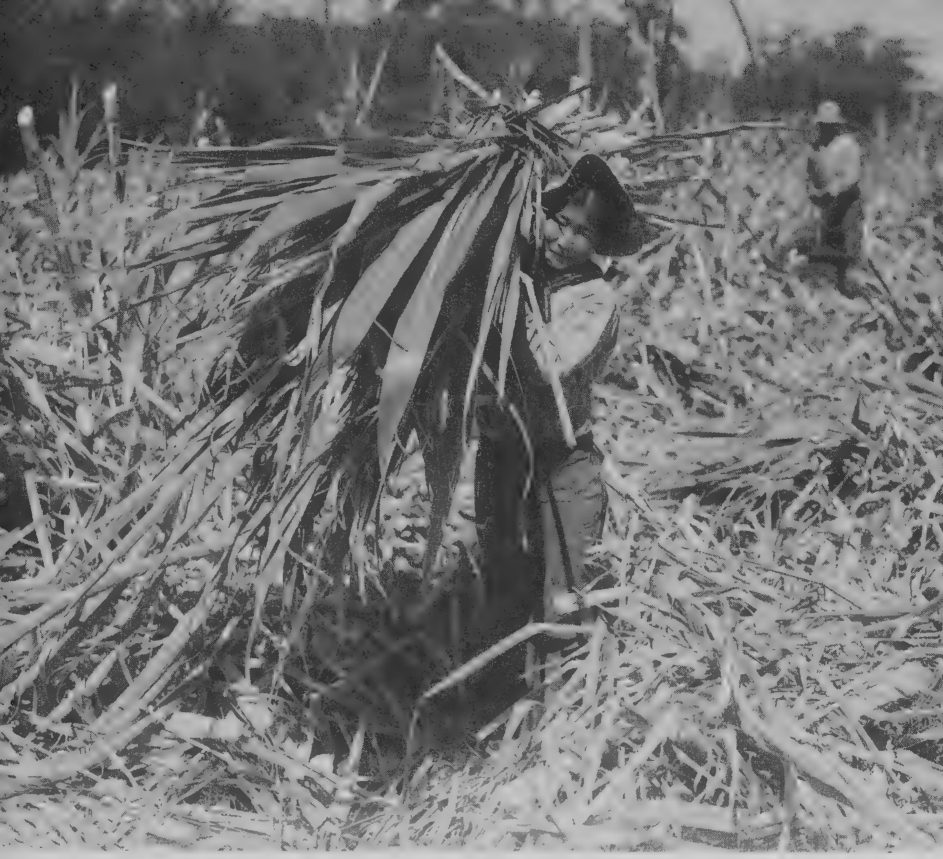
Japanese sugarcane worker, Maui, Hawaii, 1932.
Fieldwork was punishingly difficult. Hoeing weeds was both boring and backbreaking. Workers moved for hours in a straight line without talking. Harvesting the cane with mechanical swings of a machete was dirty and exhausting. It resulted in blistered hands and arms scratched by the saw-blade edges of the cane leaves. Twelve feet tall, the cane enclosed the workers, who sweated from the terrible heat and humidity. Surrounded by red dust, they cov-
ered their faces with handkerchiefs. A song summed up a woman worker’s experience in the field:
My husband cuts the cane stalks
And I trim their leaves
With sweat and tears we both work
For our means.
After collecting the cane stalks, the workers tied them into bundles and loaded them onto railway cars. A train carried the stalks to the mill, where they were crushed and their juices were boiled. Inside the mill, laborers worked amid heat, steam, and the constant loud clanking and whirring of machinery.
Workers United
Contrary to the stereotype of Japanese immigrants as quiet and ready to accept anything, Japanese laborers in Hawaii aggressively protested against unfair labor conditions. They often engaged in strikes. At first, laborers of different groups tended to think in terms of ethnicity, rather than seeing that workers of all ethnic groups shared the same struggle. Japanese workers, for example, orga-
nized themselves into “blood unions” based on their ethnic identity.
The most important action of the blood unions was the Japanese strike of 1909. Pointing out that Portuguese workers received $22.50 a month while Japanese workers got only $18 a month for the same work, the Japanese called for higher wages and an end to racial inequality in pay. Several thousand Japanese plantation laborers halted work on the island of Oahu. Fellow Japanese on the other islands sent support in the form of money and food. Japanese businesses also aided the strikers, and the Japanese Physicians Association gave free medical care to the strikers and their families.
The strike showed that the workers were beginning to think of themselves as permanent settlers, not temporary visitors. They were becoming Japanese Americans. In their demand for a higher wage they explained that they wanted to “unite our destiny with that of Hawaii, sharing the prosperity and adversity of Hawaii with other citizens of Hawaii.”
The planters responded by pressuring the government to arrest the strike leaders for conspiracy. Then they hired Chinese, Hawaiian, Portuguese,
and Filipino workers as “scabs”—laborers who would break the strike by doing the strikers’ jobs. The strikers held out for four months before they were forced to return to work.
The Japanese strikers had won a victory, for soon afterward the planters raised their wages and ended the system of different wages for different races. Yet after the strike was broken, the planters began importing massive numbers of Filipino workers. By 1920 the labor force was 30 percent Filipino and only 44 percent Japanese.
Workers of both nationalities began to realize that the labor movement in Hawaii would have to be based on working-class unity across ethnic lines. When the Filipino union went on strike in 1920, the Japanese union joined the strike. This work stoppage by eight thousand people—77 percent of the plantation workforce on Oahu— brought sugar production to a standstill. The Japanese union questioned the wisdom of having separate, ethnic labor organizations. It proposed one union for “laborers of all nationalities.”
Divide and Control Confronted by the prospect of workers uniting,
the planters turned to their time-tested strategy of divide and control. They promoted distrust between the Filipino and Japanese communities and offered a bribe to Filipino union leader Pablo Manlapit. Both Filipino and Japanese workers were surprised when Manlapit suddenly called off the strike, calling it a Japanese action to cripple Hawaii’s economy—even though the Filipino union had been the first to strike.
Many Filipino union members defied Manlapit and continued to strike. The planters stepped up their attack with propaganda claiming that the Japanese strikers were puppets of the Japanese government, which planned to “Japanise” Hawaii. The planters hired Hawaiians, Portuguese, and Koreans as strikebreakers, and they evicted the striking workers from their homes on the plantations.
Forced to take shelter in Honolulu’s vacant lots, homeless during the height of a flu epidemic, thousands of workers and their family members became ill. One hundred and fifty died. Tired, hungry, and sick, the strikers gave up their struggle in July. The planters claimed a victory—but three months later they quietly raised wages by 50 percent.
Ethnic Communities
On the plantations, workers of different nationalities were usually housed in separate camps. The early camps were generally crowded and unsanitary, with as many as fifty workers living under one roof. But over time, as planters replaced single workers with married men, the barracks were replaced by cottages for families. The planters had learned that it was in their own best interests to make the workers more comfortable. “Pleasant surroundings, with some of the modern comforts and conveniences,” said one plantation official, “go a long way to make the worker healthier and more efficient in his work.”
Meanwhile, the workers were turning their camps into ethnic communities. On every plantation, Japanese immigrants established Buddhist temples and Japanese-language schools for their children. They held traditional celebrations such as the midsummer obon, or festival of souls, when they dressed in kimonos and danced in circles to the beat of taiko drums to honor the reunion of the living with the spirits of the dead.
At first, the laborers of each ethnic group spoke only their native language. This gave each group a sense of community within its camp, letting mem-
bers maintain ties with each other and with their culture as they shared memories and experiences. Soon, though, workers of different groups began to acquire a common language. Planters wanted workers to know basic English, the language in which commands were given. A plantation dialect called “Pidgin English” developed—simple English that also included Hawaiian, Japanese, Portuguese, and Chinese phrases and rhythms.
Pidgin had begun as a language of command, but it soon became the language of community. “The language we used had to be either Pidgin English or broken English,” said a Filipino worker, explaining how different groups communicated with each other on the plantation. “And when we don’t understand each other, we had to add some other words that would help to explain ourselves. That’s how this Pidgin English comes out beautiful.”
As Pidgin English became the language of the camps, it let people from different countries communicate with each other, helping them create a new identity that was tied to Hawaii. The use of a new language reflected a deeper change in how they saw themselves and their place. They had come to Hawaii planning to earn money and then return to Japan, and many did return. Of the 200,000 Japanese
who entered Hawaii between 1885 and 1924, about 110,000, or 55 percent of them, went home. What is significant, though, is that almost half stayed.
A New Generation
Gradually, over the years, Japanese workers found themselves establishing families in their new Hawaiian home. In 1920 nearly half the Japanese in Hawaii were just nineteen years old or younger. The immigrants were planting roots through their children.
Some immigrants with children considered returning to Japan but found themselves unable to do so. In a letter to his brother, Asakichi Inouye explained that he had decided not to return to Japan because his children were settled in Hawaii, and so was his grandson Daniel (who would later be elected to the US Senate). Inouye feared that he and his wife would not find contentment in their old home in Japan.
Something similar happened to Shokichi and Matsu Fukuda. They had emigrated from Japan together in 1900 to work on the Hawaiian island of Maui. Twenty years later they decided to go back to Japan and take their Hawaiian-born children with them. Their teenage son, however, refused to
go. Hawaii was his home, the only world he knew, and he wanted the family to stay there.
Seeing their parents suffering from backbreaking work, low wages, and discrimination, many second-generation Japanese Americans refused to be forced into plantation labor. Education, they believed, was the key to job opportunities and freedom from the plantation. They wanted to be something more than field laborers.
The planters did not want the immigrants’ children to receive too much education. They needed the second generation as plantation laborers. Sixth or maybe eighth grade, they felt, was enough. Young people stayed in school, however, and learned about the American ideals of democracy and equality. Returning from school to their camps, they saw whites on the top and Asians on the bottom, and they began to question the plantation system.
Japanese immigrants had labored to build the great sugar industry in Hawaii. Their sweat and tears had watered the cane fields. As they learned Pidgin English and watched their children grow up in the camps and attend American schools, they realized that they had become settlers, and that Hawaii had become their home.
With one woven basket
Alone I came
Now I have children
And even grandchildren too.
Transforming California
During a visit to California in the 1920s, a young Japanese man from Hawaii was shocked by the strong anti-Japanese hostility he encountered. Although he had heard rumors about how badly whites treated Japanese on the US mainland, reality was a shock:
But I didn't realize the true situation until I had a personal experience. In one instance, I went to a barbershop to get my hair trimmed. On entering the shop, one of the barbers approached me and asked for my nationality. I answered that I was Japanese, and as soon as he heard that I was of the yellow race, he drove me out of the place as if he were driving away a cat or a dog.
In Hawaii, 40 percent of the population was
Japanese in 1920. On the mainland, however, the Japanese were a tiny racial minority. They totaled just 2 percent of the population in California. Scorned by white society, they had become the targets of hostile and violent white workers.
Most of the immigrants had been farmers in Japan. For centuries their families had cultivated small plots, irrigating the land and relying on intensive labor to make it productive. To become farmers in America was their dream. Although Japanese immigrants also worked at first as field hands, on railroad construction, and in canneries, many became farmers. They raised crops for white landowners, rented land, and, once they had saved enough money, bought land of their own.
The Japanese immigrants entered American agriculture at a time of change. Beginning in the late nineteenth century, the rise of industry and the growth of cities had created a demand for fresh produce in the nation’s urban centers. At the same time, irrigation expanded greatly in California, opening the way for intensive agriculture—orchards and gardens as opposed to vast wheat fields or pastures that required little water. Two important technological developments—railway lines and the refrigerated railway car—made it
possible for California’s farmers to ship perishable fruits and vegetables to almost anywhere in the United States.
Japanese farmers came onto this scene at the right time, and they rapidly flourished. In 1900 California’s Japanese farmers owned or rented twenty-nine farms, totaling 4,698 acres. Within five years the acreage farmed by the Japanese had jumped to 61,858. By 1920 Japanese farmers were cultivating nearly half a million acres, growing large percentages of the strawberries, onions, tomatoes, celery, snap beans, and green peas that were produced in the state. That year the production of Japanese farms was valued at $67 million, about 10 percent of the total value of California’s crops.
Workdays on the farms were long and demanding—especially for women, who had the double duty of fieldwork and housework. Still, driven by their dreams of rich harvests, these pioneering Japanese men and women turned the dusty Sacramento Valley and the deserts of the Imperial Valley into lush and profitable fields and orchards.
One of the most successful Japanese farmers was Kinji Ushijima, better known as George Shima, who came to California in 1887. He worked as a potato picker, then a labor contractor,
and then a farmer. Shima leased and bought undeveloped swamplands, then built dams and ditches to drain them, turning them into fertile farmlands. A fleet of steamboats and barges carried Shima’s potatoes from the delta of the Sacramento River to San Francisco. At the time of his death in 1926, the “Potato King,” as he was called, had an estate worth $15 million.
Yet success had not protected Shima from racism. When he bought a house in an attractive part of the city of Berkeley, close to the University of California campus, a professor led a group of protesters with the message that Shima should move to an “Oriental” neighborhood. But Shima refused to move. At Shima’s funeral, the chancellor of Stanford University and the mayor of San Francisco showed their respect by helping to carry his casket.
An End to Immigration
Many Japanese immigrants believed that their success, especially in agriculture, would help them become accepted into American society. They had failed to recognize the depth of the belief that America was meant to be white. In fact, their very success as farmers sparked a backlash against them.
In 1907, in an arrangement known as the Gentlemen’s Agreement, the federal government had pressured Japan to limit the immigration of laborers to the United States. Six years later California passed the Alien Land Law, which said that no foreigner who was not eligible to become a citizen could buy land. This law was aimed at Japanese immigrants and was based on race. Because the 1790 Naturalization Act said that only “white” persons could become naturalized US citizens, California’s Alien Land Law kept the Japanese from buying property in the state.
Takao Ozawa challenged the federal law in 1915 by filing an application for citizenship. He had arrived in the United States twenty years earlier, had graduated from high school and attended college, and had worked and raised a family in Hawaii. When his application for citizenship was turned down, Ozawa fought the decision all the way to the US Supreme Court. In 1922 the Supreme Court ruled against Ozawa, saying that it was clear that he was not Caucasian, or white.
Race-based immigration limits grew tighter by 1924. That year Congress passed a general immigration law that denied entry to any foreigners who were not eligible to become citizens. Neither
the Japanese nor any other non-white immigrants could enter the country. A Japanese American newspaper scolded Congress for betraying America’s ideals and dishonoring its best traditions. The immigrants’ decades of hard work seemed to be for nothing, as reflected in a haiku:
America ... once
A dream of hope and longing,
Now a life of tears.
Nisei: Americans by Birth Laws prevented the Issei, the Japanese immigrants, from becoming citizens and buying land. Their future in America lay in their children, the Nisei, or second generation. The Nisei were a rapidly growing group within the Japanese community. In 1920 more than a quarter of the Japanese population of the mainland United States had been born there. Twenty years later nearly two-thirds of the Japanese population was American-born.
Because they had been born in the United States, the Nisei were citizens. Citizenship together with education, the immigrant generation believed, would give their children opportunities
that had been closed to them. Many parents were willing to give up their own comforts, even necessities, for the education of their children.
But citizenship and education, the second generation discovered, did not prevent racial discrimination. Even the Nisei, born in the United States, were called “Japs” and told to “go back to Japan.” Japanese American schoolchildren dodged rocks thrown by white children. When they grew a little older they were complimented on their English and asked how long they had been in America.
The Nisei also had trouble finding jobs, even though most of them graduated from high school with good grades and had completed college. The average educational level of the Nisei was two years of college, well above the national average. Still, they were denied opportunities.
Their situation was made worse by the fact that many Nisei came of age during the Great Depression of the 1930s, a time of massive unemployment in the United States. Young people who had dreamed of becoming lawyers or doctors found themselves working in small Japanese businesses such as laundries and fruit stands. A disappointed Nisei who worked in a produce stand
explained, “I would much rather it were doctor or lawyer... but... 1am only what I am, a professional carrot washer.”
Growing up in America gave the Nisei a sense of twoness, which Monica Sone described in her autobiography Nisei Daughter. As a child in Seattle she was surrounded by two cultures. At home she ate traditional Japanese dishes such as pickled radishes and rice, as well as ham and eggs. She studied Japanese odori dance as well as ballet.
Monica’s family attended Japanese theater, sumo wrestling matches, and picnics where the city’s Japanese American community sang the songs and feasted on the foods of their homeland. At the same time, Monica was a member of the Mickey Mouse Club and a kid in American society. While she enjoyed many of her parents’ activities, she knew she was not just Japanese.
The biggest problem for Monica and other Nisei was job discrimination. After Monica graduated from high school, she applied to secretarial college and was told that only six Japanese American girls could be admitted, because the school had so much trouble finding jobs for them after they finished their training.
Yet the problem was deeper than employment.
It was a profoundly cultural question: What did it mean to be an American? In their hearts, the Nisei did not wish to be completely assimilated, to become American only. They felt they were a complex combination of two cultures, and they wanted to embrace both of them, to be both Japanese and American.
A JAPANESE MAN WHO DREAMED OF GOING TO America could emigrate and enter the United States as a worker. For a Japanese woman, one way to enter America was to marry a Japanese man who was already there—even if she had never met him and had seen him only in a photograph.
The families of men who had emigrated from Japan were eager to find picture brides for their faraway relatives. Picture bride Ai Miyasaki said, “When I told my parents about my desire to go to a foreign land, the story spread through town. From here and there requests for marriage came pouring in just like rain!”
Riyo Orite was also a picture bride. Her marriage to a man in America was arranged through a relative. “All agreed to our marriage, but I didn’t get married immediately,” she recalled. “I was engaged at the age of sixteen and didn’t meet Orite until I was almost eighteen. I had seen him only in a picture at first. ... Being young, I was unromantic. I just believed that girls should get married. I felt he was a little old, about thirty, but the people around me praised the match. His brother in Tokyo sent me a lot of beautiful pictures [taken in America]. ...
My name was entered in the Orites’ koseki [family register]. Thus we were married.”
Marriage is a major life event. So is leaving the land of one’s birth to settle in a foreign country. For thousands of Japanese picture brides, the two happened together. Young women crossed the Pacific Ocean and met their husbands the same day they first set foot in their new home, America.