Reading, directions, and study material are available on this page. JavaScript enables interactive checks and saved device preferences.
Choose a weekly study guide Week 0 (Foundations) — Race and identity Week 1 (Foundations) — Course ideas and learning methods Week 2 (Foundations) — Writing a strong paragraph Week 3 (Foundations) — Myths, narratives, and identity Week 4 (Ch2) — Ireland as a blueprint for colonization Week 5 (Ch2) — From civilizing missions to extermination Week 6 (Ch2) — Caliban, Prospero, and colonialism Week 7 · Four Question narrative · OPT Chapter 2 Week 8 · Four Question narrative · OPT Chapter 2 Week 9 (Ch3) — Indentured servitude and slavery Week 10 (Ch3) — Self-interest and alliances in Bacon’s Rebellion Week 11 (Ch3) — Causes and consequences of Bacon’s Rebellion Week 12 (Ch4) — Economics and ideology in American Progress Week 13 (Ch4) — Jackson and Indian removal Week 14 (Documents A) — Geography and American history, 1607–1836 Week 15 (Documents A) — Who invented race and what did it buy them? Week 16 (Review) — Semester 1 synthesis and final exams Week 17 (Ch5) — Slavery, the economy, and its beneficiaries Week 18 (Ch5) — The ideological enforcement of slavery Week 19 (Ch6) — Irish identity, economics, and racial hierarchy Week 20 (Ch7) — War with Mexico, dispossession, and resistance Week 21 (Ch7) — Continue land, labor, and resistance Week 22 (Ch8) — Chinese labor and legal exclusion Week 23 (Documents B) — Compare Irish, Mexican, and Chinese migration Week 24 (Ch9) — Native dispossession, ideology, and policy Week 25 (Ch9) — Continue the two-week dispossession aim Week 26 (Ch10) — Japanese American collective organizing Week 27 (Ch11) — Russian Jewish organizing and comparison Week 28 (Ch12) — Demanding labor while rejecting people Week 29 (Review) — ACT reading practice Week 30 (Review / Ch13) — ACT practice and the Great Migration opening Week 31 (Ch13) — Compare Great Migration push and pull factors Week 32 (Ch13) — Housing, hiring, and racial hierarchy in Chicago Week 33 (Ch14) — Japanese American incarceration during WWII Week 34 (Ch14) — Wartime economic opportunity and its limits Week 35 (Ch15) — World War II and the Civil Rights Movement Week 36 (Ch15) — Racial injustice and economic injustice Week 37 (Documents C) — How excluded people compelled change Week 38 (Review) — Semester 2 final exams and course close Go
Week 0 · Your next steps Read the assigned material, explain the connection in your notebook, and use the checklist to revise your response.
Study words: culture · dominance · ethnicity · power · race
Open this week’s words · Use writing feedback
Use your current packet or Classroom post for dates, reading boundaries, and the required quotation edition.
Recall before opening a gist.Try an organizer before its model.Revise one part after checking.
Start with 1, or choose the part you need.
Check Yourself · summary, quiz & sequencing ↓
Use the course ideas to explain race and identity.
Use your notes and the three Key Ideas to explain why the evidence matters.
03 / WRITE
Write Leave with: Plan a claim, choose evidence, explain it, and connect a Key Idea.
In your notebook A racial category changes legal opportunity Irish immigrants
Irish immigrants are classified as white.
YPT 12 ↓ qualifies them under the historical rule
The 1790 Naturalization Act permits white immigrants to apply for citizenship.
YPT 12 ↓ opens a legal route
Irish immigrants can become American citizens despite anti-Catholic prejudice.
YPT 12 Asian immigrants
Asian immigrants are excluded from the white category.
YPT 12 ↓ disqualifies them under the same rule
The citizenship rule excludes Asian immigrants.
YPT 12 ↓ closes that route
Asian immigrants cannot gain citizenship through the route available to Irish immigrants.
YPT 12 The unequal outcome comes from a racial classification enforced through a historical law.
EVIDENCE & WRITING SUPPORT
What is race? Evidence, facts & appositives + Chapter 1 supplies examples of racial classification and unequal treatment; these examples support the course framework rather than a complete definition of race. The citizenship rule is historical, not current law.
One possible quote
Because they were white, however, the Irish could become American citizens, unlike Asian immigrants.
What it can show Use this historical comparison to show racial classification shaping legal opportunity; connect it to the course idea that race is socially constructed.
Facts & context The chapter describes a naturalization rule that reserved eligibility for white immigrants, making a racial category consequential for legal membership.
YPT 12 ↗ Irish Catholic immigrants faced religious hostility even while their classification as white allowed access to citizenship under that rule.
YPT 12 ↗ Takaki connects being mistaken for a foreigner to a historical narrative that treats whiteness as a sign of American identity.
YPT 5–6 ↗ Sample appositives The bold phrase renames the noun. Continue with your own main clause.
the 1790 Naturalization Act , the historical law limiting naturalization eligibility to white immigrants, …
YPT 12 ↗ Irish immigrants , Catholic migrants facing hostility within a predominantly Protestant society, …
YPT 12 ↗ the Master Narrative , a historical account equating American identity with European ancestry, …
YPT 6–7 ↗ Check your response Find your answer to the aim, the evidence behind it, and the explanation of what that evidence shows.
Use the 10-point rubric ↗
01 · Summary cloze 02 · 10 questions 03 · Put it in order Complete the explanation. Race is a Summary blank 1 Choose… historical construction benefits law consequence rights Summary blank 2 Choose… historical construction benefits law consequence rights Summary blank 3 Choose… historical construction benefits law consequence rights Summary blank 4 Choose… historical construction benefits law consequence rights Summary blank 5 Choose… historical construction benefits law consequence rights
Check summary Start again Show answers
Return to the reading YPT 51 YPT 53 Question 1 of 10 2 of 10 3 of 10 4 of 10 5 of 10 6 of 10 7 of 10 8 of 10 9 of 10 10 of 10 0 of 10 checked
Order the explanation: a shared action, an unequal legal outcome. Drag the blocks, use the arrows, or focus a block and press Alt + ↑ / ↓.
⠿ Unequal punishment gives the same offense different lifelong consequences. ↑ ↓
⠿ Workers undertake a shared escape. ↑ ↓
⠿ The court assigns additional years to the white men but lifetime servitude to John Punch. ↑ ↓
⠿ Officials try the runaways. ↑ ↓
Check order Shuffle again Show correct order
● Correct ● Close ● Needs reordering
Return to the reading YPT 51 YPT 53 Enable JavaScript to check answers and reorder events.
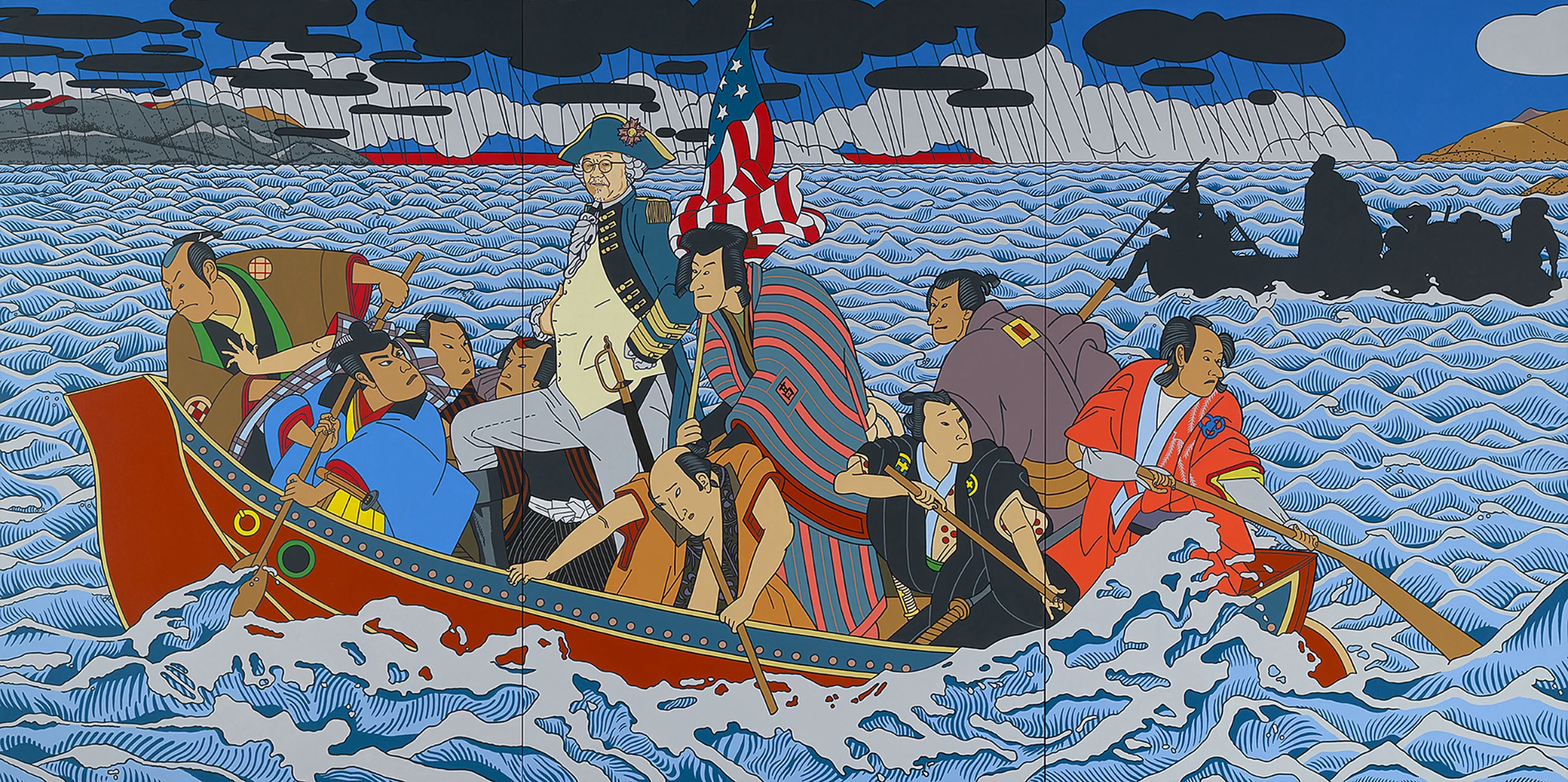
Roger Shimomura, Shimomura Crossing the Delaware