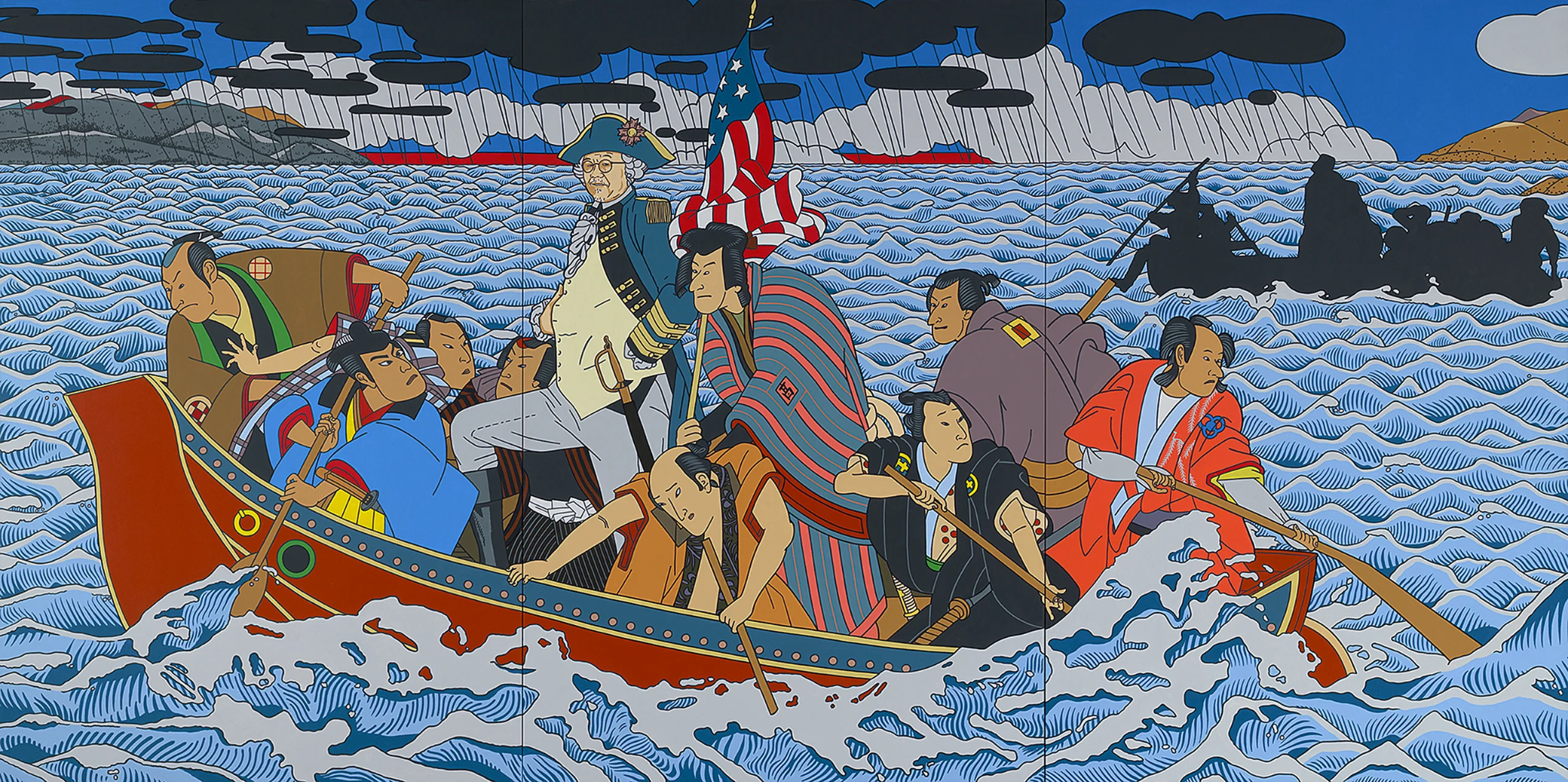
How were slavery, China, and Manifest Destiny major factors governing America's decision to go to war against Mexico?
Select a highlight to read its note.
No yellow annotations for this aim yet. Blue highlights connect to the key ideas.
Listen to chapter 7
24:46Chapter 7
The War Against Mexico
WHILE IRISH WOMEN WORKED in the textile mills of Massachusetts and Irish men built roads and railway tracks, America’s frontier moved westward. The United States grew larger by acquiring territory from other nations by purchase, treaty, or force. In the 1840s, the Mexican-American war gave Irish immigrant men another job to do for the United States—serving as soldiers in a conflict with the neighboring nation of Mexico. That war greatly enlarged the American empire by adding California and the Southwest to the United States. It also added another ethnic group to American diversity: Mexicans.
The Troubled Region Called Tejas
The first conflicts between the United States and Mexico took place in a Mexican territory called
Tejas—or, as it is known today, Texas. Although Texas was part of Mexico, Americans began crossing the Mexican border to settle there in the 1820s. Many were slaveholders from the South in search of new lands on which to grow cotton.
In 1826 President John Quincy Adams tried to buy Texas for a million dollars, but Mexico refused. A year later, worried about US expansion westward, the Mexican government investigated the situation in Texas. It found a growing number of Americans living there, breaking Mexican laws, and taking possession of land without permission from the authorities. When visiting the American settlement at Austin, a Mexican lieutenant, José Maria Sanchez, predicted, “In my judgment, the spark that will start the conflagration that will deprive of us Texas will start from this colony.”
To stem the tide of Americans, in 1830 the Mexican government outlawed slavery and banned any more American immigration into Texas. American foreigners in Texas were furious. Many were determined to defy Mexico’s antislavery law. At the same time, more Americans crossed the border into Mexico as illegal aliens. By 1835 there were twenty thousand Americans in Texas, greatly outnumbering the four thousand Mexicans.
Tensions grew. Stephen Austin, an American colonizer who had brought three hundred families of settlers into Texas in the 1820s with the permission of the Mexican government, now urged his countrymen to “Americanize” Texas and bring the territory under the US flag. He called for Americans to come to Texas, bringing rifles with them, for conflict between the civilized white Americans and the “mongrel Spanish-Indian and negro race” of Mexico, he believed, was unavoidable. “War is our only recourse,” he declared. “There is no other remedy.”
War Breaks Out
War came in 1836 when some Americans in Texas began an armed uprising by barricading themselves inside a fort called the Alamo in the town of San Antonio. The Mexican government declared their action illegal and sent troops to end the rebellion. The rebels refused to surrender. Most were killed in the battle that followed. The Mexican army then captured the nearby town of Goliad and executed four hundred American prisoners there.
Under the rallying cry “Remember the Alamo!” the Americans counterattacked, killing 630 Mexican soldiers and capturing their leader. The
victorious Americans declared Texas an independent country and named it the Lone Star Republic.
The new republic—which Mexico refused to recognize—did not remain independent for long. In 1845 it was annexed, or added, to the United States. Mexico broke off diplomatic relations with the United States in protest. Tensions between the two countries then focused on a border dispute that involved two rivers.
The United States claimed that the border between Texas and Mexico was the Rio Grande. Mexico insisted that the border was 150 miles to the north, at the Nueces River. Both countries sent troops into the territory between the two rivers. US forces under General Zachary Taylor blockaded the mouth of the Rio Grande, preventing Mexican boats and ships from entering it—an act of war according to international law.
In May 1846 an armed skirmish between troops from both sides gave the US government the excuse it needed to declare war on Mexico. President James Polk said, “War exists notwithstanding all our efforts to avoid it.” In reality, the border dispute hid the real reason behind the war. That reason was California.
The Taking of California California had been colonized by Spain, which regarded California as part of its Mexican colony and began sending settlers there in 1769. Although some of the settlers were of Spanish blood, many were desperately poor people of mixed Indian and black blood who came to California from Mexico. In exchange for moving to the remote and wild California territory, settlers of Spanish blood received land grants and herds of cattle, while the poorest settlers became laborers. The total number of settlers remained small.
Mexico—including California—gained its independence from Spain in 1821. At the time there were only about three thousand Spanish and Mexicans living in California. A few Anglos, or people from the United States, also lived there. The Anglos were generally accepted. The Mexican government even offered them land grants if they converted to Catholicism and became naturalized citizens of Mexico.
By the 1840s more Anglo settlers were entering California, but now they came as illegal aliens because Mexico had outlawed further immigration. War between the United States and Mexico was looming on the horizon, and a key goal of the US
government was to gain ownership of California. The territory was an important source of raw materials, such as the cattle hides that were made into boots and shoes in the factories of New England.
Even more important, California was at the edge of North America, on the Pacific Ocean. Its coast had several good harbors, and American whaling ships and naval ships in the Pacific needed harbors where they could make repairs and get supplies. The nation’s policymakers also wanted to promote American trade across the Pacific. In a speech to Congress, President Polk spoke of how California’s harbors would shelter American ships and would quickly become centers of “an extensive and profitable commerce with China, and other countries of the East.”
In California, the war between the United States and Mexico began in the small town of Sonoma when a band of armed frontiersmen invaded the home of the Mexican general who was in charge of the territory north of San Francisco. These rebels raised a flag with the image of a bear and declared that California was now the independent Bear Flag Republic. Soon afterward, a US naval commander sailed his ship into Monterey Bay and claimed California for the United States.
American Conquest
The taking of California turned out to be almost nonviolent. In the Southwest, however, the war had unleashed a brutal military campaign. When US military forces marched into Mexico, they were accompanied by a horde of American volunteers who fought alongside the soldiers. American forces committed many acts of violence against Mexican civilians, ordinary people not involved in the fighting.
One report of these acts came from a young captain named Ulysses S. Grant, who would later become president of the United States. “Since we have been in Matamoros a great many murders have been committed,” Grant wrote. “Some of the volunteers and about all the Texans seem to think it perfectly right to impose on the people of a conquered city to any extent, and even to murder them where the act can be covered by dark. And how much they seem to enjoy acts of violence too!”
General Winfield Scott, the commander of the American army in Mexico, admitted that American soldiers had “committed atrocities to make Heaven weep and every American of Christian morals blush for his country. Murder, robbery and rape of mothers and daughters in the presence of
tied-up males of the families have been common all along the Rio Grande.”
The horror ended in early 1848, a few months after Scott’s army occupied the capital, Mexico City. In the Treaty of Guadalupe Hidalgo, Mexico accepted the Rio Grande as the border of Texas. Mexico also turned the Southwest territories over to the United States in exchange for $15 million. The treaty gave the United States a vast new territory: New Mexico, Arizona, Nevada, parts of Colorado and Utah, and California, its prime target. Together with Texas, these territories had made up more than half of Mexico.
“Foreigners in their Own Land” Many Americans saw the war and conquest as glorious, the triumph of a superior people over an inferior one. Some even believed that God intended Americans to populate and civilize the entire continent. Newspaper editor and poet Walt Whitman wrote, “What has miserable, inefficient Mexico . . . to do with the great mission of peopling the New World with a noble race?”
Mexicans had a different view of the Anglo conquest. Their national border had been moved,
and suddenly thousands of Mexicans found themselves inside the United States. Under the Treaty of Guadalupe Hidalgo, Mexicans in the new US territories could either move south across the new border into Mexico, or stay in the United States. If they stayed, they would be guaranteed the rights of American citizens.
Most stayed, not wanting to uproot their families and leave their homes and land. Yet as more and more Anglos streamed into the former Mexican territories, the Mexicans living there felt like strangers, surrounded by people who spoke only English. A Mexican diplomat named Manuel Crescion Rejon said, “Descendants of the Indians that we are, the North Americans hate us... and they consider us unworthy to form with them one nation and one society.” A few years later, a man named Pablo de la Guerra told the California state senate that he and the other “conquered” Mexicans had become “foreigners in their own land.”
Anglo over Mexican
Mexicans living in the United States lacked political power, even though they had been granted suffrage, or the right to vote. In California, for example, Mexi-
cans originally outnumbered Anglos by ten to one, but they quickly became a minority. The California Gold Rush, which began in 1848, started a massive migration of Anglos into the territory. A year later California had a hundred thousand Anglos and only thirteen thousand Mexicans.
Anglos dominated California’s legislature and passed laws aimed at Mexicans. In 1850, for example, the legislature created a tax on foreign miners. In reality it was a tax on Mexican miners, because the tax collectors took fees mainly from Spanish-speaking miners—including US citizens of Mexican ancestry. California’s goldfields simmered with ethnic conflict. Anglo miners resented the Mexicans as competitors and made no distinction between citizens of Mexico and Mexican Americans. Mobs of Anglo miners, armed with pistols, knives, pickaxes, and shovels, drove Mexicans away from the gold diggings.
In Texas, Anglos took measures to limit the political participation of Mexicans. During the 1890s, many counties excluded both Mexicans and blacks from primary elections. The state legislature passed other measures, such as a poll tax, that were designed to prevent Mexicans from voting.
Political limitations made it hard for Mexicans not only to vote but also to protect their rights as landowners. The original version of the Treaty of Guadalupe Hidalgo guaranteed that Mexicans who remained in the United States would keep all legal titles to property. The United States Senate, however, removed that part of the treaty. Instead, it said that Mexicans could appeal to American courts to have their land titles confirmed.
But whether the courts would really confirm those titles was another matter. Starting in 1891, claims in New Mexico were decided by a Court of Private Land Claims. Dominated by Anglos, the court confirmed the titles of about two million acres but turned down claims for more than thirty-three million acres. As a result, Anglos wound up owning about four-fifths of the Mexicans’ land. In California, many Mexicans lost their claims because the boundaries of their land grants had not been drawn by surveyors with instruments according to American rules. Others lost their land to squatters, Anglos who settled on Mexican-owned property and refused to leave.
Unfamiliar with American law and lacking skill
in speaking English, Mexicans fell prey to Anglo lawyers. If they won their claims, the landowners might have to pay the lawyer as much as a quarter of their land. Others borrowed money at high rates of interest to pay their lawyers. Even landowners who won their claims often had to sell their land to pay off their debts. In the end, many of the Mexican cattle ranchers lost their lands.
Even the climate worked against the Mexican ranchers and farmers. In times of drought, Anglos could protect their land better than Mexicans, because Anglos had better access to bank credit. They could borrow the money to dig deeper wells. After the drought, the Anglos were financially stronger and could buy land from Mexicans who had suffered economic losses during the drought.
One Mexican old-timer in Santa Barbara later described the decline of the Mexican ranchers who had fallen into debt to Anglo merchants and lost their lands. “The Spanish people had to live,” he said, “and as the dwindling herds would not pay their bills, they mortgaged their land to the Americanos. They got much of our lands.”
From Landholders to Laborers
In 1910 a Mexican American newspaper in Laredo, Texas, reported that “Mexicans have sold the great share of their landholdings and some work as day laborers on what once belonged to them.” In Texas as well as in other parts of the United States that had once belonged to Mexico, most Mexicans were no longer landholders. They had become laborers.
Mexicans were extensively used in ranching and agriculture. Mexican vaqueros, or cowboys, taught Anglo cowboys and ranchers their techniques of roping, branding, and handling cattle. But when railway lines brought the era of the long cattle drives to an end, the Mexican cowboys began to vanish. Some of them turned to fieldwork.
Mexican farm laborers had been in the cotton fields since before Texan independence. As cotton growing increased after the Civil War, Mexicans became the mainstay of agricultural labor. They dug irrigation ditches to bring water from rivers and streams to parched areas. Some of their techniques had been brought to the Southwest by the Spanish. Other techniques came from the Pueblo Indians, who had created complex irrigation systems long before the Spanish arrived.
Mexicans also served as an important workforce
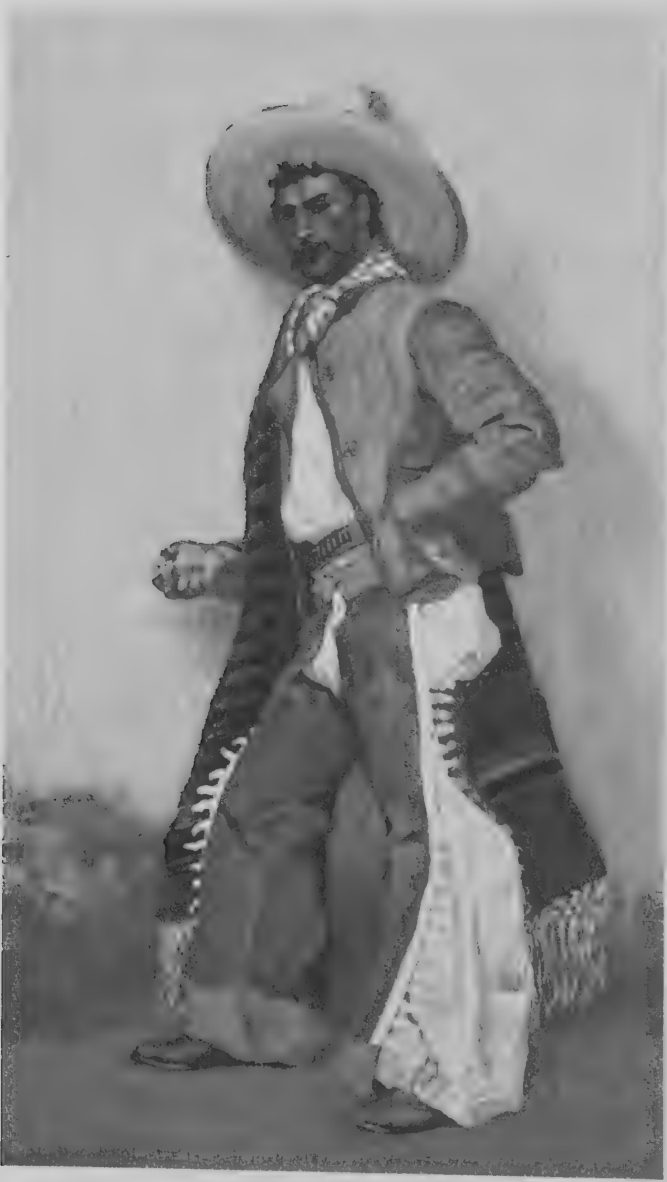
Frederick Remington, A Vaquero, 1881–1901.
in railroad building. During the 1880s a majority of workers on the Texas and Mexican Railroad were Mexican. By 1900 the Southern Pacific Railroad had 4,500 Mexican employees in California. Railroad work was migratory. The workers and their families lived in boxcars and were taken to where they were needed. Mexicans also worked in the mining industries.
Whatever kind of work they did, Mexican laborers found themselves in a system in which job rank was tied to race. On Anglo-owned ranches, for example, managers and foremen were Anglo. Cowhands were Mexican. In the mines, Anglo workers ran machines while Mexicans did the hard and dangerous hand labor.
Even where Mexicans did the same work as Anglos, they were paid less. For example, a congressional investigation found that wage differences in the copper mines of the West were due to systematic discrimination against Mexicans. To justify this race-based system, a mine owner named Sylvester Mowry used language that might have come from a plantation slave owner, saying that “the lower class of Mexicans . . . are docile, faithful, good servants. . . . They have been ‘peons’ for generations. They will always remain so, as it is their natural condition.”
Mexican Workers Get Organized
Like the enslaved blacks of the Old South, Mexican workers showed that they could defy the image of the quiet, obedient servant. Demanding respect and better wages, they repeatedly went on strike. Through strikes, Mexican construction and mine workers succeeded in protecting their jobs as well as gaining higher pay and eight-hour workdays.
Protesting wage cuts in 1903, Mexican and Japanese farm laborers went on strike together in Oxnard, California. They formed a union called the Japanese Mexican Labor Association (JMLA) and held meetings in both Japanese and Spanish, with English as a common language for both groups. For the first time in California history, two minority groups, united by their economic class, had come together to form a union.
The JMLA asked to be included in the American Federation of Labor (AFL), a national organization. The president of the AFL agreed to accept the Mexicans—but not any Japanese or Chinese members.
The Mexican members of the JMLA refused the AFL's terms. The secretary of the Mexican branch of the JMLA wrote, “We beg to say in reply that our Japanese brothers here were the first to recognize
the importance of cooperating and uniting in demanding a fair wage scale... . We will refuse any other kind of charter, except one which will wipe out race prejudice and recognize our fellow workers as being as good as ourselves.”
Without the support of the AFL, the JMLA passed out of existence a few years later, but its strike had shown that Mexican laborers were ready to stand in solidarity with laborers from other ethnic groups.
The most powerful Mexican workers’ show of force happened in Arizona. It started in 1903, when 3,500 miners—8o percent of them Mexican—went on strike for equal wages, an eight-hour workday, free hospitalization, and other benefits. The strikers shut down the mines but they had to return to work after heavy rains and flooding destroyed many of their homes. Several strike leaders went to prison, convicted of inciting a riot.
Twelve years later, however, five thousand miners struck again. This time the mine owners sealed the entrances to the mines and told the workers to “go back to Mexico.” Hundreds of strikers were arrested during the nineteen-week conflict, but in the end the workers managed to win wage increases.
The strikes brought out a feeling of ethnic solidarity. Mexican musicians entertained the strikers, and Mexican merchants provided them with food and clothing. More important, the strikes were often supported by associations called mutualistas, which were self-help organizations formed within the Mexican American community. Members of the community contributed to the mutualistas and also turned to them for loans, money for hospital and funeral expenses, and other needs.
As the mutualistas grew and became more organized, they blew away the myth of Mexicans as a quiet, siesta-loving, sombrero-wearing people. Through these ethnic organizations, Mexican Americans unified to resist racism and exploitation. The mutualistas reflected a dynamic Mexican American identity—a proud attachment to the culture south of the border as well as a fierce determination to claim their rights and dignity north of the border.
THE US CONQUEST OF CALIFORNIA BEGAN IN the small town of Sonoma, north of San Francisco. There, in the early morning of June 6, 1846, General Mariano G. Vallejo was rudely awakened in his home by thirty armed Americans. The Americans’ homemade flag displayed the image of a grizzly bear—the symbol of their Bear Flag Republic. To the Mexicans, the grizzly was a thief, a stealer of their cattle. They called the armed intruders Los Osos, “the bears.”
Vallejo represented Mexican authority, and even though he was no longer on active duty, the Americans had come to “arrest” him and carry him to Sacramento as their prisoner. They entered his home, with its handsome mahogany chairs, fine piano, and large library. Vallejo offered them wine before he went to his room to change clothes for the journey.
Unlike his captors, Vallejo had been born in California. He belonged to the elite, educated class and owned a vast estate, where he lived with his wife, the mother of sixteen children. Vallejo’s brother, sister, and Anglo brother-in-law also lived nearby. Los Osos took Vallejo’s brother and brother-in-law prisoner, too.
Two months later Vallejo was freed and allowed to return home. He wrote to a friend that more than a
thousand cattle, six hundred horses, and many other valuable possessions had been stolen in his absence. Later, after California came firmly under US rule, Vallejo fought to keep his land. He lost the title to one land claim in court. He battled all the way to the US Supreme Court to keep the other claim, near Petaluma. Although Vallejo won the legal battle, squatters had settled on his land and refused to move. They also drove away his laborers and burned his crops.
Vallejo was forced to sell off pieces of his land. His estate, which had once covered more than 100,000 acres, shrank to 280 acres. Bitter over the loss of the land, he cursed the new order: “The language now spoken in our country, the laws which govern us, the faces we encounter daily are those of the master of the land, and of course antagonistic to our interests and rights, but what does that matter to the conqueror? He wishes his own well-being and not ours!”
While fighting for his land, Vallejo also took part in the politics of the new state. He was elected to the California legislature in 1850. That same year, he donated land to be used for the new state capital, although the land proved unsuitable and the capital was built elsewhere.