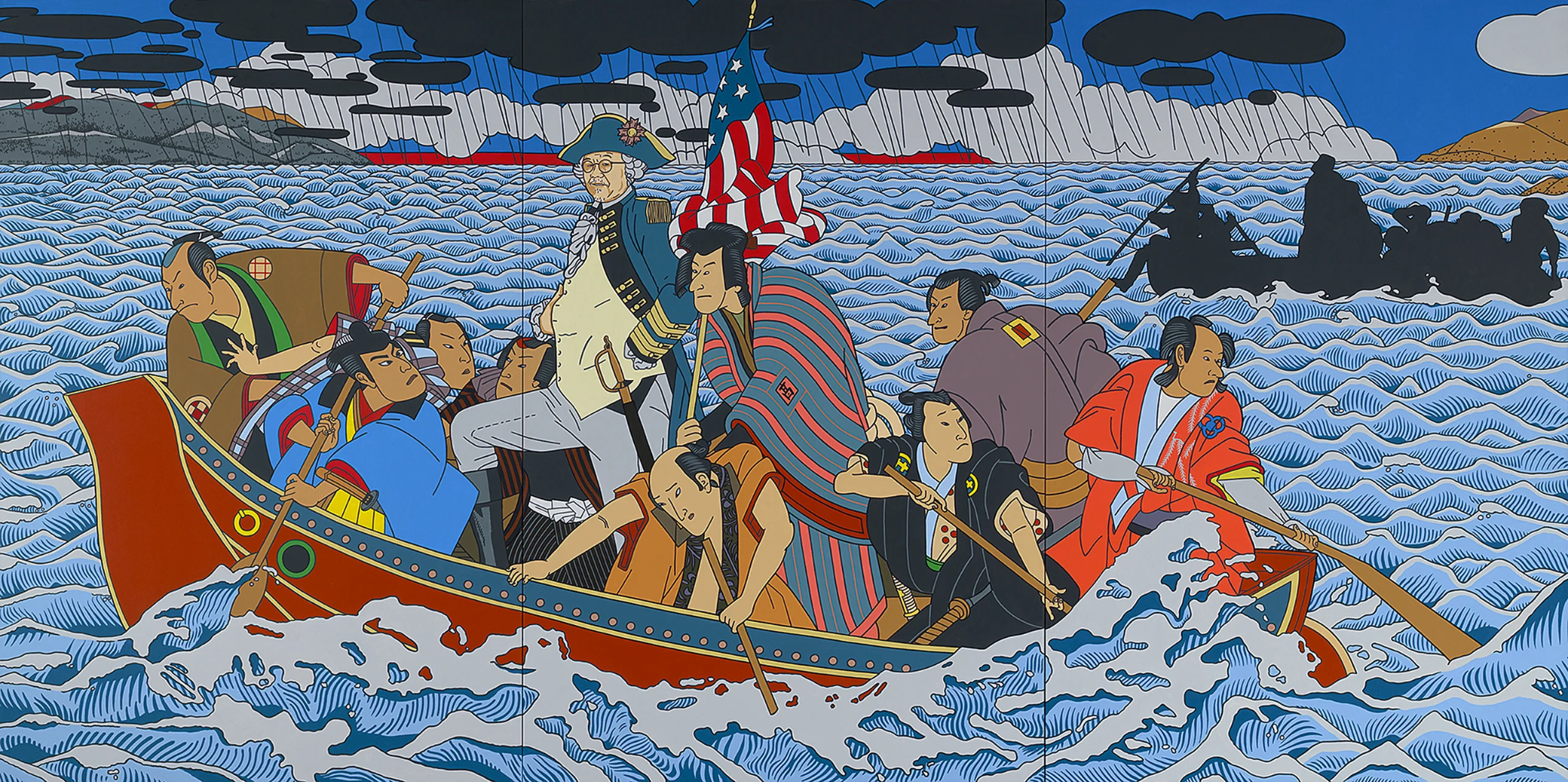
How did the people America excluded compel America to change?
Select a highlight to read its note.
No yellow annotations for this aim yet. Blue highlights connect to the key ideas.
Listen to chapter 16
20:33Chapter 16
New Waves of Newcomers
THE WORLD HAS CONTINUED to rush into America, weaving more threads into the nation’s complex multicultural tapestry. The civil rights movement of the 1960s focused on race relations within the United States. Meanwhile, during the movement and after, new waves of foreigners kept immigrating. Some of these newcomers came from familiar shores, such as China. Others, such as the immigrants from the Caribbean, Vietnam, and Afghanistan, opened new links between their homelands and America.
As always, many of the newcomers have been pushed from their homelands by war, poverty, and political or religious persecution. At the same time, they have been pulled to America by the dream of freedom and an economic fresh start.
The Door Opens to the Chinese
In the 1960s, as the United States passed new civil rights laws to address the problem of discrimination against blacks, some Americans questioned the immigration law, which still assigned quotas based on national origin. Under the quota system, only a set number of people from each country could enter the United States every year. In many cases, such as China, Japan, and the countries of black Africa, “national origin” really meant “racial origin.” In fact the immigration law discriminated not just by nationality but by race as well. Lawmakers began to call for an end to this system.
“Just as we sought to end discrimination in our land through the Civil Rights Act,” said one congressman, “today we seek by phasing out the national origins quota system to eliminate discrimination in immigration to this nation composed of the descendants of immigrants.” In 1965 Congress responded by removing all restrictions on Asian immigration—an injustice that Asian Americans had tried for decades to overcome.
For the Chinese, the new law reopened the gates to the land they had once called Gold Mountain. In 1960 there were 237,000 Chinese in the United States. By 1980 the number had jumped
to 812,200. Before the new wave of immigration, the majority of the American Chinese population had been born in the United States. Afterward, the majority was foreign-born.
Chinese students flocked to the United States for education. By 1980 half of the three hundred thousand foreign students in the country were from China or other Asian countries. Many of them were able to find jobs as skilled workers, which let them exchange their student visas for immigration papers. At that point they could bring their wives and children to the United States. Once they became US citizens, they could bring their parents and siblings as well. In this way one Chinese student could set in motion a chain migration of family members.
Not all of the new Chinese immigrants were educated. Many spoke English poorly or not at all. Their employment opportunities were limited. Like generations of immigrant women before them, a large number of the new Chinese female immigrants found jobs in the garment industry. Often they worked for minimum wages in sweatshop conditions. A Chinatown resident said in the mid-1980s, “The conditions in the factories are terrible. Dirty air, long hours, from eight in the
morning to eight at night, six days! They are paid by the piece and only a few can make good money. They don’t protest because they don’t know how to talk back and they don’t know the law.”
Some of the immigrants, though, were well educated and had held professional jobs in China. Even these immigrants found it hard to obtain good jobs in America. One couple had been an architect and a biology professor in China. Unable to speak English, they toiled at low-paying menial jobs until a federal program called the Comprehensive Employment Training Act provided funds for the wife to take English classes and begin a new career in library science, and became the head librarian in UC Berkeley’s Asian American Library. Like the earlier immigrants from China, the new wave wanted to assimilate and succeed, but they had to overcome steep challenges to do so.
Vietnamese War Refugees
Unlike the immigrants from China, the Vietnamese were war refugees who were fleeing for their lives. From 1955 to 1975 their homeland had been torn by the Vietnam War, a civil conflict in which the United States supported South Vietnam while
communist North Vietnam received aid from China.
The war ended disastrously for South Vietnam and the United States. The South Vietnamese government collapsed, and North Vietnamese troops marched into the capital of the south. Just before the government fell, ten to fifteen thousand Vietnamese people were evacuated from South Vietnam. Most were military personnel who had been US allies, and their families.
Then, in the frenzied last days before the North Vietnamese arrived, another eighty-six thousand fled from the country. From the roof of the American embassy they climbed into helicopters. Most had no chance to prepare for emigration—they had less than ten hours’ notice that they would be leaving. Many thought they would be gone for only a month or two.
A total of about one hundred thirty thousand Vietnamese refugees found sanctuary in the United States in 1975. They came from the educated classes, and they generally had some familiarity with Western customs. About two-thirds of them spoke English well. After entering the United States through processing stations on military bases, they were spread throughout the
country, but they soon began to gather and form ethnic communities in places like Orange County, California.
Meanwhile, life in Vietnam under a new communist government, in the aftermath of a massively destructive war, was brutally difficult. People were marched into the countryside and forced to dig canals and do farm work. As one immigrant recalled, “Life was very hard for everybody. All had changed! I could see no future for me in Vietnam, no better life! I wanted to escape.”
Thousands did escape in this second wave of departures—more than 277,000 by 1979. They took their families aboard crowded, leaky boats, braving the dangers of storms and pirates to sail to ports in Thailand, where they waited in refugee camps to be sent to Australia, Canada, France, and especially the United States. Many of them were ethnically Chinese, people who had lived in Vietnam and experienced discrimination there. Unlike the first wave of Vietnamese refugees, the second wave generally did not speak English.
By 1985 there were 643,200 Vietnamese living in the United States. “Remember these are people who were on our side,” said an American veteran of the Vietnam War. “They have a right to come to
this country as refugees. They just need a home.” Still, like earlier Asian immigrants, the Vietnamese did not feel welcome, and they felt the sting of racial slurs.
In their adopted country, many refugees realized that they could not completely maintain their traditional Vietnamese culture, especially where gender roles were concerned. In America, Vietnamese women became wage earners and gained new independence. Family relationships became strained when college-educated young women who wanted professional careers tried to break away from the traditions of arranged marriage and female obedience. As the younger generation spoke English more often, some felt their Vietnamese language slipping away.
Over the years, as the refugees had children and made places for themselves in American society, they began to realize that their stay in the United States would be permanent. By 2000 their numbers had increased to about 1.4 million. They formed ethnic colonies, many of them in California, where 40 percent of Vietnamese Americans live. As the Vietnamese entered medicine, business, retail trade, and other professions, they added a new element to American multicultural-
ism. In turn, they were transformed, becoming no longer purely Vietnamese but rather Vietnamese Americans.
Terrorism and Afghan Refugees
Like the Vietnamese, the Afghans came to the United States as refugees, but from a different war and a different region of the world. Afghanistan, their homeland, is a landlocked Muslim country about the size of Texas, located in South Asia.
Afghanistan became a battleground in the Cold War, the conflict between the United States and the communist world that dominated international politics after World War II. The Cold War ended in 1991 when the Soviet Union, a communist superpower made up of Russia and neighboring countries, broke up.
Twelve years before the Soviet Union went out of existence, it invaded Afghanistan. To prevent the Soviets from gaining control there, the United States helped finance and train anti-Soviet militias. Meanwhile, a number of Afghans fled to the United States as political exiles and refugees.
The fighting lasted ten years, but in 1989 Soviet troops withdrew from Afghanistan in
defeat. Before the exiled Afghans could return home, however, civil war broke out among various factions within their country. In 1996 a fiercely conservative, anti-Western faction called the Taliban seized control of Kabul, the Afghan capital. Refugee Sediqullah Rahi said, “The Taliban are primitive, closed-minded people. They are not allowing anything progressive in Afghanistan. Our economy is destroyed, our social life is destroyed, our people’s lives are nothing.” Refugees who had thought of returning to Afghanistan put their plans on hold.
Then came 9/11—the fateful day of September 11, 2001, when Muslim hijackers attacked the World Trade Center towers in New York and the Pentagon in Washington, DC. The terrorists were traced to Al-Qaeda, an underground organization based in Afghanistan. The following year, the United States and a group of other nations invaded Afghanistan.
Afghans in the United States lived not only with bitter memories of fleeing from their homeland but also with worry about what the Taliban was doing to their country and its people. Then, after 9/11, they also faced anti-Muslim hostility in the United States. As soon as news of the attacks
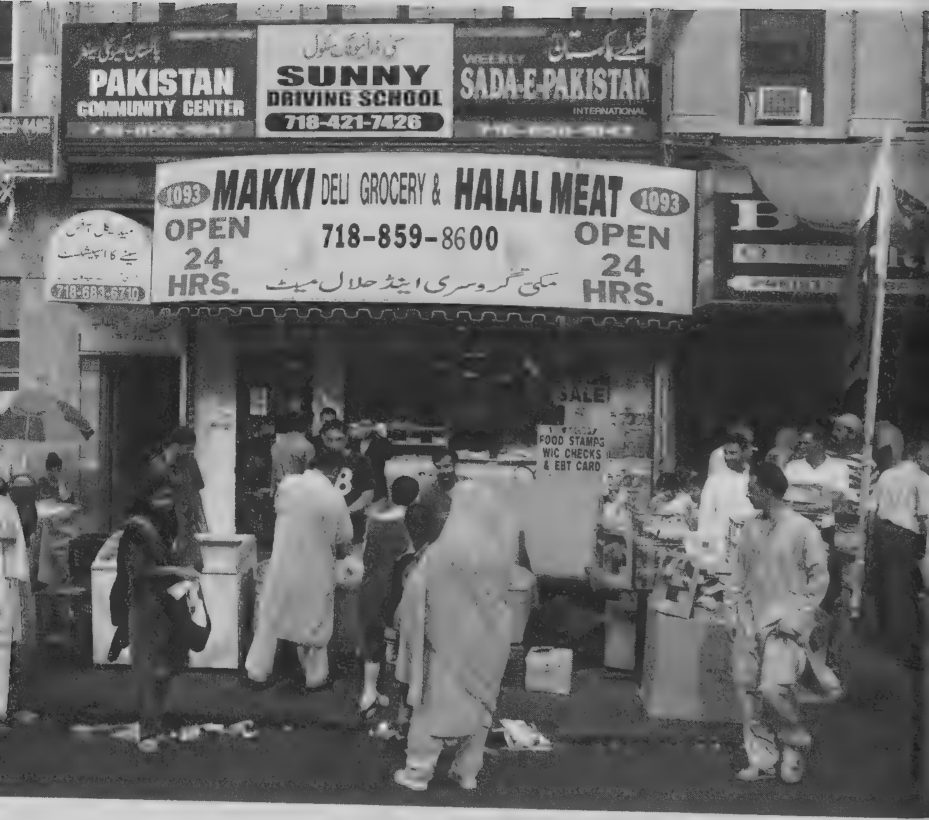
Pakistani neighborhood near Newkirk Avenue in Brooklyn, New York, 2005.
appeared on television and the Internet, Afghan Americans began to fear for their safety. “It was at this moment that I realized everything is going to change,” recalled one of them in 2007. “Being Afghan American is not what people think it was before; now it’s what people want to know about you and who you really are inside, an American or a terrorist.”
Some Afghans pretended they were Mexican, Greek, or Italian to prevent abuse. Others demonstrated their American loyalties by hanging US flags on their homes and businesses. A young woman named Fatema Nourzaie, who had been born in California after her parents fled from Afghanistan, told how 9/11 affected the Muslim community in the United States: “I started hearing how girls in hijab (Muslim women’s scarves) were being attacked. Indians were getting shot because they ‘looked’ Middle Eastern, and mosques were getting burned down. That was the only time I ever was afraid to be a Muslim.”
Even before that world-shattering event, Nourzaie had struggled over what it meant to be Afghan American. “I don’t think I could ever label myself completely as one or the other,” she said. “I am just as much American as I am Afghan.”
In her view, Afghan Americans are an example of successful integration, not assimilation, because they have kept their culture and identity rather than losing it in mainstream America. “Afghans have kept their uniqueness, the beauty of their culture, and at the same time have thoroughly functioned in today’s society. I think that’s what integration means.”
Afghan Americans are part of a larger population subgroup in the United States, made up of people of South Asian descent, from Bangladesh, India, and Pakistan as well as from Afghanistan. During the 1990s, South Asians became one of the fastest-growing parts of the American population. The great majority of South Asians in the United States are of Indian descent. The 2010 census recorded 2.6 million Indian Americans, making them the nation’s second-largest group of Asian Americans, after the 3.2 million Chinese Americans.
Crossing the Border to El Norte By the early twenty-first century, the United States was home to an estimated twelve million undocumented immigrants, sometimes called illegal
aliens because they are foreigners, or aliens, who do not have permission to be in the country. Most are from Mexico. They cannot become citizens, yet many of them work and pay taxes. Their fate is a problem that the nation has yet to solve.
What is to be done with them? Arrest them and deport them, say those who favor stricter immigration controls or who are against Mexican immigration. Prevent them from getting driver’s licenses or jobs. Do not let them use medical services or schools. Build bigger fences and send troops to guard the border. Beneath this nativist speech is a fear of the “browning” of America.
But there is another opinion. Time magazine, in its cover story on June 18, 2007, argued that undocumented aliens should be given amnesty. In other words, they should be allowed to stay, no longer as illegals, but with a route to citizenship. Undocumented immigrants are “by their sheer numbers undeportable,” the article pointed out. “More important, they are too enmeshed in a healthy U.S. economy to be extracted.”
The economic recession that began in 2008, however, showed that the US economy was not healthy. Growth sputtered and unemployment rose. This stressful climate fueled concerns about
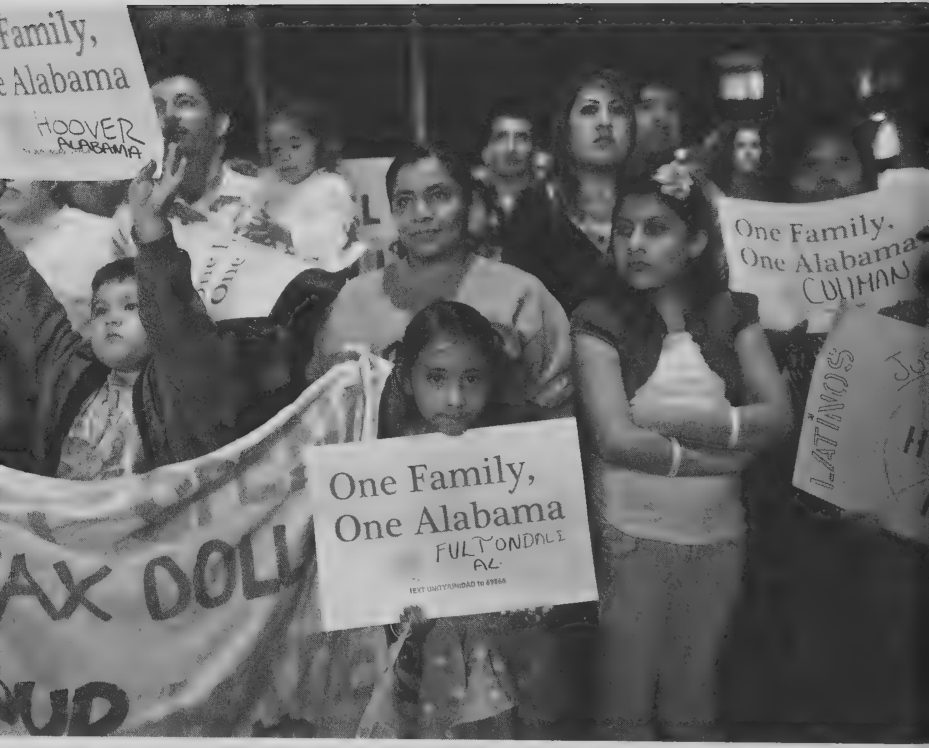
Demonstrators oppose Alabama’s law requiring public schools to check students’ immigration status, among other provisions, Birmingham, Alabama, 2011.
undocumented aliens taking jobs or consuming American resources. States such as Arizona and Utah passed laws aimed at cracking down more tightly on illegal immigrants. In 2011 Alabama passed the nation’s strictest law, which required schools to check students’ immigration status.
Like the earlier waves of Mexican immigrants, new arrivals were being pushed to El Norte by growing poverty. The North American Free Trade Agreement (NAFTA), which became law in 1994, had a devastating effect on Mexican farmers. Under NAFTA, corn grown by US farmers who received financial aid (called subsidies) from the government could be shipped to Mexico, where it was sold more cheaply there than locally grown corn. This bankrupted 1.5 million Mexican farmers.
Many of the ruined farmers fled north across the border. “During the years NAFTA has been in effect,” wrote journalist David Bacon in 2007, “more than 6 million people have come to live in the United States. They didn’t abandon their homes, families, and farms and jobs willingly. They had no other option for survival.”
To cross the border illegally, Mexicans risk death running across busy freeways or walking across parched deserts. They keep coming because they
know that employers will hire them. Without Mexican labor, many farmers and fruit growers cannot harvest their crops. Ronald Reagan, a Republican who served as US president from 1981 to 1989, was aware of that fact as long ago as 1977, when he pointed out that apples were rotting on the trees of New England because of the lack of workers. “One thing is certain in this hungry world,” Reagan said. “[N]o regulation or law should be allowed if it results in crops rotting in the fields for lack of harvesters.”
Many of the nation’s Mexican immigrants live in California, and the majority of those residents are in the United States legally. In 2006 the US Census Bureau reported that 70 percent of the Mexicans in California were US citizens. Some were born in the United States. Others, born in Mexico, became US citizens through naturalization. One of these naturalized citizens was Roselia Aguilar of San Jose.
Mexican-born Aguilar, who worried about the backlash against Mexican Americans, was twenty-nine years old when she stood with 450 people from fifty-seven nations and solemnly took an oath to “bear true faith and allegiance to the Constitution.” Moments after the ceremony
she said, “I feel it’s one of the most important things that ever happened to me. It’s just different. I feel something nice inside me. I feel like I was born again.”
IN 2011 YOUNG PEOPLE ACROSS THE UNITED states took a stand to raise public awareness of the — plight of students who are “illegals” foreigners who do not have the documents that would identify them as legal immigrants.
Urging lawmakers to pass the DREAM Act, a proposed path to citizenship for some of the many young people who were brought into the United States illegally as children by their parents, a group called the Dream Team staged a protest in Charlotte, North Carolina, in September. At a rally attended by several hundred students, some stepped forward and announced that they were in the country illegally. “My name is Alicia Torres and I’m risking it all,” one of them called out. “Today is the day that I am coming out of the shadows and saying I exist. I am no longer going to be afraid.” At least ten undocumented immigrants were arrested.
Two months later in Georgia, a recent high-school graduate named Dulce Guerrera, who had publicly revealed her own undocumented status in March, organized a rally at the state capitol for
Youthful activists may have been inspired by a high-profile “coming out.” In June 2011 journalist Jose Antonio Vargas, who won a Pulitzer Prize in 2008 for his coverage of a school shooting on the Virginia Tech campus, published an article in the New York Times revealing that his mother had sent him from his home in the Philippines to live with his grandparents in the United States when he was twelve. She wanted to give him a better life, but she could not give him immigration documents. For almost twenty years he had lived the life of an illegal alien. He was tired of the secrecy and felt that Americans ought to know how many hard-working, successful people are in his situation.
Opposition to the DREAM Act comes from people like Roy Beck, the director of an organization that pushes for tighter immigration control. He says, “Our own American young adult college grads are in dire straits in the job market. .. . So, as compelling as the case for these DREAM students is, we have to acknowledge that legalizing them does actually victimize our own young adults.”
But Vargas, Guerrera, and other activists disagree. They believe there is room in the United
States—and in the American dream—for young people like them: undocumented aliens who had no control over the fact that they were brought into the country illegally. They hope to convince lawmakers to change the immigration rules so that they can become citizens, complete their educations, and look for jobs without having to cover up their origins.