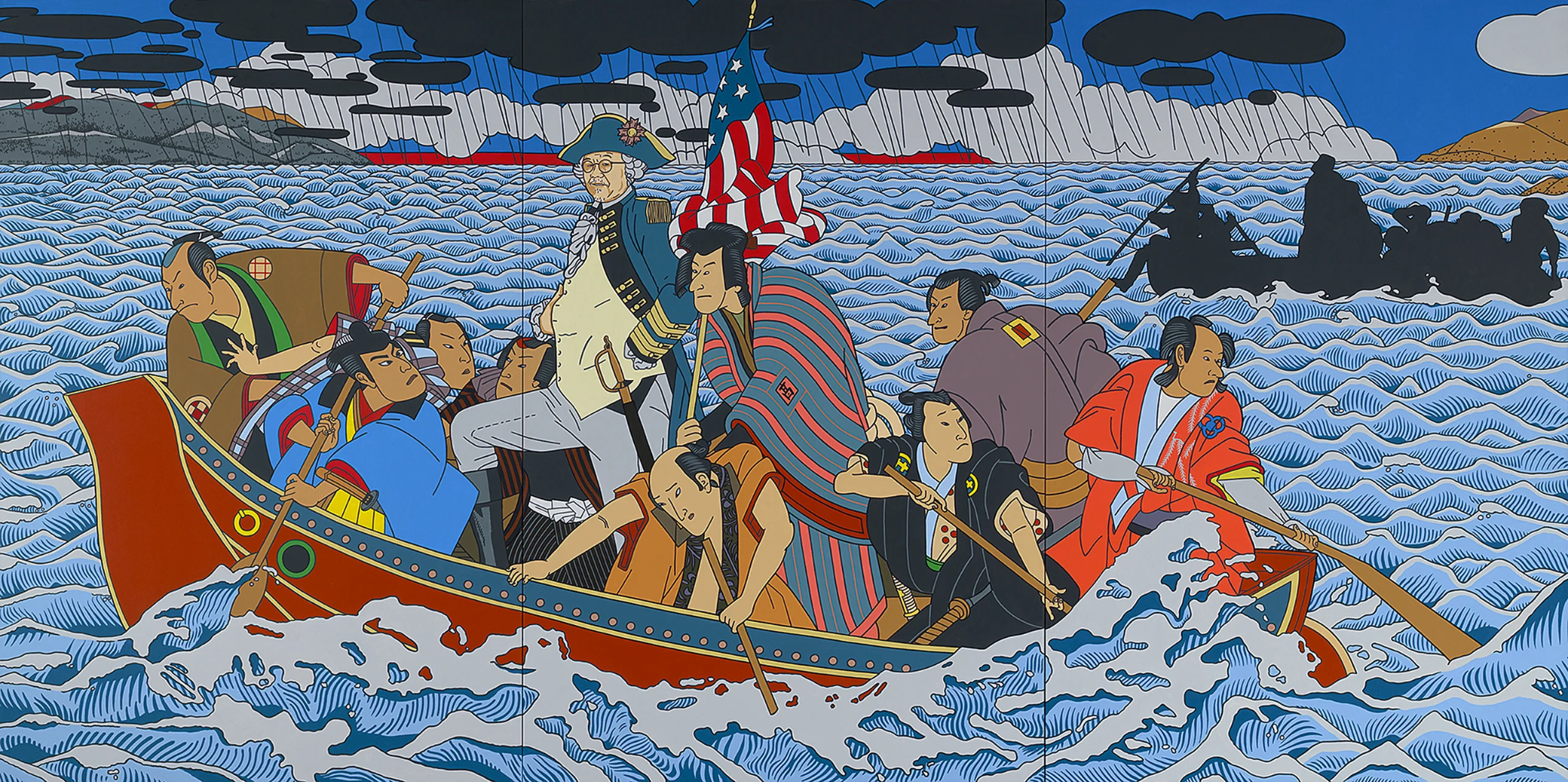
Why did America keep demanding people’s labor while rejecting the people themselves?
Select a highlight to read its note.
No yellow annotations for this aim yet. Blue highlights connect to the key ideas.
Listen to chapter 12
19:11Chapter 12
Up from Mexico
UNLIKE THE IMMIGRANTS from Asia and Europe, Mexicans lived in a country that bordered the United States. For a long time, entry was easy.
“All you had to do,” said Cleofas Calleros, who immigrated with his family from Mexico in the early 1900s, “coming from Mexico, if you were a Mexican citizen, was to report at the immigration office on the American side. . . give your name, the place of your birth, and where you were going to;
Most of the immigrants, however, did not even bother to report to the immigration office. They simply walked across the shallow Rio Grande, and then put on American-style hats and shoes in place of their Mexican sombreros and sandals.
A Pull to the North Like the Japanese immigrants who arrived at about the same time, Mexicans saw the United States as a land of opportunity. They called it El Norte, the North. People who had gone north wrote home to tell about the good life there, or bragged about it when they came home to visit. This led more and more Mexicans to head for El Norte.
“If anyone has any doubt about the volume of this class of immigrant,” wrote an American reporter in 1914, “a visit to South Texas would reveal the situation. In a day’s journey by automobile through that region one passes hundreds of Mexicans, all journeying northward on foot, on burroback and in primitive two-wheeled carts. ... When questioned many of them will tell you that they fled Mexico to escape starvation.”
The pull of El Norte was only one force behind this wave of immigration. Mexicans were also pushed from their homeland. Large landowners had been taking over small farms and uprooting rural families. Forced to become tenant farmers and sharecroppers, the peasants were exploited in the countryside, but when they moved to the cities, they suffered from periods of unemployment as industries first grew, then shrank.
Poverty was not the only problem. There was also the danger of violence. The Mexican Revolution began in 1910 and lasted for years, forcing thousands of refugees to flee northward. One of them was Jesus Moreno, who arrived in Los Angeles with his family in 1915. “We came to the United States to wait out the conclusion of the Revolution,” he said. “We thought it would be over in a few months.”
The movement northward was accelerated by developments in transportation. In 1895 a railroad company built a line nine hundred miles into Mexico, linking the Texas border town of Eagle Pass with the Mexican city of Durango. The railroad triggered a mass migration. “There is not a day in which passenger trains do not leave for the border, full of Mexican men who are going in gangs to work on railroad lines in the United States,” reported a Mexican newspaper in 1904.
Traveling by train overnight, the men covered a great cultural distance as well as a great geographical one. One of their songs told what it felt like to cross the border by train:
The fleeting engine
Can’t do anything good
Because at dusk it is at home
And at dawn in a strange country.
Most of the immigrants were from the agricultural labor class, and they were mostly young, between the ages of fifteen and forty-four. Married men either brought their wives with them or migrated first and then sent for their families after they had found work.
Between 1900 and 1930, the Mexican population of the Southwest swelled from an estimated 375,000 to 1,160,00. The majority of these people had been born in Mexico, not the United States. They settled in Texas, Arizona, New Mexico, and California, but some spread out as far as Illinois and Michigan. Their first concern was to find work.
Sprinkling the Fields with Sweat In the early twentieth century, Mexicans were drawn across the border because the United States needed their labor. They worked in a wide range of jobs. Some became urban industrial workers, serving the construction and railroad industries. But although three-quarters of the construction
workers in Texas by 1928 were Mexican, they were kept in low-level manual labor jobs. Supervisory and skilled positions were reserved for whites.
In Los Angeles, El Paso, and other cities with a large Mexican population, the majority of Mexicans worked in garment factories, canneries, or food-processing plants, or as janitors and gardeners, not in banks and offices. A federal official explained why a Mexican made a good railroad worker: “His strongest point with his employers is his willingness to work for a low wage.”
Most Mexicans, however, worked in agriculture. In California, farmers turned to Mexican labor after immigration laws ended the flow of workers from Asia. At least two-thirds of the state’s two hundred thousand farm laborers in the 1920s were Mexican. In Texas, the percentage was even higher. The state employment service estimated that 85 percent of Texas’s agricultural laborers were Mexican. Many of them were hired for the backbreaking work of picking cotton all day under the hot Texas sun.
Farm work was seasonal and migratory. Packed into old trucks and cars, laborers followed the crops. Their location at any given time was determined by where the jobs were. An immigrant named Anastacio Torres recalled picking cotton in
California in 1919, then, when the cotton season ended, working in a paper plant in Los Angeles, and after that returning to agricultural work in the Imperial Valley, where he picked lemons.
The migrant laborers lived in squalid camps with crude shelters, often made of canvas or even palm fronds. The growers felt no responsibility for the health or comfort of their workers. One farmer bluntly stated, “[When] they have finished harvesting my crops, I shall kick them out on the country road. My obligation is ended.”
Mexicans on Strike Feeling that they were entitled to dignity as well as better working conditions and higher wages, Mexicans took part in labor struggles, especially during the Great Depression of the 1930s. Between 1928 and 1933, Mexican farm laborers in California had had their wages cut from 35 to 14 cents an hour. In response, they supported strikes led by a variety of labor unions.
By actively participating in the labor movement, Mexicans challenged the stereotyped image of people from their country as passive and easygoing. Growers reacted with alarm to the formation of Mexican unions, and to their militancy.
One of the most powerful Mexican strikes occurred in 1933. Twelve thousand laborers in the San Joaquin Valley struck to resist cuts in their pay. To break the strike, growers kicked the workers out of their camps, dumped their possessions on the highway, and used the local police to arrest strike leaders. A deputy sheriff told an interviewer: “We protect our farmers here in Kern County. They are our best people. . . . But the Mexicans are trash. They have no standard of living. We herd them like pigs.”
The Mexican strikers refused to back down. Women were especially active. They came to the picket lines every day, and they called out to strikebreakers, urging them to join the strike. A worker named Lydia Ramos explained why she would not cross the picket lines as a strikebreaker: “Well, we believe in justice. So I want everything that’s good for me and I want everything that’s good for somebody else. Not just for them. . . but equality and justice.” In the end, the strikers reached a compromise with the growers and received a wage increase.
The strikes represented a deep discontent with life in El Norte. One of the strikers, Juan Berzunzolo, had come to the United States in 1908
and worked on the tracks of the Southern Pacific railway and in the beet fields of Colorado. “I have left the best of my life and strength here,” he said, “sprinkling with the sweat of my brow the fields and the factories of these gringos [Anglos].”
Tortillas and Turbans
Working in the fields alongside the Mexicans were immigrants from India. At the beginning of the twentieth century, workers from the Punjab, a region of northern India, started arriving on the West Coast of the United States. By 1920 some 6,400 had entered the country. Nearly all of them were men, and most of them were Sikhs, members of a religion that had originated in India in the sixteenth century. They wore turbans, a piece of cloth wrapped around their heads.
The Sikhs had been farmers in the Punjab, so they gravitated toward farm labor in America. Like the Mexicans, the Sikhs followed the harvests of different crops. Sikh men and Mexican women met each other while working in the fields and orchards. They formed relationships that sometimes led to marriage.
Love was not the only reason for Sikh men to
marry Mexican women. Sikhs were not considered white by American courts. Therefore they could not become naturalized citizens. The Alien Land Law of 1913 said that foreigners who were not able to become citizens could not buy land. Sikhs could, however, acquire land through their Mexican wives if they bought it in their wives’ names.
“Two years ago I married a Mexican woman,” said Inder Singh, a Sikh farmer in the Imperial Valley in 1924, “and through her I am able to secure land for farming. Your land law can’t get rid of me now; I am going to stay.”
In Sikh Mexican families, two cultural traditions met and blended. Foods were interchanged—Mexican tortillas and the flat Indian breads called rotis; jalapefio peppers and Punjabi chillis. Languages were mixed as well. Mexican wives usually understood some Punjabi, but English and Spanish were spoken in the home, and the Punjabi fathers learned to speak Spanish with their children. In most cases the children were baptized as Catholics, like their Mexican mothers, and raised under the compadrazgo (godparents) system of the Catholic Church and the Spanish culture.
The number of Sikh Mexican marriages was not large. Still, these couples—and the families they
produced—added one more flavor to the multicultural mix of American society.
On the Other Side of theTracks Mexican laborers were allowed to be in the United States as laborers, but they were kept from becoming full members of society. They could shop in Anglo parts of town only on Saturdays, and they could get food in Anglo cafés only by sitting at the counter or taking their food out. Mexicans lived in segregated neighborhoods called barrios. In many towns the barrios were located on the other side of the railroad tracks from where the Anglos lived.
Schools were segregated, too. One educator said, “There would be a revolution in the community if the Mexicans wanted to come to the white schools. It is based on racial inferiority.” In their segregated schools, young Mexican Americans were trained to become obedient workers. Like the Hawaiian sugar planters who wanted to keep the American-born generation of Japanese on the plantations, Anglo farmers in Texas wanted the schools to help reproduce the labor force. The sugar-beet growers worried that if every Mexican
got a high-school education, there would be no one to pick their beets.
“Educated Mexicans,” one farmer said, “are the hardest to handle. . .. They make more desirable citizens if they would stop about the seventh grade.” One Mexican American student remembered his sixth-grade teacher advising him not to go to high school, with these words: “Your people are here to dig ditches, to do pick and shovel work. I don’t think any of you should plan to go to high school.”
Some teachers, though, gave Mexican American children a sense of dignity and self-respect. In his autobiography Barrio Boy, Ernesto Galarza fondly recalled his school principal and teachers who never punished children for speaking Spanish on the playground. “Becoming a proud American,” Galarza said, “did not mean feeling ashamed of being a Mexican.”
Beginning in the 1920s, Mexicans found that they were no longer wanted in the United States. Nativists had grown alarmed at the large number of Mexican immigrants. Referring to the mixed-race background of many Mexicans, one nativist said: “From the racial point of view, it is not logical to limit the number of Europeans while we throw
the country open without limitation to Negroes, Indians, and half-breeds.”
Magazines and newspapers published hysterical articles about the “Mexicanization” of the United States. Anglo workers spoke out against the Mexicans who competed with them for jobs, and the American Federation of Labor, one of the country’s labor unions, complained about the use of Mexicans as cheap labor, which was putting white men out of work.
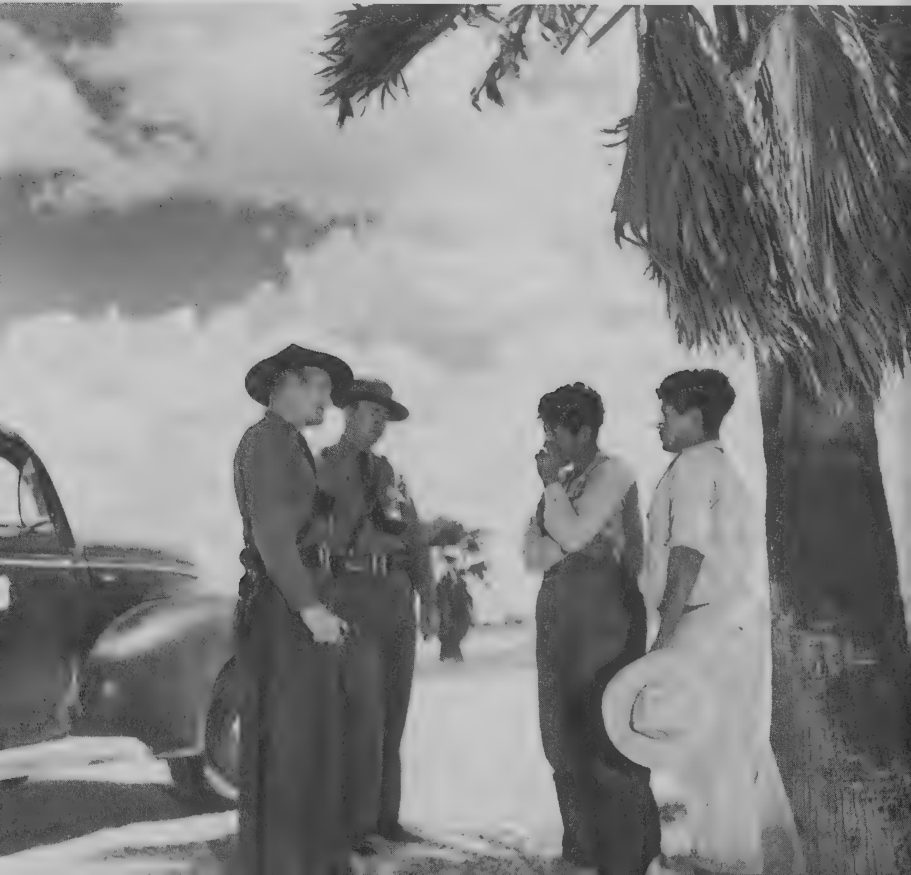
United States border patrol officers question Mexican workers, 1940.
Then came the Great Depression of the 1930s. Unemployment skyrocketed. Thrown out of work, and blamed for the loss of white workers’ jobs, Mexicans became targets of a program called repatriation, which meant returning them to their country of origin. In fact it was deportation—forcing people to leave the country they were living in.
Private charities and government agencies used a variety of tactics to encourage Mexicans to go back to Mexico. They threatened to cut off welfare aid, they offered free transportation by train (which sometimes meant being crammed into a boxcar), and they used police raids to pressure people into leaving or, in some cases, to physically remove them.
Some four hundred thousand Mexicans were sent out of the country during repatriation. Many were children. The Los Angeles Chamber of Commerce estimated that about 6o percent of those children had been born in the United States and were US citizens.
The Barrio: A Mexican American World
For many Mexicans, the border was only an imaginary line between Mexico and the United
States—one that could be crossed and recrossed at will. Living in El Norte, they created a Mexican American world called the barrio.
Barrios were ethnic islands. There Mexican Americans did not feel like strangers, as they did when they ventured across the railroad tracks into Anglo parts of town.
Barrios were often slums, made up of shacks and dilapidated houses without sidewalks or even paved streets, but Mexicans could celebrate their national holidays there, eat the familiar foods of home, tell stories about Mexico, and play their traditional music in bands that displayed both the US and Mexican flags.
What bound the people of the barrios together was not just their Mexican ethnicity but also their economic class. Everyone was poor, and everyone was looking for work. The barrios were networks of job information. They also served as places where new arrivals from Mexico could sleep, eat, and learn the ropes of life in America. People shared what they had, not as charity but as asistencia, help that was given and received on trust, with the idea that those who were helped would repay the kindness someday.
As evening fell on the barrios, people sat in
front of their houses and talked, just as they had done in villages on the other side of the border. They spoke of their love for their homeland, and they complained about racism and discrimination in the United States. Yet despite their nostalgia and their complaints, most of them stayed. They were making El Norte their homeland.
Although the word barrio was first used in the United States to describe these Mexican American communities, mostly in the West, these were not the only centers of Latino life and culture in America. In many cities across the country, Spanish-speaking communities formed, made up of immigrants not just from Mexico but from Central and South America and the Caribbean as well. One of the largest of these communities is Spanish Harlem, also known as El Barrio or East Harlem—a neighborhood in northeastern Manhattan, in New York City, that became home to Puerto Rican migrants as early as the 1920s. It has a large population of Nuyoricans, who are secondand third-generation Puerto Ricans, born in the United States.
SIX-YEAR-OLD IGNACIO PINA AND HIS FAMILY were in Hamilton, Montana, in 1931. His father and oldest sister were out in the sugar-beet fields one day, and his mother was cooking tortillas, when authorities suddenly burst into their home with guns and told them to get out. The family was not allowed to take anything with them—not even the trunk that contained the birth certificates of Ignacio and his five siblings, proof that all six of them had been born in the United States and were US citizens.
The Pifia family was thrown into jail for ten days, then put on a train and sent to Mexico. They were just one of many families uprooted during the repatriation movement of the 1930s, when US authorities used bullying, trickery, and threats to ship up to four hundred thousand Mexicans and Mexican Americans to Mexico. Like Ignacio Pifia, many of the deportees were children who were US citizens. Repatriation means “returning to one’s homeland,” but these children had never been to Mexico. They had been born in the United States,
and repatriation violated their legal right to be in the country.
For the Pifias, repatriation was a disaster. The whole family became ill with typhoid fever. Ignacio’s father died four years later. “My mother was left destitute, with six of us, in a country we knew nothing about,” says Pifia. “We were misfits there. We weren’t welcome.”
In the slums of Mexico City, Pifia’s education went only as far as the sixth grade. Still, sixteen years after he was deported, he managed to get the documents he needed to prove that he had been born in Utah. He returned to the United States, worked for a railroad, and made sure that his children went to college. Decades after repatriation, though, the painful memories remained fresh. “The Depression was very bad here. You can imagine how bad it was in Mexico,” he said. “You can’t put 16 years of pure hell out of your mind.”