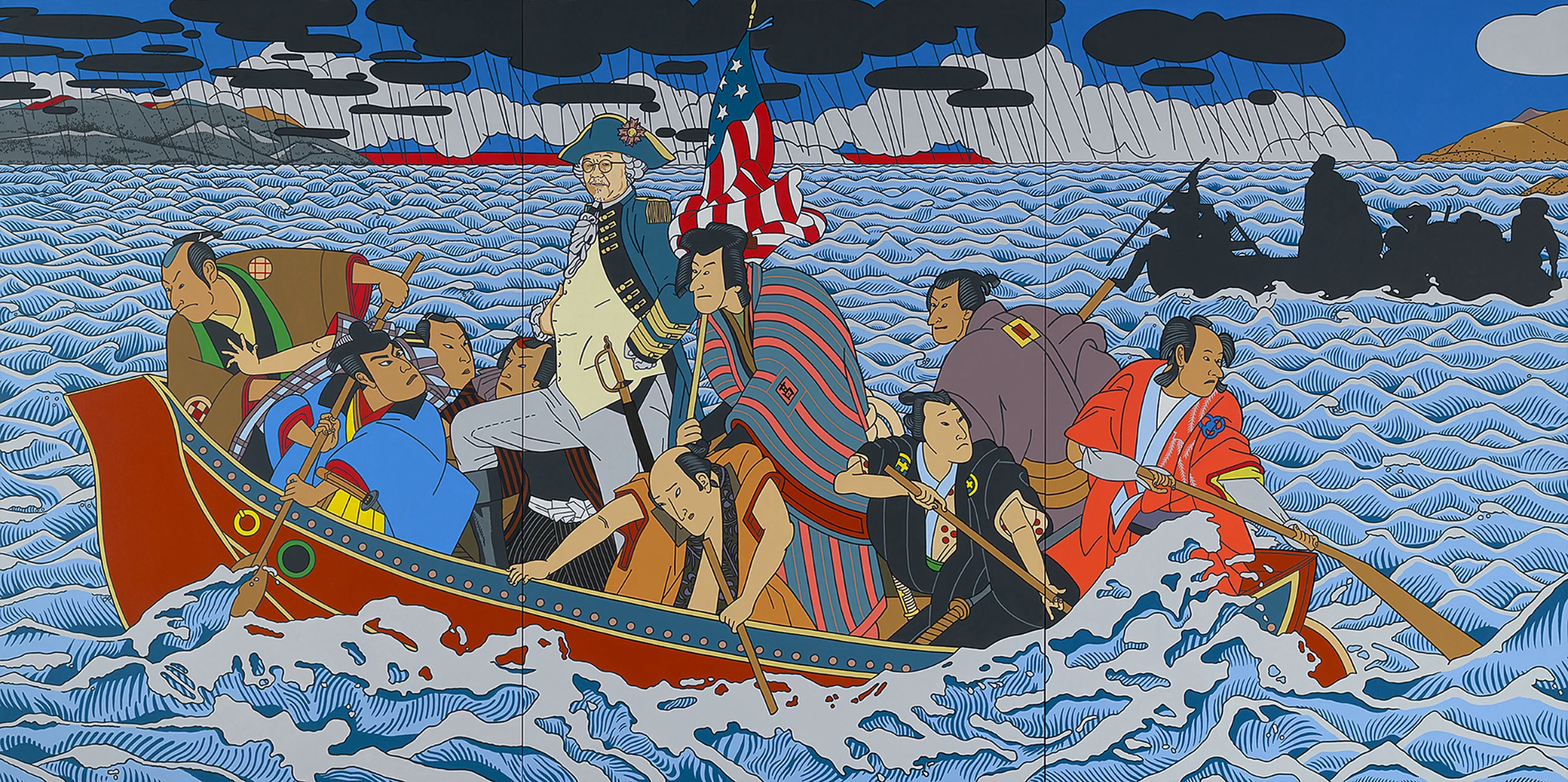
WITH THE END of the frontier in the 1890s, America witnessed the arrival of a new group of immigrants. Like the Irish, the Japanese were pushed here by external influences. During the nineteenth century, America's expansionist thrust had reached all the way across the Pacific Ocean. In 1853, Commodore Matthew C. Perry sailed his armed naval ships into Tokyo Bay and forcefully opened Japan's doors to the West. As Japanese leaders watched Western powers colonizing China, they worried that their country would be the next victim. Thus, in 1868, they restored the Meiji emperor and established a strong centralized government. To defend Japan, they pursued a twin strategy of industrialization and militarization and levied heavy taxes to finance their program. Bearing the burden of this taxation, farmers suffered severe economic hardships during the 1880s. "The distress among the agricultural class has reached a point never before attained," the Japan Weekly Mail reported. "Most of the farmers have been unable to pay their taxes, and hundreds of families in one village alone have been compelled to sell their property in order to liquidate their debts." Thousands of farmers lost their lands, and
hunger stalked many parts of the country. "What strikes me most is the hardships paupers are having in surviving," reported a journalist. "Their regular fare consists of rice husk or buckwheat chaff ground into powder and the dregs of bean curd mixed with leaves and grass."1 Searching for a way out of this terrible plight, impoverished farmers were seized by an emigration netsu, or fever. Fabulous stories of high wages abroad stirred their imaginations. A plantation laborer in the Kingdom of Hawaii could earn six times more than in Japan; in three years, a worker might save four hundred yen-an amount equal to ten years of earnings in Japan. When the Japanese government first announced it would be filling six hundred emigrant slots for the first shipment oflaborers to Hawaii, it received 28,000 applications. Stories about wages in the United States seemed even more fantastic-about a dollar a day, or more than two yen. This meant that in one year a worker could save almost a thousand yen -an amount equal to the income of a governor in Japan. No wonder a young man begged his parents: "By all means let me go to America." Between 1885 and 1924, 200,000 left for Hawaii and 180,000 for the U.S. mainland. In haiku, one Japanese migrant captured the feeling of expectation and excitement:
Hugh dreams of fortune Go with me to foreign lands, Across the ocean.
Prospective Japanese immigrants exclaimed, "In America, money grew on trees."2
Picture Brides in America
Like the Chinese, the Japanese crossed the Pacific driven by dreams of making money. But the two migrations differed significantly. The Japanese flow east to America included an abundance of women. By 1920, women represented 46 percent of the Japanese in Hawaii and 35 percent in the Golden State, compared with only 5 percent for the Chinese. Why did proportionally more women emigrate from Japan than China? Unlike China, J~pan was ruled by a strong central government that was able to regulate emigration. Seeking to avoid the problems of prostitution, gambling, and drunkenness that reportedly
plagued the predominantly male Chinese community in the United States, the Japanese government promoted female emigration. The 1882 Chinese Exclusion Act had prohibited the entry of "laborers," both men and women, but the militarily strong Japan was able to negotiate the 1907 Gentlemen's Agreement. While this treaty prohibited the entry of Japanese "laborers," it allowed the Japanese government to permit women to emigrate as family members. 3 Through this loophole in immigration policy came over sixty thousand women, many as "picture brides." The picture bride system was based on the established custom of arranged marriage. In Japanese society, marriage was not an individual matter but rather a family concern, and parents consulted go-betweens to help them select partners for their sons and daughters. In situations involving families located far away, the prospective bride and groom would exchange photographs before the initial customary meeting. This traditional practice lent itself readily to the needs of Japanese migrants. "When I told my parents about my desire to go to a foreign land, the story spread throughout the town," picture bride Ai Miyasaki later recalled. "From here and there requests for marriage came pouring in just like rain!" Similarly, Riyo Orite had a "picture marriage." Her marriage to a Japanese man in America had been arranged through a relative. "All agreed to our marriage, but I didn't get married immediately," she recalled. "I was engaged at the age of sixteen and didn't meet Orite until I was almost eighteen. I had seen him only in a picture at first .... Being young, I was unromantic. I just believed that girls should get married. I felt he was a little old, about thirty, but the people around me praised the match. His brother in Tokyo sent me a lot of beautiful pictures [taken in the United States] .... My name was entered in the Orites' koseki [family register]. Thus we were married."4 The emigration of Japanese women occurred within the context of internal economic developments. While women in China were restricted to farm and home, Japanese women were increasingly entering the wage-earning workforce. Thousands of them were employed in construction work as well as in the coal mines, where they carried heavy loads on their backs out of the tunnels. Young women were also working in textile mills, where they had sixteen-hour shifts and lived in dormitories. By 1900, 60 percent of Japan's industrial laborers were women. While it is not known how many of the women who emigrated had been wage earners, this proletarianization of women already well under way in Japan paved the way for them to consider working in America. 5
Japanese women were also more receptive to the idea of traveling overseas than Chinese women. The Meiji government required the education of female children, stipulating that "girls should be educated ... alongside boys." Emperor Meiji himself promoted female education. Japanese youth, "boys as well as girls," he declared, should learn about foreign countries and become "enlightened as to ideas of the world." Japanese women, unlike their Chinese counterparts, were more likely to be literate. "We studied English and Japanese, mathematics, literature, writing, and religion," recalled Michiko Tanaka. Under the reorganization of the school system in 1876, English was adopted as a major subject in middle school. Women also heard stories describing America as "heavenly," and some of the picture brides were more eager to see the new land than to meet their husbands. "I wanted to see foreign countries and besides I had consented to marriage with Papa because I had the dream of seeing America," Michiko Tanaka revealed to her daughter years later. "I was bubbling over with great expectations," said another picture bride. "My young heart, 19 years and 8 months old, burned, not so much with the prospects of uniting with my new husband, but with the thought of the New World."6 The emigration of women was also influenced by Japanese views on gender. A daughter was expected to marry and enter her husband's family. "Once you become someone's wife you belong to his family," explained Tsuru Yamauchi. "My parents said once I went over to be married, I should treat his parents as my own and be good to them." One day, Yamauchi was told that she would be going to Hawaii to join her future husband: "I learned about the marriage proposal when we had to exchange pictures." Emigration for her was not a choice but an obligation.7
Whether a Japanese woman went to America often depended on which son she married. Unlike the Chinese, Japanese farmers had an inheritance system based on impartible inheritance and primogeniture. Usually the first son inherited the family's holdings. In the mountainous island nation of Japan, arable land was limited, and most of the farm holdings were small, less than two and a half acres. Division of a tiny family holding would mean disaster for the family. As the inheritor of the family farm, the eldest son had the • responsibility of caring for his aged parents and hence was required to stay home. The other sons would have to leave the family farm and find employment in town. This practice of relocating within Japan could easily be applied to moving
abroad. Thus, although the immigrants included some first sons, they tended to be the younger ones. Unlike Chinese sons who had to share responsibility for their parents, these Japanese men were not as tightly bound to their parents and were allowed to take their wives and children with them to America. 8 But whether or not women migrated was also influenced by needs in the receiving countries. In Hawaii, the government initially stipulated that 40 percent of the contract labor emigrants from Japan were to be women. During the government-sponsored contract labor period from 1885 to 1894, women constituted 20 percent of the emigrants. During the period from 1894 to 1907, thousands of additional women sailed to Hawaii as private contract laborers. Planters assigned 72 percent of them to field labor. Furthermore, they promoted the Japanese family as a mechanism of labor control. In 1886, Hawaii's inspector-general of immigration reported that Japanese men were better workers on plantations where they had their wives. After 1900, when Hawaii became a territory of the United States, planters became even more anxious to bring Japanese women to Hawaii. Since the American law prohibiting contract labor now applied to the islands, planters had to find ways to stabilize their labor force. Realizing that men with families were more likely to stay on the plantations, managers asked their business agents in Honolulu to send "men with families."9 Meanwhile, Japanese women were pulled to the United States mainland, where their husbands needed them as workers. Shopkeepers and farmers sent for their wives, thinking they could assist as unpaid family labor. Wives were particularly useful on farms where production was labor intensive. "Nearly all of these tenant farmers are married and have their families with them," a researcher noted in 1915. "The wives do much work in the fields."10 As they prepared to leave their villages for Hawaii and America, many women felt separation anxieties. One woman remembered her husband's brother saying farewell: "Don't stay in the [United] States too long. Come back in five years and farm with us." But her father quickly remarked: "Are you kidding? They can't learn anything in five years. They'll even have a baby over there .... Be patient for twenty years." Her father's words shocked her: suddenly she realized how long the separation could be. Another woman recalled the painful moment she experienced when her parents came to see her off: "They did not join the crowd, but quietly stood in front of the wall. They didn't say 'good luck,' or 'take
care,' or anything. . . . They couldn't say anything because they knew, as I did, that I would never return." As their ships sailed from the harbor, many women gazed at the diminishing shore:
With tears in my eyes I turn back to my homeland, Taking one last look. 11
Tears in the Canefields
"Get labor first," sugar planters in Hawaii declared, "and capital will follow." By pursuing this strategy, they successfully developed a profitable sugar export economy. Between 1875 and 1910, cultivated land multiplied nearly eighteen times, or from 12,000 to 214,000 acres. To achieve this triumph, planters had to find workers, and their chief source was Japan. To their labor suppliers, they sent requisitions for needed supplies. In a letter to a plantation manager, July 2, 1890, the Davies Company of Honolulu acknowledged receipt of an order for:
bonemeal canvas Japanese laborers macaroni Chinaman
In another letter, January 3, 1898, the Davies Company confirmed a list of orders which included:
DRIED BLOOD [fertilizer]. LABORERS. We will book your order for 75 Japanese to come as soon as possible. MULES & HORSES.12
Though they imported workers along with supplies, planters were conscious of the nationalities of their laborers. They were systematically developing an ethnically diverse labor force in order to create divisions ampng their workers and reinforce management control. Complaining about the frequency of strikes on plantations where the workers were mostly from the same country, plantation managers recommended: "Keep a variety of laborers, that is different nationalities, and thus prevent any concerted action in case
of strikes, for there are few, if any, cases of Japs, Chinese, and Portuguese entering into a strike as a unit." In a "confidential" letter to planter George Wilcox, a labor supply company wrote: "Regarding the proportion of Chinese and Japanese laborers we beg to advise, that the Hawaiian Sugar Planters' Association and the Bureau of Immigration have agreed upon 213rd of the former and 1/3 of the latter. For your private information we mention, that the reason for this increasing the percentage of the Chinese laborers is due to the desire of breaking up the preponderance of the Japanese element."13 Planters explained that they preferred to divide the workforce "about equally between two Oriental nationalities." In 1903, they began importing Korean laborers in order to "pit" them against the Japanese. Aware of the antagonism between these two groups, planters believed that the Koreans were "not likely to combine with the Japanese at any attempt at strikes." After receiving a demand for higher wages from Japanese laborers, a planter asked a labor supplier to send a shipment of Korean laborers: "In our opinion, it would be advisable, as soon as circumstances permit, to get a large number of Koreans in the country ... and drive the Japs out."14 But the Korean labor supply was cut off in 1905. Informed about abuses suffered by the Koreans on the plantations, the Korean government prohibited further emigration to Hawaii. A year later, planters began bringing laborers from the Philippines, a territory acquired by the United States after the Spanish- American War. Again the purpose was to diversify and discipline the labor force. On July 28, 1909, the Hawaiian Sugar Planters' Association reported that several hundred Filipino laborers were en route to Hawaii: "It may be too soon to say that the Jap is to be supplanted, but it is certainly in order to take steps to clip his wings," and to give "encouragement to a new class [Filipinos] ... to keep the more belligerent element in its proper place." Planters anxiously asked the labor suppliers to hurry the delivery of the Filipino workers. On August 7, for example, one of them complained about the high wages demanded by the Japanese laborers on his plantation: "If possible for you to arrange it I should very much like to get say 25 new Filipinos to put into our day gang .... In this way perhaps we can stir the Japs a bit." Twenty days later, he wrote again, stating that he was very pleased to receive the shipment of thirty Filipinos, and that he planned to use them to bring the Japanese workers to "their senses."15 To strengthen their authority over their ethnically diverse
workforce, planters stratified tasks according to race: whites occupied the skilled and supervisory positions, while Asian immigrants were the unskilled field laborers. In 1904, the Hawaiian Sugar Planters' Association passed a resolution that restricted skilled positions to "American citizens, or those eligible for citizenship." Asian immigrants were excluded, for they were not "white" and therefore ineligible to become naturalized citizens. In 1915, Japanese laborers were mostly field hands and mill laborers. Of 45 mill engineers, 41 were of European ancestry, three were Hawaiian or part-Hawaiian, and only one was Japanese. A racial division was particularly evident in supervisory positions: of the 377 overseers, only 2 were Chinese and 17 Japanese, while 313 were white. A Japanese worker told an interviewer how he was frustrated by racial discrimination. "I haven't got a chance" to get ahead in employment, he explained. "You can't go very high up and get big money unless your skin is white. You can work here all your life and yet a haole [white] who doesn't know a thing about the work can be ahead of you in no time."16 On the plantations, Japanese workers found themselves in a world of regimented labor. Early in the morning, they were jarred from their sleep by the loud scream of the plantation siren. A work song captured the beginning of the workday:
''Awake! stir your bones! Rouse up!" Shrieks the Five o'Clock Whistle. "Don't dream you can nestle For one more sweet nap. Or your ear-drums I'll rap With my steam-hammer tap Till they burst. Br-r-row-aw-i-e-ur-ur-rup! Wake up! wake up! wake up! w-a-k-e-u-u-u-up!"
"Filipino and Japanee; Porto Rican and Portugee; Korean, Kanaka and Chinese; Everybody whoever you be On the whole plantation- Wake up! wake up! wake up! w-a-k-e-u-u-u-up! Br-r-row-aw-i-e-ur-ur-rup/"17
When the whistle stopped shrieking, lunas, or foremen, strode through the camps. "Get up, get up," they shouted as they knocked on the doors of the cottages and barracks. "Hana-hana, hanahana, work, work."18 "All the workers on a plantation in all their tongues and kindreds, 'rolled out' sometime in the early morn, before the break of day," reported a visitor. One by one and two by two, laborers appeared from "the shadows, like a brigade of ghosts." From the labor camps, they came by train, "car after car of silent figures," their cigarettes glowing in the darkness. In front of the mill, they lined up, shouldering their hoes. As the sun rose, its rays striking the tall mill stack, "quietly the word was passed from somewhere in the dimness. Suddenly and silently the gang started for its work, dividing themselves with one accord to the four quarters of the compass, each heading toward his daily task." The workers were grouped into gangs of twenty to thirty workers and marched to the fields. Each gang was supervised by an "overseer, almost always a white man." The ethnicity of the gangs varied: some were composed of one nationality, while others included Hawaiians, Filipinos, Puerto Ricans, Chinese, Japanese, Portuguese, and Koreans.19 There were gangs of women workers, too. In 1920, 14 percent of the plantation labor force was female, mostly Japanese. Women were concentrated in field operations such as hoeing, stripping leaves, and harvesting. Though they were given many of the same assignments as men, women were paid less than their male counterparts. Female field hands, for example, received an average wage of only fifty-five cents per day in 1915, compared to the seventy-eight cents for male field hands.20 Field work was punishing and brutal. "We worked like machines," a laborer complained. "For 200 of us workers, there were seven or eight lunas and above them was a field boss on a horse. We were watched constantly." A Japanese woman recalled: "We had to work in the canefields, cutting cane, being afraid, not knowing the language. When any haole or Portuguese luna came, we got frightened and thought we had to work harder or get fired." "The luna carried a whip and rode a horse," another Japanese laborer recounted. "If we talked too much the man swung the whip. He did not actually whip us but just swung his whip so that we would work harder."21 The lunas "never called a man by his name," the workers grumbled. "Every worker was called by number," one of them
complained. "Always by the bango, 7209 or 6508 in that manner. And that was the thing I objected to. I wanted my name, not the number." Carried on chains around their necks, the bangos were small brass disks with stamped identification. In the old country, workers had names that connected them to family and community; but in Hawaii, they had become numbers. They resented this new impersonal identity. Laborers were "treated no better than cows or horses," one of them recalled. The bango seemed to emblematize a distance between themselves and their humanity. 22
The laborers cursed the overseers, "talking stink" about the driving pace of the work: "It burns us up to have an ignorant luna stand around and holler and swear at us all the time for not working fast enough. Every so often, just to show how good he is, he'll come up and grab a hoe and work like hell for about two minutes and then say sarcastically, 'Why you no work like that?' He knows and we know he couldn't work for ten minutes at that pace." The lunas were just plain mean.
Hawaii, Hawaii But when I came What! saw Was hell The boss was Satan The lunas His helpers. 23
In the cane fields, workers hoed weeds, one of the most tedious and backbreaking tasks. They had to "hoe hoe hoe ... for four hours in a straight line and no talking," said a worker. "Hoe every weed along the way to your three rows. Hoe-chop chop chop, one chop for one small weed, two for all big ones." When the cane was ripe, lunas on horseback led the workers into the fields to harvest the crop. The cutting of the cane caught the eye of a visitor: "Just beyond these Chinese huts were canefields, an intense yellowgreen, the long, slender leaves tossing in the breeze like a maizefield before the harvest. There were great bands of Japanese at work in the field." They worked with "incredible rapidity, the line of men crossing a field, levelling the cane."24 Harvesting the cane was dirty and exhausting work. As the workers mechanically swung their machetes, they felt the pain of blistered hands and scratched arms. "When you cutting the cane
and you pulling the cane back," a worker said, "sometimes you get scratched with the leaves from the cane because they have a little edge just like a saw blade." Their heavy arms and their bent backs begged for a break, a moment of rest.
Becoming weary I sit for a while to rest In the cane field, And whistle To call the breezes. 25
Sometimes the breezes failed to come. Twelve feet high, the cane enclosed and dwarfed the Japanese workers. As they cut the stalks, they sweated from the terrible heat and humidity. Surrounded by clouds of red dust, the laborers covered their faces with handkerchiefs. The mucus they cleared from their noses looked like blood.
My husband cuts the cane stalks And I trim their leaves With sweat and tears we both work For our means. 26
After collecting the cane stalks, the workers tied them into bundles and loaded them onto railway cars. A train then pulled the cane to the mill where engines, presses, furnaces, boilers, vacuum pans, and centrifugal drums crushed the cane and boiled its juices into molasses and sugar. Inside the mill, laborers felt as if they were in the "hold of a steamer." The constant loud clanking and whirring of the machinery were deafening. "It was so hot with steam in the mill," Bashiro Tamashiro recalled, "that I became just like pupule [crazy] ."27 At four-thirty in the afternoon, the plantation whistle shrieked the signal to stop working. "Pau hana," the laborers sighed, "finished working." Though they were too tired to hoe another row or carry another bundle of stalks, they felt a sudden final burst of energy and eagerly scrambled to their camps. Contrary to the stereotype of the Japanese immigrants as quiet and accommodating, they aggressively protested against the unfair labor conditions and often engaged in strikes. Divided by their diverse national identities, laborers of different groups initially tended to define their class interests in terms of their
particular ethnicity. Thus, Japanese workers organized themselves into "blood unions" based on ethnic membership. The most important manifestation of "blood unionism" was the Japanese strike of 1909. Protesting against a differential wage system based on ethnicity, the strikers demanded higher wages and equal pay for equal work. They angrily pointed out that Portuguese laborers were paid $22.50 per month, while Japanese laborers received only $18.00 for the same work. "The wage is a reward for services done," they argued, "and a just wage is that which compensates the laborer to the full value of the service rendered by him .... If a laborer comes from Japan and he performs the same quantity of work of the same quality within the same period of time as those who hail from the opposite side of the world, what good reason is there to discriminate one as against the other? It is not the color of skin that grows cane in the field. It is labor that grows cane."28 Seven thousand Japanese plantation laborers halted operations on Oahu, while their compatriots on the other islands provided support by sending money and food. Japanese business organizations such as the Honolulu Retail Merchants Association contributed to the strike fund, and the Japanese Physicians Association gave free medical service to the strikers and their families. A strong sense of ethnic solidarity inspired the strikers. Stridently shouting banzais at rallies, they declared their determination to "stick together" as Japanese. 29 The strike reflected an awakening consciousness among the workers, a transformation from sojourners to settlers, from Japanese to Japanese Americans. In their demand for a higher wage, the strikers explained: "We have decided to permanently settle here, to incorporate ourselves with the body politique [sic] of Hawaii-to unite our destiny with that of Hawaii, sharing the prosperity and adversity of Hawaii with other citizens of Hawaii." Significantly, the Japanese were framing their demands in "American" terms. They argued that the deplorable conditions on the plantations perpetuated an "undemocratic and un-American" society of "plutocrats and coolies." Fair wages would encourage laborers to work more industriously and productively. The goal of the strike was to create "a thriving and contented middle class-the realization of the high ideal of Americanism."30
The planters responded by pressuring the government to arrest the strike leaders for "conspiracy." Then they hired Koreans, Hawaiians, Chinese, Portuguese, and Filipinos as scabs.
The strikers held out for four months before they were forced to return to work. But they had actually scored a victory, for shortly afterward, the planters eliminated the differential wage system and raised the wages of the Japanese workers. A strike based on ethnicity seemed to make sense to Japanese plantation laborers in 1909, for they constituted about 70 percent of the workforce, while Filipinos represented less than 1 percent. But this ethnic solidarity also made it possible for the planters to use laborers of other nationalities to undermine the "Japanese" strike. After the 1909 strike was broken, planters imported Filipino laborers in massive numbers. Eleven years later, Japanese workers represented only 44 percent of the labor force, while Filipino workers had risen to 30 percent. Organized into separate "blood" unions, workers of both nationalities began to realize that the labor movement in Hawaii would have to be based on interethnic working-class unity. In December 1919, the Japanese Federation of Labor and the Filipino Federation of Labor submitted separate demands to the Hawaiian Sugar Planters' Association. The workers wanted higher wages, an eight-hour day, an insurance fund for retired employees, and paid maternity leaves. Their demands were promptly rejected by the planters. The Japanese union thought that both groups should plan for a long strike. Feeling that the time for action had arrived, however, the Filipino Federation of Labor unilaterally issued an order for the Filipinos to strike and urged the Japanese to join them. "This is the opportunity that the Japanese should grasp," declared the leader of the Filipino union, "to show that they are in harmony with and willing to cooperate with other nationalities in this territory, concerning the principles of organized labor .... We should work on this strike shoulder to shoulder."31 Three thousand Filipino workers went out on strike. They set up picket lines and called for labor solidarity. "What's the matter? Why you hana-hana [work]?" the Filipino strikers asked their Japanese co-workers. Several Japanese newspapers urged the Japanese laborers to support the Filipinos. The Hawaii Shimpo scolded Japanese workers for their hesitation: "Our sincere and desperate voices are also their voices. Their righteous indignation is our righteous indignation .... Fellow Japanese laborers! Don't be a race of unreliable dishonest people! Their problem is your problem!" The Hawaii Hochi advised Japanese laborers to strike immediately: "Laborers from different countries" should take
"action together." Between Filipinos and Japanese, the Hawaii Choho declared, there should be "no barriers of nationality, race, or color." Sensing the will of the community, the Japanese Federation of Labor ordered its members to join the strike. United in struggle, eight thousand Filipino and Japanese strikers-77 percent of the entire plantation workforce on Oahu-brought production to a sudden stop. Here was a Hawaiian version of the "giddy multitude." "Pau hana," they told each other, "no go work." "Pau hana," they declared defiantly, "we on strike."32 During the strike, the leaders of the Japanese Federation of Labor questioned the wisdom of having two separate unions and consequently formed the Hawaii Laborers' Association - a name that conveyed multiethnic class camaraderie. They insisted that all workers, regardless of ethnicity, should cooperate in safeguarding their standard of living. The fact that the "capitalists were haoles [Caucasians]" and the "laborers Japanese and Filipinos" was a "mere coincidence," explained Takashi Tsutsumi. The fundamental distance was class. Japanese and Filipinos were acting as "laborers" in "a solid body" during the 1920 strike. What the workers were learning from their struggle, Tsutsumi continued, was the need to build "a big, powerful and non-racial labor organization" which could "effectively cope with the capitalists." Such a union would bring together "laborers of all nationalities."33 The strikers were learning a valuable lesson. Filipinos and Japanese, joined by Spanish, Portuguese, and Chinese, had participated in the first major interethnic working-class struggle in Hawaii. They had all been awakened by the 5:00 A.M. whistle and had labored together in the fields and mills; now they were fighting for a common goal. As they walked the picket lines and protested at mass rallies, they understood more deeply the contributions they had made as workers to Hawaii's economic development. "When we first came to Hawaii," they proudly declared, "these islands were covered with ohia forests, guava fields and areas of wild grass. Day and night did we work, cutting trees and burning grass, clearing lands and cultivating fields until we made the plantations what they are today."34 Confronted by this interethnic challenge, the planters turned to their time-tested strategy of divide-and-control. The president of one sugar corporation explained: "We are inclined to think that the best prospect, in connection with this strike, is the fact that two organizations, not entirely in harmony with each other, are connected with it, and if either of them falls out of line, the
end will be in sight." The planters fomented distrust between the two nationalities. They offered a bribe to Filipino union leader Pablo Manlapit. Suddenly, to the surprise of both the Filipino and Japanese strikers, Manlapit called off the strike, condemning it as a Japanese action to cripple the economy of Hawaii. But, at the rank-and-file level, many Filipinos continued to strike. Escalating their attack, the planters launched a "program of propaganda": they claimed that the Japanese strikers were puppets of Japan and were seeking to "Japanise" the islands.35 Meanwhile, the planters enlisted Hawaiians, Portuguese, and Koreans as strikebreakers. They also served forty-eight-hour eviction notices to the strikers, forcing them to leave their homes and find makeshift shelters in Honolulu's empty lots. Homeless during the height of an influenza epidemic, thousands of workers and their family members became sick, and one hundred and fifty died. "My brother and mother had a high fever," Tadao Okada recalled, "but all of us were kicked out of our home." Tired, hungry, and ill, the strikers gave up their struggle in July. The planters claimed a complete victory, but three months later, they discretely increased wages by 50 percent. 36 The strikes represented only the surface of a contested terrain. Beneath the conflict over who would control labor and benefit from the wealth it created was a quiet struggle over the content of culture in Hawaii. Would the culture be dominated by the Anglo-American planter class, or would it be enriched with the traditions and customs of the Japanese as well as of the other nationalities in Hawaii? Culture was critical, for it had the power to deny or provide a way for people to affirm their individual selfesteem and positive group identity. In the camps, Japanese workers were conscious of the racial and class hierarchy symbolized by the plantation housing pattern. According to the graphic description by Milton Murayama in his novel, All I Asking For Is My Body, the manager's house was on the top of the hill. Below it were the nice-looking homes of the Portuguese and Japanese lunas, then the identical wooden frame houses of the Japanese camp, and finally the more run-down Filipino camp. This stratified system was laid out around its sewage system. The concrete ditches that serviced the toilets and outhouses ran from the manager's house on the highest slope down to the Filipino camp on the lowest perimeter of the plantation. The tiered housing pattern and sewage system seemed emblematic: "Shit too was organized according to the plantation pyramid."37
Workers of different nationalities were usually housed in separate camps. "There were the Japanese camps," recalled Richard Okawa, describing the Rawi Plantation on the Big Island, "and the Chinese and Filipino camps, and one camp for the Puerto Ricans." The Puunene Plantation on Maui had sixteen camps, including many Japanese and Filipino camps, said Minoru Takaki, who worked all his life on the Puunene Plantation. There were also "Young Hee Camp," "Ah Fong Camp," "Spanish A Camp," "Spanish B Camp," and ''Alabama Camp." "Yeah," he said, "we used to have Negroes on the plantation."38 Generally, the early camps were crowded and unsanitary. According to a contemporary observer, workers were housed in dwellings that resembled "pig sties," and several hundred laborers "swarmed together" in one-story "tenements." A Japanese laborer recalled: "Fifty of us, both bachelors and married couples, lived together in a humble shed-a long ten-foot-wide hallway made of wattle and lined along the sides with a slightly raised floor covered with a grass rug, and two tatami mats to be shared among us." Another worker described the "large partitioned house" she inhabited: "The type of room for married people was small, no bed or anything .... It was just a space to lay the futon down and sleep. We didn't have any household things, only our one wicker trunk, not even a closet. We just pounded a nail by the place we slept, a hook where I hung my muumuu, the old kanaka [Hawaiian] style."39 As planters employed men with families rather than single men, they began replacing the barracks with cottages for families. Planters decided that "dependable married men" were "preferred" as workers and authorized the building of cottages for married laborers. In 1920, the Hawaiian Sugar Planters' Association promoted the development of family housing units: "Housing conditions on the plantations have changed greatly during the past few years, lately on account of the change in labor from single to married men." But planters also had self-interested reasons for improving the camps. They wanted to "stimulate" a "home feeling" in order to make their workers happier and more productive. "Pleasant surroundings, with some of the modern comforts and conveniences," explained a plantation official, "go a long way to make the worker h~althier and more efficient in his work."40 The laborers had their own reasons for beautifying their camps. Seeking to add a reminder of their homeland, Japanese workers placed bonsai plants on the steps of their cottages. They also created artistic gardens; a mainland visitor observed that
the flowers and "miniature gardens with little rocky pools and goldfish" suggested "a corner of Japan." Determined to have their traditional hot baths, Japanese workers also built furos. "The bath was communal," Tokusuke Oshiro said. "We all took a bath together. If, however, you got in last, it would be very dirty."41
Meanwhile, the workers were transforming their camps into ethnic communities. "There was another thing I'd come to like about the camp," remarked Kiyoshi in Milton Murayama's novel about plantation life. "The hundred Japanese families were like one big family. Everybody knew everybody else, everybody was friendly."42 On every plantation, Japanese immigrants established Buddhist temples and Japanese-language schools for their children. The camps became the sites for their traditional celebrations. During the midsummer, Japanese held their traditional obon, or festival of souls. Dressed in kimonos, they danced in circles to the beat of taiko drums to honor the reunion of the living with the spirits of the dead. In early November, they observed the Mikado's birthday. Irritated by the interruption of the plantation production schedule, plantation managers found they had no choice but to let their Japanese workers have the day off. "There is an old custom here among the Japs of observing the 3rd of November as a holiday," a plantation manager complained. "The Emperor's Birthday was celebrated everywhere," Tokusuke Oshiro recalled. "Mainly there was sumo .... Several young men, usually the good ones, got together at a camp and had Japanese-style sumo matches."43 The Japanese immigrants also enjoyed sharing their ethnic foods. The daughter of a Portuguese laborer remembered how her mother would make gifts of her bread and "little buns for the children in the camp. The Japanese families gave us sushis and the Hawaiians would give us fish." "Everybody took their own lunches" to school, Lucy Robello of the Waialua plantation said. "And like the Japanese used to take their little riceballs with an ume [pickled plum] inside and little daikon [radish]. And us Portuguese, we used to take bread with butter and jelly or bread with cheese inside." Then, at noon, Japanese and Portuguese children would trade their kaukaus [lunches] with each other. Meanwhile, in the fields, their parents were also sharing their lunches. "We get in a group," William Rego recalled. "We pick from this guy's lunch and that guy'll pick from my lunch and so forth." Crossing ethnic lines, workers would taste each other's foods and exclaim in Hawaiian: "Ono, ono ! " "Tasty, tasty! "44 Initially, the laborers of each ethnic group spoke only their
native language. Language gave each group a sense of community within the plantation camps, enabling its members to maintain ties with each other as they shared memories of their distant homelands and stories of their experiences in the new country. But soon workers of different nationalities began to acquire a common language. Planters wanted the immigrant laborers to be taught a functional spoken English so they could give commands to their multilingual workforce. "By this," explained a planter, "we do not mean the English of Shakespeare but the terms used in everyday plantation life. A great many of the small troubles arise from the imperfect understanding between overseers and laborers." Over the years, a plantation dialect developed called "pidgin English" -a simple English that incorporated Hawaiian, Japanese, Portuguese, and Chinese phrases as well as their rhythms and intonations. Though it had begun as "the language of command," this hybrid language with its luxuriant cadences, lyrical sounds, and expressive hand gestures soon became the language of the community. "The language we used had to be either pidgin English or broken English," explained a Filipino laborer describing the communication of different ethnic groups on the plantation. "And when we don't understand each other, we had to add some other words that would help to explain ourselves. That's how this pidgin English comes out beautiful."45 As pidgin English became the common language of the camps, it enabled people from different countries to communicate with each other and thus helped them create a new identity associated with Hawaii. This acquisition of a new language reflected a deeper change in their outlook toward themselves and their new land. They had come to Hawaii intending to earn money and then return to Japan. Of the 200,000 Japanese who entered Hawaii between 1885 and 1924, 110,000, or 55 percent, went home. What is so striking and so significant is the fact that so many sojourners stayed. Gradually, over the years, Japanese immigrant workers found themselves establishing families in the new land. By 1920, 45 percent of the Japanese in Hawaii were nineteen years old and younger. The immigrants were planting new roots in Hawaii through their children. In a letter to his brother, Asakichi Inouye explained why he h~d decided not to return to Japan: "My children are here, and my grandson [Daniel, who would later be elected to the U.S. Senate], and it is here that I have passed most of the days of my life. I do not believe that my wife and I, in our last
years, could find contentment in Yokoyama, which has become for us a strange place." When Shokichi and Matsu Fukuda migrated to Maui in 1900, they were sojourners. Some twenty years later, they decided they would return to Japan and take their Hawaiianborn children with them. But their son, Minoru, was a teenager by then, and Hawaii was his home, the only world he knew. "He refused to go," remembered his niece Aiko Mifune. "Japan was a foreign country to him. He was very adamant that the family should stay in Hawaii." Mitsue Takaki also found herself planting new roots in Hawaii. She had come as a picture bride in 1920; eleven years later, her husband injured his knee on the plantation and returned to Japan for medical treatment. When he tried to reenter Hawaii, the immigration authorities refused to grant him permission. Mitsue chose to remain in the islands with her three small children - Minoru, Susumu, and Kimiyo. She went to night school to learn English and worked as a maid in the plantation clubhouse to support her children. She wanted them to be educated and have opportunities in the land of their birth.46 The planters, however, did not want the children of immigrant workers to have opportunities: they needed the second generation as plantation laborers. In their view, these children should not be taught beyond the sixth or eighth grade, and their education should be vocational training. A sugar corporation president declared that teachers should prepare their students to enter plantation work like their parents. Pointing to the need for agricultural labor, a plantation manager complained: "Why blindly continue a ruinous system that keeps a boy and girl in school at the taxpayers' expense long after they have mastered more than sufficient learning for all ordinary purposes?" A visitor from the mainland noticed the presence of Japanese children on the plantations and asked a manager whether he thought the coming generation of Japanese would make intelligent citizens. "Oh, yes," he replied, "they'll make intelligent citizens all right enough, but not plantation laborers-and that's what we want."47 In many schools, however, students were learning about freedom and equality as they recited the Gettysburg Address and the Declaration of Independence. "Here the children learned about democracy or at least the theory ofit," said a University of Hawaii student. They were taught that honest labor, fair play, and industriousness were virtues. But they "saw that it wasn't so on the plantation." They saw whites on the top and Asians on the bottom. Returning from school to their camps, students noticed the
wide "disparity between theory and practice." This contradiction was glaring. "The public school system perhaps without realizing it," the university student observed, "created unrest."48 Seeing their parents suffering from drudgery, low wages, and discrimination, many second-generation Japanese Americans refused to be tracked into plantation labor. Education, they believed, was the key to employment opportunity and freedom from the plantation. "Father made up his mind to send his children to school so far as he possibly could," said the daughter of a Japanese plantation worker. "Yet he had no idea of forcing us. Instead he employed different methods which made us want to go to school. We were made to work in the cane fields at a very early age .... After a day's work in the fields dad used to ask: 'Are you tired? Would you want to work in the fields when you are old enough to leave school?' ... My father did everything in his power to make us realize that going to school would be to our advantage."49 Young Japanese Americans aspired to be something more than field laborers. Toshio Takaki, who had come to the Puunene Plantation from Japan at the age of 13, felt this restlessness. Initially he worked as a field laborer, but he had an artistic passion and developed an interest in photography. "The cottages in camp were small and he used the closet as a darkroom," neighbor Ellen Kasai recalled. He went around the plantation carrying a camera and taking pictures, and impressed the people in McGerrow Camp as an odd and interesting young man. The plantation could not hold him down, and sometime in the 1920s he left to study with the photographer Jerome Baker in Honolulu. The 1926 Honolulu city directory's entry for Toshio Takaki listed him as a finisher for the Honolulu Photo Supply Company; six years later he was listed as Harry T. Takaki, photographer, with a studio on Bethel Street.50 Japanese immigrants had labored to build the great sugar industry in Hawaii. Their sweat had watered the canefields. As they spoke pidgin English and as they watched their children grow up in the camps and attend American schools, they began to realize that they had become settlers and that Hawaii had become their home.
With one woven basket Alone I came Now I have children And even grandchildren too. 51
During a visit to California in the 1920s, a young Japanese man from Hawaii was shocked by the pervasiveness and intensity of anti-Japanese hostility. He had heard "various rumors" about the terrible ways whites treated the Japanese there. "But I didn't realize the true situation until I had a personal experience," he said. "In one instance, I went to a barber shop to get my hair trimmed. On entering the shop, one of the barbers approached me and asked for my nationality. I answered that I was Japanese, and as soon as he heard that I was of the yellow race, he drove me out of the place as ifhe were driving away a cat or a dog."52 Compared with their counterparts in Hawaii, where the Japanese represented 40 percent of the population in 1920, the Japanese on the mainland were a tiny racial minority, totaling only 2 percent of the California population. They were scorned by white society and had become the target of hostile and violent white workers. Denied access to employment in the industrial labor market, many Japanese entered entrepreneurial activity. "When I was in Japan, I was an apprentice to a carpenter," explained an immigrant, "but in America at that time the carpenters' union wouldn't admit me, so I became a farmer."53 Most of the immigrants had been farmers in Japan: for centuries their families had cultivated small plots, irrigating the land and relying on intensive labor. To become a farmer in America was their dream. Initially, the Japanese worked in agriculture, railroad construction, and canneries. Within two decades after first arriving, however, thousands of them were becoming farmers. 54
To obtain land, the Japanese used four methods-contract, share, lease, and ownership. The contract system was a simple arrangement: the farmer agreed to plant and harvest a crop for a set amount to be paid by the landowner when the crop was sold. The share system involved greater risks as well as the possibility of greater remuneration because the farmer received a certain percentage of the crop's profit. The contract and share systems enabled the Japanese immigrant to raise himself from field laborer to farmer without much capital. Under both arrangements, the landowner provided the tools, seed, fertilizer, and everything else necessary for the production of the crop; the Japanese farmer, in turn, was responsible for the labor. In order to feed himself and his workers, he purchased supplies on credit from storekeepers and merchants. After the crop was harvested
and sold, he paid for his expenses-wages owed to his laborers and bills owed to his creditors. Under the lease arrangement, the Japanese farmer rented the land. He could obtain capital through loans from brokers and shippers. At the end of the season, if he harvested a bountiful crop and received a good price for it, he would pay his rent and clear his debts. 55 The eventual goal was to become a landowning farmer. What enabled the Japanese to become farmers so rapidly was their timely entry into agriculture. Beginning in the late nineteenth century, industrialization and urbanization had led to increased demands for fresh produce in the cities. The development of irrigation in California at this time opened the way for intensive agriculture and a shift from grain to fruit and vegetable production: between 1879 and 1909, the value of crops representing intensive agriculture skyrocketed from just 4 percent to 50 percent of all crops grown in California. This tremendous expansion occurred under a market stimulus created by two extremely important technological achievements-the completion of the national railroad lines and the invention of the refrigerated car. Now farmers were able to ship their perishable fruits and vegetables to almost anywhere in the United States. 56
Japanese farmers were in the right place at the right time, and they rapidly flourished. As early as 1910, they produced 70 percent of California's strawberries, and by 1940 they grew 95 percent of the fresh snap beans, 67 percent of the fresh tomatoes, 95 percent of the celery, 44 percent of the onions, and 40 percent of the fresh green peas. In 1900, California's Japanese farmers owned or leased twenty-nine farms totaling 4,698 acres. Within five years, the acreage had jumped to 61,858 and increased again to 194,742 by 1910 and to 458,056 acres ten year later. The workday on the farms was long and demanding. Stooped over the rows of plants, husbands and wives worked side by side, their hands in constant motion as they felt the hot sun on their backs.
Both of my hands grimy, Unable to wipe away The sweat from my brow, Using one arm as towel- That I was ... working ... working.
Remembering the relentless pace of farm work, Yoshiko Ueda said: "I got up at 4:30 A.M. and after preparing breakfast I went
to the fields. I went with my husband to do jobs such as picking potatoes and sacking onions. Since I worked apace with ruffians I was tired out and limp as a rag, and when I went to the toilet I couldn't stoop down. Coming back from the fields, the first thing I had to do was start the fire [to cook dinner]." Ueda worked so hard she became extremely thin. "At one time I got down to 85 pounds, though my normal weight had been 150."57 Women had double duty-field work and housework. "I got up before dawn with my husband and picked tomatoes in the greenhouse," Kimiko Ono recounted. "At around 6:30 A.M. I prepared breakfast, awakened the children, and all the family sat down at the breakfast table together. Then my husband took the tomatoes to Pike Market. I watered the plants in the greenhouses, taking the children along with me .... My husband came back at about 7 P.M. and I worked with him for a while, then we had dinner and put the children to bed. Then I sorted the tomatoes which I had picked in the morning and put them into boxes. When I was finally through with the boxing, it was midnight-if I finished early-or 1:30 A.M. ifl did not."
Face black from the sun Even though creamed and powdered, No lighter for that!
"We worked from morning till night, blackened by the sun. My husband was a Meiji man; he didn't even glance at the house work or child care. No matter how busy I was, he would never change a diaper." Another woman described how after a long day laboring in the greenhouse and taking care of the children, she had to work at night: "I did miscellaneous chores until about midnight. However tired I was, the 'Meiji man' wouldn't let me sleep before him."58 Driven by their dreams of making the land yield rich harvests, these pioneering men and women converted marginal lands like the hog wallow lands in the San Joaquin Valley, the dusty lands in the Sacramento Valley, and the desert lands in the Imperial Valley into lush and profitable agricultural fields and orchards. "Much of what you call willow forests then," farmer S. Nitta proudly told an interviewer in 1924, "Japanese took that land, cleared it and made it fine farming land." In 1920, the agricultural production of Japanese farms was valued at $67,000,000-approximately 10 percent of the total value of California's crops. 59
One of the most successful Japanese farmers was Kinji Ushijima, better known as George Shima. After arriving in 1887, he worked as a potato picker in the San Joaquin Valley and then became a labor contractor, supplying Japanese workers to white farmers. Shima wanted to become a farmer himself and began by leasing fifteen acres. To expand his operations, he leased and purchased undeveloped swamplands in the delta; diking and draining his lands, he converted them into fertile farmlands. A fleet of a dozen steamboats, barges, tugboats, and launches transported Shima's potatoes from Stockton to San Francisco. By 1912, Shima controlled 10,000 acres of potatoes valued at $500,000 and was regarded as a Japanese Horatio Alger. The San Francisco Chronicle praised Shima as a model: his success "pointed to the opportunities here to anybody with pluck and intelligence." Wealth did not immunize Shima from racism, however. When he purchased a house in an attractive residential section close to the university in Berkeley, he was told by protesters led by a classics professor to move to the "Oriental" neighborhood. The local newspapers announced: "Jap Invades Fashionable Quarters" and "Yellow Peril in College Town." But Shima refused to move. America was his home, he insisted; he had lived in this country so long that he felt "more at home here than in Japan." Widely known as "the Potato King," Shima had an estate worth $15 million when he died in 1926. His pallbearers included David Starr Jordan, the chancellor of Stanford University, and James Rolph, Jr., the mayor of San Francisco. 60
Many Japanese immigrants believed that their success, especially in agriculture, would help them become accepted into American society. This was the vision of Kyutaro Abiko. His mother had died giving birth to him in 1865, and Abiko was raised by his grandparents. When he was fourteen years old, he ran away to Tokyo, where he was converted to Christianity. Separated from his family, Abiko lacked the usual ties binding him to Japan. Feeling his "ambitions were stifled" there, Abiko departed for America. In 1885, he arrived in San Francisco, with only a dollar in his pocket. While doing menial jobs to make ends meet, he attended the University of California but did not complete his degree. By the early 1890s, Japanese immigrants were arriving in increasing nu'mbers, and Abiko saw opportunities in the service business. During the 1890s, he operated several enterprises, including a restaurant and a laundry, and began publishing a newspaper, the Nichibei Shimbun. Fluent in English and
familiar with business, Abiko became a labor contractor and one of the founders of the Japanese American Industrial Corporation. His company quickly became one of the largest labor contracting agencies in California, supplying Japanese labor to agriculture, mining, and the railroads. 61 A thoughtful man, Abiko worried about the future of the Japanese in America. They were coming as sojourners, and he believed that this mentality was one source of their problems. They were driven by a single purpose-to make money and return to Japan as soon as possible. Thinking they would be here only temporarily, they did not care about their shabby living conditions and indiscreet behavior such as drinking, gambling, and carousing with prostitutes. Neither did they feel a desire or a responsibility to contribute to American society. The sojourner identity, in turn, was contributing to an anti-Japanese exclusionist movement, for it seemed to confirm hostile claims that they were foreign and unassimilable. In Abiko's view, the Japanese should bring their families and settle in America. Abiko personally set an example: in 1909, he returned to Japan to marry Yonako and brought her back to his new homeland. But the Japanese immigrants had to do more than establish families here, Abiko argued. They had to become farmers. A student of American history and culture, Abiko realized that farming had been the path for many European immigrants to become Americans. He was certain the Japanese were suited to become Americans through agriculture, for most of them had been farmers in the old country. His newspaper, the Nichibei Shimbun, became the voice of his message: go into farming, own land, be productive, put down roots in America.62 An activist, Abiko took his crusade beyond words. He decided to create an actual model of his ideal Japanese farming community. In 1906, he founded the American Land and Produce Company which purchased 3,200 acres of undeveloped desert land near Livingston in the San Joaquin Valley and parcelled the land into forty-acre lots for sale to Japanese farmers. "We believe that the Japanese must settle permanently with their countrymen on large pieces of land," Abiko declared, "if they are to succeed in America." The settlement was called the Yamato Colony. "Yamato," the ancient name for "Japan," was to be a "new Japan," Abiko's "city upon a hill" in the San Joaquin Valley of California.63 A handful of Japanese pioneers responded to the invitation in 1907 and moved to this desolate site where they were greeted
by clouds of fine sand blowing in the wind. The colonists settled as families and planted grapevines, which took four seasons to mature-a sign they were planning to stay. Significantly, the pioneers chose a site for a cemetery. "If there was to be a permanent colony," Seinosuke Okuye wrote in his diary in 1907, "the spot for the cemetery should be chosen from the beginning." Abiko's faithful followers had left the graves of their ancestors in Japan, and now they were preparing to become literally one with the soil of their adopted land. 64 The nearby Merced River had been dammed, and the Yamato colonists constructed a system of irrigation canals and ditches to tap this life-giving supply of water. By 1910, they had planted 1,064 acres of grapes, 507 acres of fruit trees, 100 acres of alfalfa, and 500 acres of hay. "In the eleven years since the Japanese founded their colony," reported the San Francisco Chronicle in 1918, "fruit shipments from Livingston have increased from nothing in 1906 to 260 carloads in 1917." By then, the Yamato Colony was home for forty-two farmers, all with families. They were mixing their labor with the soil and becoming Americans.
A wasted grassland Turned to fertile fields by sweat Of cultivation: But I, made dry and fallow By tolerating insults.
Fertile fields moistened by sweat, Abiko hoped, would bring respect to the Japanese and an end to the insults directed against them as "strangers."65 But this strategy of acceptance through agriculture failed to recognize the depth of racial exclusionism. Their very success provoked a backlash. In 1907, the federal government pressured Japan to prohibit the emigration oflaborers to the United States. Six years later, California enacted the Alien Land Law, which prohibited landownership to "aliens ineligible to naturalized citizenship." Aimed at Japanese immigrants, this restriction was based on the 1790 federal law providing that only "white" persons could become citizens.
Determined to p;ove his right and fitness for citizenship, Takao Ozawa filed an application for United States citizenship on October 14, 1914. Ozawa was confident he was qualified. After arriving here as a student in 1894, he graduated from high
school in Berkeley, California, and had attended the University of California for three years. He then moved to Honolulu, where he worked for an American company and settled down to raise a family. When his application was denied, Ozawa challenged the rejection in the U.S. District Court for the Territory of Hawaii in 1916. But the court ruled that Ozawa was not eligible for naturalized citizenship. The petitioner was, the court declared, "in every way eminently qualified under the statutes to become an American citizen," "except" one-he was not white. Six years later, the case went before the Supreme Court. Ozawa informed the Court that he was a person of good character. Honest and industrious, he did not drink liquor, smoke, or gamble. More important, "at heart" he was "a true American." He did not have any connection with the government of Japan or with any Japanese churches, schools, or organizations. His family belonged to an American church and his children attended an American school. He spoke the "American (English) language" at home so that his children could not speak Japanese. Ozawa lost his appeal: he was not entitled to naturalized citizenship, the Supreme Court held, because he "clearly" was "not Caucasian."66 Two years later, Congress enacted a general immigration law that included a provision prohibiting the entry of all "aliens ineligible to citizenship," the code phrase for Japanese. In an editorial on the 1924 law, the Rafu Shimpo of Los Angeles scolded the lawmakers for betraying America's own ideals and dishonoring its best traditions. Congress had "planted the seeds" of possible future "cataclysmic racial strife," the newspaper warned, by "branding" the Japanese people as inferior. Asked by an interviewer what he thought about the new exclusion law, a Japanese immigrant exploded: "That's not right. It's all right if they treat all countries like that, but just Japan, that's not right." Another immigrant explained: "We try hard to be American but Americans always say you always Japanese. Irish become American and all time talk about Ireland; Italians become Americans even if do all time like in Italy; but Japanese can never be anything but Jap."67 Over thirty years of hard work seemed to be "ending darkly."
America ... once A dream of hope and longing, Now a life of tears. 68
The immigrants had hoped that their lands, transformed from deserts to farmlands, would entitle them to settlement in America. But now the Issei, the first generation, feared they would have no future in their adopted land, except through their children -the Nisei, the second generation. Representing a rapidly growing group within the Japanese community, the Nisei constituted 27 percent of the mainland Japanese population in 1920 and 63 percent twenty years later, on the eve of World War II.69 Because their children were Americans by birth, the Issei hoped the Nisei would be able to secure the dignity and equality of opportunity denied to them. "You are American citizens," they reminded their children time and again like a litany. "You have an opportunity your parents never had. Go to school and study. Don't miss that opportunity when it comes." Education would give the second generation access to employment opportunities denied to the immigrants. The parents were willing to give up their own comforts, even necessities, for the education of their children.
Alien hardships Made bearable by the hope I hold for my children. 70
But citizenship and education, the second generation soon discovered, did not immunize them from racial discrimination. Even they, American citizens by birth, were told to "go back" to Japan and called "Japs." Walking home from school, Japanese children were often attacked by white boys throwing stones at them. Often perceived as foreigners, Nisei winced when asked: "You speak English well; how long have you been in this country?"71 The Nisei also experienced difficulty finding jobs in the mainstream economy. Generally, Japanese Americans graduated from high school with good grades, even honors, and many had completed college. The average educational level of the Nisei was two years of college, well above the national average. Still they found themselves denied employment opportunities in the larger economy. Many came of age during the Depression-a time of massive unemployment in the country. Job possibilities were especially limited for them because of racial discrimination. A study of 161 Nisei who graduated from the University of California between 1925 and 1935 found that only 25 percent were employed in
professional vocations for which they had been trained. Twentyfive percent worked in family businesses or trades that did not require a college education, and 40 percent had "blind alley" jobs. In Los Angeles, the vast majority of Nisei worked in small Japanese shops, laundries, hotels, fruit stands, and produce stores. "I am a fruitstand worker," a Nisei explained. "It is not a very attractive nor distinguished occupation. I would much rather it were doctor or lawyer ... but my aspirations of developing into such [were] frustrated long ago by circumstances [and] I am only what I am, a professional carrot washer."72 To grow up Japanese American was to feel a sense of twoness, an experience described by Monica Sone in her autobiography, Nisei Daughter. As a child living with her family in Seattle, she was surrounded by a cultural duality. She ate pickled daikon and rice as well as ham and eggs. Monica played games likejan-ken-po and jacks, and studied Japanese odori dance and ballet. To be Japanese, Monica learned, involved an identity with Japan. Seattle's Japanese celebrated Tenchosetsu, the emperor's birthday, shouting banzai, banzai, banzai and singing "Kimi Gayo," the Japanese national anthem. They would attend sumo wrestling matches and performances of Japanese classical plays. Every June, Seattle's Japanese held a community gathering-the Nikon Gakko picnic where they played games, sang naniya bushi songs, danced, and stuffed themselves with sushi, barbecued teriyaki meats, and musubi rice balls.73 Monica knew she was not just Japanese. While she enjoyed many of the activities of her parents, she was also being a kid in American society. She was a member of the Mickey Mouse Club, which met every Saturday morning at the Coliseum Theater. "We sang Mickey Mouse songs," she recalled, "we saw Mickey Mouse pictures, we wore Mickey Mouse sweaters, we owned Mickey Mouse wrist watches."74
As she grew up, Monica found that the Japanese were not welcome in America. She heard whites call her father "Shorty" and "Jap." Even the second-generation Japanese, Monica painfully noticed, were denied a claim to the land of their birth. As a teenager, she drove out to the country with some friends to swim at the Antler's Lodge. But the manager blocked their entrance, saying, "Sorry, we don't want any Japs around here." "We're not Japs. We're American citizens," the angry teenagers yelled as they sped away in their car.75 The most anxious problem Monica and her fellow Nisei faced
was employment discrimination. Their job prospects seemed dim. "A future here! Bah!" exploded one of her father's friends. "How many sons of ours with a beautiful bachelor's degree are accepted into American life? Men with degrees in chemistry and physics do research in the fruit stands of the public market. And they all rot away inside." After graduation from high school, Monica applied for secretarial training at Washington State Vocational School and was told by the counselor: "We are accepting six of you Japanese-American girls this year. I don't want you to think that we are discriminating against people of your ancestry, but from our past experiences, we have found it next to impossible to find jobs for you in the business offices downtown."76 The problem for Monica Sone and her fellow Nisei went far beyond the mere matter of jobs. It was profoundly cultural, involving the very definition of who was an American. Deep in their hearts, Nisei did not wish to be completely assimilated, to become simply "American." They felt they were a complex combination of the two cultures, and they wanted to embrace their dual identity. But their hope to be both Japanese and American would be violently shattered on a December morning in 1941.