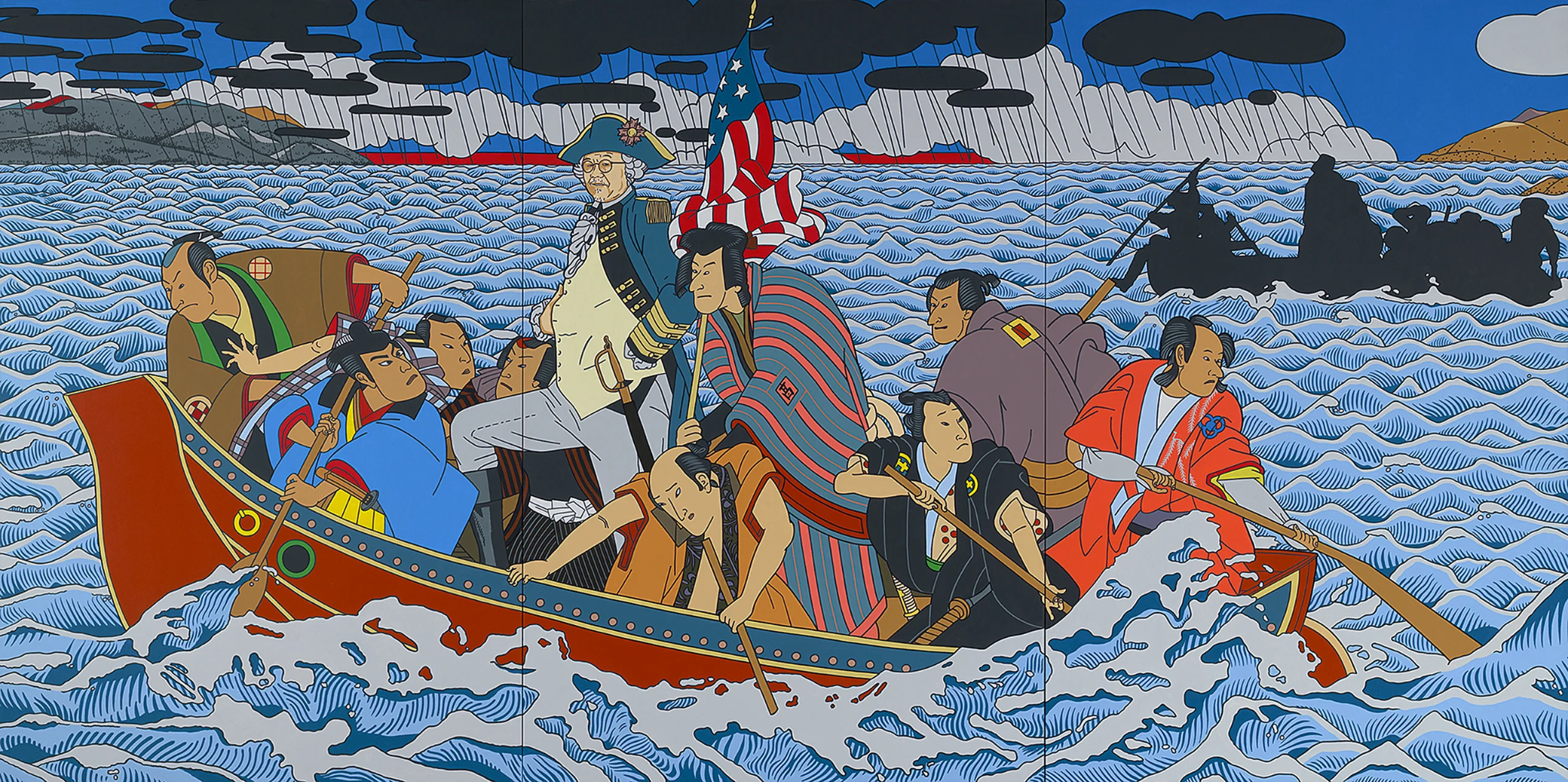
Roger Shimomura, Shimomura Crossing the Delaware Choose a weekly study guide Week 1 (Foundations) — Course ideas and learning methods Week 2 (Foundations) — Writing a strong paragraph Week 3 (Foundations) — Myths, narratives, and identity Week 4 (Ch2) — Ireland as a blueprint for colonization Week 5 (Ch2) — From civilizing missions to extermination Week 6 (Ch2) — Caliban, Prospero, and colonialism Week 7 (Ch2) — Four questions and the idea of the savage Week 8 (Ch2) — Economics and ideology in the colonies Week 9 (Ch3) — Indentured servitude and slavery Week 10 (Ch3) — Self-interest and alliances in Bacon’s Rebellion Week 11 (Ch3) — Causes and consequences of Bacon’s Rebellion Week 12 (Ch4) — Economics and ideology in American Progress Week 13 (Ch4) — Jackson and Indian removal Week 14 (Documents A) — Geography and American history, 1607–1836 Week 15 (Documents A) — Who invented race and what did it buy them? Week 16 (Review) — Semester 1 synthesis and final exams Week 17 (Ch5) — Slavery, the economy, and its beneficiaries Week 18 (Ch5) — The ideological enforcement of slavery Week 19 (Ch6) — Irish identity, economics, and racial hierarchy Week 20 (Ch7) — War with Mexico, dispossession, and resistance Week 21 (Ch7) — Continue land, labor, and resistance Week 22 (Ch8) — Chinese labor and legal exclusion Week 23 (Documents B) — Compare Irish, Mexican, and Chinese migration Week 24 (Ch9) — Native dispossession, ideology, and policy Week 25 (Ch9) — Continue the two-week dispossession aim Week 26 (Ch10) — Japanese American collective organizing Week 27 (Ch11) — Russian Jewish organizing and comparison Week 28 (Ch12) — Demanding labor while rejecting people Week 29 (Review) — ACT reading practice Week 30 (Review / Ch13) — ACT practice and the Great Migration opening Week 31 (Ch13) — Compare Great Migration push and pull factors Week 32 (Ch13) — Housing, hiring, and racial hierarchy in Chicago Week 33 (Ch14) — Japanese American incarceration during WWII Week 34 (Ch14) — Wartime economic opportunity and its limits Week 35 (Ch15) — World War II and the Civil Rights Movement Week 36 (Ch15) — Racial injustice and economic injustice Week 37 (Documents C) — How excluded people compelled change Week 38 (Review) — Semester 2 final exams and course close
Semester 2 final exams and course close Gist response
Across the course, the desire for land, workers, and profit helped shape who held power and who faced exclusion. Stories about racial differences often made unequal treatment seem acceptable, while people denied rights organized to challenge those stories and the rules built around them. The final review brings these connections together through specific examples of what people wanted, what they did, and what changed.
Words of the Day flashcards → Check Yourself · summary, quiz & sequencing ↓
Review your course notes and your Week 37 response for the final exams.
Build your response in your notebook Return to the three key course ideas and find examples in your notes. Review the evidence and explanations in your Week 37 response. Revisit the questions you still need to clarify before the final exams. Two quick models Key Idea example: Tobacco profits increased colonists’ demand for land, so growers pushed into Powhatan territory. This shows Key Idea 1 because an economic goal shaped a colonial decision. YPT 33
Question to clarify: How did legal freedom after the Civil War differ from equal treatment in practice?
Why they work: The first note ties a named event to a course idea; the second turns a broad uncertainty into a question you can answer with evidence.
Final review across the YPT reader and the course’s key ideas.
01 · Summary cloze 02 · 10 questions 03 · Put it in order Complete the explanation. A final explanation joins the course’s key ideas through concrete Summary blank 1 Choose… evidence constraints resistance choices power Summary blank 2 Choose… evidence constraints resistance choices power Summary blank 3 Choose… evidence constraints resistance choices power Summary blank 4 Choose… evidence constraints resistance choices power Summary blank 5 Choose… evidence constraints resistance choices power
Check summary Start again Show answers
Return to the reading YPT 33 YPT 57 YPT 59 YPT 70–71 YPT 154 YPT 280 YPT 298–299 YPT 301 YPT 311 Question 1 of 10 2 of 10 3 of 10 4 of 10 5 of 10 6 of 10 7 of 10 8 of 10 9 of 10 10 of 10 0 of 10 checked
Put the course-review episodes in chronological order. Drag the blocks, use the arrows, or focus a block and press Alt + ↑ / ↓.
⠿ English settlers pursue land in early Virginia. ↑ ↓
⠿ Removal expands white access to Native territory in the 1830s. ↑ ↓
⠿ World War II changes work and the politics of belonging. ↑ ↓
⠿ Postwar organizing wins specific civil rights reforms. ↑ ↓
⠿ Bacon’s Rebellion exposes colonial conflicts in 1676. ↑ ↓
⠿ Chinese laborer exclusion becomes federal law in 1882. ↑ ↓
Check order Shuffle again Show correct order
● Correct ● Close ● Needs reordering
Return to the reading YPT 33 YPT 57 YPT 59 YPT 70–71 YPT 154 YPT 280 YPT 298–299 YPT 301 YPT 311 Enable JavaScript to check answers and reorder events.