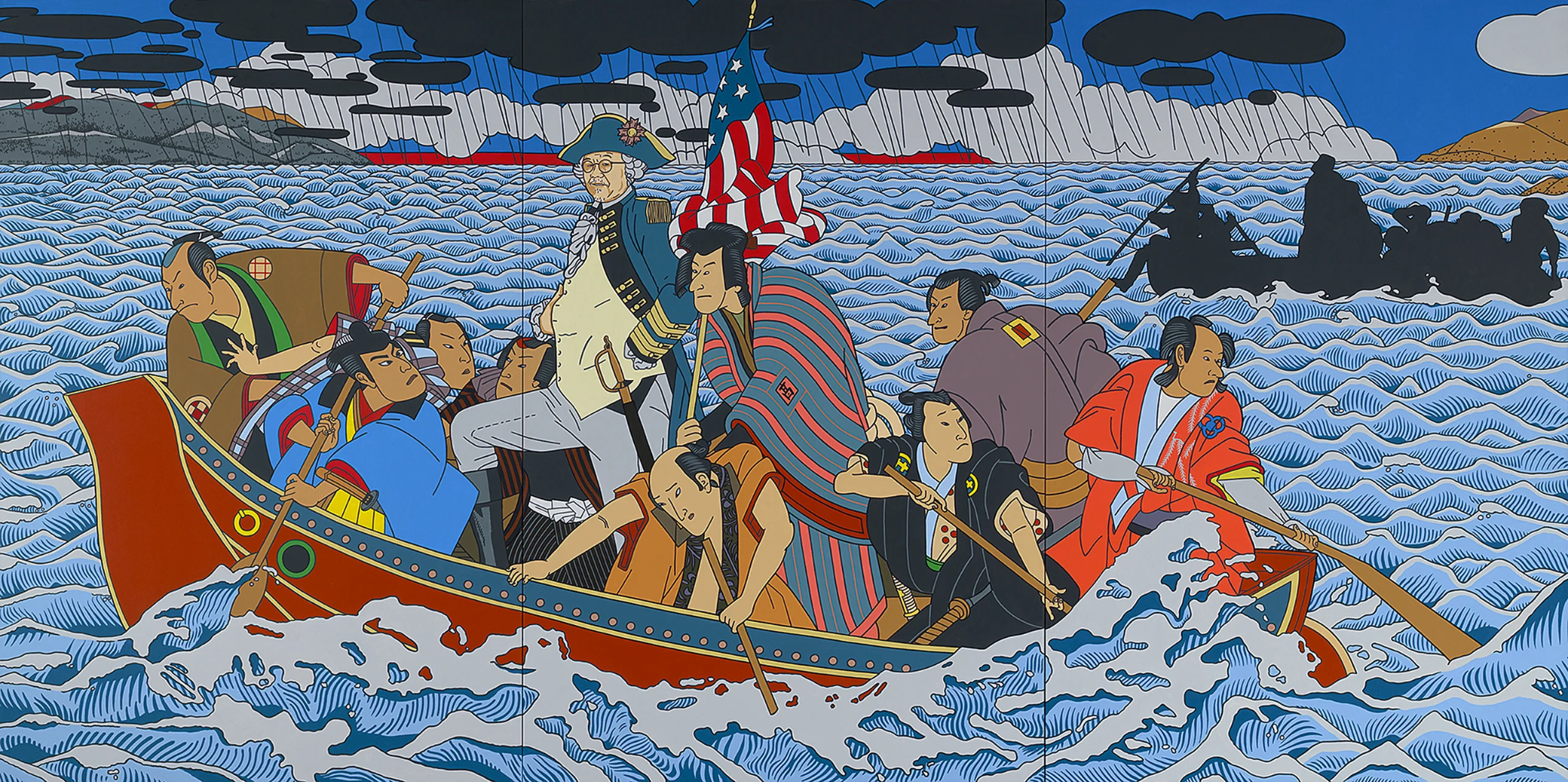
Roger Shimomura, Shimomura Crossing the Delaware Choose a weekly study guide Week 1 (Foundations) — Course ideas and learning methods Week 2 (Foundations) — Writing a strong paragraph Week 3 (Foundations) — Myths, narratives, and identity Week 4 (Ch2) — Ireland as a blueprint for colonization Week 5 (Ch2) — From civilizing missions to extermination Week 6 (Ch2) — Caliban, Prospero, and colonialism Week 7 (Ch2) — Four questions and the idea of the savage Week 8 (Ch2) — Economics and ideology in the colonies Week 9 (Ch3) — Indentured servitude and slavery Week 10 (Ch3) — Self-interest and alliances in Bacon’s Rebellion Week 11 (Ch3) — Causes and consequences of Bacon’s Rebellion Week 12 (Ch4) — Economics and ideology in American Progress Week 13 (Ch4) — Jackson and Indian removal Week 14 (Documents A) — Geography and American history, 1607–1836 Week 15 (Documents A) — Who invented race and what did it buy them? Week 16 (Review) — Semester 1 synthesis and final exams Week 17 (Ch5) — Slavery, the economy, and its beneficiaries Week 18 (Ch5) — The ideological enforcement of slavery Week 19 (Ch6) — Irish identity, economics, and racial hierarchy Week 20 (Ch7) — War with Mexico, dispossession, and resistance Week 21 (Ch7) — Continue land, labor, and resistance Week 22 (Ch8) — Chinese labor and legal exclusion Week 23 (Documents B) — Compare Irish, Mexican, and Chinese migration Week 24 (Ch9) — Native dispossession, ideology, and policy Week 25 (Ch9) — Continue the two-week dispossession aim Week 26 (Ch10) — Japanese American collective organizing Week 27 (Ch11) — Russian Jewish organizing and comparison Week 28 (Ch12) — Demanding labor while rejecting people Week 29 (Review) — ACT reading practice Week 30 (Review / Ch13) — ACT practice and the Great Migration opening Week 31 (Ch13) — Compare Great Migration push and pull factors Week 32 (Ch13) — Housing, hiring, and racial hierarchy in Chicago Week 33 (Ch14) — Japanese American incarceration during WWII Week 34 (Ch14) — Wartime economic opportunity and its limits Week 35 (Ch15) — World War II and the Civil Rights Movement Week 36 (Ch15) — Racial injustice and economic injustice Week 37 (Documents C) — How excluded people compelled change Week 38 (Review) — Semester 2 final exams and course close
ACT PREP Gist response
Reading closely means following what happens, identifying the main point, and using the passage to explain your answer. This week continues that practice, then begins the story of Black Americans moving from the South to Northern cities. After slavery ended, farm debt and racial violence still limited many Black families’ freedom, helping explain why they would seek new lives elsewhere.
Words of the Day flashcards → Check Yourself · summary, quiz & sequencing ↓
Continue ACT practice Monday–Thursday. On Friday, begin Chapter 13 with Reconstruction.
Build your response in your notebook Read the assigned passage and write a brief gist for each paragraph. For each answer, mark the words in the passage that support your choice. When you review a mistake, explain why the correct answer fits and why your first answer did not. Two quick models
Gist model: “Residents objected because the library was their only free place for books and computers.” → Library serves community
Mistake-review model: I first chose “They wanted more parking” because the passage mentioned a parking lot. But that was the town’s plan, not the residents’ reason. The evidence says the library provided free books and computers, so the answer about community access fits better.
Why they work: The gist compresses a paragraph into 1–3 words. The review names the first mistake, quotes the evidence, and explains why the better answer fits.
ACT reading practice and the start of Chapter 13. This check uses YPT; keep working with your separately assigned ACT passages in class.
01 · Summary cloze 02 · 10 questions 03 · Put it in order Complete the explanation. Practice reading causal explanations as Chapter 13 begins. Southern debt and violence were Summary blank 1 Choose… power pull segregation equality push factors Summary blank 2 Choose… power pull segregation equality push factors Summary blank 3 Choose… power pull segregation equality push factors Summary blank 4 Choose… power pull segregation equality push factors Summary blank 5 Choose… power pull segregation equality push factors
Check summary Start again Show answers
Return to the reading YPT 256–257 YPT 259–262 Question 1 of 10 2 of 10 3 of 10 4 of 10 5 of 10 6 of 10 7 of 10 8 of 10 9 of 10 10 of 10 0 of 10 checked
Order the chapter-opening causal explanation. Drag the blocks, use the arrows, or focus a block and press Alt + ↑ / ↓.
⠿ Wartime northern labor demand creates recruitment opportunities. ↑ ↓
⠿ Southern debt and racial violence encourage departure. ↑ ↓
⠿ Migrants travel toward northern cities. ↑ ↓
⠿ Workplace divisions constrain collective power despite new jobs. ↑ ↓
⠿ Housing restrictions limit where many can settle. ↑ ↓
Check order Shuffle again Show correct order
● Correct ● Close ● Needs reordering
Return to the reading YPT 256–257 YPT 259–262 Enable JavaScript to check answers and reorder events.