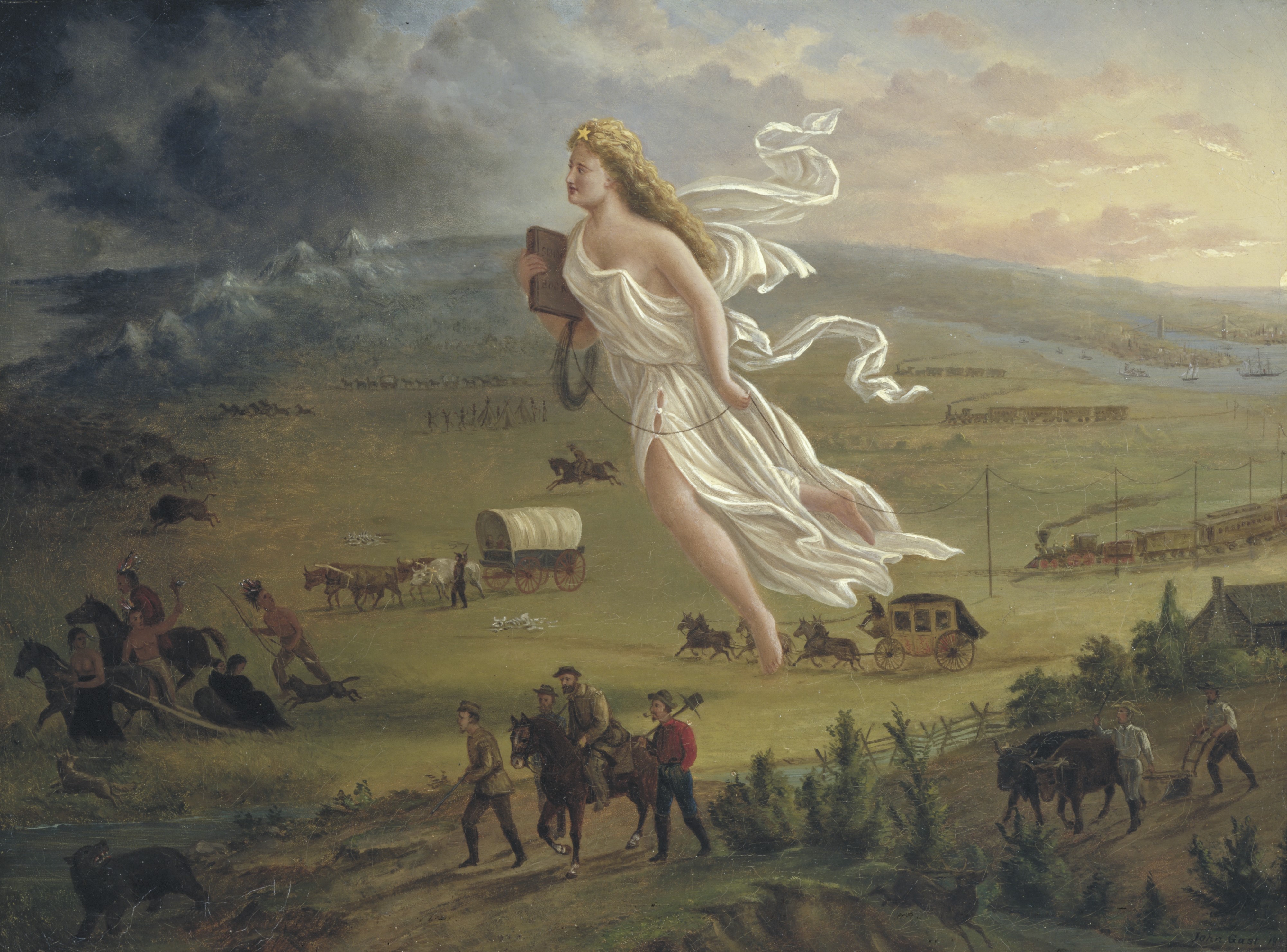
How does John Gast depict the relationship between economics and ideology in his 1872 painting American Progress?
Gist response
In American Progress, farmers, wagons, and railroads move west beneath a glowing woman, while Native people retreat into darkness. The farms and railroads suggest economic opportunity, while the woman and spreading light present expansion as the arrival of a better civilization. Gast brings money and beliefs together: the painting makes settlers’ gain of land and business look like a rightful national mission, even as Native people lose their homes.
John Gast, American Progress, 1872. The painting is the visual source; OPT supplies historical context.
Read the image; then connect the OPT context
Visual detail to examine
Interpretation to test
OPT context
Farms, wagons, railroads, and telegraph wire
Expansion promises land, transportation, and commerce.
Railroads opened agricultural and mineral regions and extended markets.OPT 94–95
The glowing woman and the movement from light toward darkness
The composition presents expansion as the spread of an enlightened civilization.
Settlers described railroad expansion and dispossession as the advance of civilization.OPT 95
Native people and animals retreating before the settlers
Economic development is shown together with displacement.
Native people experienced the railroad through the destruction of buffalo and pressure for removal.OPT 95–96
Explore the evidence
Read around each passage. Ask what it supports, what it complicates, and how you would explain the connection.
Business interests behind expansion
“Behind the "resistless" railroad were powerful corporate interests, deliberately planning the settlement of the West and the extension of the market.”
Railroad expansion involved deliberate commercial choices. Use this context to interpret the economic activity shown in Gast’s painting, while keeping visual evidence distinct from the book.
How might an image of inevitable progress hide the decisions and interests behind expansion?
Calling dispossession civilization
“All of this was seen by white settlers as the advance of civilization.”
Takaki’s account of settlers’ interpretation · OPT 95
The preceding passage describes railroad lobbying and the weakening of tribal political standing. The word civilization made those changes appear beneficial from the settlers’ perspective.
How could the painting’s contrast between light and darkness suggest a similar judgment?
Transportation and valuable land
“The building of railroads, and the access thereby given to all the agricultural and mineral regions of the country, is rapidly bringing civilized settlements into contact with all tribes of Indians.”
President Ulysses S. Grant, quoted by Takaki · OPT 94
Grant connects transportation with access to resources and settlement. Compare this language with the relationship between trains, farms, settlers, and Native people in the painting.
Which visual details suggest economic opportunity, and which suggest an ideology of civilization?
Connect a Key Idea
Economic forces shape history
Farms and railroads promise material gains; OPT identifies corporate efforts to open land and extend markets.
The painting’s light and darkness can make settlers’ economic expansion look like a moral national mission. This is an interpretation of the image, supported by comparison with the rhetoric in OPT.
Start with the gist, then make it more precise using a detail, a relationship, or a qualification from the reading.
Build the next sentence
Gast places ___ beside ___, suggesting that ___.
Although the painting presents ___ as progress, OPT shows that ___ gained while ___ lost.
Add context with an appositive
John Gast, the painter of American Progress, …
railroad companies, businesses seeking routes and new markets in the West, … OPT 95
Push your thinking
Whose viewpoint does the composition make most attractive?
What would a painting of the same expansion from a Native community’s perspective emphasize?
Write
What were Andrew Jackson's motivations for ratifying the Indian Removal Act?
Gist response
Jackson wanted Native land opened to white settlement and cotton growing, and his own wealth had grown through buying and selling land taken from Native peoples. He also claimed that moving Native people west would protect them from white society. Those economic interests and claims of protection helped him justify removal, while Native communities lost homes and control over their land.
Read with the question in mind
Jackson’s interests, policies, and stated justificationsOPT 79–82
The surrounding paragraph traces Jackson’s own land transactions and profits. It connects his personal economic position to treaties that made Native land available to settlers.
How does evidence of Jackson’s land speculation complicate his claim that removal protected Native people?
Cultivated land becomes a target
“He supported the efforts of Mississippi and Georgia to abolish Indian tribal units and allow white settlers to take cultivated Indian lands.”
Removal targeted land already cultivated by Native communities. Farming did not protect them when settlers and governments wanted control of that land.
What does the word cultivated reveal about the claim that settlers were simply improving unused land?
A claim of protection
“Jackson claimed his goal was to protect the Indians from the "mercenary influence of white men."”
Takaki’s account of Jackson’s stated justification · OPT 82
Jackson presented removal as protection and described himself as a parent. Compare that justification with his support for taking cultivated Native land.
How does presenting coercion as protection change the moral appearance of a policy?
Removal opens the Cotton Kingdom
“He was clearing the way for the rise of the Cotton Kingdom.”
Takaki’s interpretation of Jackson’s removal policy · OPT 82
Takaki connects forced removal to the expansion of cotton cultivation. Explain how a change in control of land made a profitable agricultural system possible.
Who gained access to land, and whose existing homes and farms were displaced?
Check
Connect a Key Idea
Economic forces shape history
Removal transferred control of land and opened space for cotton cultivation. This links economic interests to government policy.
The surrounding paragraph traces Jackson’s own land transactions and profits. It connects his personal economic position to treaties that made Native land available to settlers.
How does evidence of Jackson’s land speculation complicate his claim that removal protected Native people?
Removal opens the Cotton Kingdom
“He was clearing the way for the rise of the Cotton Kingdom.”
Takaki’s interpretation of Jackson’s removal policy · OPT 82
Takaki connects forced removal to the expansion of cotton cultivation. Explain how a change in control of land made a profitable agricultural system possible.
Who gained access to land, and whose existing homes and farms were displaced?
Who invented race in America and what did it buy them?
Removal targeted land already cultivated by Native communities. Farming did not protect them when settlers and governments wanted control of that land.
What does the word cultivated reveal about the claim that settlers were simply improving unused land?
A claim of protection
“Jackson claimed his goal was to protect the Indians from the "mercenary influence of white men."”
Takaki’s account of Jackson’s stated justification · OPT 82
Jackson presented removal as protection and described himself as a parent. Compare that justification with his support for taking cultivated Native land.
How does presenting coercion as protection change the moral appearance of a policy?