How were the push and pull factors driving the Great Migration similar and different to the migrations of other groups in American history?
Gist response
Black southerners moved north to escape debt, Jim Crow, and racial violence and to pursue industrial jobs and greater freedom. Like earlier migrants, they followed work and information from friends, relatives, and newspapers. Unlike immigrants crossing a national border, they were already Americans moving within their own country, yet citizenship did not protect them from racial exclusion.
World War I reduced European immigration and increased the need for workers. Employers recruited Black southerners because the labor market had changed.
How did a war across the Atlantic affect migration within the United States?
Migrants also sought dignity
“there's no chance for a coloured man who has any self-respect.”
A Black Mississippian describing life in the South, quoted by Takaki · OPT 316
The speaker connects migration to self-respect as well as wages. Jim Crow and racial violence made remaining in the South costly in ways a pay comparison alone cannot explain.
What would an explanation focused only on higher wages leave out?
Compare economic dependence in Mexico
“Forced to become tenant farmers and sharecroppers, the peasants had become especially vulnerable to exploitation.”
Takaki’s narration about Mexican peasants · OPT 293
Loss of control over land also pushed Mexican families to migrate. This resemblance does not erase the difference between crossing an international border and moving within one’s country.
Which similarity is economic, and which difference concerns citizenship and borders?
Connect a Key Idea
Economic forces shape history
Explain how northern labor demand and southern dependence on landlords worked together to make migration possible and desirable.
Start with the gist, then make it more precise using a detail, a relationship, or a qualification from the reading.
Build the next sentence
Because ___ made staying in the South difficult, migrants ___; meanwhile, ___ made the North seem possible.
Like ___, Black southerners ___; however, the migrations differed in ___.
Although northern jobs promised ___, migrants still faced ___.
Add context with an appositive
the Chicago Defender, a Black newspaper that publicized northern jobs and challenged southern racism, … OPT 314 · OPT 316
Robert Abbott, the owner of the Chicago Defender, … OPT 314
Push your thinking
Why are push and pull factors stronger explanations when connected to each other?
How did migrants’ accounts complicate a story told only through population totals?
Write
How did housing segregation, factory hiring, and divide-and-control unionism work together to rebuild racial hierarchy in Chicago, 1910–1919?
Gist response
Chicago needed Black workers, but access to work did not bring equal access to housing or power. White neighborhood organizations tried to keep Black families out, employers used racial divisions and a company union to control workers, and distrust frustrated interracial organizing. These pressures reinforced one another and helped turn competition over homes and jobs into violence.
Read with the question in mind
Housing, hiring, company unionism, and violenceOPT 319–322
White residents organized to prevent sales to Black families; threats and bombings policed neighborhood boundaries.
Black residents faced restricted choices and concentrated exposure to violence.OPT 319 · OPT 322
Factory hiring
Before the war, employers sometimes hired Black workers as strikebreakers and discharged them after strikes; wartime demand later expanded industrial jobs.
Access to jobs could depend on employers’ immediate needs and could deepen conflict among workers.OPT 320
Company unionism
Managers financed a separate Black union and warned workers against the white union.
Racial mistrust helped employers weaken a shared labor movement.OPT 321–322
Interracial organizing
The Stockyards Labor Council urged a common cause but failed to win sufficient Black participation.
Solidarity required addressing distrust; proclaiming unity was insufficient.OPT 321–322
Explore the evidence
Read around each passage. Ask what it supports, what it complicates, and how you would explain the connection.
Organize to enforce a housing boundary
“must remain white. There will be no compromise.”
A leader of the Hyde Park Improvement Protective Club, quoted by Takaki · OPT 319
The club sought to stop real estate agents from selling homes to Black families in white blocks. Residential segregation was actively enforced, rather than simply reflecting where families preferred to live.
Who had to cooperate to keep the housing boundary in place?
Use a company union to divide workers
“Seeking to keep the workforce racially divided, they hired a black promoter, Richard Parker, to set up a black company union, the American Unity Labor Union.”
Takaki’s narration about stockyard and packinghouse managers · OPT 321
Management used a separate organization to weaken interracial worker cooperation. Parker’s appeal to racial solidarity served employers’ interest in controlling labor.
How can an appeal to solidarity within one group weaken workers’ shared bargaining power?
An alternative: a common labor cause
“The bosses think that because we are of different color and different nationalities we should fight each other.”
The Stockyards Labor Council’s appeal, quoted by Takaki · OPT 321
The council identified racial division as useful to employers and urged workers to organize together. Its difficulty winning Black workers’ trust shows that a call for unity did not erase past exclusion.
Why might Black workers distrust this appeal even when cooperation could benefit them?
Workplace and neighborhood conflict reinforce each other
“Racial competition in the workplace added fuel to social antagonisms in the neighborhoods where tensions were literally beginning to explode.”
Takaki links employment conflict to residential hostility and violence. A complete explanation should connect institutions instead of treating housing and work as separate problems.
How could a hiring policy increase conflict outside the factory?
Check
Connect a Key Idea
Economic forces shape history
Managers had incentives to recruit workers and prevent a united workforce from bargaining against them.
Start with the gist, then make it more precise using a detail, a relationship, or a qualification from the reading.
Build the next sentence
Housing segregation and workplace division reinforced each other because ___.
Although industrial hiring offered ___, management’s use of ___ limited ___.
Parker appealed to ___, whereas the labor council appealed to ___; the difference mattered because ___.
Add context with an appositive
Richard Parker, the promoter hired to organize a Black company union, … OPT 321
the Stockyards Labor Council, the union that sought to recruit Black workers into an interracial labor movement, … OPT 321
Push your thinking
What evidence shows that segregation required decisions and enforcement?
Why should we distinguish a company union from an independent workers’ organization?
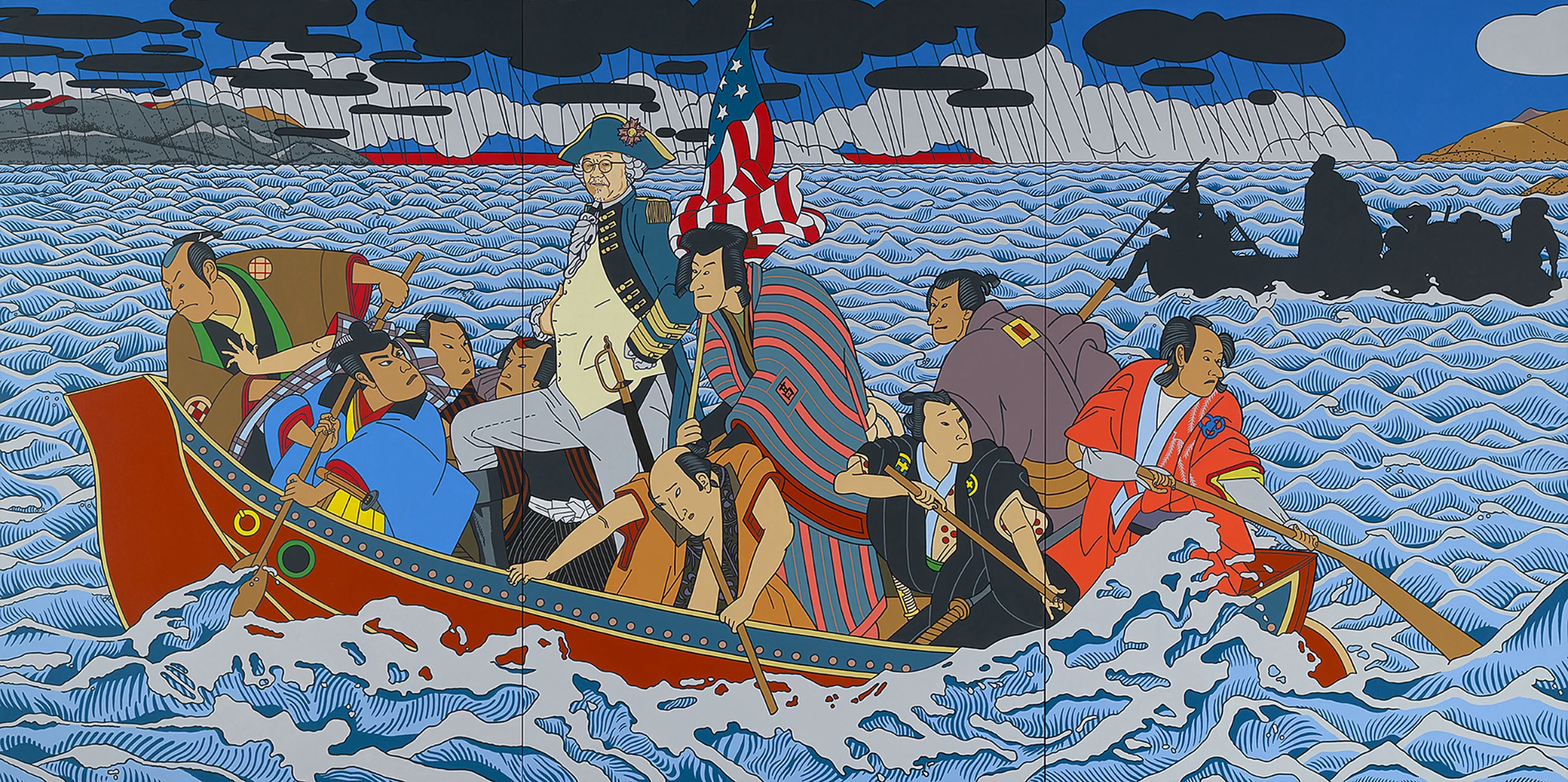
Roger Shimomura, Shimomura Crossing the DelawareHow did the people America excluded compel America to change?
Migration as a refusal of southern conditionsOPT 312–317
Efforts and barriers to interracial organizingOPT 321–322
Migrants also sought dignity
“there's no chance for a coloured man who has any self-respect.”
A Black Mississippian describing life in the South, quoted by Takaki · OPT 316
The speaker connects migration to self-respect as well as wages. Jim Crow and racial violence made remaining in the South costly in ways a pay comparison alone cannot explain.
What would an explanation focused only on higher wages leave out?
An alternative: a common labor cause
“The bosses think that because we are of different color and different nationalities we should fight each other.”
The Stockyards Labor Council’s appeal, quoted by Takaki · OPT 321
The council identified racial division as useful to employers and urged workers to organize together. Its difficulty winning Black workers’ trust shows that a call for unity did not erase past exclusion.
Why might Black workers distrust this appeal even when cooperation could benefit them?