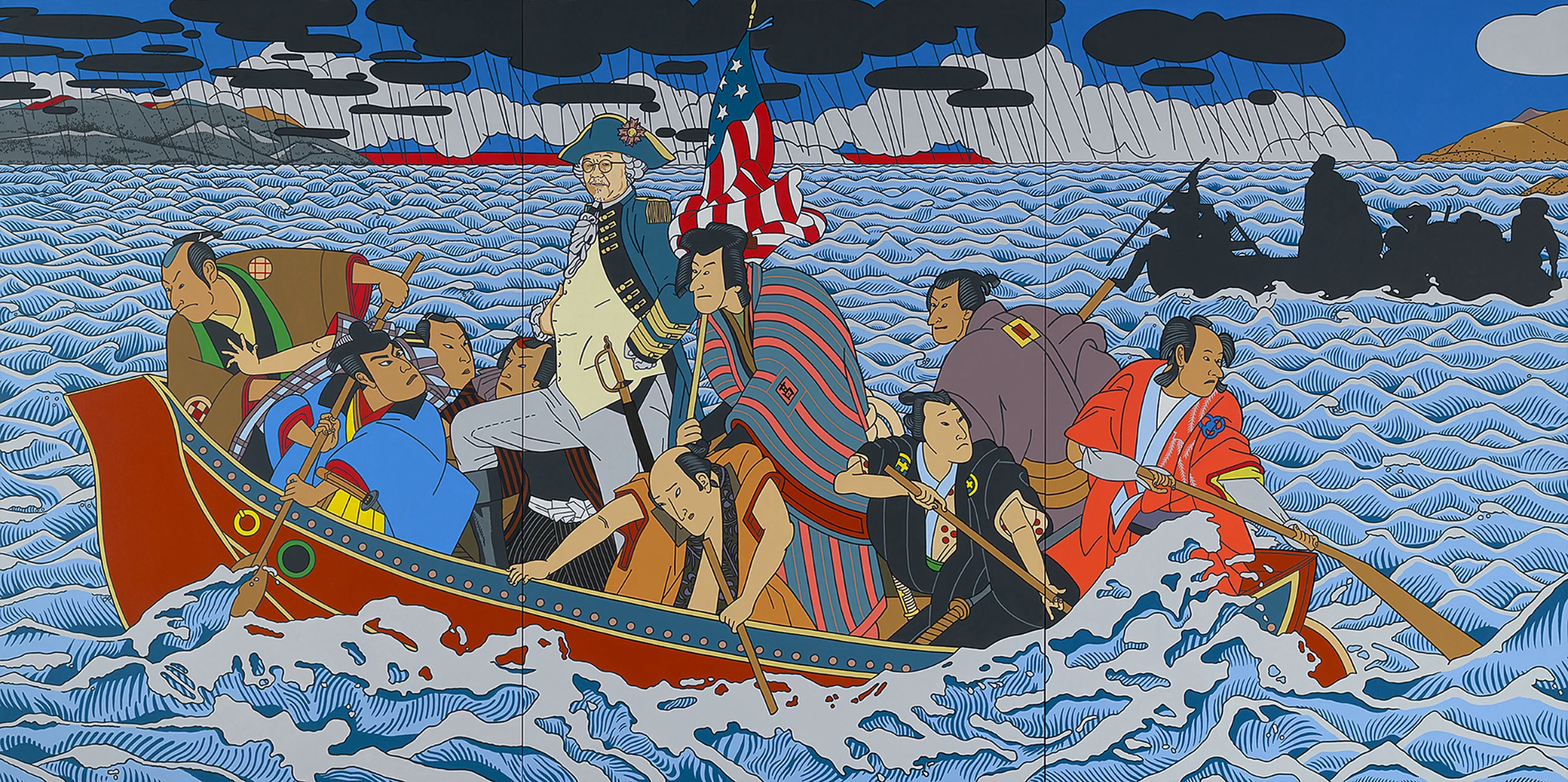
CALIBAN ALSO COULD have been Asian. "Have we devils here?" the theatergoers heard Stephano declare in The Tempest. "Do you put tricks upon's with savages and men of Inde, ha?" The war against Mexico reflected America's quest for a passage to India. During the nineteenth century, this vision inspired Senator Thomas Hart Benton of Missouri to proclaim the movement toward Asia as America's manifest destiny. The "White" race was obeying the "divine command, to subdue and replenish the earth," as it searched for new and distant lands. As whites migrated westward, Benton pointed out, they were destroying "savagery." As civilization advanced, the "Capitol" had replaced the "wigwam," "Christians" had replaced "savages," and "white matrons" had replaced "red squaws." Under the "touch" of an "American road to India," Benton exclaimed, the western wilderness would "start" into life, creating a long line of cities across the continent. Crossing the Rocky Mountains and reaching the Pacific, whites were· finally circumnavigating the earth to bring civilization to the "Yellow" race. "Orientalized," to use the concept of Edward Said, Asians had become the "Other."1
The annexation of California led to not only American expan-
sion toward Asia but also the migration of Asians to America. In a plan sent to Congress in 1848 shortly after the Treaty of Guadalupe Hidalgo, policymaker Aaron H. Palmer predicted that San Francisco, connected by railroad to the Atlantic states, would become the "great e:inporium of our commerce on the Pacific." Chinese laborers, he proposed, should be imported to build the transcontinental railroad as well as to bring the fertile lands of California under cultivation. "No people in all the East are so well adapted for clearing wild lands and raising every species of agricultural product ... as the Chinese."2
Pioneers from Asia
A year later, Chinese migrants began arriving in America, but they came for their own reasons. Many sought sanctuary from intense conflicts in China caused by the British Opium Wars. Significantly, while British colonialism was pushing Irish westward across the Atlantic, it was also driving Chinese eastward across the Pacific. Many migrants were also fleeing from the turmoil of peasant rebellions such as the Taiping Rebellion and the bloody strife between the Punti ("Local People") and the Hakkas ("Guest People") over possession of the fertile delta lands. "Ever since the disturbances caused by the Red bandits and the Kejia bandits," a Chinese government report noted, "dealings with foreigners have increased greatly. The able-bodied go abroad."3 Harsh economic conditions also drove Chinese migrants to seek survival in America. Forced to pay large indemnities to Western imperialist powers, the Qing government imposed high taxes on peasant farmers; unable to pay these taxes, many of them lost their lands. Floods intensified the suffering. "The rains have been falling for forty days," an 184 7 report to the emperor stated, "until the rivers, and the sea, and the lakes, and the streams have joined in one sheet over the land [for miles]." Behind the emigrating spirit was starvation. "The population is extremely dense," an observer explained; "the means of subsistence, in ordinary times, are seldom above the demand, and consequently, the least failure of the rice crop produces wretchedness."4 Learning about Garn Saan, "Gold Mountain," many of the younger, more impatient, and more daring Chinese left their villages for America. The migrants were mostly men, planning to work abroad temporarily. They were illiterate or had very little schooling, but they dreamed ofnew possibilities inspired by stories
of the "gold hills." To these hopeful migrants, Am~rica possessed an alluring boundlessness, promising not only gold but also opportunities for employment. Sixteen-year-old Lee Chew recalled the triumphant return of a fellow villager from the "country of the American wizards." With the money he had earned overseas, he bought land as spacious as "four city blocks" and built a palace on it. Then he invited his family and friends to a grand party where they were served a hundred roasted pigs, chickens, ducks, geese, and an abundance of dainties. Young Lee was inspired, eager to leave for this fabulous country. 5 America seemed so beckoning. During the 1860s, a Chinese laborer might earn three to five dollars a month in China; in California, he could work for the railroad and make thirty dollars a month. A folk song expressed the emotions of many migrants:
In the second reign year of Haamfung [1852], a trip to Gold Mountain was made. With a pillow on my shoulder, I began my perilous journey: Sailing a boat with bamboo poles across the sea, Leaving behind wife and sisters in search of money, No longer lingering with the woman in the bedroom, No longer paying respect to parents at home. 6
The immigrants migrated to America voluntarily as free laborers: some of them paid their own way, and probably most of them borrowed the necessary funding under the credit-ticket system. Under this arrangement, an individual borrowed money from a broker to cover the cost of transportation and then paid off the loan plus interest out of his earnings in the new country. The majority of the migrants were married. As they prepared to leave their farms and villages, they realized that they would probably not see their wives again for years. But they promised to return someday.7 And so they left China, by the hundreds of thousands. Three hundred and twenty-five Chinese migrants joined the "Forty- Niners" rushing to California. Like their counterparts from the eastern United States and elsewhere, they came to search for gold. A year later, 450 more Chinese arrived in California; then
suddenly, they came in greatly increasing numbers-2,716 in 1851, and 20,026 in 1852. By 1870, there were 63,000 Chinese in the United States. Most of them-77 percent-were living in California, but they were elsewhere in the West as well as in the Southwest, New England, and the South. The Chinese constituted a sizable proportion of the population in certain areas: 29 percent in Idaho, 10 percent in Montana, and 9 percent in California. By 1930, about 400,000 had made the Pacific crossing to America. Significantly, about half of them stayed and made the United States their permanent home. At first, there were signs that the Chinese were welcome in California. "Quite a large number of the Celestials have arrived among us of late, enticed thither by the golden romance that has filled the world," the Daily Alta California reported in 1852. "Scarcely a ship arrives that does not bring an increase to this worthy integer of our population." The paper predicted that "the China boys will yet vote at the same polls, study at the same schools and bow at the same altar as our own countrymen." Three years later, merchant Chun-Chuen Lai of San Francisco sanguinely observed that "the people of the Flowery land [ China] were received like guests," and "greeted with favor. Each treated the other with politeness. From far and near we came and were pleased."8 But Lai failed to notice the rapidly changing political climate that had begun to turn against his fellow immigrants. From the goldfields of the Sierras came the nativist cry: "California for Americans." In 1852, the California legislature enacted a second foreign miners' tax. Aimed mainly at the Chinese, this tax required a monthly payment of three dollars from every foreign miner who did not desire to become a citizen. Even if they had wanted to, the Chinese could not have become citizens, for they had been rendered ineligible to citizenship by a 1790 federal law that reserved naturalized citizenship for "whites." By 1870, California had collected five million dollars from the Chinese, a sum representing between 25 to 50 percent of all state revenue. 9 During the 1860s, twenty-four thousand Chinese, two-thirds of the Chinese population in America, were working in the California mines. Most of these miners were independent prospectors. Many organized themselves into small groups and formed their own companies. A newspaper correspondent described companies of twenty or thirty Chinese "inhabiting close cabins, so small that one ... would not be of sufficient size to allow a couple
of Americans to breathe in it. Chinamen, stools, tables, cooking utensils, bunks, etc., all huddled up together in indiscriminate confusion, and enwreathed with dense smoke, presented a spectacle." These miners worked mainly placer claims. To extract the gold, they shoveled sand from the stream into a pan or rocker and then washed away the sand and dirt until only the heavy particles of gold remained. Chinese miners became a common sight in the California foothills, especially along the Yuba River and its tributaries and in towns like Long Bar, North-east Bar, and Foster Bar. They wore blue cotton shirts, baggy pants, wooden shoes, and wide-brimmed hats and had queues hanging down their backs.10 As mining profits declined, however, the Chinese began leaving the goldfields. Thousands of them joined other Chinese migrants to work on the railroad. In February 1865, fifty Chinese workers were hired by the Central Pacific Railroad to help lay tracks for the transcontinental line leading east from Sacramento; shortly afterward, fifty more were hired. The immigrant laborers were praised by company president Leland Stanford as "quiet, peaceable, industrious, economical-ready and apt to learn all the different kinds of work" required in railroad building. "They prove nearly equal to white men in the amount of labor they perform, and are much more reliable," company superintendent Charles Crocker reported. "No danger of strikes among them. We are training them to do all kinds of labor: blasting, driving horses, handling rock as well as pick and shovel." When white workers demanded that the company stop hiring Chinese laborers, Crocker retorted: "We can't get enough white labor to build this railroad, and build it we must, so we're forced to hire them. If you can't get along with them, we have only one alternative. We'll let you go and hire nobody but them." Within two years, Crocker had hired twelve thousand Chinese, representing 90 percent of the entire workforce. The savings derived from the employment of Chinese rather than white workers was enormous. The company paid the Chinese workers thirty-one dollars a month; had management used white workers, they would have had to pay the same wages plus board and lodging, which would have increased labor costs by one-thjrd.11
The construction of the Central Pacific Railroad line was a Chinese achievement. They performed the physical labor required to lay the tracks and provided important technical labor such as operating power drills and handling explosives for boring the
tunnels through Donner Summit. The Chinese workers were, in one observer's description, "a great army laying siege to Nature in her strongest citadel. The rugged mountains looked like stupendous ant-hills. They swarmed with Celestials, shoveling, wheeling, carting, drilling and blasting rocks and earth." Time was critical to the company's interest, for the amount of payment it received in land and subsidy from the federal government was based on the miles of track it built. Determined to accelerate construction, the managers forced the Chinese laborers to work through the winter of 1866. Snowdrifts, over sixty feet tall, covered construction operations. The workers lived and worked in tunnels under the snow, with shafts for air and lanterns for light. Work was dangerous, occasionally deadly. "The snow slides carried away our camps and we lost a good many men in those slides," a company official reported matter-of-factly; "many of them we did not find until the next season when the snow melted."12 The Chinese workers went on strike that spring. Demanding wages of forty-five dollars a month and an eight-hour day, five thousand laborers walked out "as one man." The company offered to raise their wages from thirty-one to thirty-five dollars a month, but the strikers stood by their original demands. "Eight hours a day good for white men, all the same good for Chinamen," they declared. In response, the managers moved to break the strike. They wired New York to inquire about the feasibility of transporting ten thousand blacks to replace the striking Chinese. Superintendent Crocker isolated the strikers and cut off their food supply. "I stopped the provisions on them," he stated, "stopped the butchers from butchering, and used such coercive measures." Coercion worked. Virtually imprisoned in their camps in the Sierras and starving, the strikers surrendered within a week.13 Forced to return to work, the Chinese completed the railroad, the "new highway to the commerce of Asia." After they were released by the Central Pacific Railroad in 1869, thousands of them went to San Francisco, where their compatriots were already heavily involved in manufacturing. The formation of an urban Chinese community and the industrial development of the city paralleled each other. In 1860, only 2,719 Chinese resided in San Francisco, representing 7.8 percent of the Chinese population in California. Ten years later, the Chinese population in the city had soared to 12,022, a 343 percent increase. Meanwhile, San Francisco had begun to develop as a locus of industry: in 1860, it had about two hundred manufacturing firms employ-
ing some fifteen hundred workers. Ten years later, with nearly one-fourth of California's Chinese population living there, San Francisco had more than twelve thousand laborers employed in industrial production and was the ninth leading manufacturing city in the United States. Half of the labor force in the city's four key industries-boot and shoe, woolens, cigar and tobacco, and sewing-was Chinese.14 Meanwhile, in the rural regions the Chinese were helping to develop California's agriculture. Between 1860 and 1880, hundreds of Chinese were able to become farmers through tenancy, which offered a way to enter the business with minimum capital. "We found the broad fields apportioned off and rented to separate companies of Chinamen who were working them upon shares-each little company having its own cabin," an observer reported in 1869. "Teams being furnished them, they do all the working, preparing the ground, seeding, tending the crop, and gathering the fruit, leaving nothing for the proprietor to do but to attend to the marketing, and to put into his own pocket half of the proceeds."15 Most of the Chinese engaged in agriculture were laborers. They helped to transform farming in California from wheat to fruit. "They were a vital factor," historian Carey McWilliams wrote, "one is inclined to state the vital factor, in making the transition possible." Experienced farmers in the Pearl River Delta before coming to America, the Chinese shared their agricultural knowledge with their white employers, teaching them how to plant, cultivate, and harvest orchard and garden crops.16
Indeed, the Chinese built the agricultural industry of California. In the San Joaquin and Sacramento river deltas, they constructed networks of irrigation canals and miles of dikes and ditches. Wielding shovels and working waist-deep in water, they drained the tule swamps and transformed the marshes into agricultural lands. In 1869, a writer for the Overland Monthly acknowledged the change in the landscape wrought by the Chinese: "The ditches and dykes which at present protect only a few little patches here and there of the most fruitful soil that the sun shines on, may be made to perform a like service all over the Tulare swamps; and the descendants of the people who drained those almost limitless marshes on either side of their own swiftlyflowing Yellow River, and turned them into luxuriant fields, are able to do the same thing on the banks of the Sacramento and the San Joaquin." In the Salinas Valley, Chinese laborers dug six miles of ditches to drain the land, cutting the peat soil "with huge
knife-like spades and pitching it out with steel forks and hooks." Their work boosted the value of the land from $28 per acre in 1875 to $100 per acre two years later.17 In 1869, the Overland Monthly described the ubiquitous presence of Chinese laborers in California agriculture: "Visit a hop plantation in the picking season, and count its 50, 60, or 70 pickers in the garb of the eastern Asiatics, working steadily and noiselessly on from morning till night, gathering, curing and sacking the crop .... Go through the fields of strawberries ... the vineyards and orchards, and you will learn that most of these fruits are gathered or boxed for market by this same people." In 1880, the Chinese represented 86 percent of the agricultural labor force in Sacramento County, 85 percent in Yuba, and 67 percent in Solano.18 Though they were paid low wages, Chinese farm laborers did not always passively accept what their employers offered them. In 1880, fruit pickers in Santa Clara County went out on strike for higher wages. After the 1882 Chinese Exclusion Act reduced the supply of farm labor, Chinese agricultural workers demanded higher rates for their wages. In 1900, the Bureau of Labor Statistics reported: "Relieved, by the operation of the Exclusion Acts, in great measure from the pressing competition of his fellowcountrymen, the Chinese worker was not slow to take advantage of circumstances and demand in exchange for his labor a higher price, and, as time went on, even becoming Americanized to the extent of enforcing such demands in some cases through the medium of labor organization."19 Meanwhile, Chinese workers became targets of white labor resentment, especially during hard times. "White men and women who desire to earn a living," the Los Angeles Times reported on August 14, 1893, "have for some time been entering quiet protests against vineyardists and packers employing Chinese in preference to whites." Their protests soon became violent as economic depression led to brutal anti-Chinese riots by unemployed white workers throughout California. From Ukiah to the Napa Valley to Fresno to Redlands, Chinese were beaten and shot by white workers and often loaded onto trains and shipped out of town. These immigrants bitterly remember this violence and expulsion as the "driving out."20
"Ethnic antagonism" in the mines, factories, and fields forced thousands of Chinese into self-employment-stores, restaurants, and especially laundries. Chinese washhouses were a common
sight as early as the 1850s. By 1890, there were sixty-four hundred Chinese laundry workers in California, representing 69 percent of all laundry workers. During this period, the ratio of Chinese laundry workers to all Chinese workers jumped from one out of every seventeen to one out of every twelve. 21 The "Chinese laundryman" was an American phenomenon. "The Chinese laundryman does not learn his trade in China; there are no laundries in China," stated Lee Chew who came to America in the early 1860s. "The women there do the washing in tubs and have no washboards or flat irons. All the Chinese laundrymen here were taught in the first place by American women just as I was taught." In China, observed Chin Foo Wong of New York, laundry work was a "woman's occupation," and men did not "step into it for fear of losing their social standing."22 Why did Chinese men in America enter this line of work? Unlike the retail or restaurant business, a laundry could be opened with a small capital outlay of from seventy-five to two hundred dollars. The requirements were minimal: a stove, trough, dry room, sleeping apartment, and a sign. A Chinese laundryman did not need to speak much English to operate his business. "In this sort of menial labor," said one, "I can get along speaking only 'yes' and 'no.'" He could also manage without knowing numbers. "Being illiterate, he could not write the numbers," another laundryman said, describing a fellow operator. "He had a way and what a way! See, he would draw a circle as big as a half dollar coin to represent a half dollar, and a circle as big as a dime for a dime, and so on. When the customers came in to call for their laundry, they would catch on to the meaning of the circles and pay accordingly."23
But "Chinese laundrymen" were also "pushed" into their occupation. Laundry work was one of the few opportunities that were open to Chinese. "Men of other nationalities who are jealous of the Chinese have raised such a great outcry about Chinese cheap labor that they have shut him out of working on farms or in factories or building railroads or making streets or digging sewers," explained Lee Chew. "So he opens a laundry." Thus the "Chinese laundry" represented a retreat into self-employment from a narrowly restricted labor market. "You couldn't work in the cigar factories or the jute or woolen mills any more-all the Chinese had been driven out," old Chinese men later sadly recalled. "About all they could be was laundrymen or vegetable peddlers then." Racial discrimination drove Chinese into work they disdained as degrading to them as men. 24
While most Chinese lived in the West, they were present elsewhere in the United States, including the South. A year after the end of the Civil War, a planter declared: "We can drive the niggers out and import coolies that will work better at less expense, and relieve us from the cursed nigger impudence." The plan was to turn from black to Chinese labor. "Emancipation has spoiled the negro and carried him away from the fields of agriculture," the editor of the Vicksburg Times in Mississippi complained in 1869. "Our prosperity depends entirely upon the recovery oflost ground, and we therefore say let the Coolies come." That same year, the southern planters' convention in Memphis announced that it was "desirable and necessary to look to the teeming population of Asia for assistance in the cultivation of our soil and the development of our industrial interests." In his address to the convention, labor contractor Cornelius Koopmanshoop announced that his company had imported thirty thousand Chinese laborers into California and offered to make them available in the South. 25
Planters soon saw that the Chinese could be employed as models for black workers: hardworking and frugal, the Chinese would be the "educators" of former slaves. During the 1870s, Louisiana and Mississippi planters imported several hundred Chinese laborers and pitted them against black workers. They praised the foreign workers for outproducing blacks and for "regulating" the "detestable system of black labor." A southern governor frankly explained: "Undoubtedly the underlying motive for this effort to bring in Chinese laborers was to punish the negro for having abandoned the control of his old master, and to regulate the conditions of his employment and the scale of wages to be paid him." An editor in Kentucky spoke even more bluntly when he predicted that the introduction of Chinese labor would change the "tune" from "'forty acres and a mule'" to "'work nigger or starve.'" Planters welcomed their new workers. "Messrs. Ferris and Estell, who are cultivating on the Hughs place, near Prentiss," a Mississippi newspaper reported in 1870, "recently imported direct from Hong Kong, a lot of Chinese, sixteen in number, with whom as laborers, they are well pleased."26 The Chinese did not stay long on the plantations, however. As early as 1871, the New Orleans Times noted that the Chinese preferred to work in the city rather than do the "plodding work of the plantations." In 1880, about a hundred Chinese were living in New Orleans, where they worked as laundrymen, cigar makers, shoemakers, cooks, and woodcarvers. By then the southern plant-
ers had overthrown Reconstruction; with their political power over blacks restored, they quickly lost interest in Chinese labor.27 The use of Chinese labor and its success raised two crucial questions. "What shall we do with them is not quite clear yet," remarked Samuel Bowles in 1869 in his book Our New West. "How they are to rank, socially, civilly, and politically, among us is one of the nuts for our social science students to crack, -if they can." And what would happen to white workers as America's industrial development depended more and more on Chinese labor?28 One answer to both questions was the concept of a yellow proletariat in America. According to this view, the Chinese would constitute a permanently degraded caste labor force. They would be in effect a unique "industrial reserve army" of migrant laborers forced to be foreigners forever. Thus, unlike European immigrant laborers, the Chinese would be a politically proscribed labor force. Serving the needs of American employers, they would be here only on a temporary basis. "I do not believe they are going to remain here long enough to become good citizens," Central Pacific manager Charles Crocker told a legislative committee, "and I would not admit them to citizenship." The employers of Chinese labor argued that they did not intend to allow the migrants to remain and become "thick" (to use Cracker's term) in American society.29 The advocates of Chinese labor offered assurances to white laborers. They explained that Chinese "cheap" labor would reduce production costs, and the resulting low prices for goods would be equivalent to a wage increase for white workers. They also argued that Chinese labor would upgrade white labor, for whites would be elevated to foremen and directors. "If society must have 'mudsills,"' they elaborated, "it is certainly better to take them from a race which would be benefited by even that position in a civilized community, than subject a portion of our own race to a position which they have outgrown." Charles Crocker explained:
I believe that the effect of Chinese labor upon white labor has an elevating instead of degrading tendency. I think that every white man who is intelligent and able to work, who is more than a digger in a ditch ... who has the capacity of being something else, can get to be something else by the presence of Chinese labor .... There is proof of that in the fact that after we got Chinamen to work, we took the more intelligent of the white laborers and made foremen of them. I know of several of them now who never expected, never had a dream that they were going to be anything but shovelers
of dirt, hewers of wood and drawers of water, and they are now respectable farmers, owning farms. They got their start by controlling Chinese labor on our railroad. 30
What enabled businessmen like Crocker to degrade the Chinese into a subservient laboring caste was the dominant ideology that defined America as a racially homogeneous society and Americans as white. The status of racial inferiority assigned to the Chinese had been prefigured in the black and Indian past. 31
Indeed, the newcomers from a Pacific shore found that racial qualities previously assigned to blacks had become "Chinese" characteristics. Calling for Chinese exclusion, the San Francisco Alta warned: "Every reason that exists against the toleration of free blacks in Illinois may be argued against that of the Chinese here." White workers referred to the Chinese as "nagurs," and a magazine cartoon in California depicted the Chinese as a bloodsucking vampire with slanted eyes, a pigtail, dark skin, and thick lips. The Chinese were described as heathen, morally inferior, savage, childlike, and lustful. Chinese women were condemned as a "depraved class," their immorality associated with a physical appearance "but a slight removal from the African race."32 Like blacks, Chinese men were viewed as threats to white racial purity. At the 1878 California Constitutional Convention, John F. Miller warned: "Were the Chinese to amalgamate at all with our people, it would be the lowest, most vile and degraded of our race, and the result of that amalgamation would be a hybrid of the most despicable, a mongrel of the most detestable that has ever afflicted the earth." Two years later, lawmakers prohibited marriage between a white person and a "negro, mulatto, or Mongolian."33 In the minds of many whites, the Chinese were also sometimes associated with Indians. The editor of the California Marin Journal declared that the winning of the West from the "red man" would be in vain if whites were now to surrender the conquered land to a "horde of Chinese." Policies toward Indians suggested a way to solve the "Chinese Problem." "We do not let the Indian stand in the way of civilization," stated former New York governor Horatio Seymour, "so why let the Chinese barbarian?" In a letter published in the New York Times, Seymour continued: "Today we are dividing the lands of the native Indians into states, counties, and townships. We are driving off from their property the game upon which they live, by railroads. We tell them plainly, they must
give up their homes and property, and live upon corners of their own territories, because they are in the way of our civilization. If we can do this, then we can keep away another form of barbarism which has no right to be here." A U.S. senator from Alabama "likened" the Chinese to Indians, "inferior" socially and subject to federal government control. The government, he argued, should do to the Chinese what it had already done to the Indians-put them on reservations. 34 All three groups-blacks, Indians, and Chinese-shared a common identity: they were all Calibans of color. This view was made explicit in the 1854 California Supreme Court decision of People v. Hall. A year before, George W. Hall and two others were tried for murdering Ling Sing. During the trial, one Caucasian and three Chinese witnesses testified for the prosecution. After the jury returned a guilty verdict, the judge sentenced Hall to be hanged. Hall's lawyer then appealed the verdict, arguing that the Chinese witnesses should not have been permitted to testify against Hall. An existing California statute provided that "no black or mulatto person, or Indian, shall be permitted to give evidence in favor of, or against, any white person," and the question was whether this restriction included the Chinese. In its review, the California Supreme Court reversed Hall's conviction, declaring that the words "Indian, Negro, Black, and White" were "generic terms, designating races," and that therefore "Chinese and other people not white" could not testify against whites. 35 This view of a shared racial status among all three groups led President Rutherford B. Hayes to warn Americans about the "Chinese Problem." The "present Chinese invasion," he argued in 1879, was "pernicious and should be discouraged. Our experience in dealing with the weaker races-the Negroes and Indians-is not encouraging. I would consider with favor any suitable measures to discourage the Chinese from coming to our shores."36 Three years later, Congress passed the Chinese Exclusionary Act, which prohibited the entry of Chinese laborers. Actually, there was very little objective basis for viewing Chinese immigrants as a threat to a homogeneous white society. The Chinese constituted a mere .002 percent of the U.S. population in 1880. Restriction was rooted in racism. Behind the exclus.ion act were fears and forces that had little relationship to the Chinese. Something had gone wrong in America, and an age of economic opportunity seemed to be coming to an end. This country had been a place where an abundance of
land and jobs had always been available. But suddenly, during the closing decades of the nineteenth century, society was experiencing what historian John A. Garraty called "the discovery of unemployment." This new reality plunged America into a national crisis. Enormous expansions of the economy had been followed by intense and painful contractions: tens of thousands of men and women were thrown out of work, and social convulsions such as the violent 1877 Railroad Strike rocked the nation. 37 Within this context of economic crisis and social strife, Congress made it unlawful for Chinese laborers to enter the United States for the next ten years and denied naturalized citizenship to the Chinese already here. Support for exclusion was overwhelming. In the debate, lawmakers revealed fears that went much deeper than race. They warned that the presence of an "industrial army of Asiatic laborers" was exacerbating class conflict between labor and capital within white society. They claimed that white workers had been "forced to the wall" by corporations employing Chinese. The struggle between labor unions and the industrial "nabobs" and "grandees" was erupting into "disorder, strikes, riot and bloodshed." "The gate," nervous men in Congress declared, "must be closed." The specter of the "giddy multitude" was haunting American society again. Six years later, the prohibition was broadened to include "all persons of the Chinese race," although exemptions were provided for Chinese officials, teachers, students, tourists, and merchants. Renewed in 1892, the Chinese Exclusion Act was extended indefinitely in 1902.38 Meanwhile, contrary to the stereotype of Chinese passivity, the Chinese fought discrimination. Time and again, they took their struggle for civil rights to court. Believing that the Chinese should be entitled to citizenship, they challenged the 1790 Naturalization Law. In 1855, Yong Chan applied for citizenship in San Francisco's federal district court. The local newspapers noted that he was more "white" in appearance than most Chinese. The court denied him citizenship, however, ruling that the 1790 law restricted citizenship to "whites" and that the Chinese were not "white." Seeking federal legislation to abolish discriminatory state laws, Chinese merchants successfully lobbied Congress to include protections for them in the 1870 Civil Rights Act, which declared that "all persons" within the jurisdiction of the United States shall have "the same right" to "make and enforce contracts, to sue, be parties, give evidence, and to the full and equal benefit of all laws and proceedings for the security of person and
property as is enjoyed by white citizens." Furthermore, "no tax" shall be imposed "by any State upon any person immigrating thereto from a foreign country which is not equally imposed and enforced upon every person emigrating to such State from any other foreign country, and any law of any State from any other foreign country is hereby declared null and void." The new federal law voided the foreign miners' tax. 39 But guarantees of equal protection by federal law had little effect on what actually happened in society. The Chinese continued to be vulnerable, victims of racial violence. Blamed as "the source of the troubles" of white workingmen, the Chinese suffered from racial attacks. They had to flee from boys who threw rocks at them and screamed, "God Damn Chinamen." "When I first came," Andrew Kan recounted, "Chinese treated worse than dog. Oh, it was terrible, terrible. At that time all Chinese have queue and dress same as in China. The hoodlums, roughnecks and young boys pull your queue, slap your face, throw all kind of old vegetables and rotten eggs at you." "The Chinese were in a pitiable condition in those days," recalled Kin Huie in his account of San Francisco's Chinatown during the 1870s. "We were simply terrified; we kept indoors after dark for fear of being shot in the back. Children spit upon us as we passed by and called us rats."40 In general, the unwelcome newcomers were apprehensive about settling in America. As a Chinese merchant in San Francisco explained, the immigrants did not find "peace in their hearts in regard to bringing families."41
Twice a Minority: Chinese Women in America
A few Chinese women did come to Gold Mountain. In 1852, of the 11,794 Chinese in California, only seven were women. Eighteen years later, of 63,199 Chinese in the United States, 4,566 were female-a ratio of fourteen to one. In 1900, of the 89,863 Chinese on the United States mainland, only 4,522, or 5 percent, were female. Chinese tradition and culture limited migration for women. Confucianism defined the place of a woman: she was instructed to obey her father as a daughter, her husband as a wife, and her eldest son as a widow.· According to custom, the afterbirths of children were buried in different places, depending on the sex of the baby-in the floor by the bed for boys and outside the window for girls. This practice symbolized what was expected to happen to
a woman: she would leave her home to join the family of her husband. As a daughter-in-law, she would take care of her husband's aging parents. "A boy is born facing in; a girl is born facing out," said a proverb. A daughter's name was not recorded on her family tree; it was entered later next to her husband's name in his genealogy. 42 Women were also left behind because it would have been too expensive for them to accompany their husbands, and the men thought they would be gone only temporarily. Moreover, according to an explanation sometimes known as the "hostage theory," women were kept home in order to ensure that their absent husbands would not become prodigal sons in America. The Chinese system of patrilineal descent provided for the equal division of a family's land among all adult sons and the sharing ofresponsibility for their elderly parents. By keeping the wives and children of their sons at home, parents hoped they would be able to buttress family ties and filial obligations: their wandering sons would send money home and also return someday. "The mother wanted her son to come back," explained Mau Yun Len, a Chinese immigrant woman. Married to Too Shing Len, she continued: "If wife go to America, then son no go back home and no send money.''43
There were also conditions in America that discouraged women from joining their husbands. In California, Chinese men entered a society of harsh frontier conditions and racial hostility. As railroad and farm workers, they were viewed by employers as temporary and migratory. The very nature of their work rendered it difficult to have families here. But even if they had wanted to bring their wives, the men discovered that many whites viewed America as a "white man's country" and perceived the entry of Chinese women and families as threatening to racial homogeneity. Federal immigration policies had been enacted to bar Chinese women. Passed in 1875 to prohibit the entry of prostitutes, the Page Law was enforced so strictly and broadly that it excluded not only Chinese prostitutes but also Chinese wives. The 1882 prohibition of"Chinese laborers" included women.44 Earlier, however, some Chinese men had been able to bring their wives to America or to have women sent here to become their wives. Ah Chew came to California in 1854 when he was fifteen years old. After he decided to settle down in the Sacramento Delta, his grandson explained, he went back to "China on a sailboat to marry, and then brought his wife over here." Similarly, in 1862, Gee-Hee Chin came to Washington where he worked in
a lumber mill. Within a few years, he sent for a wife and got her a job as a cook in the mill's cookhouse. In 1875, Mrs. Chin gave birth to their son, Lem Chin, believed to be the first Chinese born in the Washington Territory. In 1869, A. W. Loomis reported the case of "a wife coming all the way alone across the stormy sea" to be with her husband. "Friends at home besought her not to do a thing so in conflict with Chinese custom; the husband and his relatives in this country, when they heard of her purpose, wrote entreating her not to expose herself to the hardships and perils on the sea, and to the trials which would be liable to befall her here; but she answered that where the husband was there she had a right to be." She came to California where she supported herself and her child by sewing garments and making cigarettes while her husband worked for a mining company in the Kern River area. In America, Chinese families were gradually forming as men began to leave mining and railroad construction and enter more stable pursuits like farming and shopkeeping. As early as 1876, in its memorial to President Ulysses S. Grant, the Chinese Six Companies noted the presence of "a few hundred Chinese families" in the country, and added: "There are also among us a few hundred, perhaps a thousand, Chinese children born in America."45 During the early decades, most of the Chinese women came alone, often forcibly transported to America as prostitutes. After arriving, they were compelled to sign contracts to pay for the cost of transportation and became sexual indentured servants. One of them, Ah So Wong, described her tragic experience: "I was nineteen when this man came to my mother and said that in America there was a great deal of gold .... He was a laundryman, but said he earned plenty of money. He was very nice to me, and my mother liked him, so my mother was glad to have me go with him as his wife. I thought that I was his wife, and was very grateful that he was taking me to such a grand, free country, where everyone was rich and happy." Then two weeks after Ah So Wong arrived in San Francisco, she was shocked to learn that her companion had taken her to America as a "slave" and that she would be forced to work as a prostitute. 46 Chinese prostitutes worked in the mining outposts, agricultural villages, and in .the Chinatowns of Sacramento, Marysville, and San Francisco. Dressed in fancy clothes and jewelry, some prostitutes worked in high-class brothels. "And every night, seven o'clock, all these girls were dressed in silk and satin, and sat in front of a big window," recalled Lilac Chen who had been brought
to San Francisco in 1893 by a brothel owner, "and the men would look in and choose their girls who they'd want for the night." Most prostitutes worked in lower-grade brothels or in "cribs" -4-by-6foot street-level compartments with their windowed doors covered with bars or heavy screens. Dressed in cotton tunics and trousers, women peered from the windows, promising men pleasure for twenty-five or forty cents: "Lookee two bits, feelee floor bits, doee six bits." They were fed two or three times a day, their dinner usually consisting of rice and a stew of pork, eggs, liver, and kidneys.47 Virtual slaves, many of the prostitutes became opium addicts, seeking a drug-induced psychic sanctuary from the daily abuse and degradation. Disease was a constant threat: syphilis and gonorrhea were widespread. Life was dangerous and sometimes short. Occasionally, prostitutes were beaten to death by their customers or owners, and others committed suicide by taking an overdose of drugs or drowning themselves in San Francisco Bay.48
In the 1870 census manuscripts, 61 percent of the 3,536 Chinese women in California listed their occupation as "prostitute." But the number of Chinese prostitutes in California decreased significantly. By 1880, only 24 percent of the 3,171 Chinese women in the state were designated as "prostitute" in the census. The number of adult Chinese females listed as "housekeepers" more than doubled from 21 percent in 1870 to 46 percent in 1880. Many prostitutes had been able to pay off their debts of indentured servitude and free themselves. Marriages and children became possibilities for them. A Chinese folk song urged Chinese prostitutes to seek husbands and a safer life:
Prostitution ruins the body most harmfully. My advice is to get hitched to a man. We've all witnessed the frequent raids of brothels in the Golden Gate; You need not to worry about these roughnecks once you live with a man. 49
The problem for Chinese men was that there were too few Chinese women. "In all New York there are less than forty Chinese women," Lee Chew commented bitterly, "and it is impossible to get a Chinese woman out here [to the United States] unless one goes to China and marries her there, and then he must collect
affidavits to prove that she is really his wife. That is in the case of a merchant. A laundryman can't bring his wife here under any circumstances." Protesting the legislation prohibiting the entry of Chinese women, a Chinese man asked: "What Chinese going do for wife?" For the overwhelming majority of Chinese men, their future would not include a family in their adopted country. "Pathetic the lonely bachelors stranded in a foreign land," reflected a Cantonese rhyme. 50
A Colony of "Bachelors"
Though they generally considered themselves sojourners, the Chinese showed signs of settling down from the very beginning. During the 1850s, Chinatown in San Francisco was already a bustling colony of thirty-three general merchandise stores, fifteen apothecaries, five restaurants, five herb shops, three boarding houses, five butcher stores, and three tailor shops. A traveler reported that the stores were "stocked with hams, tea, dried fish, dried ducks, and other Chinese eatables, besides copper pots and kettles, fans, shawls, chessmen, and all sorts of curiosities. Suspended over the doors were brilliantly-colored boards covered with Chinese writings, and with several yards of red ribbon streaming from them, while the streets thronged with Celestials, chattering vociferously as they rushed about from store to store." A Chinese immigrant, arriving in San Francisco in 1868, found a thriving and colorful Chinatown, "made up of stores catering to the Chinese only." The people were "all in their native costume, with queues down their backs," and the entire street fronts of the stores were open, with groceries and vegetables overflowing on the sidewalks. Every morning, vegetable peddlers could be seen in the streets, wearing "loose pajamalike" clothes and "carrying two deep baskets of greens, fruits, and melons, balanced on their shoulders with the help of a pole."51 Nine years later, the Chinese quarter of San Francisco was six blocks long, running from California Street to Broadway. Travelers' reports described a foreign community. All day long and often until late at night, the streets were crowded with people. With shaven crowns and neatly braided queues, men sauntered "lazily along, talking, visiting, trading, laughing, and scolding in the strangest, and, to an American, the most discordant jargon." The stores and shops had signs with euphonious and poetic names. Adorning the entrances of wholesale houses were signs for
"everlasting harmony, producing wealth," "unitedly prospering," "the flowery fountain," and "ten thousand profits." Apothecary shops offered assurances: "The hall of the approved medicines of every province and of every land." Restaurants described their culinary delights: "Fragrant almond chamber." "Chamber of the odors of distant lands." "Fragrant tea chamber." Fan Tan saloons enticed men with dreams of quick wealth: "Get rich, please come in," "Riches ever flowing." On the glass windows and doors of their stalls, opium dealers pasted red cards: "Opium dipped up in fractional quantities. Foreign smoke in broken parcels. No. 2 Opium to be sold at all times." Scrolls on the walls of stores announced: "Ten thousand customers constantly arriving. Let rich customers continually come."52 The immigrants also built Chinatowns in rural towns like Sacramento, Marysville, and Stockton, where these business communities served the needs of Chinese miners and farmers. By 1860, there were 121 Chinese merchants, storekeepers, and grocers in the three counties of Sacramento, Yuba, and San Joaquin. Twenty years later, their number had increased by 44 percent to 174. In addition, there were 22 restaurant keepers, 54 butchers and fish sellers, and 564 laundrymen and laundresses. 53 Organizations abounded in the Chinatowns. Tongs were present almost from the very beginning: in 1852, the first secret society, the Kwang-tek-tong, was founded in California. Originally underground antigovernment movements in the homeland, the tongs served a particular need in Chinese America. "We are strangers in a strange country," explained a tong member. "We must have an organization to control our country fellows and develop our friendship." A laundry worker said he had decided to join a tong because it offered friendship and support to Chinese migrants in an unfamiliar land. Tongs also provided protection. "Occasionally members of the tongs use their organization to take advantage of non-members of tongs," said a Chinese. Meeting the needs of immigrants, tongs proliferated in the United States. Extending their activities beyond mutual assistance, they came to control the opium trade as well as gambling and prostitution in the Chinese communities. 54 The immigrants also formed fongs, organizations composed of family and village members, and clans, larger groups of village associations. These associations maintained clubhouses that functioned as residences and social centers. They established temples, transmitted letters to villages in China, and shipped home the bodies or bones of the deceased. In addition, district associa-
tions were responsible for receiving newcomers, providing initial housing, finding employment, and administering the "creditticket" system to make certain all the migrant's debts had been paid before he returned to China. In San Francisco, the district associations were later organized into the Chung Wai Wui Koon, known popularly as the Chinese Six Companies. This organization helped settle interdistrict conflicts and provided educational and health services to the community. The leaders of the Chinese Six Companies were merchants who interacted with the city's white business community and had access to public officials. Gradually, the Chinese were creating their own communities in America. They built altars to honor their gods and celebrated traditional holidays. During Chinese New Year in January or February, they ushered in the New Year with lion dances and firecrackers. During the celebration, whites also joined the festive throngs in Chinatown. "The merchants," said Loomis, "appear highly delighted to see and to welcome all of our citizens whom they can recognize as friends, and all with whom they have had any kind of business connections." As soon as the clock tolled off the last minute of the departing year, firecrackers exploded in a roaring, crackling din, filling entire streets with columns of smoke and sheets of fire to frighten away the evil spirits for the new year. 55 For recreation, many men attended the Chinese theater. The first Chinese play in America was presented in 1852, when 123 actors of the Hong Fook Tong performed at the American Theater in San Francisco. In 1879, a Chinese theater was erected, a threestory brick building with a seating capacity of twenty-five hundred people. The price of admission was thirty-five cents. During performances, the men-sometimes a few hundred, sometimes a thousand-sat on benches in the gallery. Smoking cigars and cigarettes and eating mandarin oranges and melon seeds, they listened to the Chinese orchestra and watched the drama. On Sundays, most of the men had no families to take on outings. They had "no homes in this country," observed Otis Gibson of San Francisco. They strolled the streets, he added, for they had "nothing to do, and nowhere else to go." When asked about what he did during his free time, a waiter at a restaurant replied: "Yes, go to theater. When I no work? I sleep. Sometimes gamble a little." At night and during the weekends, men played mah-jongg, fantan, and "baakgapbiu," a game similar to keno. "Gambling is mostly fan tan," reported Lee Chew, "but there is a good deal of poker, which the Chinese have learned from Americans and can play very well.
They also gamble with dominoes and dice." Tom Lee, a cook and houseboy, said: "No get lonely for home China, many China boys all same one family. Sometime have holiday. Put on Merican hat, shoe, tie, all same White man, walk to Stockton have good time."56
Mostly, the men spent their leisure hours in the back rooms of stores. There "all Chinese came," a migrant recalled. "Not just relatives. They all just like to get together. They talk together." Cut off from their wives, men spent endless hours talking about their lives. Sometimes "Letters for the colony" would arrive from China, directed in care of the store that served as a community post office. "Our village had something to do- they send a letter over here, we get together and talk it over-and send it back," a migrant stated. "We communicate, see, otherwise you're alone. You know nothing." One sojourner received a letter from his mother, a wailing reminder to fulfill his filial obligations:
I hear that you, __ ___, my son, are acting the prodigal .... For many months there has arrived no letter, nor money. My supplies are exhausted. I am old; too infirm to work; too lame to beg. Your father in the mines of the mountains suffers from a crushed foot. He is weak, and unable to accumulate money. Hereafter. my son, change your course; be industrious and frugal, and remit to me your earnings; and within the year let me welcome home both your father and yourself. 57
Married men received letters from their "widows" in China. Stranded sojourners, they read "letters oflove, soaked with tears" that complained about their long absence. Since most of the men were illiterate, they relied on the store proprietors to use their calligraphy skills to write letters for them. One migrant dictated a letter that began, "My Beloved Wife":
It has been several autumns now since your dull husband left you for a far remote alien land. Thanks to my hearty body I am all right. Therefore stop your embroidering worries about me. Yesterday I received another of your letters. I could not keep tears from running down my cheeks when thinking about the miserable and needy circumstances of our home, and thinking back to the time of our separation. Because of our destitution I went out, trying to make a living. Who could know that the Fate is always opposite to man's design?
Because I can get no gold, I am detained in this secluded corner of a strange land. Furthermore, my beauty, you are implicated in an endless misfortune. I wish this paper would console you a little. This is all what I can do for now.
This letter was never finished and never mailed, left in a desk drawer of the Kam Wah Chung Store in John Day, Oregon.58
What happened to the nameless writer of this unmailed letter probably paralleled the life stories of the owners of the store where it was found. On Lung and Hay Ing had come to America as sojourners in the 1880s. At first, they worked as wage earners and then opened their own general store. Gradually over the years, as they built their business and developed personal and social ties to their new community, they came to feel detached from their homeland and their families. In 1899, Lung's father commanded in a letter: "Come home as soon as you can. Don't say 'no' to me any more .... You are my only son. You have no brothers and your age is near forty .... You have been away from home for seventeen years, you know nothing about our domestic situation ... . Come back, let our family be reunited and enjoy the rest of our lives." In a letter to "My Husband-lord," Lung's wife scolded her absent mate: "According to Mr. Wang, you are indulging in sensuality, and have no desire to return home. On hearing this I am shocked and pained. I have been expecting your return day after day ... . But, alas, I don't know what kind of substance your heart is made of .... Your daughter is now at the age of bethrothal and it is your responsibility to arrange her marriage." Her appeal must have moved her husband, for Lung wrote to his cousin Kwang-jin Liang on March 2, 1905: "We are fine here, thank you. Tell my family that I will go back as soon as I accumulate enough money to pay the fare." But a few weeks later, Lung learned in a letter from his cousin, dated March 4, that certain family events had already passed him by: "Two years ago your mother died. Last year your daughter married. Your aged father is immobile. He will pass away any time now. Your wife feels left out and hurt .... Come back as soon as you receive this message." Meanwhile, Ing's father had also written to his son in 1903: "Men go abroad so that they might make money for support of their families, but you have sent neither money nor a letter since you left."59
Like Lung and Ing, thousands of men had come to America in search of Gold Mountain. But they never returned.
My life's half gone, but I'm still unsettled; I've erred, I'm an expert at whoring and gambling. Syphilis almost ended my life. Ashamed~ frightened- Now, I must wake up after this long nightmare .... 60
In America, the Chinese found their lives circumscribed in new and different ways. As strangers from a different shore, they had been denied equality of opportunity and were separated from their homeland by the "tyrannical laws" of exclusion. "They call us 'Chink,'" complained an old laundryman, cursing the "white demons." "They think we no good! America cut us off. No more come now, too bad!" Though they could not become citizens, they felt they had earned the right to claim their adopted country. "Since I have lived and made money in this country," Andrew Kan argued, "I should be able to become an American citizen."61
A Sudden Change in Fortune: The San Francisco Earthquake
Back in their homeland, Chinese women fingered and studied old yellowing photographs of their men, so young and so handsome. Look at these dreamers and the twinkle in their eyes, filled with possibilities and promises, they said proudly. But, what did they look like now, after decades in Garn Saan? A folk song conveyed the widening emotional distances that had developed between Chinese men in America and their wives in China:
Pitiful is the twenty-year sojourner, Unable to make it home. Always obstacles along the way, pain knitting my brows. A reflection on the mirror, a sudden fright: hair, half frost-white. Frequent letters from home, all filled with much complaint. 62
Desperate to be reunited with their loved ones, some men looked for loopholes in the law. Aware that Chinese merchants were permitted to bring their families here, Chinese laundrymen,
restaurant owners, and even common laborers sometimes tried to pose as "paper merchants." A Chinese who had sworn in his oath to the immigration authorities that he was a "merchant" turned out to be a hotel cook; another was actually a gardener. Other Chinese would bribe merchants to list them as partners or would buy business shares in order to claim they were merchants. "A number of the stores in the cities are organized just for that purpose," explained an immigration commissioner. "They are organized just to give the Chinese a chance to be a merchant."63 Most Chinese men, however, thought they would never be able to bring their wives to America. Then suddenly a natural disaster occurred that changed the course of Chinese-American history. Early in the morning of April 18, 1906, an earthquake shook San Francisco. ''Aih yah, dai loong Jen, aih yah dai loong Jen," residents of Chinatown screamed, "the earth dragon is wriggling." In terror, they jumped out of their beds, fled from collapsing buildings, and ran down buckling streets. "I remember how everything fell off the shelf," said eighty-three-year-old Alice Fun who was born in San Francisco in 1899. "We had one of those stoves made out of brick and the stove had crumbled. So my father was going to put it back together again. But very soon we had to evacuate the place." Leland Chin was asleep when the earthquake hit: "I wake up, and here everything is shaking. Then here went everything tumbling down!" He looked out onto California Street and saw "a big crack" in the earth. Then came the fires, roaring down along Montgomery Street and the financial district. 64 The fires destroyed almost all of the municipal records and opened the way for a new Chinese immigration. Chinese men could now claim they had been born in San Francisco, and as citizens they could bring their wives to the United States. Before the earthquake, women consistently remained at 5 percent or less of the Chinese population. In 1900 there were only 4,522 Chinese females in America. Only handfuls of them entered the country each year: between 1900 and 1906, their numbers ranged from 12 to 145 annually. But after the catastrophe in San Francisco, they began arriving in increasing numbers-from 219 in 1910, to 356 in 1915, to 573 in 1920, to 1,050 in 1922, and 1,893 two years later. One of every four Chinese immigrants was female during this period, compared to only one of twenty during the nineteenth century. Altogether 10,048 Chinese females came between 1907 and 1928. By 1930, women represented 20 percent of the Chinese population, providing the beginning of a viable base for the formation of Chinese-American families. 65
Chinese sons also began coming to America. According to U.S. law, the children of American citizens were automatically U.S. citizens, even if they were born in a foreign country. Thus children in China fathered by Chinese-American citizens were American citizens by birth and eligible for entry to the United States. Many of them came here as bona fide sons of American citizens. Others came as imposters, or "paper sons." Hay Ming Lee explained how the process worked: "In the beginning my father came in as a laborer. But the 1906 earthquake came along and destroyed all those immigration things. So that was a big chance for a lot of Chinese. They forged themselves certificates saying they were born in this country, and then when the time came, they could go back to China and bring back four or five sons, just like that!" Exactly how many boys falsely claimed citizenship as "paper sons" will never be known, but it was later calculated that if every claim to natural-born citizenship were valid, every Chinese woman living in San Francisco before 1906 would have had to have given birth to eight hundred children. 66 By the thousands Chinese began entering the United States again. After sailing through the Golden Gate and disembarking on Angel Island in San Francisco Bay, the newcomers were placed in the barracks of the immigration station. Their quarters were crowded and unsanitary, resembling a slum. "When we arrived," said one of them, "they locked us up like criminals in compartments like the cages in the zoo. They counted us and then took us upstairs to our rooms. There were two to three rooms in the women's section .... Each of the rooms could fit twenty or thirty persons." The men were placed in one large room. There were 190 "small boys up to old men, all together in the same room," a visitor reported in 1922. "Some were sleeping in the hammock like beds with their belongings hanging in every possible way ... while others were smoking or gambling." The days were long and tedious, and "lights went out at a certain hour, about 9 P.M." But their "intestines agitated," many could not fall asleep. The inmates could see San Francisco to the west and Oakland to the east; they had journeyed so far to come to America and yet they were not allowed to enter. 67 The purchase of a birth certificate, many of the "paper sons" discovered, did not guarantee entry, for they had to pass an examination and prove their American identity. To prepare for the examination, they studied "crib sheets," or hau-kung, and memorized information about the families of their "fathers": they had
to remember "everyone's name, the birthday, and if they passed away, when." When they approached the Golden Gate, they tore up their crib sheets and threw them overboard. Paper son Jim Quock recalled: "The only way I could come was to buy a paper, buy a citizen paper. I paid quite a bit of money, too. I paid $102 gold!" Quock was given a two-hundred-page book about his "paper" family to study. After his arrival at the Angel Island Immigration Station, he was detained for three weeks for the interrogation. "They ask you questions like how many steps in your house?" Quock recalled. "Your house had a clock? Where do you sleep at your house? I said, 'I sleep with my grandmother and brother.' They say, 'Okay, which position do you sleep?' All kinds of questions; you got to think.'' Sometimes "paper sons" had to think quickly during the examination. Two young men, seeking admission as the sons of a merchant, were questioned by the inspectors. The first applicant was asked if there were a dog in the house and he answered, "Yes.'' Later, they asked the second applicant the same question and he said, "No, no dog." The inspectors then recalled the first applicant, pressing him about the existence of the dog. "Yes," he replied smartly, "well, we had a dog, but we knew we were coming to the United States, so we ate the dog.''68 The newcomers were not released until they had convinced the authorities their papers were legitimate. Not everyone passed the examination. Approximately 10 percent of all the Chinese who landed on Angel Island were forced to return to China. On the walls of the barracks, they carved poems of protest and disappointment.
Barred from land, I really am to be pitied. My heart trembles at being deported back to China .... I came to seek wealth but instead reaped poverty. 69
The lucky ones were allowed to hurry onto ferries and sail happily to San Francisco. By 1943, some fifty thousand Chinese had entered America through Angel Island.
"Caught in Between": Chinese Born in America
From Angel Island, the newcomers went to the cities, seeking shelter and employment in the Chinatowns of Los Angeles, Oakland,
Chicago, Seattle, Portland, Sacramento, New York, and Boston. By 1940, 40 percent of all Chinese lived in two cities-San Francisco and New York. The metropolitan Chinatowns developed a different character and purpose from the nineteenth-century Chinatowns. They were no longer way stations to service single male workers in transit to the goldfields, farms, and railroads. Chinatowns had become residential communities for families, Chinese economic enclaves, and tourist centers. "Wherever the Chinese are," observed Rose Hum Lee in 1942, "it has been possible to count the variations in the ways they can earn their living on the fingers of the hand-chop suey and chow mein restaurants, Chinese art and gift shops, native grocery stores that sell foodstuffs imported from China to the local Chinese community and Chinese laundries."70 Chinatown also became a place where children lived. The immigration of Chinese women after the 1906 San Francisco earthquake led to the formation of families in the Chinese community. In 1900, only 11 percent of the Chinese population were American born. Children were rare: only 3.5 percent of the Chinese were under fifteen years old, compared to 34.7 percent of the general population. "The greatest impression I have of my childhood in those days was that at that time there were very few families in Chinatown," recalled a resident. "Babies were looked on with a kind of wonder." Children were "petted" by the Chinese bachelors. But the American-born Chinese group grew quickly to 41 percent of the population in 1930 and 52 percent ten years later.71 In their Chinatown world, children watched their parents at work-laundrymen expertly wielding hot irons over hongchoong (ironing beds), seamstresses operating sewing machines in noisy garment factories, and cooks chopping carrots and celery in cramped restaurant kitchens. The youngsters noticed how their parents had to work long hours: "My father would get up and leave the house about six in the morning and not close the store until almost nine at night. So what's that? Fifteen hours?" Younger children accompanied their mothers to the factory. "My mother tied me to her back and sewed," recalled Victor Wong, who was a child in San Francisco's Chinatown during the 1930s. "The constant drum of sewing machines. The chatter of Cantonese. The F car rolling and rumbling from somewhere through Stockton Street near the tunnel. Stop; screeching and ding-ding off again to somewhere not Chinatown." The children were urged by their parents to study hard so that they could have better lives.
"I've worked my fingers to the bones for you boys to get yourself an education," an immigrant father told his son. "If you cannot be better than they [whites] are, try to be their equal anyway, because that way, one of these days, you can be up there too."72 For the second-generation Chinese, education was viewed as the way to get "up there." The children went to the public schools, where they said the Pledge of Allegiance to the flag of the United States and learned about American culture. In the essay "Problems of Second Generation Chinese" published in 1932, Kit King Louis wrote that in the home the two cultures met and sometimes also clashed. Many American-born Chinese, especially the more educated youngsters, simply wanted more independence and more choice for themselves than their parents allowed. Betty Lee Sung, the daughter of a Chinese laundryman in Baltimore, broke from the expectations of her father: "My father did not want me to go on to college at all. He thought girls shouldn't have an education. He wanted me to get married; he wanted to match me with all sorts of men. And I didn't want to do that. I wanted to go to school. And he said, 'If you want to go to school and you disobey me, I'll disown you.' And I said, 'Well, I'll just have to leave. Good-bye, papa."' But in reality the choice-to be Chinese or American -was not so simple, so clear-cut. Many youngsters experienced stormy and at times subtle ambivalence. "There was endless discussion about what to do about the dilemma of being caught in between ... being loyal to the parents and their ways and yet trying to assess the good from both sides," commented Victor Wong. "We used to call ourselves just a 'marginal man,' caught between two cultures."73
World War II would change the conditions of the Chinese in America, especially of the second generation. When Jade Snow Wong graduated from Mills College, she found herself worrying about her future career. She had assumed she would enter graduate studies for a master's degree in social work. "But Pearl Harbor had been bombed," she wrote in her autobiography, "and the students, like everyone else, were caught in the war fever." 74