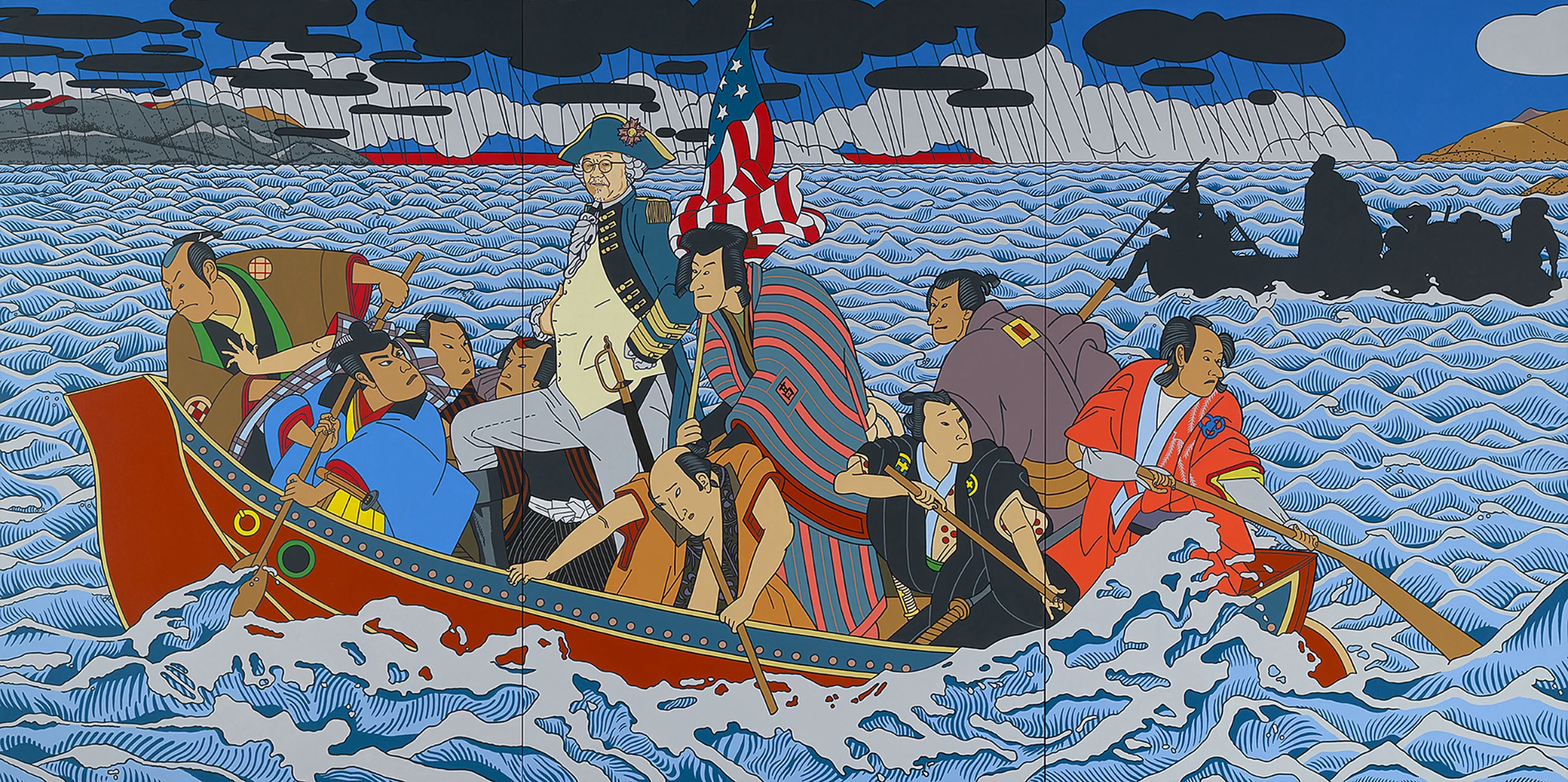
AS IRISH WOMEN were working in Lowell's textile mills and as Irish men were helping to build a national system of transportation, America's frontier was advancing westward toward the Pacific Ocean. The Market Revolution was setting in motion forces that would lead to the violent acquisition of territory from Mexico. During the war against Mexico in the 1840s, many Irish immigrants served in the U.S. Armed Forces. Ironically, the Irish had been pushed from their homeland by British imperialism, and here they found themselves becoming Americans by participating in the conquest of Mexico. Jefferson's vision of a continent covered with "a people speaking the same language, governed in similar forms, and by similar laws" was being realized. In the expanding American empire, however, the "people" were actually becoming more diverse: added to the blacks, Indians, and Irish were Mexicans.1
"We Must Be Conquerors or We Are Robbers"
The Market Revolution stimulated the expansion of the Cotton Kingdom into Mexico, a sovereign nation bordering the United States
in the Southwest. During the 1820s, Americans crossed the Mexican border, settling in a territory known as Tejas. Many of them were slaveholders from the South in search of new lands for cotton cultivation. In 1826, President John Quincy Adams tried to purchase Texas for a million dollars, but Mexico refused the offer. A year later, worried about U.S. westward expansion, the Mexican government sent a commission to investigate the influx of Americans into Texas. In his diary, Lieutenant Jose Maria Sanchez described how the foreign intruders were growing in number and defying Mexican laws. "The Americans from the north have taken possession of practically all the eastern part of Texas, in most cases without the permission of the authorities. They immigrate constantly, finding no one to prevent them, and take possession of the sitio [location] that best suits them without either asking leave or going through any formality other than that of building their homes." While visiting the American settlement of San Felipe de Austin, Sanchez predicted: "In my judgment, the spark that will start the conflagration that will deprive us of Texas, will start from this colony." Similarly, Commissioner Manuel Mier y Teran reported: "The incoming stream of new settlers is unceasing." As the military commander of Mexico's eastern interior provinces in 1829, Mier y Teran expressed apprehension: "The department of Texas is contiguous to the most avid nation in the world. The North Americans have conquered whatever territory adjoins them." Then he added ominously: "They incite uprisings in the territory in question."2 In 1830, the Mexican government outlawed the institution of slavery and prohibited further American immigration into Texas. The new policy, however, provoked opposition among some Mexicans in the territory. The council of San Antonio, composed of members of the Mexican elite, favored keeping the border open to Americans. "The industrious, honest North Americans settlers have made great improvements in the past seven or eight years," the council declared. "They have raised cotton and cane and erected gins and sawmills."3 American foreigners in Texas were furious about the new restrictions. As slaveholders, many of them were determined to defy the Mexican law abolishing slavery. Americans continued to cross the border as illegal aliens. By 1835, there were some twenty thousand Americans in Texas, greatly outnumbering the four thousand Mexicans. Tensions were escalating. Stephen Austin urged his countrymen to "Americanize" Texas and bring
the territory under the U.S. flag. He stated that his "sole and only desire" since he first saw Texas was to "redeem it from the wilderness-to settle it with an intelligent honorable and enterprising people." He invited compatriots to come to Texas, "each man with his rifle," "passports or no passports." Viewing the conflict as one between a "mongrel Spanish-Indian and negro race" and "civilization and the Anglo-American race," Austin declared that violence was inevitable: "War is our only recourse. There is no other remedy."4 War came in 1836 when some Americans in Texas began an armed insurrection against Mexican authority. The center of the rebellion for independence was San Antonio, where a mission had been converted into a fort that would become the stuff of American legend. Barricading themselves in the Alamo, 175 Texas rebels initiated hostilities in a struggle for what would be called the Lone Star Republic. The Mexican government declared the action illegal and sent troops to suppress the rebellion. Surrounded by Mexican soldiers, the rebels refused to surrender. According to one story, their leader, William Barret Travis, dramatically drew "a line in the sand." All the men who crossed it, he declared, would fight to the death. 5 Led by General Antonio Lopez de Santa Anna, the Mexican soldiers stormed the Alamo and killed most of the rebels, including Jim Bowie and Davy Crockett. Among the men slain were a few Mexicans, including Juan Abamillo, Carlos Espalier, and Antonio Fuentes, who had decided to side with the Americans. The conflict even pitted brother against brother-Gregorio Esparza defended the fort while Francisco Esparza was one of the attacking soldiers. Santa Anna's army then captured the town of Goliad, where four hundred American prisoners were executed. Rallying around the cry, "Remember the Alamo," Sam Houston organized a counterattack. Houston's troops surprised Santa Anna's forces at San Jacinto. According to historian Carlos Castaneda, they "clubbed and stabbed" Mexican soldiers seeking to surrender, "some on their knees." The slaughter became "methodical" as the Texan riflemen "poured a steady fire into the packed, jostling ranks." After the battle, two Americans and 630 Mexicans lay dead.6 Houston forced Santa Anna to cede Texas. Mexico repudiated the treaty, but Houston declared Texas an independent republic and was subsequently elected its president. In his inaugural address, Houston claimed that the Lone Star Republic reflected
"glory on the Anglo-Saxon race." He insisted that their struggle was against Mexican "tyranny" and for American "democracy": "With these principles we will march across the Rio Grande, and ... ere the banner of Mexico shall triumphantly float upon the banks of the Sabine, the Texan standard of the single star, borne by the Anglo-Saxon race, shall display its bright folds in Liberty's triumph, on the isthmus of Darien."7 In 1845, the United States annexed the Lone Star Republic, and Mexico broke off diplomatic relations. Tensions between the two countries then focused on a border dispute: the United States claimed that the southern border of Texas was the Rio Grande River, but Mexico insisted that it was 150 miles to the north at the Nueces River. In early January 1846, President James K. Polk ordered General Zachary Taylor to take his troops into the disputed territory. The American forces occupied an area near the mouth of the Rio Grande and blockaded the river-an act of war under international law. On May 9, an armed skirmish between American and Mexican forces provided the pretext for a declaration of war. In his war message, Polk declared that Mexican troops had "passed the boundary of the United States ... invaded our territory and shed American blood upon American soil." He added: "War exists notwithstanding all our efforts to avoid it."8 The border dispute shrouded the real reason behind the war. A key U.S. objective was the annexation of California. This territory was an important source of raw material for the Market Revolution: it exported cattle hides to New England, where Irish factory laborers manufactured boots and shoes. More important, California had strategic harbors. Sperm oil from whales was a crucial fuel and lubricant in the growing economy, and the American whaling industry was sending its ships to the Pacific Ocean. The ports of California were needed for repairs and supplies. Policymakers also wanted to promote American trade with the Pacific Rim. In a message to Congress, President James K. Polk explained that California's harbors "would afford shelter for our navy, for our numerous whale ships, and other merchant vessels employed in the Pacific ocean, and would in a short period become the marts of an extensive and profitable commerce with China, and other countries of the East."9 In California, the war began in the small town of Sonoma. There, on June 6, 1846, General Mariano Vallejo was rudely awakened at his home by thirty armed Americans. They had arrived "before it was quite light," one of them recalled. "We knocked on
the front of his dwelling and one of his servants came out. We was standing all a-horseback." So began the revolt to wrest California from Mexico and establish what would be called the "Bear Flag Republic." The rebels were mostly uncouth frontiersmen, viewed by the Mexicans as strangers, "grimy adventurers," and "exiles from civilization." Some of them had crossed the border after the Mexican government had prohibited American immigration and hence were illegal aliens. Most of the intruders had been in California for less than a year, and now they were claiming the territory as theirs. Their homemade flag displayed the image of a grizzly bear facing a lone star, suggesting an analogy to the Texas Republic. To the Mexicans, the bear was a thief, a plunderer of their cattle; they would call the armed intruders los Osos (the Bears).10
Commandante Vallejo represented Mexican authority in the region of California north of San Francisco, and the American rebels had come to "arrest" him. Actually, Vallejo was no longer on active duty, and there were no Mexican troops at the fort. The ragtag rebels entered the general's elegant home with its handsome mahogany chairs and fine piano; a gentleman always, Vallejo offered them wine before returning to his bedroom to change his clothes. A striking contrast to the Americans, Vallejo was educated and cultured, the possessor of a vast library. The general, his brother Salvador, and his brother-in-law Jacob Leese were then taken as prisoners to Fort Sutter near Sacramento. Salvador Vallejo bitterly recalled that his captors would check on them and comment: "Let me see if my Greasers are safe."11 Two months later, General Vallejo was freed and allowed to return home, only to find his rancho stripped. "I left Sacramento half dead, and arrived here [Sonoma] almost without life, but am now much better," Vallejo wrote to an American friend in San Francisco. "The political change has cost a great deal to my person and mind, and likewise to my property. I have lost more than one thousand live horned cattle, six hundred tame horses, and many other things of value .... All is lost."12 Unlike his immigrant captors, Don Vallejo was a Californian by birth. As the commander of the Sonoma fort, he represented a long history of Spqnish and Mexican efforts to secure the California territory against American and Russian expansion. Three centuries earlier, believing that Asia was close to Mexico, Hernan Cortes had sent an expedition to California, and in 1542, Juan Rodriguez Cabrillo sailed along its coast. The Spanish
colonization of this region began in 1769, when Father Junipero Serra founded the mission of San Diego de Alcala. The plan was to extend the Spanish frontier northward as the colonizers took Indian lands and converted the native peoples. During the next half century, twenty2one missions were established, stretching five hundred miles along the California coast northward to Los Angeles, Santa Barbara, Monterey, San Jose, San Francisco, and So:µoma.
While some of the settlers came from Spain, most were from Mexico, recruited from the ranks of the desperately poor. They were generally mestizo: the forty-six settlers sent to Los Angeles, for example, were "a mixture of Indian and Negro with here and there a trace of Spanish." The government promised the colonists equipment and food, including herds of cattle. By 1781, however, there were only about six hundred settlers in Alta California. Trying to bolster immigration, Governor Diego de Borica reported: "This is a great country, the most peaceful and quiet country in the world ... [with] good bread, excellent meat, tolerable fish." But California failed to attract settlers: by 1821, there were only three thousand Mexicans, most of them the offspring of the first colonists. Meanwhile, Spain had overextended its empire; overthrowing Spanish rule, Mexico became an independent country.13 The owner of a vast estate, Vallejo belonged to the Mexican elite. Like other rancheros, he had been granted vast tracts ofland by the Spanish and Mexican governments. In Don Vallejo's stratified society, the gente de razon were at the top. The Spanish term for "people of reason" generally meant Spanish and Castilianspeaking people, although it did come to include mestizos who were properly educated. "Throughout all California," John Marsh reported in 1836, "the Indians are the principal laborers; without them the business of the country could hardly be carried on." The laborers worked not only on the range but also in the hacienda. "Each one of my children, boys and girls, has a servant who has no other duty than to care for him or her," Dona Francisca Vallejo, the mother of sixteen children, told a visitor. "I have two for my own personal service. Four or five grind the corn for the tortillas; for here we entertain so many guests that three could not furnish enough meals to feed them all. About six or seven are set apart for service in the kitchen. Five or six are continually occupied in washing clothes of the children and the rest employed in the house; and finally, nearly a dozen are charged to attend the sewing and spinning." Vallejo and his fellow rancheros practiced
a patriarchical culture. "All our servants are very much attached to us," explained Dona Vallejo. "They do not ask for money, nor do they have a fixed wage; we give them all they need, and if they are ill we care for them like members of the family. If they have children we stand as godparents and see to their education. We treat our servants rather as friends than as servants."14 In Vallejo's California, there were also a few Anglos from the United States. The early American newcomers were generally accepted, even offered land grants by the Mexican government if they converted to Catholicism and became naturalized citizens. For example, Jacob Leese married Rosalia Vallejo, a sister of Mariano Vallejo. Don Abel Stearns of Massachusetts married into the wealthy Bandini family and became a large landowner and cattle rancher. These American men became "Dons," a title signifying high status and membership in the California landed elite. Learning Spanish and practicing the local customs, they became part of their adopted society. "While here [in San Gabriel]," an American visitor reported, "I met with a Yankee-Daniel A. Hill [from Santa Barbara] ... who had been a resident in the country for many years, and who had become, in manner and appearance, a complete Californian."15 By the 1840s, more Yankees were entering Vallejo's world, driven there by dreams of wealth and landownership generated by pamphlets and books about California. Entering California illegally, many of them might have read Richard Henry Dana's bestselling book, Two Years Before the Mast, published in 1840. In his report on his travels to California, Dana noted that some of the Mexicans were "even as fair" as the English, of "pure Spanish blood." Below them was the laboring class. Racially, the laborers went "down by regular shades," "growing more and more dark and muddy" with "pure" Indians at the bottom rung. Dana characterized Mexicans as "an idle, thriftless people." He disdainfully noticed that many Americans were marrying "natives" and bringing up their children as Catholics and Mexicans. Perhaps he had in mind his uncle. After his arrival in Santa Barbara in 1826, William G. Dana of Boston converted to Catholicism and married sixteen-year-old Josefa Carillo after delaying the nuptial ceremony for two years in order to complete naturalization formalities. Don "Guillermo" and Dona Josefa had twenty-one children. Richard never visited his uncle during his stay in California. If the "California fever" [laziness] spared the first generation, the younger Dana warned, it was likely to "attack" the second, for
Mexicans lacked the enterprise and calculating mentality of Americans. Inefficient in moneymaking, they spent their time in pleasure-giving activities such as festive parties called fandangos. What distinguished Anglos from Mexicans, in Dana's opinion, was their Yankeeness-their industry, frugality, sobriety, and work ethic. Impressed with California's natural resources-its forests, grazing land, and harbors-Dana exclaimed: "In the hands of an enterprising people, what a country this might be! "16 Determined to place California in their own hands, the intruders were now coming in groups; many brought their families and saw themselves as Americans, not future Mexicans. They were a different sort from the first Americanos. "Many [of these early immigrants] settled among us and contributed with their intelligence and industry to the progress of my beloved country," Governor Juan Alvarado observed and then added unhappily: "Would that the foreigners that came to settle in Alta California after 1841 had been of the same quality as those who preceded them!" Mexicans complained about the new settlers: "The idea these gentlemen have formed for themselves is, that God made the world and them also, therefore what there is in the world belongs to them as sons of God." "These Americans are so contriving that some day they will build ladders to touch the sky, and once in the heavens they will change the whole face of the universe and even • the color of the stars." Governor Pio Pico nervously complained: "We find ourselves threatened by hordes of Yankee immigrants who have already begun to flock into our country and whose progress we cannot arrest."17 Many of these Yankees had come west fully intending to take the territory from Mexico. The leader of Vallejo's captors, Benjamin Ide, told his men: "We must be conquerors or we are robbers." The rebels insisted that they were defending the interests of American settlers against unfair and arbitrary Mexican rule. But the manager of Fort Sutter where Vallejo was imprisoned refuted this claim. "This was simply a pretense," John Bidwell charged, "to justify the premature beginning of the war [in California], which henceforth was to be carried in the name of the United States." What Vallejo's armed captors were doing, he added, was playing "the Texas game."18 Shortly after the rebels arrested General Vallejo and established the Bear Flag Republic, Commander John D. Sloat initiated the war in California: he sailed his ship into Monterey Bay and declared California a possession of the United States.
The taking of California turned out to be almost nonviolent. Elsewhere in the Southwest, however, the war unleashed a brutal, unrestrained military campaign. American soldiers themselves documented the atrocities committed against the Mexican civilian population. "Since we have been in Matamoros a great many murders have been committed," a young captain, Ulysses S. Grant, wrote in a private letter. "Some of the volunteers and about all the Texans seem to think it perfectly right to impose on the people of a conquered city to any extent, and even to murder them where the act can be covered by dark. And how much they seem to enjoy acts of violence too!" Another officer, George G. Meade, wrote in a letter: "They [the volunteers] have killed five or six innocent people walking in the street, for no other object than their own amusement. They rob and steal the cattle and corn of the poor farmers." General Winfield Scott admitted that American soldiers had "committed atrocities to make Heaven weep and every American of Christian morals blush for his country. Murder, robbery and rape of mothers and daughters in the presence of tied-up males of the families have been common all along the Rio Grande." A Mexican newspaper denounced the outrages, describing the American invaders as "the horde of banditti, of drunkards, of fornicators ... vandals vomited from hell, monsters who bid defiance to the laws of nature, shameless, daring, ignorant, ragged, bad-smelling, long-bearded men with hats turned up at the brim, thirsty with the desire to appropriate our riches and our beautiful damsels."19 The horror ended in early 1848, a few months after General Winfield Scott's army occupied Mexico City. In the Treaty of Guadalupe Hidalgo, signed on February 2, Mexico accepted the Rio Grande River as the Texas border and ceded the Southwest territories to the United States for fifteen million dollars. The acquisition included the present-day states of California, New Mexico, Arizona, Nevada, and parts of Colorado and Utah, a total of over one million square miles. Together with Texas, the area amounted to one-half of Mexico. To many Americans, the war and the conquest had extended their "errand into the wilderness" to the Pacific. In 1845, Democratic Review editor John L. O'Sullivan announced that "to overspread the continent allotted by Providence for the free development of our yearly multiplying millions" was America's "manifest destiny." Like John Winthrop's "city upon a hill," this vision depicted the national mission as divinely designed. 20
The doctrine of "manifest destiny" embraced a belief in American Anglo-Saxon superiority. As the editor of the Brooklyn Daily Eagle, Walt Whitman exclaimed: "We pant to see our country and its rule far-reaching .... What has miserable, inefficient Mexico ... to do with the great mission of peopling the New World with a noble race?" Whitman praised General Zachary Taylor's conquest of Monterey as "another clinching proof of the indomitable energy of the Anglo-Saxon character." "This continent," a congressman chimed, "was intended by Providence as a vast theatre on which to work out the grand experiment of Republican government, under the auspices of the Anglo-Saxon race." Former secretary of state of the Texas Republic Ashbel Smith confidently predicted: "The two races, the Americans distinctively so called, and the Spanish Americans or Mexicans, are now brought by the war into inseparable contact. No treaties can henceforth dissever them; and the inferior must give way before the superior race. After the war, when the 40,000 soldiers now in Mexico shall be withdrawn, their places will be soon more than supplied by a still greater number of merchants, mechanics, physicians, lawyers, preachers, schoolmasters, and printers."21 In an essay entitled "The Conquest of California," the editor of the Southern Quarterly Review proudly explained: "There are some nations that have a doom upon them .... The nation that makes no onward progress ... that wastes its treasures wantonly-that cherishes not its resources - such a nation will burn out ... will become the easy prey of the more adventurous enemy." Enterprising Americans, the editor reported, had already begun to "penetrate" the remote territory of California, extracting her vast and hidden riches, and would soon make her resources "useful" by opening her "swollen veins" of precious metals. 22
Anglo Over Mexican
Mexicans had a different view of the Anglo conquest. Suddenly, they were "thrown among those who were strangers to their language, customs, laws, and habits." The border had been moved, and now thousands of Mexicans found themselves inside the United States. The treaty permitted them to remain in the United States or to move across the new southern border. If they stayed, they would be guaranteed "the enjoyment of all the rights of citizens of the United States according to the principles of the Constitution."23
Most remained, but they felt a peculiar alienation. "Our race, our unfortunate people will have to wander in search of hospitality in a strange land, only to be ejected later," Mexican diplomat Manuel Crescion Rejon predicted. "Descendents of the Indians that we are, the North Americans hate us, their spokesmen depreciate us, even if they recognize the justice of our cause, and they consider us unworthy to form with them one nation and one society; they clearly manifest that their future expansion begins with the territory that they take from us and pushing aside our citizens who inhabit the land." A few years later, Pablo de la Guerra vented his frustrations before the California senate. The "conquered" Mexicans, he complained, did not understand the new language, English, which was now "prevalent" on "their native soil." They had become "foreigners in their own land."24 What this meant for many Mexicans was political vulnerability and powerlessness. In California, for example, while Mexicans were granted suffrage, they found that democracy was essentially for Anglos only. At first, they greatly outnumbered Anglos by about ten to one. But the conquered people suddenly became a minority. In January 1848, gold was discovered near John Sutter's mill; the gold rush ignited a massive migration into California. By 1849, the Anglo population reached one hundred thousand compared to only thirteen thousand Mexicans.
Dominant in the state legislature, Anglos enacted laws aimed at Mexicans. An antivagrancy act, known as the "Greaser Act," defined vagrants as "all persons who [were] commonly known as 'Greasers' or the issue of Spanish or Indian blood ... and who [went] armed and [were] not peaceable and quiet persons." In 1850, the legislature passed a foreign miners' tax. This law was actually a "Mexican Miners' Tax," for the tax collectors took fees mainly from Spanish-speaking miners, including American citizens of Mexican ancestry. 25
Many of these miners had come from Mexico, where techniques for extracting gold had been developed. In California, they shared this knowledge with Anglo miners, introducing Spanish mining terms such as bonanza (rich ore) and placer (deposits containing gold particles). But Anglos resented the Mexicans as competitors, making no distinction between Mexicans and Mexican Americans. "The Yankee regarded every man but a native American as an interloper," observed a contemporary, "who had no right to come to California and pick up the gold of 'free and enlightened citizens.'" Anglo miners sometimes violently defended what they regarded
as their "right" to the gold In his memoir, Antonio Franco Coronel described one frightening experience: "I arrived at the Placer Seco [about March 1849] and began to work at a regular digging .... Presently news was circulated that it had been resolved to evict all those who were not-American citizens from the placers because it was believed that the foreigners did not have the right to exploit the placers." Shortly afterward, a hundred Anglos invaded the diggings of Coronel and some other Mexicans, forcing them to flee for their lives. "All of these men raised their pistols, their Bowie knives; some had rifles, others pickaxes and shovels."26 Though Mexicans were a minority of the state population, they continued to represent a sizable presence in Southern California. In Santa Barbara, for example, Mexicans represented a majority of the voters and dominated local elections. "The Americans have very little influence in the elections," complained Charles Huse in the 1850s. "The Californians have a majority of the votes. When they are united, they can elect whomever they wish." However, Huse predicted that Anglos would have "all the power" in a few years and would not "consult the Californians about anything." Indeed, Mexicans soon became a minority as Anglos flocked into Santa Barbara. In 1873, Mexican voters were overwhelmed at the polls. Though they elected Nicolas Covarrubias as county sheriff, they lost the positions of county assessor, clerk, treasurer, and district attorney. Politically, the Anglos were now in command. "The native population wear a wondering, bewildered look at the sudden change of affairs," a visitor noted, "yet seem resigned to their unexpected situation, while the conquerors are proud and elated with their conquest." Mexican political participation declined precipitously in Santa Barbara-to only 15 percent of registered voters in 1904 and only 3 percent in 1920.27 Compared to California, the political proscription of Mexicans in Texas was more direct. There, Mexicans were granted suffrage but only in principle. A merchant in Corpus Christi reported that the practice in several counties was to withhold the franchise from Mexicans. A traveler observed that the Mexicans in San Antonio could elect a government of their own if they voted but added: "Such a step would be followed, however, by a summary revolution." In 1863, after a closely contested election, the Fort Brown Flag editorialized: "We are opposed to allowing an ignorant crowd of Mexicans to determine the political questions in this country, where a man is supposed to vote knowingly and thoughtfully." During the 1890s, many counties established
"white primaries" to disenfranchise Mexicans as well as blacks, and the legislature instituted additional measures like the poll tax to reduce Mexican political participation. 28 Political restrictions lessened the ability of Mexicans not only to claim their rights as citizens but also to protect their rights as landowners. The original version of the Treaty of Guadalupe Hidalgo had contained a provision, Article X, which guaranteed protection of "all prior and pending titles to property of every description." In ratifying the treaty, however, the U.S. Senate omitted this article. Instead, American emissaries offered the Mexican government a "Statement of Protocol" to reassure Mexicans that "the American government by suppressing the Xth article ... did not in any way intend to annul the grants of lands made by Mexico in the ceded territories." Grantees would be allowed to have their legitimate titles acknowledged in American courts. 29 But whether the courts would in fact confirm their land titles was another matter. In New Mexico, the Court of Private Land Claims was established in 1891. Dominated by Anglo legal officials, the court confirmed the grants of only 2,051,526 acres, turning down claims for 33,439,493 acres. The court's actions led to Anglo ownership of four-fifths of the Mexican land grants. Similarly, in California, Mexican land titles were contested. Three years after the Treaty of Guadalupe Hidalgo, Congress passed a land law establishing a commission to review the validity of land grants made under Spanish and Mexican rule. The boundaries for these land grants had been drawn without surveying instruments and were loosely marked on maps indicating a notched tree, a spot "between the hills at the head of a running water," a pile of stones, and the like. Frequently, land was measured with the expression poco mas o menos (a little more or less). The entire Pomona Valley, for example, was described as "the place being vacant which is known by the name of [Rancho] San Jose, distant some six leagues, more or less, from the Ex-Mission of San Gabriel." U.S. land law, however, required accurate boundaries and proof of legitimate titles. 30
Such evidence, Mexican landholders discovered, was very difficult to provide. Unfamiliar with American law and lacking English-language skills, they became prey to Anglo lawyers. If they were successfully able to prove their claim, they would often be required to pay their lawyers one-quarter of their land. Others borrowed money at high interest rates in order to pay legal fees; after they won their cases, many rancheros were forced to
sell their land to pay off their debts. "The average length of time required to secure evidence of ownership," historian Walton Bean calculated, "was 17 years from the time of submitting a claim to the board." In the end, whether or not they won their claims, most of the great rancheros in northern California lost their lands. "When they [the rancheros] receive patent," El Clamor Publico of Los Angeles observed, "if they are not already ruined, they will be very close to it." In an 1859 petition to Congress, sixty rancheros protested that they had been forced to sell their lands to pay interests, taxes, and litigation expenses. "Some, who at one time had been the richest landholders," they observed, "today find themselves without a foot of ground, living as objects of charity."31 After paying his lawyers $80,000, Salvador Vallejo managed to prove his land claim before the Land Commission; during his appeal in the district court, however, squatters settled on his rancho. They kept burning his crops, and he finally sold his property for $160,000 and moved to San Francisco. Although Mariano Vallejo lost his Soscol land claim, he won his Petaluma land claim in appeals to the U.S. Supreme Court. But squatters had occupied his land and refused to move; they also ran off his Indian laborers and destroyed his crops. Vallejo was forced to sell parts of his vast estate, which had originally totaled more than 100,000 acres, until he was down to only 280 acres in Sonoma. Bitter over the loss of his land, Vallejo cursed the new Anglo order: "The language now spoken in our country, the laws which govern us, the faces which we encounter daily are those of the masters of the land, and of course antagonistic to our interests and rights, but what does that matter to the conqueror? He wishes his own wellbeing and not ours! "32
Meanwhile, the "play of the market" contributed to the dispossession of the Mexican landed class. The cattle industry in California had begun to decline in the late 1850s; lacking the financial resources to convert their ranches from grazing to agriculture, many rancheros were forced to sell their land. In Texas, the cattle industry was extremely unstable and volatile. The periodic falls in the cattle market generated sales and transfers of property from Mexican to Anglo ranchers. "During the ten-year boom of 1875-1885, the King ranch purchased nearly 58,000 acres of Mexican-owned land," historian David Montejano calculated, "but the ranch would acquire nearly as much, 54,000 acres, in the following five years, a time of market collapse (1886-1891)."33
During periods of drought, Anglo ranchers had an advantage: they were able to protect their ranches better than their Mexican competitors because they had greater access to bank credit and could obtain funds to dig deeper wells. After droughts, they were financially stronger and able to purchase land from economically distressed rancheros. For example, the drought of the 1890s financially devastated rancher Victoriano Chapa of Texas. In 1901, at the age of eighty-nine years, Chapa was persuaded to sell his stock and lease his land. The approaching transfer made him depressed. Chapa told historian J. Frank Dobie, whose family owned a nearby ranch: "Why have we been talked into this evil trade? We belong here. My roots go deeper than those of any mesquite growing up and down this long arroyo. We do not need money. When a man belongs to a place and lives there, all the money in the world cannot buy him anything else so good. Valgame Dios, why, why, why?" Chapa took his life two days before the transfer of his land. 34 What made the market especially destructive for rancheros was the introduction of a new system of taxation. Previously, under Mexican rule, the products of the land were taxed. This policy made sense in a region where climatic conditions caused income from agriculture to fluctuate; ranchers and farmers paid taxes only when their cattle or crops yielded profits. Under the new order, however, the land itself was taxed. While this tax system was color-blind and applied to all landowners, it assisted the dispossession of Mexican landowners. Many Mexican farmers borrowed money to pay their taxes only to be forced to sell their property to pay off debts incurred by the interest. In Southern California, for example, Julio Verdugo mortgaged his Rancho San Rafael to Jacob Elias for $3,445 at 3 percent interest per month. After eight years, Verdugo owed $58,000 and had to sell his entire rancho to Alfred B. Chapman. Chapman, feeling sorry for Verdugo, gave the old ranchero some land for a residence. 35 As Mexicans told and retold stories about the loss of their land, they created a community of the dispossessed. They recalled how "the native Californians were an agricultural people" and had "wished to continue so." But then they "encountered the obstacle of the enterprising genius of the Americans, who ... assumed possession of their lands, [took] their cattle, and destroyed their woods." In Santa Barbara, a Mexican old-timer recounted the decline of the rancheros who had fallen into debt to Anglo merchants and lost their ranches: "The Spanish people had to live and as the
dwindling herds would not pay their bills, they mortgaged their land to the Americanos. They got much of our lands."36 A Mexican woman remembered her grandmother's bitterness: "Grandmother would not trust any gringo, because they did take their land grants away and it still was a memory to her. She always used to say, 'Stay with your race, stay with your own."' A Mexican song poignantly expressed how it felt to be dispossessed and alienated on their native soil:
The Mexico-Texan, he's one fanny man Who lives in the region that's north of the Gran'; Of Mexican father, he born in thees part. For the Mexico-Texan, he no gotta Zan'; And sometimes he rues it, deep down in hees heart. He stomped on da neck on both sides of the Gran'; The dam gringo lingo no cannot spick, It twista da tong and it maka heem sik; A cit'zen of Texas they say that he ees! But then, -why they call heem da Mexican Grease? Soft talk and hard action, he can't understan', The Mexico-Texan, he no gotta Zan'. 37
In 1910, the Laredo La Cronica described the degradation of many Mexicans from landholders to laborers: "The Mexicans have sold the great share of their landholdings and some work as day laborers on what once belonged to them. How sad this truth!" Like Caliban, Mexicans found themselves now working for strangers: they were serving in "offices that profited" the Anglo Prosperos who had come to possess their country. 38
Mexicans were extensively used as workers in ranching and agriculture. In Texas, Mexican cowboys, vaqueros, helped to drive the cattle herds on the Chisholm and Western trails to the railroad centers in Abilene and Dodge City. Vaqueros taught Anglo cowboys and ranchers their time-tested techniques of roping, branding, and handling cattle. Rancher C. C. Cox described a roundup: "Once a week or oftener we would make a rodeo or round up the cattle. The plan is to have one herding ground on the Ranch-the
cattle soon learn to run together at that place when they see the vaqueros on the wing-and when those on the outskirts of the range are started, the movement becomes general, and no prettier or more interesting sight can be imagined than a rodeo in full progress-every cow catches the alarm and starts off at a brisk trot headed for the herding ground."39 But Mexican cowboys soon began to vanish. The extension of rail lines into Texas eliminated the cattle drives, and agriculture in the state shifted from grazing to tillage. Mexican cowboys had looked down on farm laborers with "mingled contempt and pity," rancher J. Frank Dobie observed in the 1920s, but "more and more of the vaqueros" were turning to "cotton picking each fall."40 Mexican farm laborers had been in the cotton fields even before Texan independence. As cotton cultivation expanded during the second half of the nineteenth century, they became the mainstay of agricultural labor. "Soil and climate are suitable and cheap labor is at hand," announced the Corpus Christi Weekly Caller in 1885. "Mexican farm labor can be utilized in the cultivation of cotton as well during the picking season." They cleared the lands for planting. "Grubbing bush," many Anglos said, "is a Mexican job." They dug irrigation ditches, bringing water from rivers and streams to parched areas. Some of the irrigation methods had originally been developed by the Moors in Africa before the tenth century and had been brought to the Southwest by the Spanish. Other techniques had come from the Pueblo Indians, who had developed irrigation systems in the region long before the arrival of the first Spaniards. Mexican laborers would level the land, then divide the fields into squares with low embankments to hold the water. After soaking a block, they would make a hole in one of the walls, permitting the water to flow into the next square. This method of irrigation came to be known as "the Mexican system." Over the years, these laborers transformed the Texas terrain from scrub bush to the green fields of the Lower Valley known as the "winter garden."41 Mexicans also served as an important workforce in railroad construction. During the 1880s, they constituted a majority of the laborers laying tracks for the Texas and Mexican Railroad. An Arizona newspaper stated: "It is difficult to get white men to work, the wages being only $1.50 a day, and board $5 per week with some minor charges, which reduce a man's net earnings." When the first Mexican section crew began working in Santa Barbara in 1894, the Morning Press reported that the "Chinamen
section hands" of the Southern Pacific had been replaced by "a gang of Mexicans." By 1900, the Southern Pacific Railroad had forty-five hundred Mexican employees in California.42 Railroad construction work was migratory. Railroad workers and their families lived in boxcars and were shunted to the places where they were needed. "Their abode," a manager said, "is where these cars are placed." In the torrid heat of summer and the freezing cold of winter, the workers laid tracks as they sang:
Some unloaded rails Others unloaded ties.
An army of bending backs and swinging arms, they connected the cities of the Southwest with ribbons of steel.
Those who knew the work Went repairing the jack With sledge hammers and shovels, Throwing earth up the track.
They shoveled up not only dirt but also complaints about the low wages and exhausting work.
And others of my companions Threw out thousands of curses. 43
Meanwhile, Mexicans were working in the mining industries. In the New Almaden Quicksilver Mine in California, Mexican miners labored deep in the bowels of the earth. To bring the ore to the surface, each worker carried a two-hundred-pound pack strapped to his shoulders and forehead. Their nerves straining and muscles quivering, hundreds of these carriers ascended perpendicular steps, "winding through deep caverns" in darkness lit by candles on the walls. They wore pantaloons with the legs cut above the knees, calico shirts, and leather sandals fastened at their ankles. Emerging into the daylight at the entrance of the mine, they deposited their burdens into cars and then took time to smoke their cigarros before descending again. In the copper mines of Arizona, Mexicans extracted the "red metal" used to manufacture electrical wires. "One might say," observed historian Carey McWilliams, " ... that Mexican miners in the copper mines
of Arizona, Utah, and Nevada, have played an important role in making possible the illumination of America by electricity."44 Mexican laborers found themselves in a caste labor system - a racially stratified occupational hierarchy. On the Anglo-owned cattle ranches in Texas, for example, the managers and foremen were Anglo, while the cowhands were Mexican. In the New Mexico mines, Anglo workers operated the machines, while Mexican miners did the manual and dangerous work. In Santa Barbara, building contractors hired Anglos as skilled carpenters and Mexicans as unskilled ditch diggers. Sixty-one percent of the Mexican laborers in San Antonio were unskilled in 1870, compared to only 24 percent of the Anglos. In Southern California cities like Santa Barbara and Los Angeles, 75 percent of the Mexican workers were crowded into low blue-collar occupations such as service and unskilled labor, compared to 30 percent of the Anglos. 45
Even where Mexicans did the same work as Anglos, they were paid less than their counterparts. In the silver mining industry of Arizona, for example, Mexican workers received between $12 and $30 a month plus a weekly ration of flour, while "American" miners got between $30 and $70 a month plus board. In the copper industry, companies listed their Mexican employees on their payrolls under the special heading of "Mexican labor," paying them at lower rates than Anglo laborers for the same job classifications. "The differences in the wages paid Mexicans and the native-born and north Europeans employed as general laborers," a congressional investigation reported, " ... are largely accounted for by discrimination against the Mexicans in payment of wages." Trapped in this dual wage system, Mexican miners were especially vulnerable to debt peonage. Forced to live in company towns, they had no choice but to buy necessities from the company store where they had to use their low wages to pay high prices for food and clothing. Allowed to make purchases on credit, these miners frequently found themselves financially chained to the company.46 Justifying this racial hierarchy, mine owner Sylvester Mowry invoked the images as well as language used earlier by slavemasters to describe the affection and loyalty of their slaves. "My own experience has taught me that the lower class of Mexicans ... ," Mowry declared, "are docile, faithful, good servants, capable of strong attachments when firmly and kindly treated. They have been 'peons' for generations. They will always remain so, as it is their natural condition."47
But, like the enslaved blacks of the Old South, Mexican workers demonstrated that they were capable of defying these stereotypes of docility and submissiveness. Demanding self-respect and better wages, they repeatedly went on strike. In 1901, two hundred Mexican construction workers of the El Paso Electric Street Car Company struck, demanding a wage increase and an end to management's practice of replacing them with lower-paid workers recruited from Juarez, Mexico. While they did not win a raise, they successfully protected their jobs against imported laborers. Two years later, Mexican members of the United Mine Workers won strike demands for a pay increase and an eight-hour day from the Texas and Pacific Coal Company in Thurber, Texas. 48 Protesting wage cuts in 1903, hundreds of Mexican and Japanese farmworkers went on strike together in Oxnard, California. Together, they organized the Japanese-Mexican Labor Association (JMLA). The strikers elected Kosaburo Baba as president, Y. Yamaguchi as secretary of the Japanese branch, and J. M. Lizarras as secretary of the Mexican branch. At their union meetings, discussions were conducted in both Spanish and Japanese, with English serving as a common language for both groups. For the first time in the history of California, two minority groups, feeling a solidarity based on class, had come together to form a union. Here was a West Coast version of the "giddy multitude." In a statement written jointly by Yamaguchi and Lizarras, the union declared: "Many of us have family, were born in the country, and are lawfully seeking to protect the only property that we have-our labor. It is just as necessary for the welfare of the valley that we get a decent living wage, as it is that the machines in the great sugar factory be properly oiled-if the machines stop, the wealth of the valley stops, and likewise if the laborers are not given a decent wage, they too, must stop work and the whole people of this country suffer with them." The strikers successfully forced the farmers to pay union laborers a piecework rate of five dollars per acre for thinning beets. The JMLA had emerged as a victorious and powerful force for organizing farm laborers.49 Flushed with victory, J. M. Lizarras petitioned the American Federation of Labor to charter their organization as the Sugar Beet Farm Laborers' Union of Oxnard. Samuel Gompers, the president of the federation, agreed to issue a charter to Lizarras on one condition: "Your union will under no circumstance accept membership of any Chinese or Japanese." Believing that this
requirement contradicted the very principles of the Oxnard strike, the Mexican strikers refused the charter. Lizarras protested:
We beg to say in reply that our Japanese brothers here were the first to recognize the importance of cooperating and uniting in demanding a fair wage scale. In the past we have counseled, fought and lived on very short rations with our Japanese brothers, and toiled with them in the fields, and they have been uniformly kind and considerate. We would be false to them and to ourselves and to the cause of unionism if we now accepted privileges for ourselves which are not accorded to them .... We will refuse any other kind of charter, except one which will wipe out race prejudice and recognize our fellow workers as being as good as ourselves. I am ordered by the Mexican union to write this letter to you and they fully approve its words.
Without the AFL charter and the general support of organized labor, the Japanese and Mexican union passed out of existence within a few years. Their strike, however, had demonstrated that Mexican laborers were ready to stand with fellow Japanese in a movement based on interethnic class unity. 50
The most powerful Mexican workers' show of force occurred in Arizona. At the Clifton-Morenci mines in 1903, some thirty-five hundred miners went out on strike, 80 percent of them Mexican. The strikers demanded an eight-hour day, free hospitalization, paid life insurance, fair prices at the company stores, and the abolition of the dual wage system. Italian and Slavonian workers joined them in demanding wages equal to those paid to Anglo Americans and northern Europeans. The strikers successfully shut down the mines, but they were forced to return to work after heavy rains and flooding destroyed many of their homes. Several strike leaders were convicted of inciting a riot and sent to prison. Twelve years later, however, the miners struck again. To thwart the actions of the five thousand strikers, the company sealed the mine entrances with cement and told them "to go back to Mexico." Hundreds of strikers were arrested during the nineteen-week conflict. The National Guard was ordered to break the strike, but in the end, the strikers m~naged to extract wage increases. "Everyone knows," commented the Los Angeles Labor Press, "that it was the Mexican miners that won the strike at Clifton and Morenci by standing like a stone wall until the bosses came to terms."51
These strikes reflected a feeling of Mexican ethnic solidarity. "Abaja las Gerentes," the workers chanted, "down with the bosses." Mexican musicians provided entertainment for the parades and meetings, while Mexican merchants, camerciantes, offered food and clothing to the strikers. More important, the huelgas (strikes) were often supported by Mexican mutualistas (benevolent associations). "The Mexicans belong to numerous societies and through these they can exert some sort of organizational stand together," reported a local newspaper during the 1903 strike at the Clifton- Morenci mines. 52 The mutualistas reinforced this consciousness of being Mexican north of the border. Everywhere in the barrios of Arizona, Texas, New Mexico, and California, there were organizations like Sociedad Benevolencia, Miguel Hidalgo, Sociedad Mutualistia, Sociedad Obreros, and Sociedad Mutualista Mexicana. Members of the mutualistas were laborers as well as shopkeepers and professionals such as lawyers, newspaper editors, and doctors. These associations helped individual members cover hospitalization and funeral expenses, provided low-interest loans, and raised money for people in time of dire need. Taking some of their names from national heroes and conducting their meetings in Spanish, they reminded Mexicans of their common origins as children of "the same mother: Mexico."53 The mutualistas dispelled the myth of Mexicans as a quiet, siesta-loving, sombreroed people. Through these ethnic organizations, Mexicans were resisting labor exploitation and racism. In 1911, several Texas mutualistas came together in a statewide convention, the Congreso Mexicanista. Concerned about anti- Mexican hostility and violence, the congress called for ethnic solidarity: "Par la raza y para la raza," "All for one and one for all." One of the delegates, the Reverend Pedro Grado, defined their struggle as that of class and race: "The Mexican braceros who work in a mill, on a hacienda, or in a plantation would do well to establish Ligas Mexicanistas, and see that their neighbors form them." United, they would have the strength to "strike back at the hatred of some bad sons of Uncle Sam, who believe themselves better than the Mexicans because of the magic that surrounds the word white." The mutualistas reflected a dynamic Mexican- American identity-a proud attachment to the culture south of the border as well as a fierce determination to claim their rights and dignity in "occupied" Mexico. 54