ON A MONDAY morning in June 1997, I was writing in my study at home when I received a call from Doris Matsui, an assistant to President Bill Clinton. She told me that the president wanted me to come to Washington to help him write a major speech on race. "He would like to take the national dialogue on race beyond the black/white binary," she said. "So it's very important for you to be here." Within hours, I was flying to Washington. The next day, at the White House, President Clinton facilitated the meeting of a small gathering of civil rights leaders and intellectuals. After raising my hand, I said: "I think your speech is timely. Sometime in the twenty-first century, whites will become a minority in the U.S. population. They already are in California. So when you come to my state to give your speech, you will be a minority." Then I tried to crack a joke: "Welcome to the club, Mr. President." Instantly, he winked at me: "Yes, I know! Why do you think I am doing all of this?" "Yes," I answered, "we will all be minorities." That Saturday, President Clinton gave his address, "One America in the Twenty-first Century: The President's Initiative on Race." To the graduating class of the University of California
at San Diego, he declared: "A half-century from now, when your own grandchildren are in college, there will be no majority race in America." He then presented highlights from our multicultural past:
Consider this: we were born with a Declaration of Independence which asserted that we were all created equal and a Constitution that enshrined slavery. We fought a bloody civil war to abolish slavery and preserve the union, but we remained a house divided and unequal by law for another century. We advanced across the continent in the name of freedom, yet in so doing we pushed Native Americans off their land, often crushing their culture and their livelihood .... In World War II, Japanese Americans fought valiantly for freedom in Europe, taking great casualities, while at home their families were herded into internment camps. The famed Tuskegee Airmen lost none of the bombers they guarded during the war, but their African American heritage cost them a lot of rights when they came back home in peace.
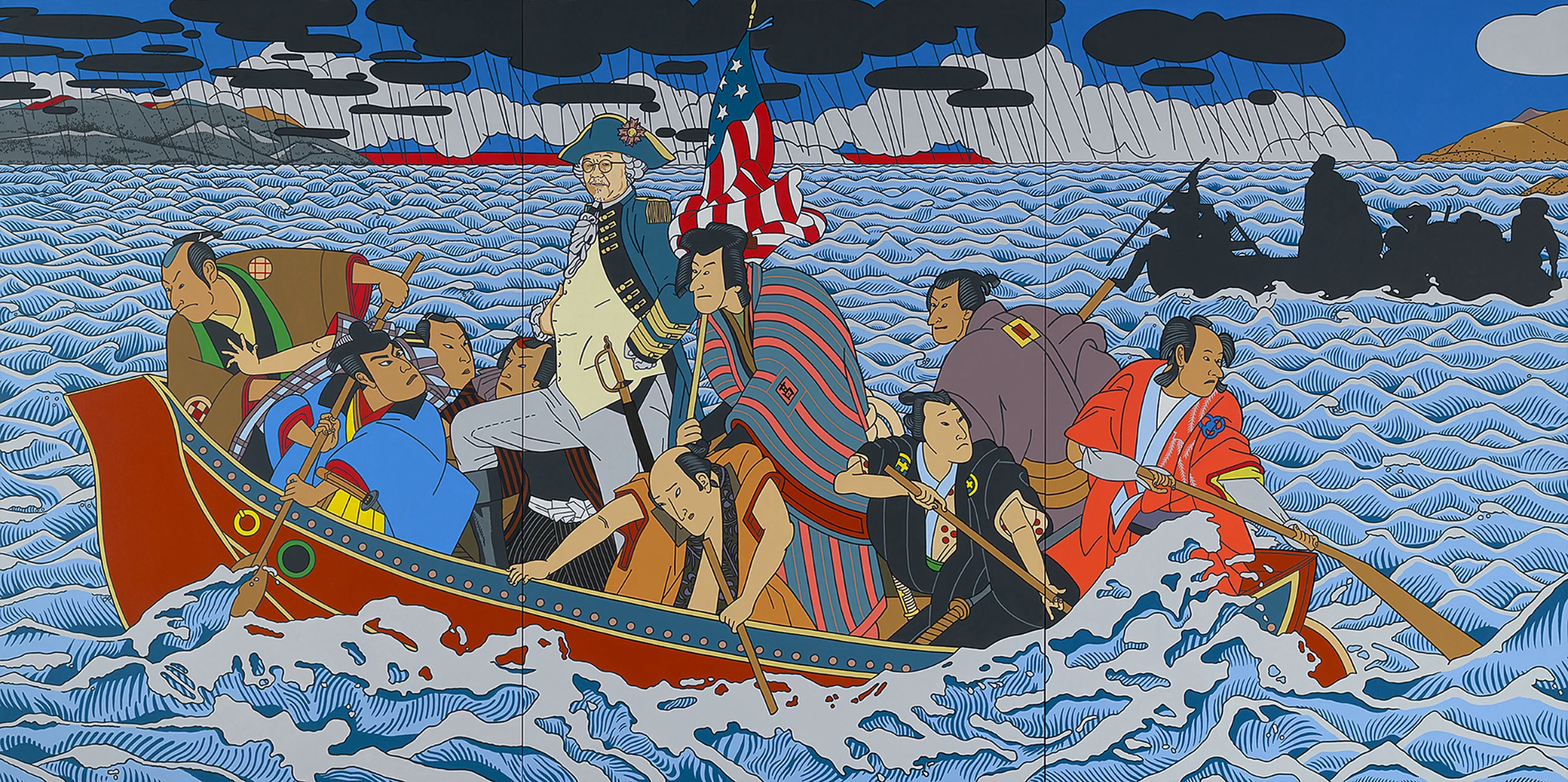
In his conclusion, President Clinton identified the challenge we faced: "More than 30 years ago, at the high tide of the civil rights movement, the Kerner Commission said we were becoming two Americas, one white, one black, separate but unequal. Today, we face a different choice: will we become not two, but many Americas, separate, unequal and isolated? Or will we draw strength from all our people and the ancient faith in the quality of human dignity, to become the world's first truly multiracial democracy?"1 The future is in our hands. The choices we make will be influenced by whether our memory of the past is the Master Narrative of American History or the narrative of "a different mirror." A history that leaves out minorities reinforces separation, but an inclusive history bridges the divide. We have the opportunity to redefine the "errand into the wilderness" -to write our own ending to Shakespeare's play about America. The bard need not be prophetic, for we have the advantage of hindsight: we know what happened not only to Prospero but also to Caliban in American history. This epic story was illuminated by Herman Melville in his great American novel Moby-Dick. The crew of the Pequod represents the races and cultures of the world. On deck, Captain Ahab and his officers are all white men. Below deck, there are whites like
Ishmael, Africans like Daggoo, Pacific Islanders like Queequeg, American Indians like Tashtego, and Asians like Fedallah. There is a noble class unity among the workers: they possess "democratic dignity," and an "ethereal light" shines on the "workman's arm."2 On their voyage through history, the people on board the Pequod known as America found their paths crisscrossing one another in events and developments such as Bacon's Rebellion, the Market Revolution, the Civil War, and World War II. Their lives and cultures have swirled together in the settling and building of America from the first meeting of Powhatans and English on the Virginia shore to the last Mexican immigrants crossing the border. Together, they have been creating what Gloria Anzaldua calls a "borderland" -a place where "two or more cultures edge each other, where people of different races occupy the same territory." How can all of us meet on communal ground? "The struggle," Anzaldua responds, "is inner: Chicano, indio, American Indian, mojado, mexicano, immigrant Latino, Anglo in power, working class Anglo, Black, Asian - our psyches resemble the bordertowns and are populated by the same people .... Awareness of our situation must come before inner changes, which in turn come before changes in society."3 Such awareness must come from a "re-visioned" history. What Gloria Steinem termed "revolution from within" must ultimately be grounded in "unlearning" much of what we have been told about America's past and substituting a more inclusive and accurate history of all the peoples of America.4 A cutting edge of this "unlearning" can be found on the continent's western shore. "California, and especially Los Angeles, a gateway to both Asia and Latin America," Carlos Fuentes observed, "poses the universal question of the coming century: how do we deal with the Other?"5 Asked whether California, with its multiethnic society, represented the America of the twenty-first century, Alice Walker replied: "If that's not the future reality of the United States, there won't be any United States, because that's who we are." Walker's own ancestry is a combination of Native American, African American, and European American. 6 King of golf Tiger Woods is a mixture of different races. "All the media try to put black in him," protested his mother, Kultida Woods. "Why don't they ask who half of Tiger is from? In the United States, one little part black is all black. Nobody wants to
listen to me. I've been trying to explain to people, but they don't understand. To say he is 100 percent black is to deny his heritage. To deny his grandmother and grandfather. To deny me!" Tiger Woods himself declared to the media: "My parents have taught me to always be proud of my ethnic background. Yes, I am the product of two great cultures, one African American and the other Asian. On my father's side I'm African American. On my mother's side I am Thai. Truthfully, I feel very fortunate, and equally proud to be both African American and Asian."7 Barack Obama is proud of his biracial identity. "We've got a tragic history when it comes to race in this country," he said, noting "pent-up anger and mistrust and bitterness." "I continue to believe that this country wants to move beyond these kinds of things." Pointing out that his father is black and his mother white, he declared: "Born into a diverse family, I have little pieces of America all in me." One of those "pieces" is Asian American. Obama was born and raised in Hawaii, the only state with an Asian-American majority. His stepfather, Lolo Soetoro, was Indonesian; his half-sister, Maya Soetoro-Ng, is married to a Chinese Canadian. Obama's legislative director is Chris Lu, the daughter of Chinese immigrants. "A lot of aspects of the senator's story will be recognizable to many Asian Americans," she said. "He talks about feeling somewhat of an outsider, about coming to terms with his selfidentity, about figuring out how to reconcile the values from his unique heritage with those of the larger U.S. society. These are tensions and conflicts that play out in the lives of all children of immigrants."8 Native-American writer Paula Gunn Allen prizes the "little pieces" in herself-American Indian, Scotch, Jewish, and Lebanese. "Just people from everywhere are related to me by blood," she explained, "and so that's why I say I'm a multicultural event. It's beautiful, it's a rainbow. It reflects light, and I think that's what a person like me can do."9 Imagine what "light" a "multicultural event" called America can reflect. America's dilemma has been the denial of our immensely varied selves. Asked whether she had a specific proposal for improving the current racial climate in America, Toni Morrison answered: "Everybody remembers the first time they were taught that part of the human race was Other. That's a trauma. It's as though I told you that your left hand is not part of your body."10
We need not repeat what Prospero did to Caliban. Instead, we
can heed the lesson of Black Elk. In his vision of the "whole hoop of the world," the Sioux holy man saw "in a sacred manner the shapes of all things in the spirit, and the shape of all shapes as they must live together like one being." The "sacred hoop" of his people was "one of many hoops that made one circle, wide as daylight and as starlight, and in the center grew one mighty flowering tree to shelter all the children of one mother and one father."11 Today, we need to stop denying our wholeness as members of one humanity as well as one nation. We originally came from many different shores, and our diversity has been at the center of the making of America. Composed of many colors and cultures, we have been "singing with open mouths their strong melodious songs" from the tobacco fields of Virginia, the textile mills of Lowell, the "Trail of Tears," the cotton fields of Mississippi, the battlefields of the Civil War, the Indian reservations of South Dakota, the railroad tracks in the Sierras of California, the snow-covered ground of Wounded Knee, the garment factories of the Lower East Side, the canefields of Hawaii, the internment camp of Manzanar, South Central Los Angeles, the Lincoln Memorial in Washington, D.C., and a thousand other places.12 Signs of our ethnic diversity can also be found across America- Ellis Island, Angel Island, Chinatown, Harlem, South Boston, the Lower East Side, places with Spanish names like Los Angeles and San Antonio or Indian names like Massachusetts and Iowa. Much of what is familiar in America's cultural landscape has ethnic origins. The Bing cherry was developed by an early Chinese immigrant named Ah Bing. American Indians were cultivating corn, potatoes, tomatoes, and tobacco long before the arrival of Columbus. The term "okay" was derived from the Choctaw word, oke, meaning "it is so." There is evidence indicating that the name "Yankee" came from Indian terms for the English-from eankke in Cherokee and Yankwis in Delaware. Jazz and blues as well as rock and roll have African-American origins. The "Forty-Niners" of the gold rush learned mining techniques from the Mexicans; American cowboys acquired herding skills from Mexican vaqueros and adopted their range terms- such as "lariat" from la reata, "lasso" from lazo, and "stampede" from estampida. Songs like "God Bless America," "Easter Parade," and "White Christmas" were written by a Russian-Jewish immigrant named Israel Baline, more popularly known as Irving Berlin.13 Like Caliban and Stephano, marginalized minorities have been chanting, "Freedom, highday! highday, freedom! freedom,
highday, freedom!" They have been singing: "We shall overcome. We shall overcome." While their struggle must continue, they have won a multitude of victories - the abolishing of slavery, the integrating of the U.S. Armed Forces, the outlawing of segregated schooling for Mexican Americans and African Americans, the ending of Jim Crow in the South, the extending of naturalized citizenship to all immigrants regardless of race, the overturning of anti-miscegenation laws, the guaranteeing of voting rights for minorities, the reopening of immigration from Asia, the granting of redress and reparations to Japanese internees, and the awakening of America to our amazing diversity. Indeed, in many significant ways, we have "overcome." What does the future hold for America? Over one hundred years ago, Herman Melville wrote: America is not a nation "so much as a world." In this new society, the "prejudices of national dislikes" could be "forever extinguished." Walt Whitman chimed: All ofus belonged to "a teeming Nation of nations" where "all races and cultures" could be "accepted" and "saluted," not "controlled or placed in hierarchy," and all could be welcomed-"Chinese, Irish, German, pauper or not, criminal or not-all, all, without exceptions." "Of every hue and caste am I, I resist any thing better than my own diversity."14 "The problem of the twentieth century," as W. E. B. Du Bois observed, was "the problem of the color line." However, the promise of the twenty-first century is the promise of the changing colors of the American people. Demography is redefining who is an American. The time has come for us to embrace our varied selves. A new America is approaching, a society where diversity is destiny. How can we prepare ourselves for this "brave new world that has such people in't"? Here, history matters. Offering our "mystic chords of memory" more inclusively, A Different Mirror tells the story of America as a diversely peopled nation, "dedicated to the proposition that all men are created equal." Woven into the multicultural tapestry of our national narrative is the fervent and felicitous message of Langston Hughes: "Let America be America again. . . . Let America be the dream the dreamers dreamed ... [where] equality is in the air we breathe."15