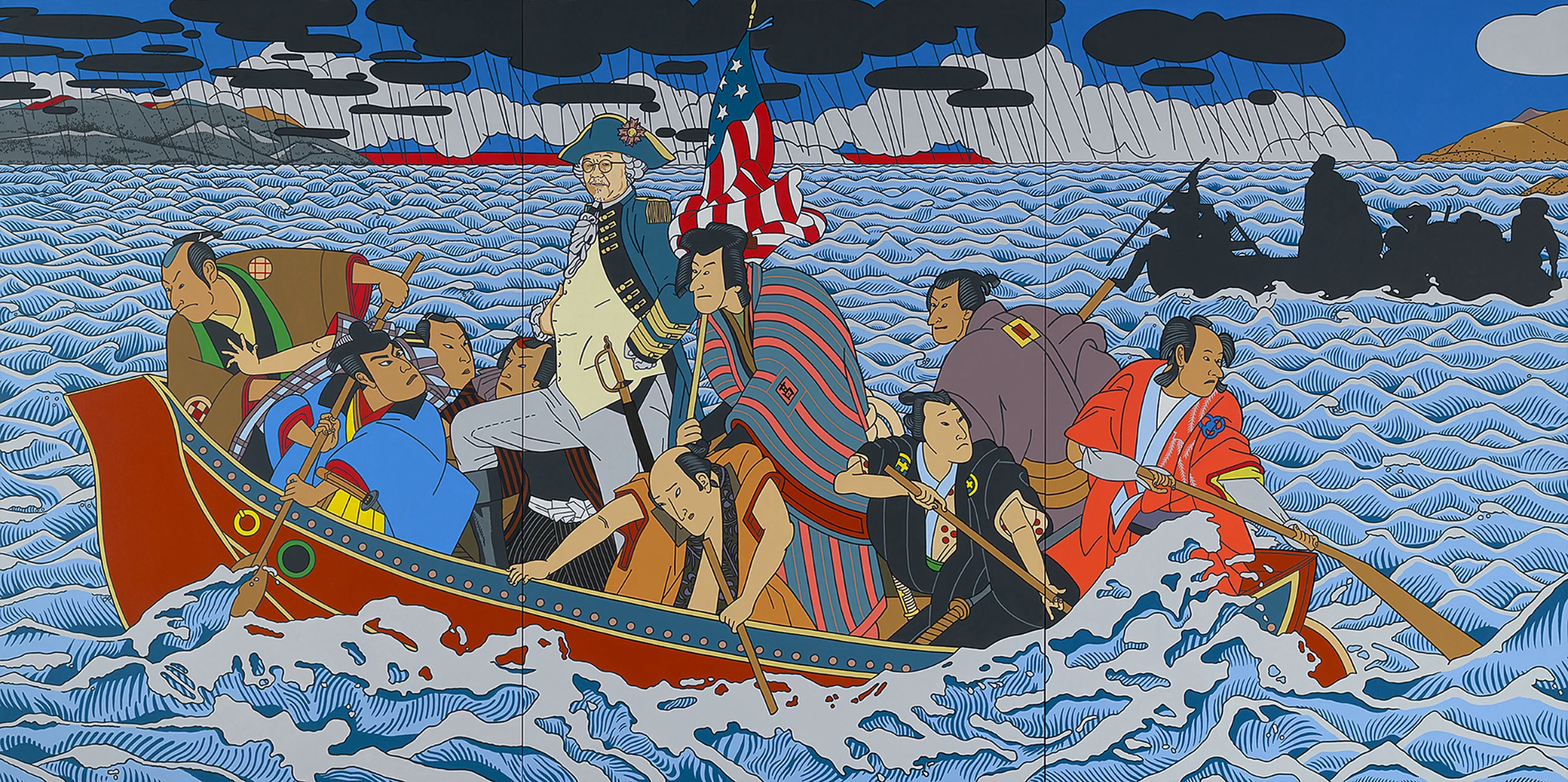
IN SHAKESPEARE'S STORY The Tempest, Prospero commands the spirit Ariel to stir the seas in order to create a storm that will blow to his enchanted island the ship carrying the King of Naples and his entourage. The tempest terrifies all on board. "Now I would give a thousand furlongs of sea for an acre of barren ground-long heath, brown furze, anything," cries Gonzalo, the king's adviser. "The wills above be done, but I would fain die a dry death." Ariel lands them gently on the island's shore. On the pedestal of the Statue of Liberty is also emblazoned a reference to a storm:
"Keep ancient lands, your storied pomp!" cries she With silent lips. "Give me your tired, your poor, Your huddled masses yearning to breathe free, The wretched refuse of your teeming shore. Send these, the homeless, tempest-tost to me, I lift my lamp beside the golden door!" 1
Fleeing the "tempests" of political strife, wars, and poverty during the recent decades, the world has rushed into America once
more, and transformed our society into a more complex multicultural tapestry.
From a "Teeming Shore": Russia, Ireland, and China
The global context of the Cold War conditioned immigration from what had been the Soviet Union. Refugees fleeing from religious oppression, Jews began arriving in America again. The collapse of Communism in Eastern Europe and Russia in the 1990s unleashed a new wave of anti-Semitism, and many Jews were afraid of what would happen to them. "Anti-Semitism and all the other old national hatreds were never really extinguished by Communism, merely frozen in time," James E. Young noted in his review of Charles Hoffman's study of the Jews of Eastern Europe in the postcommunist era. "When the thaw came, the traditional conflicts bloomed with a vengeance, picking up exactly where they left off 45 years ago." The unraveling of communist controls unleashed old, pent-up nativist passions. "The country is experiencing a process of 'decivilization,"' explained a Moscow lawyer in 1990. "The layers of civilization are being peeled off, and underneath there is this ugliness, including fascism and anti-Semitic hatred. Jews are trying to get out of Russia as fast as they can." An old Jewish man in a village near Minsk told two American visitors: "It's time now. We have to go. It wouldn't be safe for us to stay." He was not religiously Jewish: for lunch he served ham. Prohibited from practicing their religion, many Jews had become Jewish mainly in terms of their ethnic origins. "The last of the [Jewish] culture-bearers were executed 40 years ago," explained Aleksandr Z. Burakovsky, chair of the Kiev Sholom Aleichem Society. "Schools, synagogues, libraries were all abolished." Aleksandr A. Shlayen, director of the Babi Yar Center, added: "They started to beat the Jewishness out of Jews a long time ago, under the czars."2 Though many Jews in what had been the Soviet Union did not feel a strong identity as Jews, they encountered hatred from their neighbors and fellow citizens. In schools, Jewish children were beaten and called names. Resentment spread to the workplace: professional Jews experienced discrimination in employment. Graffiti on walls warned: "Jews get out." "My husband wanted to emigrate, but I didn't want to leave," recounted a young Jewish woman. "My parents are old and need to be cared for. I also thought of myself as a Soviet citizen." Many people saw her only
as a "Jew," however, and the harassment became "awful." Seeking sanctuary, half a million Jews fled to Israel and also to America. 3 Like the Jewish immigrants of the late nineteenth century, they sold their houses and furniture, giving away almost everything and leaving with only what they could carry. After their arrival, they had to start all over again. Describing the plight of a Jewish refugee family, Barbara Budnitz of Berkeley, California, explained: "These people have nothing. I offered them an old desk. They said they wanted it, but what they really needed was a bed." Many of these refugees had been engineers in the old country, but here they suffered from unemployment. Lacking Englishlanguage skills and possessing technical knowledge that had limited transferability, many were forced to find jobs as apartment managers, janitors, or even as helpers at McDonald's. According to Barbara Nelson of the Jewish Family Services in Oakland, California, about 80 percent of the Jewish refugee families were compelled to seek welfare support. 4 Still, the Jews were glad to be in America, where there was religious freedom. "My five-year-old daughter is attending school at the synagogue-something she could not do in the Ukraine," explained Sofiya Shapiro, who came with her family in 1991. "I am glad she can get to know Jewish tradition." Indeed, many of the refugees were learning about Judaism for the first time. Like the Jewish immigrants of earlier times, the recent refugees embraced the hope that this country would offer them an opportunity to begin again. "That's what America is," commented Budnitz. "We need to keep it that way."5 America's continuing allure has also been as a place for a fresh economic start. This was particularly true for the most recent wave from Ireland. Like the nineteenth-century Irish immigrants fleeing hunger and the ravages of the Potato Famine, these newcomers were pushed by grim economic conditions at home: in 1990, unemployment in Ireland was a staggering 18 percent. Seeking work in America, many entered legally with a student, work, or tourist visa, and simply stayed after it expired. Undocumented Irish workers totaled as many as 120,000. "It's an anonymous floating population," stated Lena Deevy, director of the Irish Immigration Reform Movement office in Boston. "It's like counting the homeless." These illegal ·aliens constituted what one of them described as "an underclass," forced to take "the crummiest jobs at the lowest wages." The 1986 Immigration Reform Act, which made it
unlawful for employers to hire undocumented workers, created economic and social borders for many Irish. "You can't apply for a job," explained an Irish waitress who came to Boston in 1986. "You can't answer a want ad. It's all word of mouth." Undocumented Irish workers had to keep a low profile, she added: "My social life is limited to the Irish sector. I can't talk to Americans-you just have to tell too many lies." Deevy described their nervousness: "It's like living on the edge. There's a lot of fear that someone will squeal to the INS [Immigration and Naturalization Service]." In 1990, a new immigration law provided for the distribution of 40,000 green cards to be awarded by lottery, with 16,000 of them reserved for Irish. "I plan to fill out at least a thousand applications," said Joanne O'Connell of Queens, New York, as she looked forward to this "Irish Sweepstakes."6 Facing a rising nativist backlash against illegal immigrants, many Irish newcomers joined Mexican Americans in demanding comprehensive immigration reform that would enable all of them to become legalized. In February 2006, fifteen hundred Irish participated in an immigration reform rally in San Francisco. One of them, Elaine, worked as a nanny. "We're all in the same boat," she told a reporter. "The Irish are lucky because we speak English and we're white. We do get treated better. But we [undocumented immigrants] are all hard workers. We all want a better life." Elaine explained that she would like to become a legal permanent resident so that she could build a stable life in her adopted country without fear of being picked up by immigration authorities. She also would like to take her six-year-old son to Ireland so he can maintain his ties to his grandparents and his Irish heritage.7 Joining the Jews and the Irish were also immigrants from China. In the wake of civil rights legislation for African Americans in the 1960s, the question surfaced: if discrimination is immoral and illegal, why was there an immigration restriction law based on racial exclusion? "Just as we sought to eliminate discrimination in our land through the Civil Rights Act," declared a congressman, "today we seek by phasing out the national origins quota system to eliminate discrimination in immigration to this nation composed of the descendants of immigrants." All groups should have equal opportunity to enter America. "Everywhere else in our national life, we have eliminated discrimination based on national origins," Attorney General Robert Kennedy told Congress. "Yet, this system is still the foundation of our immigration law." In 1965, Congress legislated the removal of all restrictions
to Asian immigration-an injustice of exclusion that Asian Americans had struggled for decades to overcome. 8
For the Chinese, the new law reopened the gates to the country they had affectionately called Gold Mountain. In 1960 the Chinese population was only 237,000; twenty years later it had jumped to 812,200. The Chinese-American community had been radically transformed from 61 percent American-born to 63 percent foreign-born, becoming once more mainly an immigrant community. This tide of new immigrants from China was not anticipated at all when Congress passed the 1965 immigration law. The early immigrants had been here a long time, and most of them did not have immediate family members to bring to America. But the family unification provision of the law opened the way for new immigrants who came here initially as students. "My brother-in-law left his wife in Taiwan and came here as a student to get a Ph.D. in engineering," explained Subi Lin Felipe. "After he received his degree, he got a job in San Jose. Then he brought in a sister and his wife, who brought over one of her brothers and me. And my brother's wife then came."9 During the 1960s, Chinese students flocked to the United States to pursue their education; in 1980 half of the 300,000 foreign students here were from China and other Asian countries. Thousands of Chinese students were able to find employment and then acquire Labor Department certification as immigrants under the sixth preference for skilled workers. In this way large numbers of Chinese were able to change their status from foreign students to immigrants. Once they became immigrants, they could develop an expanding immigrant kin network under the family preferences of the 1965 law. They could bring their wives and children here; then as U.S. citizens a few years later, they could bring their parents as well as their brothers and sisters, who, in turn, could arrange for the entry of their spouses and children. Thus one immigrant coming originally as a student could bring to America a chain migration of family members. Not all of the new immigrants were educated. They included low-wage laborers, employed as service workers and operatives in Chinatowns. Most of them did not have a high school certificate, or English-language skills. The problems of limited English and limited employment opportunities were self-reinforcing. "Chinese people have lower incomes because first, the language problem," explained Wing Ng. "If you know just a little English, you can go to an office and get a job cleaning up. It has more security, more
benefits. But how are you going to get a job like that if you don't know a little English? And how are you going to learn English if you have to work twelve hours a day, six days a week, and then come home and take care of your family? "10
Unable to speak English, many Chinese immigrant women had no choice but to work as seamstresses. In the 1980s, they became a major source oflabor for New York's garment industry, which had earlier employed Jewish immigrants. "These factories are one of New York City's unknown industrial success stories," said Harry Schwartz, president of the Garment Industry Development Corporation. "You walk around the Garment District and ask, 'Where have the production shops gone?' Well, they've gone to Chinatown." In San Francisco, Chinese women were producing almost half of the total volume of manufactured apparel, usually working for minimum wages in a sweatshop environment. "The conditions in the factories are terrible," reported a Chinatown resident. "Dirty air, long hours, from eight in the morning to eight at night, six days! They are paid by the piece and only a few can make good money. They don't protest because they don't know how to talk back and they don't know the law."11 While the women in Chinatown were located largely in the garment industry, many of the men were employed in the restaurants. S. L. Wong, the director of an English-language school in San Francisco's Chinatown, explained how the newcomers were locked in a low-wage restaurant-labor market: "Most immigrants coming into Chinatown with a language barrier cannot go outside this confined area into the mainstream of American industry." Danny Lowe described his predicament: "Before I was a painter in Hong Kong, but I can't do it here. I got no license, no education. I want a living, so it's dishwasher, janitor, or cook."12 The low-wage workers included immigrants who had been professionals in China. Winnie Wu had been a mathematics teacher and her husband a professor of Chinese at a university; in San Francisco, she worked as an office clerk and he as a janitor in a hotel. Both wanted to get ahead and they studied English late into the night, until 2 A.M. Wah Tom Wing had been a professional with a college degree in physics. She arrived here in 1976 and went to work on an assembly line. "We are college graduates," she said, "but are working in sewing or electronic factories. We all have taken a big step backwards in our profession or work. Life cannot forever be like this-work, work, and work."13 Similarly Wei-Chi Poon and her husband, Boon-Pui Poon, expe-
rienced the problem of underemployment. Before they came in 1968, she had been a young biology professor, and he had been an architect in the People's Republic of China. "We had a really hard time right after we got here," she said. "My husband was a very good architect, but because he couldn't speak English he could work only as a draftsman. His pay was so low that he had to work at two jobs, from eight in the morning till eleven o'clock at night." She worked in a laundry factory, packing uniforms into bags to be sent to Vietnam, while earning only the minimum wage. "The bags were at least one hundred pounds each. At the time, I was one of the younger workers, so I had more strength than some of the others. I got scared, wondering, 'Will I be doing this for the rest of my life?"' She knew she would be trapped in this dead-end job unless she learned English. ''We were so busy working and so tired we had no time and energy to study English." A program funded by the Comprehensive Employment Training Act enabled her to take English classes and work as a library assistant in the Chinatown branch of the San Francisco Library. She enrolled in the city's junior college and did so well she was able to be admitted directly to graduate study in library science at San Jose State University. In the 1990s, Wei-Chi Poon became the head of the Asian American Studies Library of the University of California at Berkeley. One of her tasks was to collect books and materials on a new group of Asian Americans-the refugees from Vietnam. 14
Dragon's Teeth of Fire: Vietnam
Unlike the immigrants from China, the Vietnamese were refugees fleeing for their lives. Their country had been a French colony since the late nineteenth century; during World War II, the Vietminh, under the leadership of Ho Chi Minh, fought the French to regain their country's independence. This war ended in 1954 when the French forces were defeated at the battle of Dien Bien Phu. At Geneva shortly afterward, the French and Vietminh signed an agreement that provided for a temporary partition of Vietnam at the Seventeenth Parallel and for an all-Vietnamese election in 1956. But a year after the Geneva conference, a new government was formed in the south headed by Ngo Dinh Diem, with the support of the United States, to counter the government in the north backed by China and the Soviet Union. The partition of Vietnam became permanent: the election was never held, and civil war erupted. U.S. involvement in the conflict began to
expand significantly in the early sixties when President John Kennedy sent special forces to Vietnam and when President Lyndon Johnson asked Congress to give him war powers in the 1964 Gulf of Tonkin Resolution. The war ended disastrously for South Vietnam and for the United States eleven years later, precipitating a massive exodus of Vietnamese to the United States. Unlike the other Asian groups already in America, the 1975 wave of Vietnamese migrants did not choose to come here. In fact, they had no decision to make, for they were driven out by the powerful events surrounding them. Most of them were military personnel and their families, in flight from the North Vietnamese troops. A week before the collapse of the South Vietnamese government on April 29, ten to fifteen thousand people were evacuated; then in a frenzy during the last days of April, eighty-six thousand Vietnamese fled from the besieged country. At the street level, panic gripped the people. "On those last days of April," remembered a refugee, "[there was] a lot of gunfire and bombing around the capital. People were running on chaotic streets. We got scared. We went to an American building where a lot of Americans and their Vietnamese associates were ready to be picked up by American helicopters." They could "feel" the bombing. "Our houses were shaking," said Thai Dang. "Then afterward we went outside and saw abandoned guns and army uniforms on the streets. The soldiers in flight had thrown away their weapons and taken off their clothes. Here and there we saw bodies."15 The city shuddered under relentless missile bombardments. Homes and buildings were burning everywhere. A poem captured the horrifying experience:
Fires spring up like dragon's teeth A furious, acrid wind sweeps them toward us from all sides All around, the horizon burns with the color of death.
Fleeing from death, frightened people rushed to get out of Saigon. From the roof of the American embassy, hundreds climbed frantically onto helicopters. Others drove to the airport, where they abandoned their cars with notes on the windshields: "For those who are left behind."16 The refugees had no time to prepare psychologically for departure; more than half of them were given less than ten hours. "I
was afraid of the killings when the Communists came to town," one of them explained. "Mother came along to the airport. Then at the last minute she stayed behind because the number of children staying was larger than those leaving." Many thought they would be gone for only a month or two: "My mother would never have left her other six children behind if she thought she wasn't coming back." Others did not even know they were leaving or where they were going. "I saw everyone running to the harbor, so I decided to go along," recalled a Vietnamese. After reaching the Philippines, a family learned they were bound for the United States; later they said: "We did not plan on taking this trip."17 Altogether some 130,000 Vietnamese refugees found sanctuary in the United States in 1975. The first-wave refugees generally came from the educated classes: 37 percent of the heads of households had completed high school and 16 percent had been to college. Almost two-thirds could speak English well or with some fluency. Coming from the urban areas, especially Saigon, they were more westernized than the general population. They had worked with the French and then the Americans. About half of them were Christian, a group that represented only 10 percent of the country's population. Unlike the earlier waves of Asian immigrants, they came as family units rather than as young single men; almost half were female. After their arrival in the United States, the 1975 refugees were initially placed in processing camps like Pendleton in California and Fort Chaffee in Arkansas. From the camps they were spread throughout the country, but they soon began to gather in communities such as Orange County, California.18 Meanwhile, in Vietnam, the fighting had stopped, and "everything had fallen into absolute silence, a silence that was so unusual." Then the new communist government began the reconstruction of society. Businesses were nationalized, and reeducation camps were instituted for individuals associated with the old regime. "New Economic Zones" were developed for the movement of the population to the countryside. Thousands of Vietnamese, particularly urban businessmen and professional elites, were ordered to "go to the country to do labour, the hard jobs, to make the irrigation canals, sometimes for one month, sometimes for two, or three months." "I remember the choked mute lines of families trudging out of the cities to begin agricultural work in the countryside," said an ethnic Chinese businessman. "They had no prior knowledge of how to do that job, yet they had no choice." One
of them said: "Life was very hard for everybody. All had changed! I could see no future for me in Vietnam, no better life! I wanted to escape."19 Thousands did escape-21,000 in 1977, 106,500 in 1978, over 150,000 in 1979, and scores of thousands later. The second-wave Vietnamese refugees took their wives and children and boarded crowded, leaky boats, risking their lives at sea, where storms threatened to drown them and pirates waited to rob them and rape the women. Two-thirds of the boats were attacked by pirates, each boat an average of more than two times. Luong Bot Chau told the terrifying story of what happened to her. She and her husband, along with more than two dozen refugees, sailed away on a small thirty-foot vessel; off the coast of Thailand, their boat was attacked by Thai pirates. The pirates chopped off one of her husband's fingers to get his ring and then tried to slit his throat. "But the knife they had was too blunt," she said later. Instead they clubbed him to death and threw his body into the sea. Then they dragged the young girls up to the deck and systematically raped them. "We heard them scream and scream," Luong Bot Chau cried. "We could not get out, because the pirates had nailed down the hatch."20 The survivors floated to Thailand, where they were forced to live in squalid refugee camps for months and often years. From the camps, they went to countries like Australia, Canada, and France, but most of them came to the United States. "In 1978 my sister, Nguyet, my brothers Tinh, Hung, my father, and I left the country," wrote Tuyet Anh Nguyen in a letter to me. "My mom and sister and couple of brothers stayed in Vietnam. It was so hard for my family to suffer the separation." The second-wave refugees were diverse, including educated professionals as well as fishermen, farmers, and storekeepers from the rural areas and small coastal cities and villages. Unlike the earlier refugees from Saigon, most of them did not speak English. Approximately 40 percent of the second wave were ethnic Chinese Vietnamese. They had experienced hostility from Vietnamese society for decades and became targets of discrimination under the new communist regime. The government's program of nationalizing the economy focused heavily on the ethnic Chinese: constituting 7 percent of the country's population, they controlled about 80 percent of its retail trade. Furthermore, military conflict had broken out between China and Vietnam in 1979, and the ethnic Chinese in Vietnam found themselves caught in the political crossfire. 21
In 1985 there were 643,200 Vietnamese in the United States.
"Remember these are the people who were on our side," an American veteran of the Vietnam War said. "They have a right to come to this country as refugees. They just need a home." But often they did not feel welcome. Like earlier Asian immigrants, the Vietnamese felt the stings of racial slurs and were sometimes called names like "Chink" and told to "go back to China." "It's really hard for you [Americans] to understand us," said a Vietnamese immigrant, "and we don't expect you to, but we do expect you to treat us as human beings and not be prejudiced."22 Many Vietnamese, especially those who fought in the army, fiercely refused to abandon their country to the communists. At Tet New Year celebrations, they gathered under a banner trumpeting the slogan To Quoc Ten Het, "Country Above All." "We shall return," they shouted as they pledged themselves to the "liberation of Vietnam." Many refugees nurtured strong attachments to their homeland. "Vietnam is my home," said a refugee in 1988 as she described her determination to go back. She had been in the United States for ten years and had even become a naturalized citizen, but she adamantly claimed her Vietnamese identity. "I get angry, mad," she argued, "when I see Vietnamese children who can't speak Vietnamese." They included her own, born in the United States. When asked what would happen to her children when she returned to Vietnam, she answered: "They will have to choose between the two countries."23 But the choice was saturated with ambivalence. "If Vietnam were a free country," said Loan Vo Le, who had fled from Saigon in April 1975, "I would like to go back. I miss my family so much. But we couldn't stay. I'm afraid we are too spoiled by life here, the conveniences, the opportunities, the education and the freedom. I feel like a Vietnamese American, but inside I'm still Vietnamese."24 In their adopted country, many refugees realized that Vietnamese culture could not be strictly maintained, particularly in terms of gender roles. "In Vietnam, the women usually were dependent on the husband a great deal," a husband explained. "Then when we came here, the Vietnamese women had jobs. This made the men feel extremely insecure." But he himself had overcome this problem. "My wife didn't work in Vietnam. Now because she is working, I start to help her with the dishes and chores around the house. Sometimes when I am on vacation and she is working, I try new recipes so that when she comes home the meals are ready. She never tells me that I should help her, but I think because she is working like me too, I should give her a hand."25
Finding new opportunities in America, many women reinvented themselves. Winnie Che, for example, began working as a waitress in 1981. "My first job I felt so happy," she said. "I can work! Somebody will hire me here." Che saved her money and took loans from family and friends and in 1983 opened a restaurant, the Little Sai-Gon, in Carnation, Washington. "In Vietnam, I would be just a housewife: clean up, cook dinner. Here, if you work hard, you can do what you want." Vietnamese women like Winnie Che began to stretch and feel the arches of their backs, freeing themselves for new activities and identities. But this exercise of new freedom was often accompanied by conflict within the family as college-educated Vietnamese women seeking professional careers tried to break from the traditions of arranged marriages and female subservient roles. 26 Thrust abruptly into a very different culture, the Vietnamese found their traditional family ties severely strained. "Back in Vietnam the family is something precious for us -father, mother, children," explained Tran Xuan Quang. "But in coming here, we saw that the family here is too loose. The father works in one place, the mother works in another, and they don't see each other at all. Sometimes the father works in the. morning and the mother works in the afternoon and the children go to school. When they get home, they hardly see each other at all." Many children began to lose their Vietnamese language. "I hated it when Americans teased me about my language," complained Mai Khanh Tran. "Maybe that's why I don't talk in Vietnamese in front of an American anymore. When I first came here, I used to talk in Vietnamese, but ever since they teased me I don't feel comfortable doing it anymore. At home I do because my parents always talk Vietnamese and I'm trying to preserve what I have for as long as possible. But I can feel it's slipping away."27 Most refugees began to realize that their stay in America would be permanent. "In their heart, they want to go back," observed San Francisco State University professor Chuong Hoang Chung. "But reality has crept in and they know they will be here for a long time. They receive letters from home saying the conditions are terrible and don't come back. They are also having children born here." Many Vietnamese would like to become part of American society. "I think it's necessary to acculturate to some degree in order to move up and most important to live within the society in harmony," said one of them. "For example, if we are strangers in the neighborhood, there might be some resistance from the
natives. But if we become their friends and show them that we are nice people too, then their anti-Vietnamese attitude would alter. In fact, if different people understand each other, then there will be a lot less hatred between races." He hoped the understanding would be based on accepting and appreciating them as Vietnamese as well as Americans.28 Meanwhile, the refugees concentrated on more immediate economic needs. Many of them secured new jobs that did not have the remunerative rewards and status of the work they had done in Vietnam. There many of the refugees had been professionals and managers; here they became workers in craft, operative, and service employment. "In Vietnam I was a history and geography teacher," a refugee told an interviewer. "Here I worked on many different jobs-bricklayer, carpenter, clerk typist, salesman, truck driver, delivery man. I felt frustrated and depressed because I had social status and possessions in Vietnam. Here I didn't have anything." "I am a patient man," another Vietnamese refugee said. "If I have to start over again, I believe I will make it someday. I believe I will become self-sufficient as an auto mechanic. Most refugees have only one hope: to have a job and become a taxpayer."29
Actually, many Vietnamese have achieved much more. In California, where the Vietnamese have concentrated and where 40 percent have made their homes, they have created their own Vietnamese colonies or ethnic enclaves. In 1988 the city council of Westminster, Orange County, officially designated the area along Bolsa Avenue from Magnolia to Bushard as "Little Saigon." This section constitutes a "large language island." "A walk down the Bolsa Avenue can testify to the extensive use and importance of Vietnamese," observed Chuong Hoang Chung. ''A look at directories published in Vietnamese and distributed free to Vietnamese shoppers shows that any Vietnamese resident of Orange County can obtain all necessary services without ever having to use English."30 Over the years, in Orange and Los Angeles counties, Vietnameseowned businesses have proliferated. Vietnamese professionals have become doctors and dentists, and ethnic Chinese Vietnamese have become almost ubiquitous in restaurants and grocery stores. Their businesses have not been just mom-and-pop stores. In fact, many of the retailers had been big merchants in Vietnam and had brought capital with them to the United States: here they opened supermarket chains like Wai Wai Supermarkets and Man Wah Supermarkets. "For people who do business here, they
feel as if they are doing business at home," said Hoang Giao of the Vietnamese Chamber of Commerce in Los Angeles. Most of the shop signs in Westminster were in Vietnamese only. But the merchants of Little Saigon have begun to reach out for a larger customer market. In some Vietnamese stores, signs announce: "Se habla espafiol."31 In northern California, Vietnamese entrepreneurs have been flourishing in San Jose. "Vietnamese now constitute 10 percent of San Jose's population and have moved into its commercial life in an aggressive way," reported T. T. Nhu in 1988. "Nearly forty percent of the retail business in downtown San Jose is Vietnamese .... The fact is that the Vietnamese have become an inescapable presence in San Jose. They want to become part of San Jose because they are here to stay." Downtown San Jose had been in decline until the arrival of the Vietnamese newcomers. "There's a new vitality downtown and it's the Vietnamese who have made it what it is today," stated Doanh Chau, executive director of the Vietnamese Chamber of Commerce. "It was abandoned. But the past few years has brought a new life to the area."32 Signs of Vietnamese-American settlement are certainly evident. Significantly, more Vietnamese have recently begun coming to America as immigrants: they are entering under the Orderly Departure Program, an agreement between Vietnam and the United States begun in 1982 which encourages family reunification by allowing twenty thousand Vietnamese to enter the United States annually. In 2000, the Vietnamese-American population totaled 1,388,000. Their presence has been folded into the larger social landscape: their favorite noodle soup, pho, has become an American dish. 33
Wars of Terror: Afghanistan
Like the Vietnamese, they came as refugees, but from another region of the world-from Afghanistan, a landlocked Muslim country nearly the size of Texas, wedged between Pakistan, Iran, and the Soviet Union (the area now comprising the countries of Turkmenistan, Uzbekistan, and Tajikistan). Ruled by a monarchy and then a constitutional monarchy, the nation became a republic in 1973, when Mohammed Daoud Khan staged a coup and forced King Zahir Shah into exile. Five years later, Daoud himself was deposed. In 1979, the Soviet Union invaded Afghanistan and installed procommunist Babrak Karma! as the new leader. Like Vietnam, Afghanistan became a battleground of the Cold
War. Concerned that Russian domination of Afghanistan could threaten U.S. access to the oil resources of Central Asia, the American government helped finance and arm the mujahideen the anti-Soviet "freedom fighters." An Afghan refugee now living in California recalled: "They were helping the mujahideen. The mujahideen were bad." The fighting turned into a civil war. "Bloody battles were everywhere. Communists and religious people, and many different groups inside Afghanistan were fighting with each other. Cousins turned on cousins, brothers turned on brothers. Sometimes, fathers turned on their sons." The bloody fighting lasted for ten years, ending with the withdrawal of Soviet troops in 1989. "We beat the Russians!" exclaimed Afghan refugees in America as many of them prepared to return to their homeland. 34 Then, before the exiles could buy their plane tickets, civil war broke out between rival anti-Soviet factions, with Iran and Pakistan playing major support roles. In 1996, the Pakistan-backed Taliban faction took control of the capital city of Kabul, which became the base for extending its domination over the rest of Afghanistan. Refugee Sediqullah Rahi said: "The Taliban are very primitive, closed-minded people. They are not allowing anything progressive in Afghanistan. Our economy is destroyed, our social life is destroyed, our people's lives are nothing. And, now, they're destroying our cultural life, too."35 Before the Taliban came to power, Kabul resembled a modern Paris. "I grew up in Kabul City during the 1960s," recalled a mother now living in Fremont, California. "Girls wore makeup, miniskirts, and went to school. Some of us even flirted with boys." Such Western lifestyles were suddenly banned. Imposing their fundamentalist version of Islam, the Taliban forced women to cover themselves in burqas, garments that covered their entire bodies, with nets hiding their faces. "One day," recalled Asia Miskeenyar, now also in Fremont, "I went to buy shoes for my son and found it hard to breathe under the afternoon sun so I removed the burqa from covering my face. A Taliban soldier spotted me in the crowded marketplace and demanded that I cover myself again. I explained that I couldn't breathe and he fired his gun in the open air. My heart was pounding and my crying son was squeezing my thighs." After Miskeenyar escaped with her children to Pakistan, she pulled off the burqa that had kept her "in the shadows for so long. I handed it to some other woman in the street. I hated that thing!"36
Then came September 11, 2001. The hijackers who attacked the World Trade Center and the Pentagon were traced to Al- Qaeda, a terrorist organization based in Afghanistan and headed by Osama bin Laden, a Saudi Arabian. In 2002, Western powers, led by the United States, invaded Afghanistan; with the help of anti-Taliban factions, the coalition quickly routed the Taliban. But the Taliban had not been vanquished. Memories of the wars and their harrowing escape from their homeland remain alive for Afghan refugees. Now living in the United States, Farhad Ahad wrote a story, "My Mother's Courage," published in 2003 in Afghan Journal: An Inter-Generational Afghan American Voice. In 1984, his parents had become convinced that the end of the war between the Russian-backed government forces and Western-backed rebels was not in sight. So in December his mother left for Pakistan with his five sisters and baby brother. "My mother had been gone for three months, and we had no news of her whatsoever, when miraculously one day she appeared at the door." She had successfully crossed the border and delivered all of his siblings to her cousins; then she had returned for her husband and Farhad. His father took his time getting ready to depart. "One of the clearest quotes I remember from my mother," he wrote, "was 'We have to go. I will not wait one more day not knowing how my children are doing over there.'" They went. "We started riding on top of camels, mules, and donkeys, but ended up traversing most of the otherwise impassable terrain on foot." His mother never lost her "cool, calm demeanor, and would press on, almost leading the entire caravan of escapees."37 Another refugee, a teacher in her homeland, was not able to save everyone in her family. Recently widowed, she was living in Kabul with four daughters, ranging in age from three to fifteen, and an eleven-year-old son. In 1996, after a rocket destroyed their home, she decided that the time had come to escape. She and her children joined a group of strangers preparing to trek to Pakistan. Covering herself and her daughters with burqas, she commanded them not to speak, for to do so would betray their educated accents at the Taliban checkpoints; they were trying to sneak by as illiterate nomadic tribal people. "One day," this mother recalled, "as we were crossing the mountains on foot, my 13-year-old daughter had an asthma attack. When we came upon a Taliban check post, my daughter began gasping for air. In a panic to breathe, she lifted her burqa to try to get some air. The Taliban started beat-
ing my daughter with rubber tubes." Her young son then threw a stone and hit the Taliban commander. The soldiers turned on him. "I screamed and screamed and screamed as they beat him unconscious then dragged him away to one of the camps hidden in the caves in the mountains. That was the last time I saw my son." The mother knew she had to keep walking to Pakistan to save her daughters. 38
For this mother and 2 million other refugees, Pakistan turned out to be a hellhole. After they successfully trekked across the mountains into Pakistan, they were herded into crowded, dangerous, and disease-infested camps. In the midst of grinding poverty, many parents were forced to make their children work in brick and carpet-weaving factories where they were beaten, sexually abused, and given opium to stimulate them to work harder. In the chaotic misery of the camps, hunger prevailed, and a grim future awaited them. The lucky ones escaped from the nightmarish camps, making their way to Europe and the United States. In 2007, the Afghan newcomers totaled about 240,000 people in America. In the beginning, the refugees found life in their new homeland confusing and challenging. "Two months after leaving Kabul," one of them recalled, "my husband and my children and I were living in an apartment in Alameda, California. It was 1980. We had one bed for the entire family, and used a cardboard box as our dining table." They quickly ran out of money. "We didn't know the language. We did not know the culture. We were scared. What was this thing called America? we asked ourselves." There were no mosques, and they were afraid to go outside their apartment. "But I was lucky, we were lucky. My little girl, and my baby boy, and my husband. We escaped. We were safe."39 Like this woman and her family, some sixty thousand Afghan refugees settled in the San Francisco Bay Area, most of them in Fremont. There they found hills that reminded them of their homeland and were attracted to the city's growing diversity. The population of this bedroom community was being transformed: once predominantly white, the community had come to include Chinese, South Asians, Mexicans, and Afghans. The refugees were also pulled to Fremont by word-of-mouth tales about an emerging Afghan community, with refugee social services, educational support such ·as ESL (English as a Second Language), and Afghan-American organizations and businesses. "As they say, Fremont is happening," observed Feraidoon
Mojadidi, owner of the Rumi Bookstore, where people can find Afghan magazines, newspapers, and books. Close to his bookstore are Afghan restaurants that feature kabobs, pallow (a rice dish similar to pilaf), and fragrant bread. Nearby are grocery stores that sell halal meats and sweet green melons native to Afghanistan. "We have many Afghan-owned businesses here, in fact this area [of Fremont] is dubbed Little Kabul," explained Homoyoun Kharmosh, a "freedom fighter" and physician who had left his homeland in 1991. Without the credentials to practice medicine in the United States, he operates a grocery store that sells Afghan breads and other Afghan foods. "I'm married and trying to support my family, so if business continues to be good I plan to buy another business. Many of my countrymen have businesses that range from hot-dog stands and gas stations to high-tech work in giant Silicon Valley corporations."40 As they settle in Little Kabul, Afghan Americans are transplanting their traditions. They celebrate the Afghan New Year-Now-ruz. As their ancestors did for thousands of years, they dress up, eat homeland foods, and dance to Afghan music. "We will celebrate our tradition over here," said Suraya Ahmadzai, who had arrived in Fremont with her two daughters and three sons in 2000. "We're not going to forget about it." The new Americans also built a $2 million mosque, attended by Afghan men in traditional turbans as well as by younger men in designer jeans and baseball caps.41 Beneath the surface of Little Kabul's prosperity and progress have been overwhelming economic and personal difficulties. The host of Lemar-TV, a television program for the Afghan community in Fremont, Naseem Yar, told me: "Here in America, many refugee men find they have no status in the home. They don't work. They don't want to work at a gas station." Many of the women also do not work. Unable to speak English and unable to work, widows find themselves on welfare, with their eldest sons working to help pay the bills. They stay at home, keeping the curtains drawn out of fear of being seen. 42
Fear became widespread among Afghan Americans in the days after the 9/11 terrorist attacks. Upon waking up that morning, Nadia Ali Maiwandi found a message from her mother on her answering machine. "My mom was nervous and stuttering about what she had seen on TV. I caught something about twin towers falling before the machine cut her off. I called and got the details. Thousands dead, she told me, the towers are gone." In the follow-
ing days and weeks, Maiwandi noticed anxiety sweeping through the Afghan community. "Some Afghans claimed Greek, Italian or Hispanic heritage to prevent abuse and hid their 'Allah' pendants under their clothes." Some Afghans tried to demonstrate their American patriotism by hanging U.S. flags from their porches.43 "When 9/11 happened," wrote Nadeem Saaed in an e-mail to me dated September 11, 2007, "I remember being in my English class at Ohlone College in Fremont. The teacher walked in very sad, so sad that she was almost about to cry." She canceled the class to let the students be with their families. Leaving campus, Nadeem and his fellow countrymen were afraid that since they were Afghans, they would be attacked and arrested. "My father told me to be extra careful now because the law is going to be much stricter on us." Nadeem saw the events of 9/11 as an anxious turning point for Afghan Americans. "I really felt like that's it, the world is not a world that we once knew anymore, but rather a world that we will never know again. It was at this moment that I realized that everything is going to change. Being Afghan American is not what people think it was before; now it's what people want to know about you and who you really are inside, an American or a terrorist."44 "After 9/11," recalled Zarpana Reitman, an Afghan-American teacher in a nearby school, "Afghan children were asked by their fellow students. 'Are you Muslim?' 'Do you know Osama bin Laden?' The Afghan children became subselves. Some of them pretended they were Mexican. The source of the problem of ignorance of Muslims is the curriculum. Children are taught about the heroic Crusaders who defended Europe against the evil Muslim invaders."45 That morning was also vividly remembered by Dr. Mohammad Qayoumi, the current president of California State University, East Bay. Years earlier, he had been a student in the U.S. Midwest, when the Soviets invaded his homeland and forced his family to flee to Pakistan. On September 11, 2001, he was driving from N orthridge to Long Beach, California, and was listening to the radio. Suddenly came the reports of the attacks on the World Trade Center. He wondered who might have done it and hoped it was not any Muslim terrorists. In the days that followed, Dr. Qayoumi noted that most Muslim Americans spoke out against the atrocity committed by a handful of terrorists. He also found "heartwarming" the support they received from many Americans. "When some Muslims were attacked by thugs in various
U.S. cities, many Americans spoke out against such travesties." But still Dr. Qayoumi was concerned that "there were those who questioned whether Muslims like me could be true to their religion and be patriotic Americans as well."46 In the wake of 9/11, what did it mean to be an Afghan American? This was the foremost question addressed at a conference organized by Melanie Gadener, an activist in Fremont's Afghan- American community. Entitled "East Meets West: Awakening to the Challenges of Afghans in Fremont, California," the conference was held in Little Kabul on June 23, 2007, and attended by more than three hundred people from the community, young and old. To assist in the communication between the generations, headsets were distributed for people to listen to instant translations from English into Farsi and Dari, two Afghan languages. In her welcoming remarks, the master of ceremonies, Zarpana Reitman, asked the participants to think about their identity-what it means for "East to meet West" in the Afghan- American community. One of the participants, Layma Murtaza, told a reporter about her struggle to be both "East" and "West." Her parents had left Afghanistan after the Soviet invasion; born and raised in Fremont, she has never been to Afghanistan but feels a strong bond with her cultural heritage. "There are a lot of kids my age," the twentyfour-year-old Murtaza said, "who don't understand or appreciate what their parents went through. We are half American. It's not a bad thing or a good thing. It's who we are. But Afghanistan is also embedded in me-it is who I am, at least a part ofme."47 Still, to be both American and Afghan has not been easy. A panelist at the conference, Tamim Ansary, author of West of Kabul, East of New York: An Afghan American Story, declared: "It is very difficult to live on two sides because the border runs up through you, and that is uncomfortable."48 One of the conference organizers, Nadeem Saaed, offered his own metaphor for the dual identity many young people feel. His parents had fled from their homeland after the Russian invasion, and he was born in Dubai, United Arab Emirates. "I identify myself as being an Afghan American," he said. "I am Afghan because that is what my parents are and that's the blood running through my veins. And I am an American because that's what makes most of my character and style. I guess you can call me a grilled cheese sandwich, except the cheese is Afghan and the toast is American. But nonetheless, a proud American I am and
very thankful for the freedom this country has given me to pursue my goals and dreams."49 Nadeem recently graduated with a degree in public health. When asked, "What are your dreams?" Nadeem answered: "I want to go back to Afghanistan, to open a hospital." Asked the same question, Zarpana Reitman replied: "I was six months old when my parents left Afghanistan because of the Russian invasion. It has always been a dream of mine to go back to Afghanistan, and to open a school there. But would it be good for my two-year-old child to be there, with all the bombings?"50 One purpose of the "East Meets West" conference was to offer a common ground for the older and younger generations to interact and try to resolve their differences in culture and identity. During the Q&A, a young man commented that "cross-generational education has to be two-way. The elders want cultural retention. The young people are uncertain about what to do. There has to be change on both sides." A father of four children and grandfather of five told a reporter for the San Francisco Chronicle: "No one really taught us about the cross-cultural differences. We've had to learn them ourselves. They've created some problems between parents and children. In our country, children do not speak in front of their elders. But here they express themselves. Back when we first started immigrating to the U.S., conferences like this should have been arranged."51 One of the young people attending the conference was Fatema Nourzaie. Her parents had fled Afghanistan after the Soviet invasion, and she was born in California. The 9/11 terrorist attack was an experience she would never forget. "I started hearing how girls in hijab were being attacked," Fatema recalled. "Indians were getting shot because they 'looked' Middle Eastern, and mosques were getting burned down. That was the only time ever I was afraid to be a Muslim." Even before that world-shattering event, Fatema had been struggling over her identity as an Afghan American. "I don't think I could ever completely label myself as either one or the other," she explained. "I am just as much American as I am Afghan." She was raised in the United States and did not know what it was like for her parents and brothers to come here from "a different world." But she had to face the fact that she was a daughter in a Muslim family. "It was hard to convince my parents to let me go to the football games or dances. It's a hard thing for Afghan parents to let their daughter go out no matter what the reason." Still Fatema
understood that Muslim parents in America felt they needed to preserve many of the old ways. Fatema would like to be both Afghan and American. "Afghans have integrated instead of assimilated," she explained. "Fremont would be a good example. Afghans have managed to keep their culture and identity. It hasn't been lost in the idea of assimilation. That's when you totally and completely become the culture that you have immigrated to and completely lose your people's original identity. Afghans have kept their uniqueness, the beauty of their culture, and at the same time have thoroughly functioned in today's society. I think that's what integration means."52 Fatema's brother Omar summed up the challenge facing Afghan Americans: "The refugees know that a return to Afghanistan is not in their near future. They will have to change and make do in America."53 Indeed, Afghan Americans, refugees and their U.S.born children, are "making do": they have begun to sort out and blend old and new cultures and identities. Across generations, they are, in one way or another and to varying degrees, reinventing themselves. They are also helping to change their adopted country, making America a nation of many religions, including Islam.
Beckoned North: Mexico
Joining the newcomers from Russia, Ireland, China, Vietnam, and Afghanistan are 12 million undocumented immigrants, mostly from Mexico. What should be done about them? Arrest them and deport them to Mexico, argue the opponents of Mexican immigration. Build bigger fences and send troops to guard the border in order to keep them out of America; prohibit them from taking jobs away from American citizens; deny them driver's licenses, access to schools and medical services; and refuse to offer them English-language classes. Tell them to stay home in Mexico. Beneath this nativist clamor is a fear of the "Browning of America," one that can be found not only in television and radio talk shows, but also print news media and anti-immigrant legislation. Give them "amnesty," answered Time magazine in its June 18, 2007, cover story, "Immigration: Why Amnesty Makes Sense." The "illegals are by their sheer numbers undeportable. More important, they are too enmeshed in a healthy U.S. economy to be extracted." America is "the only industrialized nation with a population that is growing fast enough ... to provide the kind
of workforce that a dynamic economy needs. The illegals are part of the reason for that, and amnesty ensures that competitive advantage." Time also argued that the Mexican immigrants would eventually be incorporated into the culture of their new homeland. "Assimilation is slow, but inevitable." We must have "faith in America's undimmed ability to metabolize immigrants from around the world, to change them more than they change the U.S."54 Like the earlier waves of immigrants crossing our southern border, Mexicans are being pushed by intensifying poverty. But this time it is different. The illegal border crossings from Mexico spiked upward after 1994, the year the North American Free Trade Agreement became U.S.-Mexican policy. Under NAFTA, government-subsidized corn grown in Iowa and shipped to Mexico as cheap corn bankrupted 1.5 million farmers there, forcing them to migrate to the cities and also northward across the border. Free trade has also destabilized the Mexican economy and led to increases in unemployment. "The real, dirty secret of trade agreements is displacement," wrote journalist David Bacon. "During the years NAFTA has been in effect, more than 6 million people from Mexico have come to live in the United States. They didn't abandon their homes, families, and farms and jobs willingly. They had no other option for survival."55 Pushed by the need to survive, the migrants have also been pulled by a pursuit of happiness. "Back where we're from it was a very poor community," an immigrant explained. "There was no work there. We just planted corn. So, when we saw that we could not support ourselves, well, we said we have to start looking elsewhere." "Elsewhere" has become "El Norte." "You can see why people go to America," a Mexican stated. "They come back with brand-new trucks, with videos; they have dollars. And it has an impact. You say, 'Wow, there's the good life."' One of the immigrants recalled that her friend had first migrated to the United States. "She would always write and tell me it was very pretty and that you could live here better. And that people don't have to be very skilled to live better." Women sometimes came alone, or with only their children. "My husband left me," one said, "and there was an opportunity for me to come. I decided to come here because I wanted to 'try living here, know what it is like here. I saw that it was easy for me, although I had to struggle because it was hard to understand people. But I've struggled for my children more than anything else."56
But crossing the northern border is enormously stressful. One of their songs gives an eye-level view of the experience:
Now boys, to earn lots of dollars, They left Mexico. Since they didn't bring any papers, They crossed as "wire fence jumpers." They crossed over the hills. They turned and twisted on the paths. It was night. A helicopter searched attempting to find them, But with all the bushes, they couldn't see anything.
On this side of the border, Mexicans have often had to run across busy freeways, where scores of them have been killed. Signs have been posted: "CAUTION - WATCH FOR PEOPLE CROSSING ROAD." One sign has the word "CAUTION," with a silhouette of a man, woman, and child. Forced by the border patrol to find alternate routes, many of them have died in hot deserts, their bodies rotting in desolate canyons. 57 The illegal immigrants have kept coming because they know that employers are willing and ready to hire them. Like earlier farm laborers, they are laboring in the fields and orchards of America. Without them, California's agriculture would shut down, warned Senator Dianne Feinstein. There would be sharp increases in the prices of fruits and vegetables, and a revolt by consumers if food costs skyrocketed. At stake, she stated, is the future of California's $32 billion agriculture industry, with its seventy-six thousand farms and 1 million laborers. To meet California's need for agricultural workers, President George W. Bush proposed a guest worker program. But his proposal had a definite downside. "Guest workers would have to return home and stay there for up to one year before they would be eligible to come back again," wrote conservative activist Linda Chavez and union leader John W. Wilhelm. "And while working as 'guests,' they would constitute a second class of workers with few rights on the job. It hearkens back to the dark period in the 1860s when we admitted tens of thousands of Chinese male laborers to help build our railroads and then prevented them from ever
naturalizing or bringing their families into America. Do we really want to repeat this experiment?"58 In order to stop the flow of illegal immigrants from Mexico, President Bush sent six thousand National Guard troops to the border in 2006. His action provoked the San Francisco Chronicle to issue an editorial entitled "The Border Is Not a Military Zone." "The reality is that he is chasing a mirage that will always be out of reach as long as U.S. immigration policy is detached from reality." Since the early 1990s, the number of border patrol agents has doubled. "The result? There are three times as many illegal immigrants in the United States as a decade ago." One reason is revealed in statistics: "In the early 1980s, half of all undocumented migrants returned home within a year of entering the United States. By 2000 only 25 percent did."59 Years earlier, a conservative Republican leader had raised his voice in support of the illegal immigrants. In a radio broadcast in 1977, Ronald Reagan noted the apples rotting on the trees in New England for lack of workers. "It makes one wonder about the illegal-alien fuss. Are great numbers of our unemployed really victims of the illegal-alien invasion or are those illegal tourists actually doing the work our own people won't do?" he asked. "One thing is certain in this hungry world: no regulation or law should be allowed if it results in crops rotting in the fields for lack of harvesters." Nine years later, as president of the United States, Reagan signed the Immigration and Control Act, which gave many illegal immigrants immediate permanent residency-green cards, granted in a fast-track application process for a small fee. 60 In addition to agriculture, undocumented Mexican immigrants are working in poultry processing plants, garment factories, construction, hotels, and restaurants. They also labor in homes, cleaning houses and babysitting, often being paid extremely low wages. Though the undocumented newcomers usually earn very little money, they rarely seek publicly financed medical assistance, food stamps, or welfare, for fear they will be apprehended and deported. Yet they pay taxes. A 2006 report of the Public Policy Institute of California pointed out that many illegal immigrants pay social security taxes but never collect benefits. A young and working population, they help to subsidize the Social Security retirement program benefiting mainly an aging white population.61
Individual stories humanize the experiences of these undocumented immigrants. One of them is Carmen Diera Trujillo. "I was
born in a small town called Jerez," she recalled. "I began to work when I was eight years old. Since my family was always short on money, we did not have money to pay for rent and food. So I began to work cleaning houses for the wealthy." At the age of sixteen, Carmen was told by her sister that she would have to go to the United States to work. "I had a boyfriend, and I did not want to leave my friends." But Carmen crossed the border, and initially worked as a housecleaner. "I started my life here living behind closed doors. I was not allowed to leave all week until Saturday. I cleaned the house, took care of the children, and since they knew I had come from Mexico, they would want me to cook Mexican food. They gave me videos, cassettes, and books so that at night I can study English. But since I never went to school, it was difficult to learn English because I did not know how to even write in Spanish." But Carmen was able to get a Social Security card and began working as a seamstress in the garment factories of Los Angeles. "None of my employers ever asked me for my papers. A lot of employers liked the way I worked so they would look for me whenever they needed to complete a job. I even began to work two shifts because they knew that I was a hard worker. Sometimes it was 2: 00 A.M. and I was still in downtown working." After the enactment of the 1986 immigration law, Carmen was allowed to stay permanently. "I had done my taxes every year since I began working in the garment factories. I had all the papers as proof of being a qualified applicant for amnesty. I always hoped to become legalized since all of my children were already here in the U.S. and they were by birth legal." Though she had no opportunity for schooling in Mexico, she is proud that her children have fulfilled her hopes-a master's degree in school counseling, an emergency medical technician, and two future teachers. 62
Camelia Palafox also has an inspiring story. "Ever since I was little," she revealed, "I used to tell myself that I would be a singer. I have always loved music. Everywhere there was a party, I used to sing." Camelia began singing with a small theater group in Tijuana and toured the state of Baja California. "I got a scholarship for being the best actress of all Baja California. The scholarship was a full-paid tuition for study in Mexico City. I remember when I got the scholarship, the theater group director, Professor Orozco, looked at me with a happy and sad face. He was happy for my achievements, but he was upset because he knew that at the time I [was pregnant] with my first child." The father abandoned
the family. "I was eighteen when I had Jose. I worked and took care of my son by myself. I don't regret my decision, but I would have liked to have traveled to Mexico City and see many things there." After working as a sales clerk in Tijuana, Camelia realized that in order to make more money, she needed to work in the United States. With her sister, she began doing housework in San Diego. "Cleaning houses for one or two days in San Diego would earn us the same amount of money that we would get if we worked in Tijuana for one whole week." The work was hard, and sometimes she was cheated by her employers; at other times she found that men advertising for domestic work wanted "other things and not really housecleaning." Camelia then started working as a waitress in a Mexicanowned restaurant. "Most of the customers there were Mexicans. Every once in a while la migra [the Immigration and Naturalization Service, or INS] would arrest a busload of undocumented people. Sometimes they would go undercover and check out the scene. Next thing you knew, people were running all over the place." Camelia was always afraid that she would be arrested and deported. "I felt ashamed that I didn't have papers. I felt inferior. I was scared that I would get put in a van with other people. I felt like we would be treated like animals, as if we were the dogs, and they [the INS] were the dogcatchers." In 1979, Camelia decided that it was time to sneak her five-year-old son, Jose, across the border. "I missed him a lot. It was luck that a friend's husband was able to cross him as a U.S. citizen with no problems at all." Many years after she crossed the border, Camelia was allowed to stay permanently. She took special classes and passed an examination to qualify her to work in a retirement home. "What I really like about my job is that I'm helping others. I love doing that. I come home from work, and I feel good because I know I did something to help somebody." Reflecting on her life, Camelia said: "Now that I'm a U.S. citizen, I feel a little safer. Also, as a citizen, one can vote and have their voice heard. I also got Jose to get his U.S. citizenship. When I found out that my son had been accepted to UC Berkeley, I was really happy."63 Today, young Mexican Americans are striving to find a place for themselves in the America of their dreams. One of them is Alexis Lopez. In 1950, when his grandfather Juan Frias was seventeen years old, he left his village in Mexico to find work. "During this time," Alexis wrote, "a craze of making it big in the United States
sparked throughout most of the 31 Mexican states." Juan worked in the fields of California, visiting his homeland to get married and have children but returning to the United States to work. In 1976, he decided to make his home permanently in San Francisco and brought his wife and two of his older children. One of them was Alexis's mother, Griselda. After graduation from high school, she worked as a cashier and cook at a Mexican restaurant, where she met Leonardo Lopez. Her parents disapproved of Leoardo, but she married him. Though he had been angry, her father finally came around with the birth of Alexis-"Juan's first grandchild and the first real Mexican American." Alexis has had to navigate between his two identities. "I grew up speaking Spanish because that is the main language my parents spoke at home." But "I also had a television along with Nickelodeon and the Disney Channel teaching me English, along with the English-speaking children at Woodrow Wilson Elementary School." In high school, Alexis joined the Puente Program - an outreach program for educationally and financially underserved Latinos. "This program allowed me to interact with other Mexican American students and to become more college bound. Education was not something that was necessarily promoted throughout any of the generations that came before me. My grandfather worked in the fields of California. My mother spent her childhood in Mexico, and then was taken to the U.S., where she worked and began having children as a young woman. I have the opportunity to do something else, not that it is necessarily better, but different. It is because of these generations that I am able to want something 'more' -that I am privileged to have these opportunities. They came to this country to make a better life and the only thing they would want is for those that come after them, like me, to make them proud."64
Alexis knows he is one of a fortunate few among Mexican- American students. In June 2007, the San Francisco Chronicle reported that Latinos have the lowest level of education of any racial group in the state. Just one in seven Latino high school graduates attends college, although they represent 48 percent of all high school students. "At stake is not only the future success of these young people in a job market that increasingly requires a college degree, but the viability of the California economy. If the majority of the state's future population lacks a good education, California will have too few skilled workers to meet the needs of
the information-driven economy and too few middle-class taxpayers to keep the state afloat fiscally as baby boomers retire."65 However, Mexican-American students who qualify for college admissions often encounter an additional hurdle. Belonging to families here illegally, they must pay exorbitant out-of-state tuition in many states. Criticizing this policy, columnist Cynthia Tucker wrote: "Having taken advantage of their cheap labor for decades now - eagerly employing them to water our lawns, wash our cars and pluck our chickens -we shouldn't hesitate to make it easy for their children to attend college. It isn't merely a matter of fairness or compassion, but also one of economic self-interest. Any student dedicated enough to learn a new language, excel in high school and start college is going to be successful somewhere. I'd rather it be here."66 Many of these Mexican-American students participated in the massive demonstrations on May 1, 2006. Facing an exploding racially tinged nativism, Mexican Americans realized they needed to take to the streets, but not in riots. Marching in cities across America, they protested against the draconian anti-Latino legislation pending in Congress. They called their action "A Day Without a Mexican" to send a message to America: the economy needs their labor. 67
The future for the Mexican newcomers is promising. According to the 2006 U.S. Census figures, 70 percent of California's Mexican population are U.S. citizens. This incline in citizenship is due to births in the United States and also to the recent spike in naturalized citizenship for their parents. About half of the 460,766 Mexican immigrants who became naturalized citizens between 2000 and 2006 were in California. One of them was Roselia Aguilar, a twenty-nine-year-old immigrant who has lived in San Jose for a dozen years and was worried about the backlash against immigrants from Mexico. As she stood with 450 individuals from fifty-seven nations and solemnly took an oath to "bear true faith and allegiance to the Constitution," she felt exuberant. "I feel it's one of the most important things that ever happened to me," she said moments after the ceremony. "It's just different. I feel something nice inside me. I feel like I was born again."68