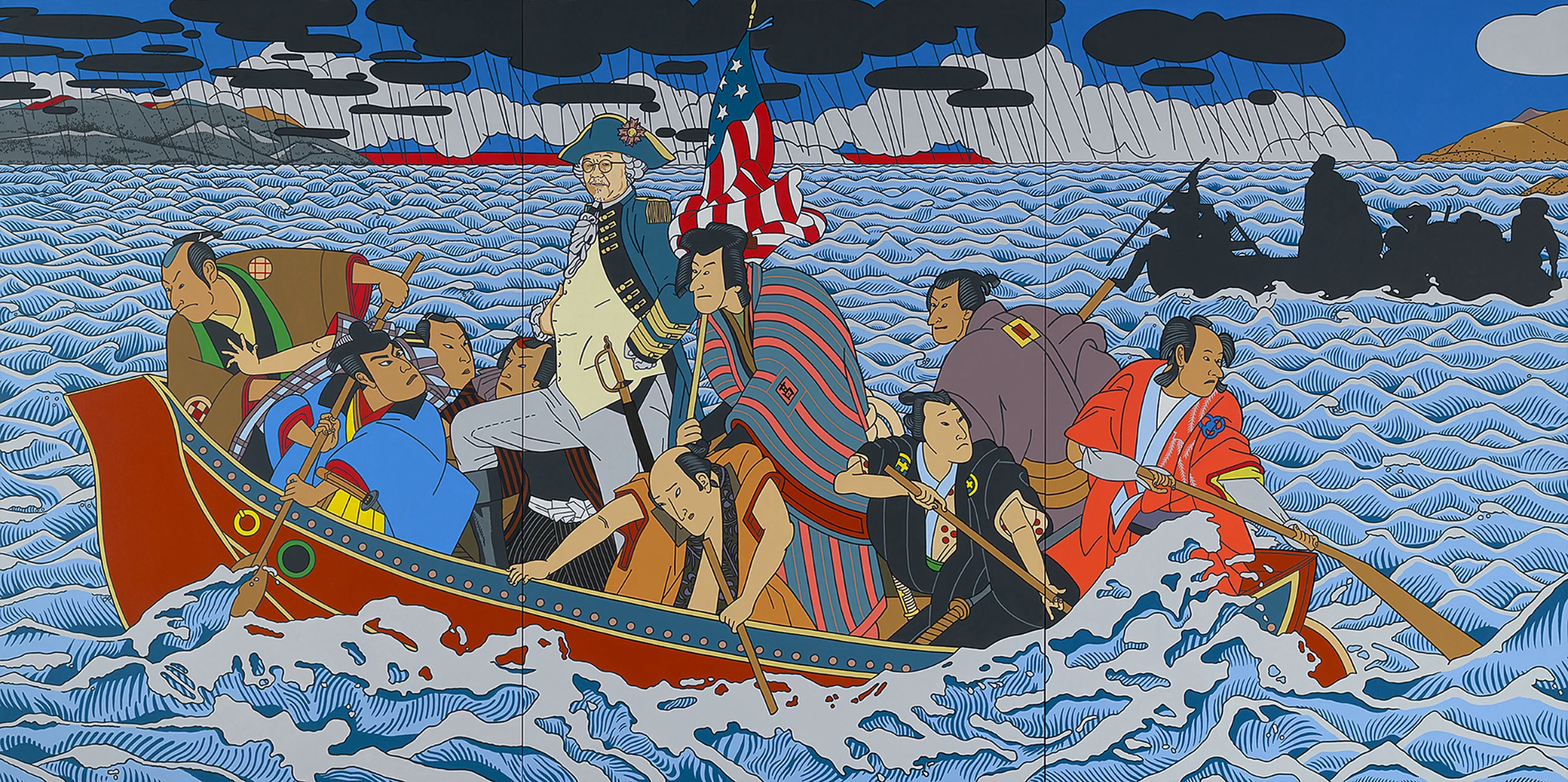
AT THE END of World War II, Walter White of the NAACP declared: "A wind is rising, a wind of determination by the have-nots of the world to share the benefits of freedom and prosperity which the haves of the earth have tried to keep exclusively for themselves. That wind blows all over the world. Whether that wind develops into a hurricane is a decision which we must make now and in the days when we form the peace."1 During the war, millions of men and women of different racial and ethnic minorities had challenged America's contradiction of the color lines, and in the process reinvented themselves. One of them was Maya Angelou. As an African-American teenager, she had been encouraged by the demand for labor to apply for a job as a streetcar operator in San Francisco. "I'd picture myself, dressed in neat blue serge suit, my money changer swinging jauntily at my waist, and a cheery smile for the passengers which would make their own work day brighter," she recalled. At the Market Street Railway Company office, the receptionist told Angelou that they were accepting applicants only from agencies. Suspicious, Angelou pointed out that the job was listed in that morning's newspaper; demanding to see the manager, she was told that he was out of the office. Angelou refused to be denied. "I WOULD HAVE THE
JOB. I WOULD BE A CONDUCTORETTE AND SLING A FULL MONEY CHANGER FROM MY BELT. I WOULD," she insisted. Returning time and again to the office, she was finally allowed to fill out an application form. "I was given blood tests, aptitude tests, physical coordination tests, and Rorschachs; then on a blissful day I was hired as the first Negro on the San Francisco streetcars."2 Angelou had discovered a spirit within her destined to soar; she would be a literary conductorette, slinging poems and stories from her heart. Ermelinda Murillo also reinvented herself during the war. Her family had emigrated from Jalisco, Mexico; in 1923, when she was three years old, they moved to Chicago. Twenty years later, a widow with a two-year-old daughter, Murillo was hired by Inland Steel Company in Indiana. She worked as a heat chaser, hot shear expediter, hotbed operator, and stocker of steel bars. "I speak some Spanish, Polish, Serbian, Croatian," Murillo said. "I learned bits of each language by working with people with various ethnic backgrounds. If I can't get a point across in one language, I simply try another. We worked hard, argued, shared a sandwich and had coffee together. To me it was a real world inside the mill." After the war, Inland Steel asked Murillo to continue working for the company. Her hard hat read: "MELA-QUEEN OF THE 12-INCH."3 One of the first Chinese-American women to volunteer for the Army Nurse Corps, Helen Pon Onyett had also earned respect during the war. She was twenty-five-years-old, with four years of nursing experience, when she enlisted in 1942. Onyett nursed wounded soldiers aboard transports off North Africa. "I can't swim, so I wore my Mae West [life jacket] twenty-four hours a day. It was very scary, especially when some of the ships you would be traveling with would be sunk right under your nose." On board, she found that she was appreciated as an army nurse. Her experience was so affirming that she served in the military reserve for more than thirty years after the war. "I wouldn't have done half the things I did if I hadn't been in the service .... I had a chance to go to school on the G.I. Bill and to improve my standing." In 1971, Onyett was promoted to the rank of full colonel. "When I spoke before audiences, people gawked at me, saying, 'Oh, my God, she's a colonel,' not 'She's Oriental.' "4 African-American Mary Daniels Williams was also changed by the war. Asked by an interviewer about her military service, Williams said that she had been a housecleaner with only a ninth-
grade education when Japan attacked Pearl Harbor. She had given birth to a stillborn child and had an unsuccessful marriage. "I had no skills. I was going nowhere fast. I was getting older and I could just see us living in the slum forever. I could see myselfliving in two or three rooms for the rest of my life, and I decided for myself I wasn't going to do it." At a post office a military recruiter promised her "education, new places to go and to visit-well, just a totally new life." Williams enlisted in the Women's Army Corps and served in England and France. After the war, she used the G.I. Bill to attend college; she completed her bachelor's degree and worked for twenty years as a social worker in Cincinnati. "I knew what I wanted," said Williams, "and I knew that I was never gonna scrub another floor."5 At the end of the war, African Americans were determined that they were "never gonna" serve again in a segregated armed forces. In 1948, while threatening to lead massive civil disobedience, A. Philip Randolph demanded the end of this shameful practice. At a meeting with President Harry Truman, Randolph declared: "Negroes are in no mood to shoulder guns for democracy abroad, while they are denied democracy here at home." Under pressure, Truman issued an executive order that required "equality of treatment and opportunity for all persons in the armed services."6 After they had returned to California from the internment camps, Kajiro and Kohide Oyama petitioned the court to overturn the Alien Land Law, which denied the right to landownership to Japanese immigrants because they were not "white." They took their case all the way to the U.S. Supreme Court, and in 1948 the Court ruled that the law prohibiting the Japanese from owning land was "nothing more than outright racial discrimination'' and therefore "unconstitutional." The Fourteenth Amendment was "designed to bar States from denying to some groups, on account of race or color, any rights, privileges, and opportunities accorded to other groups." Referring to the war against Nazi Germany, the Court declared that the Alien Land Law was "an unhappy facsimile, a disheartening reminder, of the racial policy pursued by those forces of evil whose destruction recently necessitated a devastating war." A Japanese immigrant welcomed the Court decision:
Land laws faded out, It is comfortable now - This America.
Four years later, under pressure from lobbying groups including Japanese-American veterans, Congress rescinded the "white"only restriction of the 1790 Naturalization Law. Winning citizenship for the immigrant generation "was the culmination of our dreams," exclaimed Harry Takagi. "The bill established our parents as the legal equal of other Americans; it gave the Japanese equality with all other immigrants." By 1965, forty-six thousand Japanese immigrants had taken their citizenship oaths. Although they were now in their twilight years, many of them were eager to become citizens of their adopted country. One of them rejoiced in poetry:
Going steadily to study English, Even through the rain at night, I thus attain, Late in life, American citizenship. 7
There was still another ghost from the past that needed to be exorcised-the mass internment of Japanese Americans during World War IL "Stigmatized" by the experience, the ex-internees had been silently carrying a "burden of shame." During the 1970s, however, many third-generation Japanese Americans were feeling the need to break the silence. Inspired by the Black Power movement and a growing sense of ethnic pride, they were searching for their roots. Now they wanted their elders to tell them about the internment experience. "Why? Why!" their parents would ask defensively. "Why would you want to know about it? It's not important, we don't need to talk about it." Young Japanese Americans replied that they needed to tell the world what happened during those years of infamy, and urged their parents to join pilgrimages to the camps at Manzanar and Tule Lake. The questions and the pilgrimages inspired a demand for redress and reparations. During the congressional hearings, scores of former internees came forward and told their stories. "For over thirtyfive years I have been the stereotype Japanese American," Alice Tanabe Nehira told the commission. "I've kept quiet, hoping in due time we will be justly compensated and recognized for our years of patient effort. By my passive attitude, I can reflect on my past years to conclude that it doesn't pay to remain silent."8 Finally, Japanese Americans had spoken, and their voices persuaded lawmakers to redress the injustice of internment. In 1988,
led by Congressman Robert Matsui and Senator Daniel Inouye, Congress passed a bill providing for an apology and a payment of $20,000 to each of the survivors of the internment camps. When President Ronald Reagan signed the bill, he admitted that the United States had committed "a grave wrong." During World War II, Japanese Americans had remained "utterly loyal" to this country, he pointed out. "Indeed, scores of Japanese Americans volunteered for our Armed Forces-many stepping forward in the internment camps themselves. The 442nd Regimental Combat Team, made up entirely of Japanese Americans, served with immense distinction-to defend this nation, their nation. Yet, back at home, the soldiers' families were being denied the very freedom for which so many of the soldiers themselves were laying down their lives." The nation needed, the president acknowledged, to end "a sad chapter in American history."9 The winds of protest also swept through the barrios. "During the war," stated defense worker Juana Caudillo, "there was a lessening of discrimination by some public places because they needed our money. . . . After the war, some restaurants, stores, and taverns again refused to serve us on an equal basis with whites. We knew this was totally unfair because we had worked hard to win the war." Determined to win a "double victory," Mexican-American veterans founded the American GI Forum in Corpus Christi, Texas, in 1948. Membership in this civil rights organization rose rapidly. Over one hundred forum chapters were organized within a year, spreading to twenty-three states and reaching a membership of over twenty thousand. The GI Forum organized the boycott against Coors for employment discrimination and also demanded bilingual education and the end of the bracero program.10 The war had changed Mexican Americans. After veteran Cesar Chavez returned home from fighting fascism overseas, he dedicated himself to the struggle of farm workers. His mission was to combat prejudice and win decent wages for Mexican-American agricultural laborers. As the leader of the United Farm Workers, he declared: "Our struggle is not easy. Those who oppose our cause are rich and powerful, and they have many allies in high places. We are poor. Our allies are few. But we have something the rich do not own.' We have our own bodies and spirits and the justice of our cause as our weapons." Sabine R. Ulibarri of New Mexico declared: "Those of us who went to war didn't return the same. We had earned our credentials as American citizens. We
had paid our dues on the counters of conviction and faith. We were not about to take any crap." "When our young men came home from the war," recalled Eva Hernandez, "they didn't want to be treated as second-class citizens anymore. We women didn't want to turn the clock back either regarding the social positions of women before the war. The war had provided us the unique chance to be socially and economically independent, and we didn't want to give up this experience simply because the war ended. We, too, wanted to be first-class citizens in our communities."11 This resolve to fight discrimination inspired demands to end segregated education. In the 1946 case of Mendez v. Westminster School District of Orange County, the U.S. Circuit Court of Southern California declared that the segregation of Mexican children violated their right to equal protection of the law guaranteed to them under the Fourteenth Amendment and therefore was unconstitutional. To support the Mendez case, amicus curiae briefs were filed by the American Jewish Congress, the National Association for the Advancement of Colored People, and the Japanese American Citizens League. This victory in court led the state legislature, a year later, to repeal section 8003, the law that permitted school districts to segregate Indian, Chinese, and Japanese children.12 The Mendez decision set a precedent for the historic Supreme Court 1954 Brown v. Board of Education decision. As chief counsel for the NAACP, African-American Thurgood Marshall presented the legal argument against the 1896 "separate but equal" doctrine of Plessy v. Ferguson. Behind his passion for social justice was Marshall's memory of World War II. "War is hell in every place and time," he told Carl T. Rowan, "but it was a special hell for people who were forced to fight for freedoms they had never known, for liberties that thousands of them would die without knowing it." Marshall was certain, however, that there would be a reckoning after the war. "I watched the bravery and patriotism of blacks, of the Japanese in World War Two, and I couldn't believe white Americans would continue to treat them as semislaves. People who died flying fighter planes in an Air Force that didn't welcome them. Japanese boys who fought valiantly even though their parents were behind the barbed wire of our concentration camps." Marshall said he was willing to bet "a bundle" that white Americans would respect the Fourteenth Amendment after the war and "that this country would move to place the colored race, in respect to civil rights, upon a level equal to whites."13 Marshall won his bet: the Supreme Court ruled that separate
educational facilities were "inherently unequal" and that school segregation was "a denial of the equal protection of the laws." The decision was hailed as a victory for all Americans. "We look upon this memorable decision not as a victory for Negroes alone," the NAACP announced, "but for the whole American people and as a vindication of America's leadership in the free world." Robert Williams recalled the elation he experienced when the Court announced its decision: "I felt that at last the government was willing to assert itself on behalf of first-class citizenship, even for Negroes. I experienced a sense of loyalty that I had never felt before. I was sure that this was the beginning of a new era of American democracy." A year later, the Supreme Court delivered a supplementary ruling, instructing the lower courts to implement the Brown decision "with all deliberate speed."14 Integration remained largely a court ruling on paper, however, while segregation persisted as a reality in society. Pressure for change would have to come not from judicial pronouncements, but from a people's movement for civil rights. A year after the Brown decision, blacks shifted the focus of their struggle from the courts to the community. What would turn out to be a momentous stirring for racial justice began on December 1, 1955, when a fortytwo-year-old African-American seamstress boarded a bus in Montgomery, Alabama. Rosa Parks had been an activist in civil rights protests during the war, and had attended an antisegregation program that past summer at the Highland Folk School in Tennessee. She decided the time had come for action against what Du Bois had denounced as the "Problem of the Color Line." After entering the bus, Parks sat down in the row behind the section reserved for whites. City law stipulated that the first four rows were reserved for whites, and that if whites filled up their section, blacks would have to move to make room for them. The bus became full, and the driver ordered Parks to stand up so that a white man could sit down. ''Are you going to stand up?" he asked. "No," she replied. "Go on and have me arrested." Her arrest led to an explosive protest-the Montgomery bus boycott. Although blacks were dependent on buses to get to and from work, thousands of them refused to take the bus. A song declared defiance:
Ain't gonna ride them buses no more Ain't gonna ride no more Why in the hell don't the white folk know That I ain't gonna ride no more.
Instead they shared rides, rode in black-owned taxis, and walked. "My feets is tired," a woman said, "but my soul is rested." Another walker, an elderly woman, explained: "I'm not walking for myself. I'm walking for my children and my grandchildren."15 In this history-making moment, a young minister found himself suddenly catapulted into the leadership of the struggle. When he arrived in Montgomery a year earlier to become the pastor of the Dexter Avenue Baptist Church, Martin Luther King, Jr., noticed that blacks represented almost half of the city's population. Confined to domestic service and common labor, they were surrounded by the walls of segregation. "The schools of course were segregated," King noted; "and the United States Supreme Court decision on school integration, handed down in May 1954, appeared to have no effect on Montgomery's determination to keep them that way." But, more than the schools, the buses had become an especially disliked symbol of segregation. King personally knew what it meant to be humiliated by discrimination on a bus. When he was in the eleventh grade, he had traveled with a teacher to a distant town in Georgia to give a speech at a contest. After winning a prize for his presentation "The Negro and the Constitution," he boarded the bus for Atlanta with his teacher. When the bus filled up, the white driver told them to give up their seats for some white passengers. At first King refused and was called "a black son-of-a-bitch." Advised by his teacher to avoid a confrontation, King reluctantly surrendered his seat. "That night will never leave my mind," King recalled. "It was the angriest I have ever been in my life."16 As the leader of the Montgomery bus boycott, King gave voice to black frustration. In his first speech to the boycotters, he declared: "There comes a time when people get tired. We are here this evening to say to those who have mistreated us so long that we are tired-tired of being segregated and humiliated; tired of being kicked about by the brutal feet of oppression." What should be the course of resistance? "Our actions must be guided by the deepest principles of our Christian faith," King declared. "Love must be our regulating ideal. Once again we must hear the words of Jesus echoing across the centuries: 'Love your enemies, bless them that curse you, and pray for them that despitefully use you.'" In the struggle for freedom, King fused together this Christian doctrine and Mahatma Gandhi's tactic of nonviolence. The boycott ended more than a year later when the court ordered the desegregation of the bus system. The victory affirmed the power
of blacks to transform the conditions of their lives through a grassroots movement. Their courageous action inspired an inner transformation-a hard-won sense of self-esteem. "We got our heads up now," exclaimed a black janitor proudly, "and we won't ever bow down again-no, sir-except before God."17 After the Montgomery protest came other confrontations with America's contradictions. First there were the sit-ins of black students at the Woolworth's lunch counter in Greensboro, North Carolina, in 1960. "We're trying to eradicate the whole stigma of being inferior," the students explained. "We do not picket just because we want to eat. We do picket to protest the lack of dignity and respect shown us as human beings." One of the students, Franklin McCain, recalled: "I probably felt better that day than I've ever felt in my life. I felt as though I had gained my manhood, so to speak, and not only gained it, but had developed quite a lot of respect for it." Out of the lunch counter sit-ins emerged the Student Nonviolent Coordinating Committee (SNCC). The student sit-ins spread across the South. "I myself desegregated a lunch counter, not somebody else, not some big man, some powerful man, but me, little me," a black student boasted. "I walked the picket line and I sat in and the walls of segregation toppled. Now all people can eat there." The students were standing tall against history-entrenched humiliations. "A generation of young people," King observed, "has come out of decades of shadows to face naked state power; it has lost its fears, and experienced the majestic dignity of a direct struggle for its own liberation. These young people have connected up with their own history-the slave revolts, the incomplete revolution of the Civil War, the brotherhood of colonial colored men in Africa and Asia. They are an integral part of the history which is reshaping the world, replacing a dying order with a modern democracy." In their songs, the students expressed their determination to break the chains of discrimination:
Ain't gonna let nobody turn me 'round, turn me 'round, turn me 'round, Ain't gonna let nobody turn me 'round, I'm gonna keep on walkin', keep on a-talkin' Marching up to freedom land. 18
A year after the Greensboro sit-ins came the "freedom rides"acts of civil disobedience to integrate the interstate buses and bus terminals of the South. Led by the Congress of Racial Equality
(CORE), black and white civil rights supporters defiantly and bravely rode together in buses, singing:
Hallelujah, I'm traveling Hallelujah, ain't it fine, Hallelujah, I'm traveling Down Freedom's main line.
In the South, the freedom riders were yanked from the buses and brutally beaten by racist white mobs before television cameras. "Every Freedom Rider on that bus was beaten pretty bad," recalled Isaac Reynolds. "I'm still feeling the effect. I received a damaged ear." They faced injury and even death, but they knew they could not allow violence to turn them back. "I was afraid not to continue the Freedom Ride," explained Diane Nash. "If the signal was given to the opposition that violence could stop us ... if we let the Freedom Ride stop then, whenever we tried to do anything in the Movement in the future, we were going to meet with a lot of violence. And we would probably have to get a number of people killed before we could reverse that message."19 Then, in 1963, came the famous March on Washington. The idea that had originally been proposed during World War II became a reality. On August 28, addressing the gathering of two hundred thousand people at the Lincoln Memorial, A. Philip Randolph reiterated the 1941 demands he had submitted to President Roosevelt: "We are the advance guard of a massive moral revolution for jobs and freedom. All who deplore our militancy, who exhort patience in the name of false peace, are in fact supporting segregation and exploitation. They would have social peace at the expense of social and racial justice."20 After his speech, Randolph introduced Martin Luther King, Jr., as the man who personified "the moral leadership of the civil rights revolution." Speaking to the marchers, the nation, and the world, King shared his vision of freedom in America. "Five score years ago, a great American, in whose symbolic shadow we stand, signed the Emancipation Proclamation," King declared. "I say to you today, my friends, that in spite of the difficulties and frustrations of the moment I still have a dream. It is a dream deeply rooted in the American dream. I have a dream that one day this nation will rise up and live out the true meaning of its creed: 'We hold these truths to be self-evident; that all men are created equal.' "21 Also speaking at the March on Washington, Rabbi Joachim
Prinz wove together King's dream and the still-molten memory of the Holocaust. A death camp survivor, he shared a lesson he had learned from Hitler's murderous rampage against Jews. The "most urgent" problem was not bigotry and hatred; "the most urgent, the most disgraceful, the most shameful and the most tragic problem [was] silence." The rabbi appealed to his listeners: "America must not become a nation of onlookers." The memory of the Holocaust carried a moral lesson: as a response to racial injustice, silence constituted complicity. 22 "Black and white together," the marchers sang, "we shall overcome someday." Indeed, whites were involved in the Civil Rights Movement, and many of them were Jews. Over half of the white students who went south to organize voter-registration drives during Freedom Summer of 1964 were Jewish. The two white civil rights workers who were murdered with African-American James Chaney in Mississippi that summer were Jewish-Andrew Goodman and Michael Schwerner. Jewish supporters wrote many of the checks that financed Martin Luther King's Southern Christian Leadership Conference as well as SNCC and CORE. 23 Jewish involvement in the movement for black freedom had deep roots in American history. During the 1850s, three Jewish immigrants joined John Brown's armed struggle against slavery in "Bloody Kansas." Remembering the pogroms in Russia, Jewish immigrants identified with the victims of antiblack race riots in urban America. After the killing of thirty-eight blacks during the 1917 East St. Louis riot, the Jewish newspaper Forward compared the violence to a 1903 pogrom in Russia: "Kishinev and St. Louis-the same soil, the same people. It is a distance of four and a half thousand miles between these two cities and yet they are so close and so similar to each other." Jews contributed leadership to the NAACP: its chairman for most of the years between 1914 and 1939 was Joel E. Spingarn. The head of the NAACP Legal Defense and Education Fund was Jack Greenberg, and the NAACP's fiery labor director was Herbert Hill, a graduate of an orthodox Yeshiva. One of Martin Luther King's closest personal advisers was Stanley Levison; Howard Zinn, a professor at Spelman College, was a counselor to SNCC. Over half of the white lawyers who "Yent south to defend the civil rights protesters were Jewish. 24 In joining the crusade for justice for African Americans, Jewish Americans remembered the persecution and violence they had experienced in Russia, and they knew that the border between
racism and anti-Semitism often blurred. A society that opposed discrimination, they realized, would also allow Jews equality of opportunity. Even as a ten-year-old kid cheering for Jackie Robinson when he broke into major league baseball in 1947, Jack Greenberg understood what this victory meant for Jews. Robinson was "adopted as the surrogate hero by many of us growing up at the time," the civil rights lawyer recalled. "He was the way we saw ourselves triumphing against the forces of bigotry and ignorance." Those forces had curbed Jewish admissions at Harvard and were continuing to discriminate against the appointment of Jews to the faculties of elite universities. The frontline of the battle for equality for everyone, including Jews, was the civil rights struggle for blacks. Indeed, as historian Jonathan Kaufman noted in hindsight, "Jews benefited enormously from the terrain shaped by the civil rights movement. Jews were the first to use antidiscrimination laws to gain access to restricted apartment buildings in large cities. The growing tide of tolerance left by the civil rights movement opened opportunities for Jews as well as for blacks in law firms, corporations, and universities."25 "The civil rights movement spoke to the Jewish head," Kaufman pointed out, "but it also spoke to Jewish hearts." Though many Jews had left the Lower East Side for the suburbs and had entered the mainstream of the Promised Land, they carried in their hearts a religion that compelled them to be concerned about oppression. The American Dream had worked for them; now they felt a duty as well as a memory of their own hardships to help make this promise work for blacks. Jewish civil rights workers often referred to "that quote" -the ancient pronouncement by Rabbi Hillel: "If I am not for myself, who will be for me? But if I am only for myself, what am I? And if not now, when?" Nazi genocide had unshrouded the horrible inhumanity of racism. As Jews, they nurtured a special understanding of what it meant to be degraded and victimized as the "Other."26 This black-Jewish "alliance," however, was soon "broken." As the focus of the struggle for black equality moved to the North, the relationship between blacks and Jews became increasingly strained. The Civil Rights Movement was shifting from demands for political rights to demands for economic equality. Until then, Kaufman noted, "the price of racial change had been taken out of the hide of the South. Northerners, including northern Jews, did not have to deal with consequences directly." In the North, the racial terrain was different: Jews owned about 30 percent of the
stores in Harlem, Watts, and other black communities. During the 1964 Harlem riot, blacks looted many Jewish-owned stores. A class divide separated the two groups. Ghetto blacks were also noticing that many of their landlords were Jewish. At a school integration meeting in Boston, a young black questioned whether blacks could work with Jews when Jewish landlords were exploiting them. According to Kaufman, a popular saying in the 1960s went: "Of the five people that a black meets in the course of the day-his landlord, the storeowner, the social worker, the teacher, the cop-one, the cop, is Irish. The other four are Jews."27 At a deeper level, the split between Jews and blacks reflected a larger ideological divide, as conflicting visions of equality emerged. The Civil Rights Movement had begun as a struggle for equality for blacks through integration, which was often defined as a condition of equality. To "overcome" meant to integrate the schools, buses, lunch counters, and other public facilities; this goal was expanded to include equality of opportunity for voting and employment. But in 1966, like earlier black nationalists such as Marcus Garvey, Stokely Carmichael and other young militant blacks issued a clarion call for Black Power. Increasingly, they viewed racial oppression in America as "internal colonialism." Identifying themselves with the Third World, they saw themselves as members of Frantz Fanon's "wretched of the earth," the subjugated peoples of Africa, Latin America, and Asia engaged in struggles for liberation against white colonial domination. Equality, for many black militants, now meant self-determination for blacks as a colonized people in America. The cry of black nationalism was for separatism rather than integration, and there was no place for whites, including Jews, in the movement for black liberation. 28 But the Civil Rights Movement, composed of blacks and whites fighting together against discrimination, had led to successes. In 1964, Congress prohibited discrimination in public accommodations and employment and established the Fair Employment Opportunity Commission. Ayear later, lawmakers authorized federal examiners to register qualified voters and abolished obstacles like literacy tests designed to deny voting rights to blacks. Also in 1965, the demand for equality pushed President Lyndon Johnson to promote the right of equal employment by issuing Executive Order 11246. This law required firms with federal contracts to take "affirmative action" in hiring minorities. Companies had to set "good faith goals and timetables" for employing "underutilized" qualified minority workers. At Howard University, Johnson
declared: "This is the next and more profound stage of the battle for civil rights. We seek not just freedom but opportunity-not just legal equity but human ability-not just equality as a right and a theory but equality as a fact and equality as a result."29 "We shall overcome," the Civil Rights Movement's diverse people sang, "we shall overcome." Indeed, in many significant ways, they did overcome. What emerged was a different America, less saturated with discrimination.
Raisins in the Sun: Dreams Deferred
Meanwhile, however, the Civil Rights Movement was unable to overcome the structural economic foundations of racial inequality for African Americans. While the laws and court orders prohibited discrimination, they failed to relieve poverty among blacks. African Americans had won the right to sit at a lunch counter and order a hamburger, but many of them did not have the money to pay for their meal. Blacks were told that the law now prohibited discrimination in employment, but they also saw that jobs for them were scarce. The desperation was especially acute in the inner cities of the North. "You know the average young person out here don't have a job, man, they don't have anything to do," an African American explained angrily in the early 1960s. "You go down to the employment agency and you can't get a job. They have you waiting all day, but you can't get a job."30 Explaining the reason they could not get jobs, scholar Kenneth Clark wrote in Dark Ghetto: "Those who are required to live in congested and rat-infested homes are aware that others are not so dehumanized. Young people in the ghetto are aware that other young people have been taught to read, that they have been prepared for college, and can compete successfully for white-collar, managerial, and executive jobs." One of these alienated blacks predicted in 1962: "When the time comes, it is going to be too late. Everything will explode because the people live under tension now; they going to a point where they can't stand it no more." This point was dramatically reached in Los Angeles during the long hot summer of 1965.31
"The fire bombs of Watts blasted the civil rights movement into a new phase," declared Martin Luther King, Jr. Ultimately, the struggle to realize the American Dream had to advance beyond antidiscrimination laws and confront what King called the "airtight cage of poverty." The underlying economic basis of racial
inequality was a far more elusive and formidable foe than the lynch mobs and police attack dogs. "Jobs are harder and costlier to create than voting rolls," King explained. "The eradication of slums housing millions is complex far beyond integrating buses and lunch counters." This harsh reality of urban squalor and despair was reflected in the jagged mirrors of every northern ghetto. "I see a young Negro boy," King wrote in 1963. "He is sitting on a stoop in front of a vermin-infested apartment house in Harlem. The stench of garbage is in the halls. The drunks, the jobless, the junkies are shadow figures of his everyday world."32 This impoverished and depressing world was familiar to Malcolm X. "I don't see any American dream," he declared in 1964; "I see an American nightmare." Growing up in the ghettos of the North, Malcolm Little had pursued a life of drugs and crime. Arrested and found guilty of burglary, he was given an eight-year sentence. As Malcolm X later explained, his "high school" had been the "black ghetto of Roxbury" in Boston, his "college" the "streets of Harlem," and his graduate school the "prison." While serving time, he was converted to Elijah Muhammed's Nation of Islam. As a leader of the Black Muslims, Malcolm X advocated a separatist ideology and mocked King for his faith in integration as well as his strategy of nonviolence. Like David Walker, who had issued his revolutionary appeal in the early nineteenth century, Malcolm X urged blacks to use violence to defend their rights. As the struggle for racial justice shifted from the South to the urban North, Malcolm X's message exposed the failure of the Civil Rights Movement to address the problems of joblessness and poverty."33 The Civil Rights Movement was hitting the walls of inequality based on class as well as race-what King called the "inseparable twins" of economic injustice and racial injustice. Beginning in the 1960s, black America became deeply splintered into two classes. On the one hand, the middle class experienced gains: the percentage of families earning $25,000 or more increased from 10 percent in 1960 to 25 percent in 1982, and the number of blacks in college nearly doubled between 1970 and 1980 (from 522,000 to over 1 million). On the other hand, there emerged what has been called a "black underclass." The distressing situation of this group could be measured by the persistence of intergenerational poverty, the increasing unemployment rates for young black men, and the dramatic rise in black female-headed families. Between 1960 and 1980, the percentage of such families doubled, reaching
40 percent, compared to an increase from 8 to 12 percent for white families. While blacks composed only 12 percent of the American population in 1980, they constituted 43 percent of all welfare families. "By now my wife was pregnant," said African-American John Godfrey. "And I was unemployed. So push came to shove. We went down to welfare. I needed medical protection for her and the baby. It was a sobering experience. I felt-I don't know how to put it into words-I was totally disgusted with myself. I felt I had failed myself, because I was unable to take care of myself and my family."34 Survival for many black women, even for those with husbands, became difficult on welfare. Trapped in a catch-22 situation, they wanted to get off welfare but found themselves forced by low wages to remain dependent on government subsidy. "None of my jobs ever paid more than minimum wage," said Alice Grady. "As soon as I can get a babysitter, I intend to go back to work. But it won't be easy. There is a bus stop right out front, but according to where your job is, you'd probably need two or three buses to get to work. You'd have to leave early in the morning, and you'd be leaving your children because they're not supposed to be at school until eight or nine o'clock. Then you'd have to find a babysitter for them in the evening until you got home. But I'm hoping to get off welfare and get me a good job. Right now they're helping me, but it's just making ends meet. You don't have anything left. Right now my husband is looking for a job. We vote. This year we couldn't because we were homeless. You know, the homeless can't vote. You have to have an address. It's just rough on welfare. It's just not enough. What can I do for school clothes for the kids? When my husband gets a job, we'll be cut back on welfare." A world of barriers surrounded women like Alice Grady, keeping them impoverished and blocking their avenues of exit. At several different points, they were frustrated by a cycle of poverty generated by low wages and reinforced by inadequate childcare, poor public transportation, lack of affordable housing, and political disenfranchisement. 35 Moreover, the employment situation of both black women and black men was devastated by major changes in the economy. The movement of plants and offices to the suburbs isolated many urban blacks from places of employment: in 1980, 71 percent of them lived in central cities, whereas 66 percent of whites resided in suburbs. Illustrating the dynamic interaction of the suburbanization of production, unemployment, and welfare, Chicago lost
229,000 jobs and enrolled 290,000 new welfare recipients in the sixties, while its suburbs gained 500,000 jobs. Meanwhile, blacks also suffered from the effects of the "deindustrialization of America." Due to the relocation of production to low-wage countries like South Korea and Mexico, some 22 million American workers lost their jobs between 1969 and 1976. "Blacks have been severely hurt by deindustrialization," William Julius Wilson explained, "because of their heavy concentration in the automobile, rubber, steel, and other smokestack industries."36 African-American blue-collar workers had been rendered economically superfluous. One of them was Jimmy Morse. After working for U.S. Steel in Gary, Indiana, for thirty years, he voluntarily retired in 1983 rather than wait for the imminent layoff. His monthly retirement pay totaled $552.63, which did not pay all his bills. "Now, you get the light bill outta there," he explained in 1986. "You get the water bill outta there. Buy some food outta that plus $131 we get in food stamps. You're about $40 short." During the 1970s, the region around Gary had lost 65,000 manufacturing jobs, including 12,000 at US Steel. "Foreign steel was takin' our man-hours away from us," Morse explained. "And it ain't no racial thing either. That blue-eyed soul brother is catchin' jes' as much hell as I'm catching." Actually, black workers were catching more than their share of hell. In the ranks of this new army of displaced workers was a disproportionately large number of blacks. A study of 2,380 firms which were shutdown in Illinois between 1975 and 1978 found that while blacks constituted only 14 percent of the state's workforce, they totaled 20 percent of the laidofflaborers. Of the black workers displaced between 1979 and 1984, only 42 percent were able to secure new employment. They were forced to become the "truly disadvantaged."37 Staring at the boarded-up factories, many young blacks were unable to get even their first jobs-work experience essential for acquiring skills as well as self-esteem. One of them, Darryl Swafford, grew up around Gary. Unemployed and dependent on food stamps, he had the same dream as most Americans: "I always had that goal, working in the mill. Have a home, a big car. But now there's no mill and I'm down. Just trying to make it, trying to survive." Many of the jobs available to young blacks were in the fast-food services like Burger King and McDonald's. But these jobs paid very low wages and led nowhere. "They treat you like a child on those minimum-wage jobs," complained Danny Coleman, who had worked in a fast-food restaurant. "And there is no
way you can make it on that kind of salary. It is just a dead end." Young workers like Coleman faced an economy that said: "Let them flip hamburgers."38 In the midst of this economic crisis, America's inner cities became tinderboxes for violent explosions. On April 29, 1992, immediately after four white police officers were found not guilty of assault against black motorist Rodney King, racial rage engulfed Los Angeles. The governor declared a state of emergency and ordered 6,000 National Guard troops into the city to restore order. When the unrest finally came to an end days later, the devastation was immense: 52 deaths, 2,499 injuries, and 6,559 arrests. More than 3,000 businesses had been damaged by fire, vandalism, and looting, and losses totaled $800 million. The live televised images mesmerized America. The thousands of fires burning out of control and the dark smoke filling the skies made Los Angeles look like a bombed-out city. "It took a brutal beating, an unexpected jury verdict, and the sudden rampage of rioting, looting, and indiscriminate violence to bring this crisis [of urban America] back to the forefront," Business Week reported. "Racism surely explains some of the carnage in Los Angeles. But the day-to-day living conditions with which many of America's urban poor must contend is an equally compelling story-a tale of economic injustice." The riot was a cry of rage against the poverty of the inner city. "South Central Los Angeles is a Third World country," declared Krashaun Scott, a former member of the Los Angeles Crips gang. "There's a South Central in every city, in every state." Describing the desperate conditions in his community, he continued: "What we got is inadequate housing and inferior education. I wish someone would tell me the difference between Guatemala and South Central." This comparison vividly illustrated the squalor and poverty present within one of America's wealthiest and most modern cities. Like a Third World country, South Central Los Angeles had become extremely volatile. A gang member known as Bone explained that the recent violence was "not a riot-it was a class struggle. When Rodney King asked, 'Can we get along?' it ain't just about Rodney King. He was the lighter and it blew up."39 What exploded was anguish born of despair. "What happens to a dream deferred?" asked Langston Hughes in Harlem during the 1920s.
Does it dry up Like a raisin in the sun? ... Or does it explode ?40
"Once again, young blacks are taking to the streets to express their outrage at perceived injustice," Newsweek reported, "and once again, whites are fearful that The Fire Next Time will consume them." But this time, the magazine noticed, the situation was different from the earlier riot: the recent conflict was not just between blacks and whites. "The nation is rapidly moving toward a multiethnic future in which Asians, Hispanics, Caribbean islanders, and many other immigrant groups compose a diverse and changing social mosaic that cannot be described by the old vocabulary of race relations in America." The terms "black" and "white," Newsweek concluded, no longer "depict the American social reality."41 The fire this time consumed the stores and dreams of Korean- American shopkeepers. "April 29, 1992, the night the store burned down," merchant Young Soon Han recalled, "I didn't even know what was happening. I hadn't been paying much attention to the Rodney King verdict. I didn't think the issue was so serious." Warned trouble was coming, Han went home. Later he was told that his store had been burned to the ground. During the days of fury and fire, recalled Sun Soon Kim, another storeowner, Koreatown "looked like it went to war." Smoke was rising from the buildings, and Korean merchants were frantically trying to "salvage any remains of a dream." What she saw resembled a surrealistic scene from hell. "I couldn't believe what I was seeing-like something from the movies. I felt like I was on the movie screen walking through a war zone and people in the movie theater were watching this." But she was not watching a Hollywood fantasy. "I honestly wasn't prepared for what I was about to see. In front of me was the remaining rubbles of the stores that I had poured my money, sweat, and time into. Everything I had worked so hard to build was crumbled in front of me." Kim felt that she had "died, not physically but emotionally."42 Out of the conflagration, however, arose an awareness of multiracial connectedness and an affirmation of interdependency. Shortly after the 1992 explosion, social critic Richard Rodriguez reflected: "The Rodney King riots were appropriately multiracial in this multicultural capital of America. We cannot settle
for black and white conclusions when one of the most important conflicts the riots revealed was the tension between Koreans and African Americans." He also noted that "the majority of looters who were arrested ... turned out to be Hispanic." Out of the Los Angeles conflict came a sense of community. "Here was a race riot that had no border," Rodriguez wrote, "a race riot without nationality. And, for the first time, everyone in the city realized-if only in fear-that they were related to one another." "I think good will come of [the riot]," stated Janet Harris, a chaplain at Central Juvenile Hall. "People need to take off their rose-colored glasses," she added, "and take a hard look at what they've been doing. They've been living in invisible cages. And they've shut out that world. And maybe the world came crashing in on them and now people will be moved to do something."43
Asian Americans: A "Model Minority" for Blacks?
As inner-city African Americans struggled to get by, news pundits and policymakers celebrated Asian-American success. Five years before the 1992 Los Angeles riot, CBS's 60 Minutes presented a glowing report on the stunning achievements of Asian Americans in the academy. "Why are Asian Americans doing so exceptionally well in school?" Mike Wallace asked and quickly added, "They must be doing something right. Let's bottle it." Wallace then suggested that failing black students should try to pursue the Asian-American formula for academic success. At the same time, President Ronald Reagan joined the chorus trumpeting Asian- American achievements. While congratulating Asian Americans for their family values, hard work, and high incomes, Reagan chastised blacks for their dependency on the "spider's web of welfare" and their failure to recognize that the "only barrier" to success was "within" them. Reagan had skillfully set the stage for the battle between "meritocracy" and affirmative action.44 In the spring of 1995, Governor Pete Wilson of California announced his opposition to affirmative action when he launched his campaign for the Republican nomination for the presidency. Following Wilson that summer, African-American Ward Connerly began his attack on what he scorned as "preferential treatment" for blacks. As a member of the Board of Regents of the University of California, he successfully engineered a ban on affirmative action for university admissions. Connerly argued that affirmative action represented "reverse discrimination": it discriminated
in favor of African Americans and Latino Americans, not only at the expense of whites but also of Asian Americans. Pitting Asian Americans against African Americans, Connerly declared that African-American students should be like Asian-American students, and that they should study hard, get excellent test scores and grades, and seek admission to the university based solely on their merit. Buoyed by his victory, Connerly took his crusade to the 1996 election. On the ballot, he placed Proposition 209, an initiative to prohibit affirmative action in the entire state. His proposal was called the California Civil Rights Initiative. The proposition was approved by 54 percent of the voters. But exit polls revealed that 25 percent of those who voted for it were also for affirmative action. They did not clearly understand that the "civil rights" initiative would prohibit race and gender considerations for hiring, contracting, and university admissions. In the wake of Prop. 209, diversity on university campuses declined sharply for African-American and Latino enrollments, from 5 and 15 percent to 2 and 8 percent, respectively. Yet together the two minorities totaled 40 percent of the state's population, paying taxes to subsidize the University of California. The news media and political hype over Asian-American "success" and black "failure" shrouded the impact of the Cold War economy on the problems of unemployment and poverty in the inner city. The strategic nuclear weapons program under the Reagan presidency was financed by enormous deficits. Defense expenditures under the Reagan administration more than doubled from $134 billion in 1980 to $282 billion in 1987. In that year, defense spending amounted to 60 cents out of every dollar received by the federal government in income tax. Meanwhile, resources were being diverted from social needs: defense spending was $35 billion greater in 1985 than in 1981, while funds for entitlement programs such as food stamps and welfare were cut by $30 billion. Moreover, the focus of research and development on strategic nuclear weapons was detrimental to the general economy. Between 1955 and 1990, the federal government spent more than $1 trillion on nuclear arms and other weaponry for the Cold War-a sum representing 62 percent of all federal research expenditures. This concentration on atomic arms research and production drained national resources and at the same time undermined America's capacity to produce competitive consumer goods, which, in turn, generated trade imbalances and contributed to a decline in commercial manufacturing, especially for those sectors
of the industrial economy where many blacks had been employed. The United States won the atomic arms race, but the victory was enormously costly. 45 Still, there were new prospects for change and progress. The end of the Cold War gave the country a "peace dividend." Resources devoted to nuclear-weapons production could now be shifted to the production of consumer goods, helping revitalize the economy and making it more competitive with Japan and Germany. "It's as though America just won the lottery," the New York Times editorialized exuberantly in March 1990. "With Communism collapsing, the United States, having defended the free world for half a century, now stands to save a fortune. Defense spending could drop by $20 billion next year and $150 billion a year before the decade ends." This tremendous resource could now be directed into the consumer-goods economy. What was needed, proposed Ann Markusen of Rutgers University, was "an independent Office of Economic Conversion, designed to be self-liquidating by the year 2000 and accountable to the President."46 The United States found itself perched on the threshold of a new era of economic expansion. To meet the research needs of the military over the prior half century, the government had educated and supported an impressive array of brilliant engineers and scientists. "These wizards of the cold war comprise the greatest force of scientific and engineering talent ever assembled," observed journalist William J. Broad in 1992. "Over the decades this army of government, academic and industry experts made the breakthroughs that gave the West its dazzling military edge." Released from military R&D, these "wizards" could now concentrate on the consumers-goods market. Under the guidance of a comprehensive national industrial strategy, giant American corporations like Rockwell International, Grumman, Northrup, Martin Marietta, and Lockheed could now start designing and producing "smart" consumer goods rather than "smart" bombs. More important, vital resources could now be redirected to the rebuilding of the manufacturing base in the inner cities as well as to schools and job-training programs.47 A bright future seemed ahead for America. But then came September 11, 2001, with the terrorist attack on the World Trade Center. And the hopes of the rising wind for social justice again became "dreams deferred."