
Takaki216
This WeekRead Chapter 11 in YPT

Yellow = economics · Blue = race · Pink = ideas. Page numbers are from OPT, not YPT.

OPT · A Different Mirror · OPT 262–291

Chapter 11 · The Exodus from Russia: Pushed by Pogroms

Listen to chapter 11

5 tracks

Track 1 of 5 · Chapter opening

Open selected audio in Drive

Choose a track below, then press play. Each recording is a separate section.

  1. 01Chapter opening
  2. 02A Shtetl in America
  3. 03In the Sweatshops: An Army of Garment Workers
  4. 04Daughters of the Colony
  5. 05Up from “Greenhorns”: Crossing Delancey Street
What OPT adds over YPT in this chapter

OPT follows Jewish workers’ organizing as a claim to belonging, then examines the backlash.

  • Read the 1909 strike oath and the Protocol to see how workers built collective power.Read OPT 277–280
  • Examine Lowell’s enrollment target and Takaki’s account of hostility toward Jewish success.Read OPT 286–289

Compare with YPT Chapter 11

OPT 262PDF page 294

THE EXODUS FROM RUSSIA

Pushed by Pogroms

Introduction

CALIBAN COULD ALSO have been Jewish. In Russia, Jews were degraded as the "Other." Coming from a different shore than the Japanese, they began their migration to America during the 1880s. A persecuted ethnic minority, they were forced to leave as settlers rather than sojourners; unlike the Japanese immigrants, they felt they could not return to their homeland. In an important sense, they were political refugees. "The government itself had set off the pogroms in order to save the throne from a revolutionary upheaval," observed immigrant Abraham Cahan. "By making the Jews the scapegoats, it had confused the common people so that in the end the peasants were certain that the Jews and not the Czar were the cause of their troubles." Almost everywhere, government officials encouraged acts of violence against Jews.1 The repression in Russia was pervasive. Jews were required to live in the Pale of Settlement, a region stretching from the Baltic to the Black Sea. "Within this area the Czar commanded me to stay, with my father and mother and friends, and all other people like us." recalled Mary Antin, who emigrated to America in the 1890s. "We must not be found outside the Pale, because we were Jews." Special borders contained them; like Caliban, they had been "styed." Prohibited from owning land, most Jews were forced to live in the urban areas where they earned their liveli-
OPT 263PDF page 295

hoods as merchants and artisans. In 1879, 38 percent of the Jews were employed in manufacturing or crafts, 32 percent in commerce, and only 3 percent in agriculture. Their concentration in crafts made many of them especially vulnerable. "It was not easy to live, with such bitter competition as the congestion of the population made inevitable," an immigrant explained. "There were ten times as many stores as there should have been, ten times as many tailors, cobblers, barbers, tinsmiths. A Gentile, if he failed in Polotzk, could go elsewhere, where there was less competition. A Jew could make the circle of the Pale, only to find the same conditions as at home."2

Life in the shtetls, Jewish towns and villages, was also intensely insecure, for anti-Semitic violence was a ubiquitous reality. Especially dreaded were the pogroms-massacres of Jews and the destruction of their shops and synagogues. "I feel that every cobblestone in Russia is filled with Jewish blood," an immigrant bitterly recalled. "Absolutely every year, there was a pogrom before Pesach [Passover]. In big cities during the pogroms, they used any reason to get rid of you. As many Jews as they could kill, they did; but there were some Gentiles who would save you. We survived because Pa was a gildikupets [merchant] and knew many wealthy Gentiles. But he was hurt many times." Golda Meir never forgot the persecution her family experienced: "We lived then on the first floor of a small house in Kiev, and I can still recall distinctly hearing about a pogrom that was to descend on us. I didn't know then, of course, what a pogrom was, but I knew it had something to do with being Jewish and with the rabble that used to surge through town, brandishing knives and huge sticks, screaming 'Christ killers' as they looked for the Jews, and who were now going to do terrible things to me and to my family." Similarly, Mollie Linker was only a child when her father left Russia: "I remember sitting by the window ... and looking out. When it got dark, you closed the shutters, you were afraid. You were actually always in fear because of big pogroms .... I remember that scare ... was in us all the time." The pogroms, observed Abraham Cahan, forced Jews to realize that "Russia was not their homeland and that a true home must be found for Jews. But where?"3 Spreading from shtetl to shtetl across Russia, a song pointed the way:

As the Russians, mercilessly Took revenge on us.

OPT 264PDF page 296

There is a land, America, Where everyone lives free .... 4

By the beginning of World War I, one-third of all Jews in Russia and eastern Europe had emigrated, most of them to the United States. America had caught their "fancy." Stories about freedom and a better life there were "buzzing" all around them. The distant land was viewed as a "Garden of Eden," "the golden land," where Jews would no longer be enslaved by "dead drudgery." The cry "To America!" roared like "wild-fire." "America was in everybody's mouth. Businessmen talked of it over their accounts; the market women made up their quarrels that they might discuss it from stall to stall; people who had relatives in the famous land went around reading their letters." At a sewing school in Minsk, Jewish girls received letters from America describing astonishingly high wages-the starting pay for a seamstress in New York was four dollars a week, a sum equal to a month's earnings in rubles. In Abraham Cahan's autobiographical novel, David Levinsky was seized by this emigration fever: "It was one of these letters from America, in fact, which put the notion of emigrating to the New World definitely in my mind. An illiterate woman brought it to the synagogue to have it read to her, and I happened to be the one to whom she addressed her request. The concrete details of that letter gave New York tangible form in my imagination. It haunted me ever after." While reading a letter from her father who had gone to America ahead of his family, Mary Antin felt "a stirring, a straining." "It was there, even though my mother stumbled over strange words . . . . My father was inspired by a vision. He saw something-he promised us something. It was this 'America.' And 'America' became my dream." In her dream, America became the Promised Land. 5 Hopeful possibilities exploded in their heads. Fannie Edelman wanted to escape to America where she could "fall in love and marry.'' "I was fourteen years old when I heard that people were leaving for the United States," she recalled. "I used to think of running away from our little town and from my severe father and coming to a free world called America.'' Another young woman, after deciding she wanted to emigrate, had difficulty eating and sleeping: "I was fighting to death for the money to go to America. I used to see the people going to the train to leave. I used to envy those people like anything. They said, 'You'll get married and then you'll go to America.' I says, 'I need a shlepper [a

OPT 265PDF page 297

dragger] to America? I can shlep myself!' Who didn't want to go to America?" The country also offered educational opportunities. "I heard so much about America as a free country for the Jews," said Fannie Shapiro, "and you ... didn't have to pay for schooling, so I came." Children "played at emigrating," and a mother's lullaby told children:

Your daddy's in America Little son of mine But you are just a child now So hush and go to sleep. America is for everyone They say, it's the greatest piece of luck For Jews, it's a garden of Eden A rare and precious place. People there eat challah In the middle of the week. 6

Their fears of persecution and their extravagant dreams gave them the courage to uproot themselves and leave their birthplace forever. On the streets of the shtetl, Jewish women sold their beds, chairs, kitchen tables, and other belongings in order to raise money for transportation to America. Taking only their personal possessions, Jews left familiar little towns with their cobbled streets and alleys, their smells and sounds of crowded and colorful marketplaces. "The last I saw of Polotzk was an agitated mass of people, waving handkerchiefs and other frantic bits of calico, madly gesticulating, falling on each other's necks, gone wild altogether," recalled an immigrant. "Then the station became invisible." Another explained that when he left Velizh, he had not realized that he was starting such a long journey: "This was the point at which I was cutting myself off from my past, from those I loved. Would I ever see them again?"7 As they boarded the ships, the voyagers "were all herded together in a dark, filthy compartment in the steerage." "We learned that our vessel had formerly been a cattle ship and had just been converted into a passenger boat," Alexander Harkavy wrote. "Our compartment was enormously large, and wooden bunks had been put up in two tiers, one on top of the other." The passengers felt the engine's vibrations and smelled the "choking, salty odor." As often as possible, they went up on deck, especially to see the sunset. "But as the wonderful colors sank with the sun, [their] hearts

OPT 266PDF page 298

would fill with a terrible longing for home. Then [they] would draw together and sing Russian folk songs filled with nostalgia and yearning." The sea was stormy and the ship rocked, remembered Samuel Cohen. "I kept tossing about. I stuck my head out of the bunk a little. A shower of vomit came down from the upper bunk on my face." 8 At night, the passengers thought about the world that they had left behind and the new one that awaited them. They had embarked on an exodus. "Every emigrating Jew moving westward realized he was involved in something more than a personal expedition," said Abraham Cahan. "Every Jew ... came to feel that he was part of a historic event in the life of the Jewish people." Jews were a "countryless people." Their migration to America seemed to be a continuation of a journey that had begun thousands of years earlier in Egypt, for as historian Irving Howe explained, "the events of Jewish life were divided in two endless days, the Biblical yesterday and the exile of today."9 Finally, after a long Atlantic crossing, the passengers sighted land. The moment was a deeply moving experience for Cahan's David Levinsky: "When the ship reached Sandy Hook [New Jersey] I was literally overcome with the beauty of the landscape. The immigrant's arrival in his new home is like a second birth to him." Levinsky stood breathless before "the magnificent verdure of Staten Island, the tender blue of sea and sky, the dignified bustle of passing craft." In a trance, he excitedly murmured: "This, then, is America!" "Everybody was on deck," recalled Emma Goldman, who was only seventeen years old when she arrived. "[My sister] Helena and I stood pressed to each other, enraptured by the sight of the harbor and the Statue of Liberty suddenly emerging from the mist. Ah, there she was, the symbol of hope, of freedom, of opportunity!" After a long voyage in a packed steerage of seasick people, a Polish girl climbed to the deck and saw "the big beautiful bay and the big woman with the spikes on her head and the lamp that [was] lighted at night in her hand." Suddenly, the passengers began shouting, "Ellis Island." Their bodies leaned forward, and their hands gripped the railing of the ship as they saw the immigration station.10

Who were they, these newcomers searching for a door to America? "The immigrants who had been forced to abandon their homes in Eastern Europe were a hardy lot," declared Gilbert Klaperman in The Story of Yeshiva. "With rare exceptions, they arrived penniless and inadequately trained in a profession or

OPT 267PDF page 299

handicraft. They did possess, however, indomitable faith in themselves and unflagging courage to face all difficulties. They dug their roots deep into the alien soil until it became home to them. They founded families and raised children and children's children who enriched America with invaluable contributions. This immigrant generation of the post-1881 decades may be called, indeed, the heroic generation."11 Actually, these Jewish immigrants were a highly select group. They were educated: 80 percent of the men and 63 percent of the women who came between 1908 and 1912 were literate. While most of them were poor, they were not "inadequately trained in a profession or handicraft." Two-thirds of the Jews specifying an occupation were skilled workers, compared to only 16 percent of the Italians. But, as Klaperman correctly noted, the Jews came to America as settlers. Unlike most other European immigrant groups, they planned to stay. Sixty percent of the southern Italian migrants returned to their homeland, whereas the return rate for Jews was only 3 percent. Significantly, Jews emigrated mainly as families. Almost half of them were women, compared to only about 20 percent for southern Italians. Children represented one out of every four Jews. These immigrants saw themselves as exiles, unable to return to Russia as long as religious persecution persisted. The Jews had to make America their new home.12

A Shtetl in America

From Ellis Island, most of the immigrants headed for New York City's Lower East Side. During the early nineteenth century, German Jews had settled in this area. A new Jewish community blossomed as massive waves of Russian Jews began arriving in the 1880s; by 1905, the Lower East Side had a population of a halfmillion Jews. Unlike the mostly "bachelor" community of nearby Chinatown, the Jewish colony had throngs of children. The laughter of children joined "a symphony of discordant noises" filling the air. Pushcarts lined the streets, and a cacophony of Yiddish voices, "a continual roar," rose from the crowds. "Shopkeepers grabbed the arms of passers-by and with torrents of cajolery endeavored to pull them inside their stores, cursing those who had escaped their clutching hands." In this colony, Jews seemed to be living just like they had in Russia: they resided and worked "within that small compass, meeting only people of their own nationality." Rose Cohen found that the Lower East Side was

OPT 268PDF page 300

like living in "practically the same environment" as in the homeland. It was as though "we were still in our village in Russia."13 But the ethnic enclave of the Lower East Side was also different in significant ways. There was an "American atmosphere of breathless enterprise and breakneck speed." Crowds of people were on "the streets, shouting, going in all directions." Life did not seem "normal," for "everybody was in a hurry and money was the main thing in life." The "scurry and hustle of the people" were "overwhelmingly greater, both in volume and intensity," than in the native towns of their homeland. They seemed like "a new race in the world." Pent up in the old country, their energies were being unleashed in this new land of boundlessness. The "swing and step of the pedestrians, the voices and manner of the street peddlers," seemed to testify to far "more self-confidence and energy, to larger ambitions and wider scopes, than did the appearance of the crowds" back home.14 The colony was also a ghetto. At the turn of the century, the Lower East Side was the most densely populated section of the city. Walking the streets during warm evenings, pedestrians found all the windows open and were able to see "the life inside with all its filth and sadness. Bare, scarred tables. Countless beds, with tangled sheets and blankets. The yellow gaslight, and so many, many children, and nakedness and noise." The tenth ward, located in the Jewish colony, housed over five hundred people per acre; on Rivington Street, a contemporary reported, "the architecture seemed to sweat humanity at every window and door."15 The residents were just trying to find sunlight and fresh air, to escape from the dark and stifling interiors of the "dumbbell" tenements. Six to seven stories in height, this type of apartment resembled a dumbbell: on every floor there were two apartments at each end connected by a hallway. A narrow, five-foot-wide air shaft separated the buildings. A window facing the street or a small backyard offered the only direct light for each apartment. Writing for the American Magazine in 1888, a journalist described these dumbbell tenements:

They are great prison-like structures of brick, with narrow doors and windows, cramped passages and steep rickety stairs. They are built through from one street to the other with a somewhat narrower building connecting them .... The narrow court-yard ... in the middle is a damp foul-smelling place, supposed to do duty as an airshaft; had the foul fiend designed these great barracks they

OPT 269PDF page 301

could not have been more villainously arranged to avoid any chance of ventilation ... .In case of fire they would be perfect death-traps, for it would be impossible for the occupants of the crowded rooms to escape by the narrow stairways, and the flimsy fire-escapes ... are so laden with broken furniture, bales and boxes that they would be worse than useless. In the hot summer months ... these fire-escape balconies are used as sleeping-rooms by the poor wretches who are fortunate enough to have windows opening upon them.16

Typically, each apartment was packed with people, family members, and also boarders. "At the hour of retiring," a witness told the United States Immigration Commission, "cots or folded beds and in many instances simply mattresses are spread about the floor, resembling very much a lot of bunks in the steerage of an ocean steamer." A 1908 survey of 250 Lower East Side families found that about 50 percent slept three or four persons to a room, and nearly 25 percent had five or more persons. Most of the tenements lacked baths. "I cannot get along without a 'sweat' [Russian bath] at least once a week," an immigrant complained. Occupants competed to use the toilet: each tenement had only two facilities for each floor. "A five-story house of this character contain[ed] apartments for eighteen or twenty families," counted Jacob Riis in the 1890s, "a population frequently amounting to 100 people, and sometimes increased by boarders and lodgers to 150 or more."17 To escape from the confinement of the tenements, the immigrants would retreat to the park. "On hot summer nights [we would] seek relief from the heat in Jackson Street Park," one of them remembered. "The park, innocent of grass and trees, was a large area close to the East River, with many lanes of benches ... and a stone pavilion like a Greek temple, where a small band occasionally played and milk was dispensed at a penny a glass. The park was always crowded. The men were in their undershirts. The women, more fully dressed, carried newspapers for fans. Hordes of barefoot children played games, weaving in and out of the always thick mass of promenaders."18 As they settled in the Lower East Side, the Jews began to establish organizations and create community. They formed networks or lodges, landsmanshafts, composed of people from the same town or district in Russia, seeking the company of friends from di alte heym, "the old home village." They also found community and conversation in the public bathhouses as well as in

OPT 270PDF page 302

the neighborhood delicatessens and candy stores that had become gathering places. In cafes like Schreibers on Canal Street and Cafe Royale on Second Avenue, Jewish intellectuals drank tea as they debated philosophical and political issues before rushing off to hear lectures regularly presented by the Educational Alliance and the People's Institute at Cooper Union. "There were scores of lectures every week," said Marcus Ravage. "One night it was Darwin and the next it might be the principle of air pressure. On a Saturday night there were sometimes two meetings so arranged that both could be attended by the same audience." Others preferred the movie theaters, where for five cents they could watch a half-hour film. "If it's not too busy, you can see it several times," an immigrant said. "They open at one in the afternoon, and customers, mostly women and children, gossip, eat fruit and nuts, and have a good time."19 Everywhere outside the cafes and theaters, there were peddlers. Carrying packs or pushing carts, they knocked on doors and cajoled housewives to buy their goods. Shortly after Isaac Raboy arrived at Ellis Island, he found himself on Delancey Street, where peddlers were hawking their wares as they pushed their carts filled with "exotic" things. Streams of people flowed down the streets. "Suspenders, collah buttons, 'lastic, matches, hankeches-please, lady, buy," peddlers shouted. "Bandannas and tin cups at two cents, peaches at a cent a quart, damaged eggs for a song, hats for a quarter, and spectacles warranted to suit the eye ... for thirty-five cents." A contemporary observed: "There are few more pathetic sights than an old man with a long beard, a little black cap on his head and a venerable face- a man who had been perhaps a Hebraic or Talmudic scholar in the old country ... standing for sixteen hours a day by his push-cart in one of the dozen crowded streets of the Ghetto ... selling ... apples, garden stuff, fish and second-hand shirts."20 The Jewish peddler soon became a figure of Jewish-American folklore. In one of Anzia Yezierska's stories, Gedalyeh Mindel wrote to his family: "My sun is beginning to shine in America. I am becoming a person a businessman. I have for myself a stand in the most crowded part of America, where ... every day is like market day by a fair. My business is from bananas and apples. The day begins with my pushcart full of fruit, and the day never ends before I count up at least two dollars' profit-that means ... four rubles a day, twenty-four rubles a week! ... White bread and meat I eat every day just like the millionaires." Risto-

OPT 271PDF page 303

rian Moses Rischin noted that "the peddler's pack ... provided the most direct introduction to American ways, the most promising school for the study of the country's speech, tastes and economic needs, and the broadest field for the play of the aspiring tradesman's imagination." The peddler personified the transformation of the Jewish immigrant from scholar to salesman. 21

This journey was described in Cahan's novel. An old man who had been a Talmudic scholar in Russia found that his wife was not willing to support him in America. Insisting that he go out and peddle, she snapped: ''America is not Russia. A man must make a living here." The husband told David Levinsky: "America is a topsy-turvy country." A quick learner, Levinsky abandoned his dream of becoming a scholar and turned to peddling: "I rented a push-cart and tried to sell remnants of dress-goods, linen, and oil cloth .... I would announce to the passers-by the glad news that I had struck a miraculous bargain at a wholesale bankruptcy sale ... and exhort them not to miss their golden opportunity." In this way, Levinsky began his "rise."22 But while Jewish peddlers appeared ubiquitous, they actually represented only a very small proportion of working Jews. A survey of gainfully employed Jews living in New York City in 1890 revealed that only 10 percent were peddlers. On the other hand, 60 percent worked in the garment industry. 23

In the Sweatshops: An Army of Garment Workers

For the Jewish "rise" in America, what mattered more than a frenetic entrepreneurial spirit was the fact that many Jewish immigrants brought something useful-their skills, especially in the sewing trades. "I am a tailor," recalled an immigrant years later at the age of eighty-two, "and I was working piecework on Russian officers' uniforms. I saved up a few dollars and figured the best thing was to go to the U.S.A. Those days everybody's dream in the old country was to go to America. We heard people were free and we heard about better living."24 The arrival of these skilled immigrants was timely, for they were needed in New York's expanding garment industry. In earlier times, clothes had been tailor-made, but the Civil War had transformed garment manufacturing. In order to meet the Union Army's demand for clothing, tailors established uniform standards and measurements. This innovation enabled them to massproduce garments in factories, utilizing new inventions such as

OPT 272PDF page 304

the Singer sewing machine, the electric cutting knife, and the buttonhole machine. Between 1880 and 1890, the number of men's clothing factories doubled from 736 to 1,554, and women's cloak factories tripled from 236 to 740. The center of this growing new industry was New York City. Between 1880 and 1910, the number of clothing factories jumped from 10 percent of the city's factories to 47 percent, and garment workers from 28 percent to almost half of its industrial workers. 25 German Jews had initially dominated the garment industry. Having come to America earlier, many of them had established themselves economically and socially by the time of the great Jewish migration from Russia. German-Jewish firms like Blumenthal Brothers, Kuppenheimers, and Hart, Schaffner & Marx were prominent in clothing manufacturing. Gradually, many Jewish newcomers from Russia became contractors and manufacturers themselves. Together, the German and Russian Jewish garment makers revolutionized the way clothes were made and what Americans wore. In his novel, Cahan described this triumph: "Foreigners ourselves, and mostly unable to speak English, we had Americanized the system of providing clothes for the American woman of moderate or humble means." The Jewish garment makers had democratized dress in America, offering the masses machine-made classy clothes. They had done away with "prohibitive prices and greatly improved the popular taste. Indeed, the Russian Jew had made the average American girl 'a tailor-made' girl."26 The Jewish garment makers transformed the Lower East Side into a huge, spreading industrial beehive. On the Second Avenue elevated train, a passenger could ride half a mile through the sweater district. "Every open window of the big tenements, that [stood] like a continuous brick wall on both sides of the way, [gave] you a glimpse of one of these shops .... Men and women bending over their machines or ironing clothes at the window, halfnaked. Morning, noon, or night, it made no difference." From block after block of sweatshops came the "whir of a thousand sewingmachines, worked at high pressure from the earliest dawn till mind and muscle [gave] out together."27 In 1914, about 60 percent of the businesses were small shops, employing fewer than thirty workers. Contractors did not need much capital, only about $50, to start shops with foot-power machines. Once their workers and machines were in place, they could bid for contracts from the manufacturers. Buyers provided

OPT 273PDF page 305

cloth to the contractors and paid as little as possible for the finished clothes "The shop was not the manufacturer's," wrote Cahan, describing the place where Levinsky worked. "It belonged to one of his contractors, who received from him 'bundles' of material which his employees ... made up into cloaks or jackets. The cheaper goods were made entirely by operators; the better grades partly by tailors, partly by operators, or wholly by tailors; but these were mostly made 'inside,' in the manufacturer's own establishment." The nature of the industry pushed both workers and contractors. The laborers dared not stop working, "knowing that there were plenty of other men ready instantly to take their places," journalist Ray Stannard Baker explained; "and the contractor, himself the victim of frightful competition and the tool of the manufacturer, always playing upon their ready fears, always demanding a swifter pace, forced the price constantly downward."28 To increase production, many contractors used the task system, assigning a quota to a team of ten or twenty workers-family members, boarders, or lanslite, neighbors from the old country. They worked as a unit, with specific tasks assigned to a sewingmachine operator, a baster, a presser, and a finisher. A team received a group wage based on the number of garments produced, with each member paid a certain percentage. This system drove everyone on the team, for each worker wanted to increase the pace of production for the group. "The highest speed of one was in substance made the minimum speed of others," an immigrant worker explained, "since no man could get ahead in his work without his fellow workmen keeping the same speed in the productive formation." Larger shops employed the "section" system of production: work was subdivided into several steps, and workers performed one task repeatedly. This system reduced skilled tailors and seamstresses to assembly-line workers. "When I came here," complained Bella Feiner, "I knew more than I know now. I knew how to make a whole dress." But this fragmentation of production also opened employment to unskilled immigrants. "The foreman asked me what I could do," remembered Lottie Spitzer. "And I said, 'I don't know anything.' In fact, I couldn't even handle a needle. But he taught me and [soon] I was basting sleeve linings."29 In the sweatshops, the work was physically punishing. The section system gave the bosses power to set the pace of their workers, who sat in long rows with their "bodies bent over the machines."

OPT 274PDF page 306

Each person completed an assigned task and then passed her part of the garment to the next worker on the line, while the foreman nagged them to hurry. "Most of them smoke cigarettes while they work," observed a contemporary; "beer and cheap whiskey are brought in several times a day by a peddler. Some sing Yiddish songs-while they race. The women chat and laugh sometimes-while they race." But many women were forced to work silently. "We were like slaves. You couldn't pick your head up. You couldn't talk. We used to go to the bathroom. The forelady used to go after us, we shouldn't stay too long."30 "The machines were all in a row. And it was so hot, not even a decent fan. And you ... worked, and you sweated. Windows were open, of course; flies too. You had a little half hour for lunch (we worked close to ten hours). And you talked. But you were kept so busy and the machines were roaring .... You had to be careful not to stitch your fingers in." Accidents did happen. "The machines go like mad all day, because the faster you work the more money you get. Sometimes in my haste, I get my finger caught and the needle goes right through it. It goes so quick, though, that it does not hurt much. I bind the finger up with a piece of cotton and go on working .... Where the needle goes through the nail it makes a sore finger, or where it splinters a bone it does much harm."31 The long hours and the repetitious stitching made workers feel like appendages of their sewing machines. "You don't have to think," said Mollie Wexler, who worked in a dress factory. All you have to do is "pin together and put together," "just sit and shoot like the machine itself." Anzia Yezierska related a story about a young Jewish woman who had "dreamed of free schools, free colleges" where she could learn to give out her "innermost thoughts and feelings" to the world. But no sooner had she come off the ship than hunger drove her to the sweatshop, "to become a 'hand' - not a brain-not a soul-not a spirit-but just a 'hand'-cramped, deadened into a part of the machine." A Yiddish poet described the numbness workers felt as they toiled, trapped in the sweatshops:

I work, and I work, without rhyme, without reason produce, and produce, and produce-without end. For what? and for whom? I don't know, I don't wonder since when can a whirling machine comprehend?

No feelings, no thoughts, not the least understanding; this bitter, this murderous drudgery drains

OPT 275PDF page 307

the noblest, the finest, the best and the richest, the deepest, the highest that living contains.

Away rush the seconds, the minutes and hours; each day and each night like a wind-driven sail; I drive the machine, as though eager to catch them, I drive without reason-no hope, no avail. 32

The workday was long, from eleven to fifteen hours. "My work was sewing on buttons. While the morning was still dark I walked into a dark basement. And darkness met me when I turned out of the basement." The workers had to wait until night to begin living. "At the end of the day one feels so weak that there is a great temptation to lie right down and sleep," said a seamstress. "But you must go out and get air, and have some pleasure .... Sometimes we go to Coney Island, where there are good dancing places, and sometimes we go to Ulmer Park to picnics. I am very fond of dancing, and, in fact, all sorts of pleasure."33

Daughters of the Colony

Thousands of these garment workers were young women. Many of them had come first, before their families. "In growing numbers," observed historian Susan A. Glenn, "Jewish families were willing and found it practicable to send one or more children including their working-age daughters, in advance." What made it "practicable" to send them ahead was the fact that many possessed sewing skills. In the Pale of Settlement in the 1890s, over fifty thousand Jewish women worked in the sewing trades, constituting 70 percent of all registered female artisans. The first sewing machines had been introduced in Russia two decades earlier, and the Singer sewing machine came to symbolize a guarantee of a good livelihood. Fannie Shapiro recalled that in each small Russian town there were little shops where "two, three, four, or five girls in a house, [were] working, making dresses and things. And they had a Singer's, a sewing machine." Girls reaching the age of thirteen were usually apprenticed to a seamstress. One of them, Sarah Rozner, had to work hard to learn how to operate the sewing machine: "I finally got it, and believe me it helped a lot when I came to this country."34 In America, most of the young Jewish women working in the garment industry were single, planning to work for a few years

OPT 276PDF page 308

before marriage. One of them told an interviewer: "Henry has seen me home every night for a long time and makes love to me. He wants me to marry him, but I am not seventeen yet, and I think that is too young .... Lately he has been urging me more and more to get married-but I think I'll wait." In 1910, over 70 percent of the Jewish daughters sixteen years old or over were working for wages. "Right after Passover, I entered school," remembered one of them. "When school was out in June, I knew I couldn't go back any more, so coming home I cried all the way .... My father had a job for me. I couldn't do any thing-at that age, you know, you couldn't work till you were sixteen, but kids worked at fourteen and thirteen."35 Constituting over one-third of the garment industry's workforce in 1910, these young women labored in dangerous and cramped conditions. In the sweatshops, they were literally packed together. On floor after floor, they worked elbow to elbow at sewing machines on row after row of long tables. "We are so crowded together that there is not an inch of space," they complained. "The machines are so close together that there is no way to escape in case of immergansie."36 An emergency did happen on March 26, 1911, when a fire suddenly exploded at the Triangle Shirtwaist Company. Eight hundred workers, mostly young women, were trapped in the burning building. "A stream of fire tore up through the elevator shaft and stairways to the upper floors. Fire instantly appeared at all windows, and tongues of flames crept higher and higher along the walls to where little groups of terrified girls, workers, stood in confusion." Screaming, struggling, they jumped from windows, some from the ninth floor, their bodies smashing on the sidewalks. "One girl after another fell, like shot birds, from above, from the burning floors," wrote Morris Rosenfeld in his account based on eyewitness reports. "They hit the pavement just like hail," a fireman at the scene reported. "We could hear the thuds faster than we could [see] the bodies fall." Jumping from the higher floors, the girls came down with such force that they tore the nets from the grasps of firemen or snapped the cords. Unable to escape, 146 young workers-mostly Jewish and Italian-died in the smoke and heat of the inferno. There were so many bodies they could not all be taken away in ambulances and patrol wagons; grocers and peddlers offered their wagons and pushcarts. 37 Mothers rushed to the scene, where they saw the blackened

OPT 277PDF page 309

bodies of their daughters laid out on the sidewalks. Tearing their hair, they screamed: "Oy vey, kindenyu!" "Oy vey, my child!" "For a piece of bread, a terrible death, robbed me ofmy only child." "My little girl lies dead, shrouds instead of a wedding gown." The tragedy stunned the colony: fifty thousand people marched silently in a mass memorial parade to grieve for their dead daughters. The charred bodies were buried together in the Workmen's Circle Cemetery.

Over whom shall we weep first? Over the burned ones? Over those beyond recognition? Over those who have been crippled? Or driven senseless? Or smashed? ... This is our funeral, These our graves, Our children .... 38

News of the horror rapidly spread to the shtetls of Russia. "I still remember what a panic that news caused in our town when it first came," said Elizabeth Hasanovitz. "Many a family had their young daughters in all parts of the United States who worked in shops. And as most of these old parents had an idea of America as one big town, each of them was almost sure that their daughter was a victim of that terrible catastrophe." In his description of the grisly scene, a reporter wrote: "I looked upon the dead bodies and I remembered these girls were the shirtwaist makers. I remembered their great strike of last year in which the same girls had demanded more sanitary conditions and more safety precautions in the shops. Their dead bodies were the answer."39 Indeed, many of the dead women had gone out on strike in 1909-10, participating in the famous "uprising of twenty thousand." In July, a spontaneous strike had erupted at Rosen Brothers, and then in September at Leiserson's and the Triangle Shirtwaist Factory. The striking women asked for assistance from the Ladies' Waist Makers Union Local 25. With only a hundred dues-paying members and four dollars in its treasury, Local 25 appealed to the International Ladies' Garment Workers' Union, requesting a call for a general strike in the shirtwaist industry. But the ILGWU,

OPT 278PDF page 310

founded in 1909, had only a few thousand members and lacked the resources to mobilize such a massive action. The power to do so had to come from the people themselves. On the night of November 22, 1909, thousands of workers crowded into the Cooper Union to attend a mass meeting organized by the striking women. They had come to demonstrate their support for the strikers and to denounce the intransigence of the bosses and the brutality inflicted against the picketers by hired thugs and the police. In the packed hall, their bodies restless and taut with anger, they heard speaker after speaker advise them to be patient and act cautiously. Frustrated by the urgings of restraint, a fragile-looking teenager suddenly rushed to the platform. "I am a working girl," Clara Lemlich declared in Yiddish, "one of those striking against intolerable conditions." The charismatic leader passionately articulated the pent-up feelings of the audience. She compared the abuse of the garment workers to the experience of blacks: "[The bosses] yell at the girls and 'call them down' even worse than I imagine the Negro slaves were in the South." She urged action: "I am tired of listening to speakers who talk in generalities. What we are here for is to decide whether or not to strike. I offer a resolution that a general strike be declared-now." Her brave words and her call to action touched off a thunderous applause. Meeting chairman Benjamin Feigenbaum jumped to the platform and joined hands with Lemlich. Their arms held high together, he asked the crowd in Yiddish to support her call for a general strike, framing it as a Jewish struggle: "Do you mean faith? Will you take the old Jewish Oath?" Aroused, the people raised their right hands and pledged: "If I turn traitor to the cause I now pledge, may this hand wither from the arm I now raise." The next morning, fifteen thousand shirtwaist workers were on strike. 40

"The East Side was a seething mass of excited women, girls, and men." Strikers attending packed meeting halls spilled out into the streets. "All over the East Side a sea of excited faces, a mass of gesticulating women and men, blocked the streets." "Vast crowds" were "wildly demonstrative," marching through the streets and breaking into "storms of applause as the word that another boss had settled with the strikers was passed along." The strikers swelled in numbers, to over twenty thousand; they were overwhelmingly Jewish, with Italian women constituting about 6 percent. The demands of the strikers included a fifty-two-hour workweek, overtime pay, and union recognition.41

OPT 279PDF page 311

As they picketed, the strikers were arrested by the police and beaten by thugs. Still, according to one contemporary, "neither the police, nor the hooligan hirelings of the bosses nor the biting frost and chilling snow of December and January dampened their willingness to picket the shops from early morn till late at night."

In the black winter of 1909 When we froze and bled on the picket line We showed the world that women could fight And we rose and we won with women's might.

Hail the waist makers of 1909 Making their stand on the picket line Breaking the power of those who reign Pointing the way and smashing the chain.

The courageous strikers impressed the community: they were proudly described as "unzere vunderbare farbrente meydlekh," "our wonderful fervent girls." The strike was powerful, intimidating, and by February, more than 300 of the some 450 firms in the New York industry had been forced to make some kind ofsettlement.42 Several months later, another strike exploded as fifty thousand cloak and suit workers walked off their jobs. The strikers wanted higher wages, a forty-nine-hour workweek, and a "closed shop," the hiring of union members only. Both sides reached an agreement in September with the signing of a "Protocol of Peace." Among the gains the workers received were a fifty-hour workweek, wage increases, and preferential hiring for union members.43 These labor struggles represented a watershed in Jewish- American history. They initiated "a decade of labor unrest in the garment trades," noted historian Susan A. Glenn. "Between 1909 and 1920 a wave of strikes and mass organizational campaigns swept through the garment trades, changing a largely unorganized industry into a union stronghold .... By the end of World War I clothing workers were among the best-organized members of the American labor force." The International Ladies' Garments Workers' Union had one hundred thousand dues-paying members in 1920, and one hundred seventy thousand workers belonged to the Amalgamated Clothing Workers of America.44 These labor triumphs had ethnic as well as class significance. In their struggles, the workers had created a broadly based radical Jewish consciousness. "Until now there had been no more

OPT 280PDF page 312

than a large scattering of Jewish immigrant workers who would sometimes cohere for a fierce outbreak and then crumble into isolated persons," Irving Howe noted. "The Jewish community in the United States was not really a Jewish community," remarked leftist Paul Novick, "it was just something in fermentation until the labor movement came along." The strikes were "Jewish" strikes: the workers received support and sustenance from the Jewish community. Jewish neighborhood organizations donated food and clothing, and Jewish shopkeepers allowed striking workers and families to purchase goods on credit. "The major topics most frequently bantered about concerned the union meetings and sometimes ... strikes in the needle trades in which everyone worked," an immigrant remembered. The "uprisings" of this era sharpened a shared sense of ethnicity, an immigrant Jewish identity in America.45

Up from "Greenhorns": Crossing Delancey Street

The Jews had come to make new homes in America, and their strikes had given them a sense of belonging to the new land. They were making a claim on their adopted country and demanding wages that would allow them to enjoy America's bounties. Their labor struggles, while springing from ethnic solidarity, were also transforming them from "greenhorns" into Americans. "Oysgrinen zikh," Jewish immigrants said to themselves; "Don't be a greenhorn." When they arrived in America, they were foreigners in their dress, language, and thinking. "I just didn't know how to cope with it all," a Jewish immigrant recalled. "I was unhappy because I didn't know anything, and I was frightened .... When they used to call me names like 'greenhorn,' I felt that I would rather die than hear it again."46 The passion to become American was reflected in one of the most frequently asked questions in the Lower East Side: "How long have you been in America?" How long was measured by their degree of assimilation. The Jewish immigrants began learning American ways in a process they called "purification." To become American meant to acquire "civility" -a quality of middle-class refinement in behavior and tastes. According to scholar John Cuddihy, they had been driven by the pogroms in Russia "out of their Middle Ages into the Anglo-American world of the goyim 'beyond the pale.' " In America, they were swept into a process of modernization and assimilation.47

OPT 281PDF page 313

This process required what Cuddihy termed the "price of admission": they had to give up certain customs and cultural traits that had been tied to their ethnicity. Wearing the proper clothing was crucial in acquiring the appearance of civility. "I was such a greenhorn, you wouldn't believe," said Sophie Abrams. "My first day in America I went with my aunt to buy some American clothes. She bought me a shirtwaist ... a blue print with red buttons and a hat, such a hat I had never seen. I took my old brown dress and shawl and threw them away! ... When I looked in the mirror, I couldn't get over it. I said, boy, Sophie, look at you now. Just like an American." Immediately after arriving in the Lower East Side, Cahan's Levinsky noticed that the people were better dressed than people back home. "The poorest-looking man wore a hat (instead of a cap), a stiff collar and a necktie, and the poorest woman wore a hat or bonnet." Passersby looked at Levinsky and exclaimed: "There goes a green one!" The remark stung him, for he understood what they were implying: "We are not, of course. We are Americanized." Shortly afterward, a friend bought Levinsky a suit, a hat, handkerchiefs, collars, shoes, and a necktie. "That will make you look American," said his benefactor. Levinsky gazed at himself in the mirror, "bewildered," scarcely recognizing himself in his "modern" outfit. To dress fashionably became a necessity. "Some of the women blame me very much because I spend so much money on clothes," said a garment worker. "But a girl must have clothes if she is to go into good society at Ulmer Park or Coney Island or the theater. Those who blame me are the old country people who have old-fashioned notions, but people who have been here a long time know better. A girl who does not dress well is stuck in a corner, even if she is pretty."48 Language was also an indicator of assimilation. In Russia, most Jews had made no effort to learn the dominant language, but as immigrants in America they were eager to learn English. "Today," observed a resident of New York's Jewish community in 1905, "English is more and more the language spoken on the East Side, whereas eight years ago it was rare to hear that tongue." In a letter to the Jewish Daily Forward, a mother complained about her daughter who had preceded her family to America: "During the few years she was here without us she became a regular Yankee and forgot how to·talk Yiddish .... She says it is not nice to talk Yiddish and that I am a greenhorn." As a student at a public evening school, Levinsky was impressed by his teacher's facility in English: "I would hang on his lips, striving to memorize every English

OPT 282PDF page 314

word I could catch and watching intently, not only his enunciation, but also his gestures, manners, and mannerisms, and accepting it all as part and parcel of the American way of speaking." More than dress, Levinsky believed, good English was a requirement for assimilation: "People who were born to speak English were superior beings. Even among the fallen women I would seek those who were real Americans." Learning English was a way for the immigrants to become "regular Yankees" and lessen the ethnic distance between themselves and native-born Americans.49 The quest to become American also led to the changing of names for some, possibly many. "They [immigrant Jews] themselves seemed ready to accept the idea that they were nobodies," recalled the son of an immigrant. "They were so scared that they even dropped the pride of a family name." Russian -skis and -vitches were dropped, and names like Levinsky became Levin. But names were also Anglicized: from Bochlowitz to Buckley, Jacobson to Jackson, and Stepinsky to Stevens. Many young people happily adopted "American" first names in school: Dvoirah became Dora; Hyman, Howard; Moishe, Morris; Breina, Beatrice; and Rivka became Ruth. "My Hebrew name being Maryashe in full, Mashke for short, Russianized in Marya (Mary-ya)," said Mary Antin, "my friends said that it would hold good in English as Mary; which was very disappointing, as I longed to possess a strange-sounding American name."50 American holidays and consumerism became popular in the Jewish colony. The Yiddish daily Forward noted that Jews enjoyed giving presents at Christmastime and that this practice was "the first thing" that demonstrated one was not a "greenhorn." For many newcomers, historian Andrew R. Heinze observed, the goal was to become an "allrightnik," "the successful Jewish immigrant who adopted American habits, particularly habits of consumption, so thoroughly as to blend into the group of cosmopolitan Jews who had attained a high degree of cultural assimilation." Ownership of luxury goods proclaimed silently that the newcomer was a prospective citizen, and not Europe's "wretched refuse" coming to America's "teeming shore." By adapting to abundance, the immigrants were adopting America. 51 Not to be a "greenhorn" also meant to take summer vacations at resorts, especially in the Catskill Mountains. As Jewish immigrants raised themselves economically and socially, they began flocking to cottages and hotels in small towns like Tannersville and Hunter. "One of the latest fashions among the poor people of

OPT 283PDF page 315

the East Side," the Commercial Advertiser reported in 1899, "is for the father of a family to send his wife and children to the mountains for the summer. Not that East Side prosperity has placed some of the luxuries within reach of the poor. On the contrary, board in the Catskills has come down to a point where the 'keep' of a workingman's family in a boardinghouse is almost as cheap as it is at home in the city." The resorts also offered opportunities to flaunt newly acquired accoutrements that trumpeted their success. "The only good thing about the Catskills is the fresh air," observed the Forward wryly, "but instead of taking advantage of it, the women sit on the porch like a fashion show, each one showing off her clothes and jewelry."

And here in the Catskill what do Jews believe? In kosher, certainly; in Shabbes, less, (But somewhat, for they smoke in secret then.) In Rosh Hashanah and in Yorn Kippur, In charity and in America; But most of all in pinochle and poker, In dancing and in jazz, in risque stories, And everything that's smart and up-to-date.

As Jewish businessmen, wives, garment workers, teachers, shopkeepers, and children spent their summers in the Catskills, they were participating in "a distinctly Jewish version of the American vacation," an extravagant custom "fulfilling the vision of the earthly paradise" that the immigrants had carried to America. 52 One of the "allrightniks" who vacationed in the Catskills was David Levinsky. He had gone there like the others-the "cloakmanufacturers, shirt-manufacturers, ladies'-waist-manufacturers, cigar-manufacturers, clothiers, furriers, jewelers, leather-goods men, real-estate men, physicians, dentists, lawyers" and their families. In most cases, these vacationers were "people who had blossomed out into nabobs in the course of the last few years," Levinsky reported. "The crowd was ablaze with diamonds, painted cheeks, and bright-colored silks," "a babel of self-consciousness," a minature of "parvenu smugness." As a wealthy garment manufacturer, Levinsky "paraded" his newly acquired manners, his neckties, and his English vocabulary. 53

For Jewish men to be "American" meant to participate in the world of business. But for married Jewish immigrant women,

OPT 284PDF page 316

it meant to stay at home. A government study conducted in 1907-8 found that only 8 percent of Russian-Jewish wives were wage earners, compared with 17 percent for southern Italians. Actually, many Jewish wives had incomes-the rent from their boarders: 56 percent of Jewish immigrant households in 1911 had boarders. Wives could also work in family businesses, and many of them could be seen and heard hawking from pushcarts. "At the time when girls were married it was terrible [for them] to go to work. . . . That was forbidden," recalled an immigrant woman. "[But] if they worked in their own business, they could have worked day and night."54 Not encouraged, perhaps not even permitted to be wageearning workers, the Jewish wife was expected to be a baleboste, an "owner of the home," taking care of domestic responsibilities such as preparing meals and paying the bills. "We were high class with low-class means," an immigrant daughter recalled. "We just didn't let a woman like my mother go to work, even if she wanted to." Marriage meant the end of working outside the home. "When I came here I was thirteen and a half," said Mollie Linker. At the age of fifteen years, she was working and took "almost three hundred people [out] on strike." "I got married at eighteen .... Then the babies came." Mollie Linker's father-in-law told her that as a mother it was "a shame to go to work." Similarly, Ruth Katz recalled: "At the time I came [to America], the woman was home cooking and cleaning and raising the children. Women weren't supposed to go out and work. . . . That I think we brought from Europe, that a Jewish wife should not go to work."55 While the role of the baleboste was imported, staying home for Jewish wives and mothers represented an American adaptation. In Russia, it had reflected the traditional notion of the husband's economic importance; here it acquired a new veneer. An Old World tradition had become a signature of bourgeois success in the New World. "Over time," wrote the historian Susan A. Glenn, "Jewish immigrants became increasingly sensitive to bourgeois notions of respectability." Seeking to identify themselves with "upwardly mobile, assimilated Americans," many insisted that a wife should "devote herself exclusively to her domestic obligations and leave the task of breadwinning to the husband." To have the luxury of not working meant that Jewish wives and their families were no longer "greenhorns" and that they had "made it" socially and economically. They had entered the world of "civility."56 But Jewish "success" was earned. "Most New York City Jews

OPT 285PDF page 317

did not make the leap from poverty to the middle class by going to college," historian Selma C. Berrol found. "Rather, widespread utilization of secondary and higher education followed improvements in economic status and was as much a result as a cause of upward mobility." As skilled workers, as unionized laborers, and as businessmen, many Jewish immigrants had already begun their "rise" and had the economic means to support the education of their children. 57 Jewish immigrant fathers and mothers were driven by a determination to have their children become professionals rather than peddlers, tailors, merchants, and garment factory workers. Parents wanted their children to get out of blue-collar jobs and into white-collar employment, to have occupations "higher than the dirty work in a factory." Describing the Jewish commitment to education, the Daily Forward editorialized: "The Jew undergoes privation, spills blood, to educate his child. In [this] is reflected one of the finest qualities of the Jewish people. It shows our capacity to make sacrifices for our children ... as well as our love for education, for intellectual efforts."58 However, the beneficiaries of this determination to educate the American-born generation were mainly the sons, and many of the "sacrifices" were made by their sisters, earning money in the sweatshops of the Lower East Side. After the Triangle Shirtwaist Factory fire, Elizabeth Dutcher of the Women's Trade Union League spoke to the families of the victims and was surprised to learn how much these young women had been contributing to family budgets. They had been "supporting old fathers and mothers, both in this country and abroad; mothering and supporting younger brothers and sisters, sending brothers to high school, to art school, to dental college, to engineering courses." In 1910, the income of working daughters amounted to nearly 40 percent of the family's yearly earnings. 59 With young Jewish women working, their brothers were able to go to college. A 1910 survey of the working-class sections of New York City found that there were more Jews above the age of sixteen still in school than any other ethnic group. Soon Jewish students began crowding into the colleges and universities in New York and elsewhere on the East Coast. "The thirst for knowledge," the New York Evening Post reported in 1905, " ... fills our city colleges and Columbia's halls with the sons of Hebrews who came over in steerage." By 1916, Jewish students were ubiquitous on college campuses in the city-44 percent of the enrollment

OPT 286PDF page 318

at Hunter College and 73 percent at City College. A government report noted how City College was "practically filled with Jewish pupils, a considerable proportion of them children of Russian or Polish immigrants on the East Side." Jewish students had also begun to enter Harvard, and by 1920 this elite school's population was 20 percent Jewish.60 But the increasing presence of Jewish students at Harvard provoked a backlash. In 1923, a writer for The Nation complained that the upwardly mobile Jew sent "his children to college a generation or two sooner than other stocks," and that consequently there were "in fact more dirty Jews and tactless Jews in college than dirty and tactless Italians, Armenians, or Slovaks." Anti- Semitic murmurs and complaints swept across the campus. A dormitory at Harvard was called "Little Jerusalem" because of its large number of Jewish students. Expressions of resentment and ethnic epithets began to circulate: "Jews are an unassimilable race, as dangerous to a college as indigestible food to man." "They are governed by selfishness." "They do not mix. They destroy the unity of the college." "They memorize their books! Thus they keep the average of scholarship so high that others with a degree of common sense, but less parrot-knowledge, are prevented from attaining a representative grade."61 President Abbott Lawrence Lowell announced that the college had a "Jewish problem" and led efforts to curb their enrollment. "It is the duty of Harvard," he wrote privately in a letter to a member of the Board of Overseers on March 29, 1922, "to receive just as many boys who have come, or whose parents have come, to this country without our background as we can effectively educate; including in education the imparting, not only of book knowledge, but of ideas and traditions of our people. Experience seems to place that proportion at about 15%." He was planning to place a quota on Jewish-American admissions. Two months later, President Lowell expressed concern that what had happened to resort hotels could happen to Harvard: "The summer hotel that is ruined by admitting Jews meets its fate, not because the Jews it admits are of bad character, but because they drive away the Gentiles .... This happened to a friend of mine with a school in New York, who thought, on principle, that he ought to admit Jews, but discovered in a few years that he had no school at all. A similar thing has happened in the case of Columbia College."62 In a letter to the New York Times published in June, Lowell offered another reason why he felt it was important for Harvard

OPT 287PDF page 319

to keep Jewish enrollment stable: "There is perhaps no body of men in the United States ... with so little anti-Semitic feeling as the instructing staff of Harvard University. There is, most unfortunately, a rapidly growing anti-Semitic feeling in this country ... fraught with very great evils for the Jews." Arguing that quotas would help reduce anti-Semitism on campus, Lowell continued: "The anti-Semitic feeling among students is increasing, and it grows in proportion to the increase in the number of Jews."63 Meanwhile, Harvard instituted new admissions criteria and procedures. The new policies stressed the need for well-rounded rather than strictly studious students and for "regional balance" from the interior regions rather than overrepresentation from New York City. In addition, applicants were required to submit a passport-sized photograph "for purposes of identification and for later use by the Dean's office." What was meant by "identification" and what that "use" would be were not explained. But it was known that some Jews had changed their family names, and it was thought that Jews could be identified by their "Semitic" facial features. After the establishment of these new policies, Jewish admissions to Harvard declined, fluctuating between 10 and 16 percent of each freshman class during the 1920s and 1930s. 64 Not everyone agreed with President Lowell. At a banquet of the Bunker Hill Knights of Columbus, Boston mayor James Curley criticized Harvard for seeking to bar students because of "an accident of birth." An Irish American, he denounced discrimination against the Jews: "God gave them their parents and their race, as he has given me mine. All of us under the Constitution are guaranteed equality, without regard to race, creed, or color." Then Mayor Curley warned: "If the Jew is barred today, the Italian will be to-morrow, then the Spaniard and Pole, and at some future date the Irish."65 The restrictions at Harvard were part of a larger nativist movement. In 1924, Congress passed a severely restrictionist immigration act. Among the bill's supporters was Harvard's President Lowell. The law established immigration quotas designed to reduce immigration from southern and eastern Europe. These quotas were based on 2 percent of the number of foreign-born persons of each nationality in the United States in 1890-before the height of Jewish immigration. The principle of restricting immigration according to nationality, first introduced with the 1882 Chinese Exclusion Act, was now given broader application, and Jewish immigration sharply declined after 1924.

OPT 288PDF page 320

What made Jews seem threatening to American society was the integration of a culturally different group that was growing in numbers. "As the Jewish population increases," observed Abraham Cahan, "animosity grows with it. Nations love only themselves, not strangers. If we get too close to the Americans with our language and customs, they will be annoyed .... The chasm between shtetl Jews and Yankees-it's like two different worlds. When there are only a few Jews, gentiles go slumming to inspect the novelty. When the Jews fill up the streetcars and parks, we are resented."66 Earlier, representing a small group, immigrant German Jews had been welcomed in American society. "Wherever there is a chance for enterprise and energy the Jew is to be found," declared the Philadelphia Evening Telegraph appreciatively in 1872. "He brings into every community wealth and qualities which materially assist to strengthen and consolidate its polity. . . . No other element in the community is so orderly."67 As Russian Jewish immigrants began arriving in massive waves, however, this favorable view quickly faded. "Numerous complaints have been made in regard to the Hebrew immigrants who lounge about Battery Park, obstructing the walks and sitting on the chains," the New York Tribune reported in 1882. "Their filthy condition has caused many of the people who are accustomed to go to the park to seek a little recreation and fresh air to give up this practice." Because many of the new immigrants had become peddlers and businessmen, they were seen as Shylocks. In "a society of Jews and brokers," lamented Henry Adams in 1893, "I have no place." In The Passing of the Great Race, published in 1916, Madison Grant warned that the Jewish "dwarf stature, peculiar mentality, and ruthless concentration on self-interest" were being "engrafted upon the stock of the nation." During the 1920s, Henry Ford led an anti-Semitic campaign against "international Jews," whose loyalties were allegedly not to America but only to their greedy interests. "Jewish financiers" were not building "anything," Ford argued, and Jewish labor leaders were organizing unions in order "to interrupt work." Anti-Semitism also surfaced among workers. "The Russian Jews and the other Jews will completely control the finances and Government of this country in ten years, or they will all be dead," a workingman declared in a letter to the New York Sun in 1895. "The hatred with which they are regarded ... ought to be a warning to them. The people of this country ... won't be starved and driven to the wall by Jews

OPT 289PDF page 321

who are guilty of all the crimes, tricks, and wiles that have hitherto been unknown and unthought of by civilized humanity." At the street level, "Jew-baiting" frequently occurred as rowdies taunted, stoned, and pulled the beards of Jewish peddlers.68 Ironically, the very success of Jews in America seemed to fuel anti-Semitism. The Jews "reaped more and more dislike as they bettered themselves," noted historian John Higham. "The more avidly they reached out for acceptance and participation in American life, the more their reputation seemed to suffer." "It is not the failure of Jews to be assimilated into undergraduate society which troubles them [President Lowell and the supporters of quotas]," observed Horace Kallen in 1923. "They do not want Jews to be assimilated into undergraduate society. What troubles them is the completeness with which the Jews want to and have been assimilated." Indeed, as second-generation Jews became educated and began seeking white-collar employment in gentile companies, they often encountered discrimination. Classified job listings sometimes specified "Christians only." Many hospitals turned away Jewish doctors for internships, and prestigious law firms refused to hire Jewish lawyers. The doors to university faculty appointments were often closed to Jews. A young Jewish- American professor of literature at Columbia University, Lionel Trilling, was told by his chairman in 1936 that his department was not prepared to keep "a Freudian, a Marxist, and a Jew ... at our kind of institution."69 Antagonism against Jews sharpened as they began moving out of the Lower East Side, closing the distances between them and gentile America. Seeking new homes in more middle-class areas, they often encountered restrictive covenants -clauses in deeds that explicitly prohibited selling of the property to Jews. Around the turn of the century, Jews began moving uptown to Harlem. "For rent" signs warned that they were not welcome: "Keine Juden, und keine Runde" ("No Jews, No Dogs"). But the Jews kept settling in Harlem, and one of its neighborhoods eventually came to be known as "Little Russia." "Calvary Presbyterian Church," the New York Times reported, "is now one of the prettiest little Jewish synagogues in ... New York."70 During the 1920s, over one hundred thousand Jews left the Lower East Side, cro~sing Delancey Street as they spread into the Bronx and Brooklyn. There in "the wilds of the Bronx," the "country" at the end of a long subway ride, they could live on treelined streets still bordered by open fields and vacant lots. As a

OPT 290PDF page 322

young boy, Michael Gold accompanied his father to see a house for sale in Brooklyn. "The suburb was a place of half-finished skeleton houses and piles oflumber and brick," he later wrote. "Paved streets ran in rows between empty fields where only the weeds rattled. Real estate· signs were stuck everywhere. In the midst of some rusty cans and muck would be a sign shouting, 'This Wonderful Apartment House Site for Sale!"' Similarly, Zalman Yoffeh recalled: "When I was nine years old, my mother heard of a wonderful bargain in the then sparsely-populated Brownsville [in Brooklyn]-four rooms with a private bathroom. We moved there."71 While it was not like the movement out of Egypt or Russia, another exodus had begun. "The young married people are going to the outlying districts of the Bronx and Brooklyn," observed a settlement house worker in 1925. "Their standards of living are higher than those of their parents. They seek better homes ... for the price they can afford to pay." They wanted to leave the dingy and dirty alleys of the Lower East Side where some "greenhorns" still lived and reside in "American" neighborhoods. "The generation that entered the immigrant ghetto," wrote historian Ben Halpern, "was confronted by one overwhelming task: to get out, or to enable the next generation to get out."72 Many Jews managed to get out of the colony, but their migrations led to "concentrated dispersal." They settled together in the newer neighborhoods and suburbs of New York. During the 1920s, the percentage of New York's Jews living in neighborhoods which were at least 40 percent Jewish increased from 54 to 72 percent. This new residential pattern was shaped not only by anti-Semitic housing discrimination, but also by Jewish networks of friends and family who shared information about available housing in Jewish neighborhoods. Also assisting them in their quest for new homes were Jewish real estate brokers and Jewish builders. Russian Jewish contractors, "with hosts of carpenters, bricklayers, plumbers," observed Abraham Cahan, built housing in the Bronx and Brooklyn. "Vast areas of meadowland and rock were turned by them, as by a magic wand, into densely populated avenues and streets of brick and mortar. Under the spell of their activity, cities ... sprang up within the confines of Greater New York in the course of three or four years."73 They were migrating again, this time from the Lower East Side. Years earlier, the refugees had fled the shtetls of Russia to what they called the Promised Land. Like F. Scott Fitzgerald's

OPT 291PDF page 323

imagined Dutch sailors, they saw America as a "fresh, green breast of the new world," where Gatz could reinvent himself into Gatsby.77 Determined to rise from "greenhorns," Jews passionately embraced the country's possibilities, striving to assimilate and become Americans. But as they made their journey into their adopted homeland, they fearfully watched the emergence of an evil empire in Europe that would lead to a ghastly defining moment in Jewish history.74

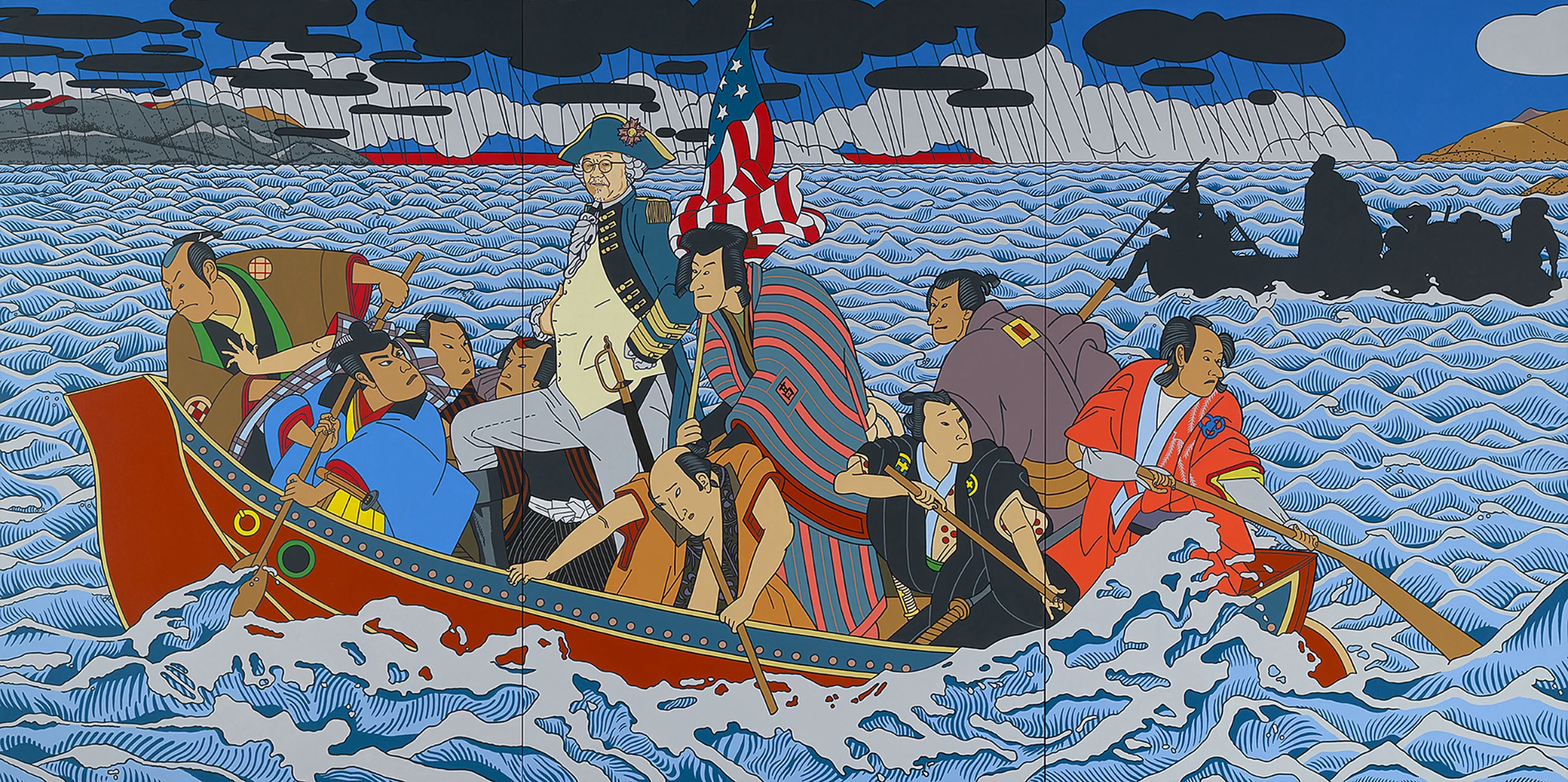
Detail of Roger Shimomura’s Shimomura Crossing the Delaware.
Roger Shimomura, Shimomura Crossing the Delaware